
It’s a familiar scene: You’ve strung hundreds of LED or incandescent lights across your roofline, wrapped your porch columns, and wound garlands around the mailbox—only to notice the extension cord feels warm to the touch. Maybe even uncomfortably hot. That warmth isn’t just inconvenient—it’s a red flag. Extension cords are not designed to carry continuous loads like permanent wiring. When they heat up under holiday lighting, they’re operating beyond safe limits—and that overheating is the body’s way of screaming “danger.” This article explains exactly why this happens, what physical and electrical principles are at play, and—most importantly—how to recognize, assess, and eliminate life-threatening risks before they escalate.
Why Heat Builds Up: The Physics Behind the Warmth
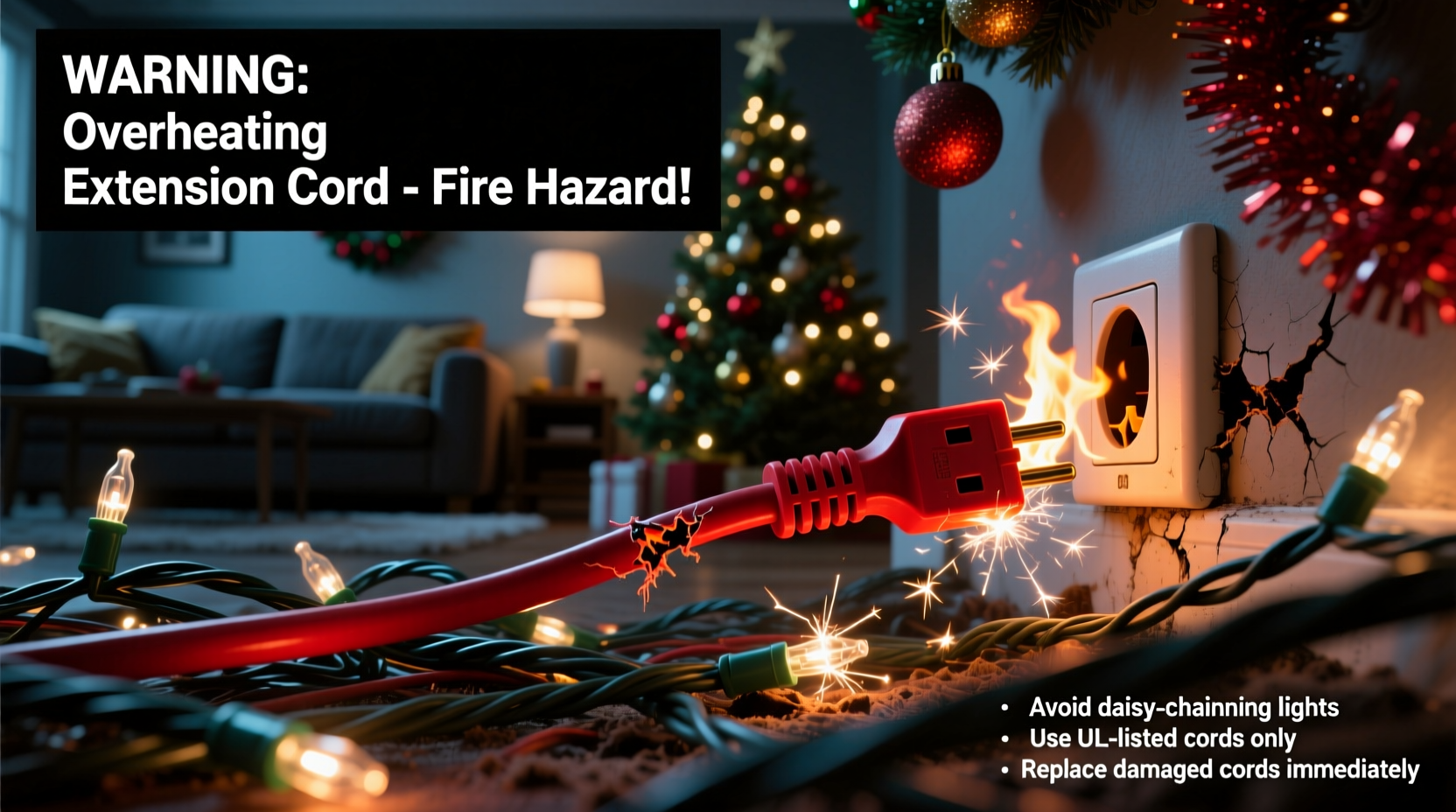
Heat in an extension cord is never accidental—it’s the direct result of electrical resistance converting energy into thermal energy (Joule heating). Every conductor—copper wire included—resists the flow of electricity. The amount of heat generated follows the formula P = I² × R, where P is power loss (in watts), I is current (in amps), and R is resistance (in ohms). Resistance increases with wire length, decreases with wire thickness (gauge), and rises with temperature itself—creating a dangerous feedback loop.
A standard 16-gauge outdoor-rated cord (common for light-duty seasonal use) has roughly 4.0 ohms of resistance per 100 feet. Plug in a string of 100 incandescent mini-lights drawing 0.33 amps? That’s harmless: ~0.44 watts of heat. But chain five such strings together (1.65 amps total) on a 50-foot 16-gauge cord? Now you’re generating over 5.5 watts of heat—enough to raise surface temperature by 20–30°C above ambient. Add poor ventilation, bundled placement under mulch or snow, or coiled storage while in use, and temperatures can exceed 60°C—well into the range where insulation begins to degrade, oxidize, and crack.
LED lights draw far less current—but many users compensate by connecting *more* strings, often exceeding the cord’s rated capacity without realizing it. A single 16-gauge cord is typically rated for just 13 amps *maximum*, but its safe *continuous* load is only 10 amps (80% derating per NEC guidelines). Exceeding that—even briefly—accelerates insulation aging and increases fire risk.
Dangers You Can’t Ignore: From Nuisance to Catastrophe
A warm cord may seem trivial next to the glow of festive lights—but it’s the leading indicator of four escalating hazards:
- Insulation breakdown: PVC and thermoplastic elastomer (TPE) jackets soften, become brittle, and lose dielectric strength above 60°C. Cracks expose live conductors, raising shock risk—especially in rain or snow.
- Connection point failure: Heat concentrates at outlets, plugs, and splices. Repeated thermal cycling (heating/cooling) loosens terminal screws, oxidizes copper contacts, and increases resistance—further amplifying heat in a runaway cycle known as “thermal runaway.”
- Fire ignition: According to the U.S. Fire Administration, holiday-related electrical fires cause an average of 160 civilian deaths and $275 million in property damage annually. Overloaded extension cords rank among the top three contributing causes—particularly when placed near combustibles like pine boughs, dried wreaths, or vinyl siding.
- Circuit-level compromise: An overheating cord stresses the entire branch circuit—including the outlet, wall wiring, and breaker. Breakers may trip erratically—or worse, fail to trip at all if undersized, mislabeled, or worn.
Real-World Case Study: The Porch Light Cascade Failure
In December 2022, a homeowner in Portland, Oregon, connected eight 100-light incandescent strands (total draw: 2.6 amps) to a single 50-foot, 16-gauge “heavy-duty” extension cord rated for 13 amps. He then daisy-chained two identical cords together to reach his second-story eaves—effectively doubling resistance and halving voltage delivery. Within 90 minutes, the middle plug connection began emitting a faint acrid odor. By midnight, the outer jacket at the female end had blistered and turned amber. At 1:17 a.m., the cord ignited while unattended, igniting dry cedar shingles. Firefighters arrived within four minutes—but the blaze had already breached the attic.
Investigation revealed three critical oversights: (1) the cumulative cord length exceeded 100 feet without upgrading gauge; (2) the “heavy-duty” label was marketing—not UL certification for continuous load; and (3) no amp meter was used to verify actual draw, which spiked to 3.2A due to low winter voltage (112V vs. nominal 120V), increasing current demand. The home suffered $184,000 in damage. No injuries occurred—but the National Fire Protection Association cited this incident in its 2023 Holiday Safety Bulletin as emblematic of preventable, gauge-and-load mismatches.
How to Assess & Fix Your Setup: A Step-by-Step Safety Protocol
Don’t guess—measure, verify, and correct. Follow this sequence before powering any display:
- Calculate total wattage and current draw: Multiply the wattage per string (found on the UL tag or packaging) by the number of strings. Divide total watts by your local supply voltage (usually 120V) to get amps. Example: 12 strings × 20W = 240W ÷ 120V = 2.0A.
- Verify cord rating and gauge: Look for the UL listing and AWG marking printed on the cord jacket (e.g., “14 AWG,” “12 AWG”). Cross-reference with the table below.
- Measure actual cord length: Uncoil fully—never estimate. Resistance scales linearly with length. A 100-ft 16-AWG cord has twice the resistance of a 50-ft version.
- Inspect every connection: Check for bent prongs, cracked housings, discolored plastic, or loose strain relief. Discard any cord with visible damage—even minor nicks.
- Test under load: After setup, run lights for 15 minutes. Carefully feel each plug, connector, and cord section. If any part is too warm to hold comfortably (>50°C surface temp), shut off immediately and reconfigure.
Extension Cord Selection Guide: Gauge, Rating, and Real-World Limits
Not all “outdoor�� cords are equal. UL 817 certification matters—and so does proper application. This table reflects *continuous duty* limits for typical residential holiday use (up to 12 hours/day), based on NEC Table 400.5(A)(3) and Underwriters Laboratories’ outdoor cord standards:
| Wire Gauge (AWG) | Max Continuous Amps (120V) | Safe Max Wattage | Recommended Max Length for 5A Load | Typical Use Case |
|---|---|---|---|---|
| 18 AWG | 5 A | 600 W | 25 ft | Single indoor string only—not for outdoor use |
| 16 AWG | 10 A | 1,200 W | 50 ft | Small porch or tree (≤300 LED lights or ≤100 incandescent) |
| 14 AWG | 15 A | 1,800 W | 100 ft | Medium yard display (up to 600 LED or 200 incandescent lights) |
| 12 AWG | 20 A | 2,400 W | 150 ft | Large home exterior, multiple zones, or mixed LED/incandescent |
| 10 AWG | 30 A | 3,600 W | 200 ft | Commercial displays or multi-circuit distribution panels |
Note: These limits assume ambient temperatures ≤30°C and free-air installation. Reduce max load by 20% if cords run through insulation, under decks, or buried in mulch.
Expert Insight: What Electrical Inspectors See Every December
“Over 70% of the hazardous cord setups I inspect during pre-holiday safety sweeps involve ‘daisy-chaining’—plugging one cord into another. Each connection adds resistance and creates a potential failure point. And nearly half use indoor-rated cords outdoors, where moisture ingress accelerates corrosion. A cord shouldn’t be warm—full stop. If it is, the system is compromised.” — Javier Mendez, Certified Electrical Inspector & NFPA 70E Trainer, with 18 years of residential holiday safety audits
Essential Safety Checklist Before Lighting Up
- ☑️ Verify every cord carries a UL or ETL outdoor rating mark (look for “WT” or “W” suffix)
- ☑️ Confirm total light wattage stays below 80% of the cord’s rated capacity
- ☑️ Use only grounded (3-prong) cords with GFCI-protected outlets
- ☑️ Avoid daisy-chaining—use a single cord long enough for the run, or install a weatherproof outlet closer to the display
- ☑️ Keep cords elevated off wet ground and away from foot traffic or lawn equipment
- ☑️ Unplug lights before adjusting, repairing, or removing them—even if “just for a minute”
- ☑️ Replace any cord showing stiffness, cracking, discoloration, or melted plastic
FAQ: Critical Questions Answered
Can I use a power strip instead of an extension cord for Christmas lights?
No—unless it’s specifically rated for outdoor, continuous-duty use and clearly marked with its amp/watt rating. Most indoor power strips lack thermal protection, weather resistance, and adequate conductor size. They’re designed for intermittent office equipment, not 12-hour-per-day lighting loads. Using one outdoors voids its UL listing and dramatically increases fire risk.
My LED lights say “low energy”—so why is my cord still warm?
“Low energy” refers to per-string draw—not total system load. It’s common to connect 10–15 LED strings (each drawing 2–4W) to one cord, easily reaching 50–60W total. While that seems small, cheap or undersized cords (especially 18 AWG “indoor-only” varieties) have high resistance. Even 50W at 120V draws 0.42A—but over 100 feet of thin wire, that current generates measurable heat. Always check the cord’s gauge and rating—not just the lights’ label.
Is it safe to wrap lights around an extension cord to hide it?
Never. Wrapping lights, tape, or foliage around a cord traps heat, restricts airflow, and insulates the conductor—causing temperature to rise exponentially. It also obscures visual inspection for damage and makes unplugging hazardous. Instead, use cord covers rated for outdoor use or route cords along non-combustible surfaces (e.g., brick, stucco) with UV-resistant clips.
Conclusion: Your Lights Should Shine—Not Your Cords
A warm extension cord isn’t a quirk of the season—it’s physics warning you that something is wrong. Ignoring it invites consequences ranging from tripped breakers and melted outlets to structure fires and electrocution. The good news? Every risk outlined here is preventable with informed choices: selecting the right gauge, respecting ampacity limits, avoiding daisy-chains, and inspecting connections regularly. Your holiday display should spark joy—not emergency calls. Take 20 minutes this weekend to audit your setup: measure, calculate, verify, and upgrade where needed. Replace that frayed 16-AWG cord with a properly rated 14-AWG version. Install a GFCI outlet on your porch. Unplug lights before bed or when away. These aren’t inconveniences—they’re non-negotiable safeguards for your home, your family, and your peace of mind.
💬 Your vigilance protects more than your lights. Share this guide with a neighbor, post it in your community group, or tag someone who strings lights every year—because safety isn’t seasonal. It’s essential.








