That sharp, warming, sometimes overwhelming “burn” on the back of your throat isn’t just a quirk of taste—it’s a measurable physiological response to ethanol concentration, volatility, and how it interacts with your sensory receptors. Yet two whiskeys at the same stated proof can feel dramatically different: one smooth and integrated, the other aggressively hot. The disparity lies not only in alcohol-by-volume (ABV) but in distillation precision, congener profile, barrel interaction, dilution method, and even ambient temperature. Understanding this helps you choose bottles aligned with your palate, serve them more thoughtfully, and appreciate the craftsmanship behind perceived heat.
The Science Behind the Burn: Ethanol, TRPV1 Receptors, and Sensory Thresholds
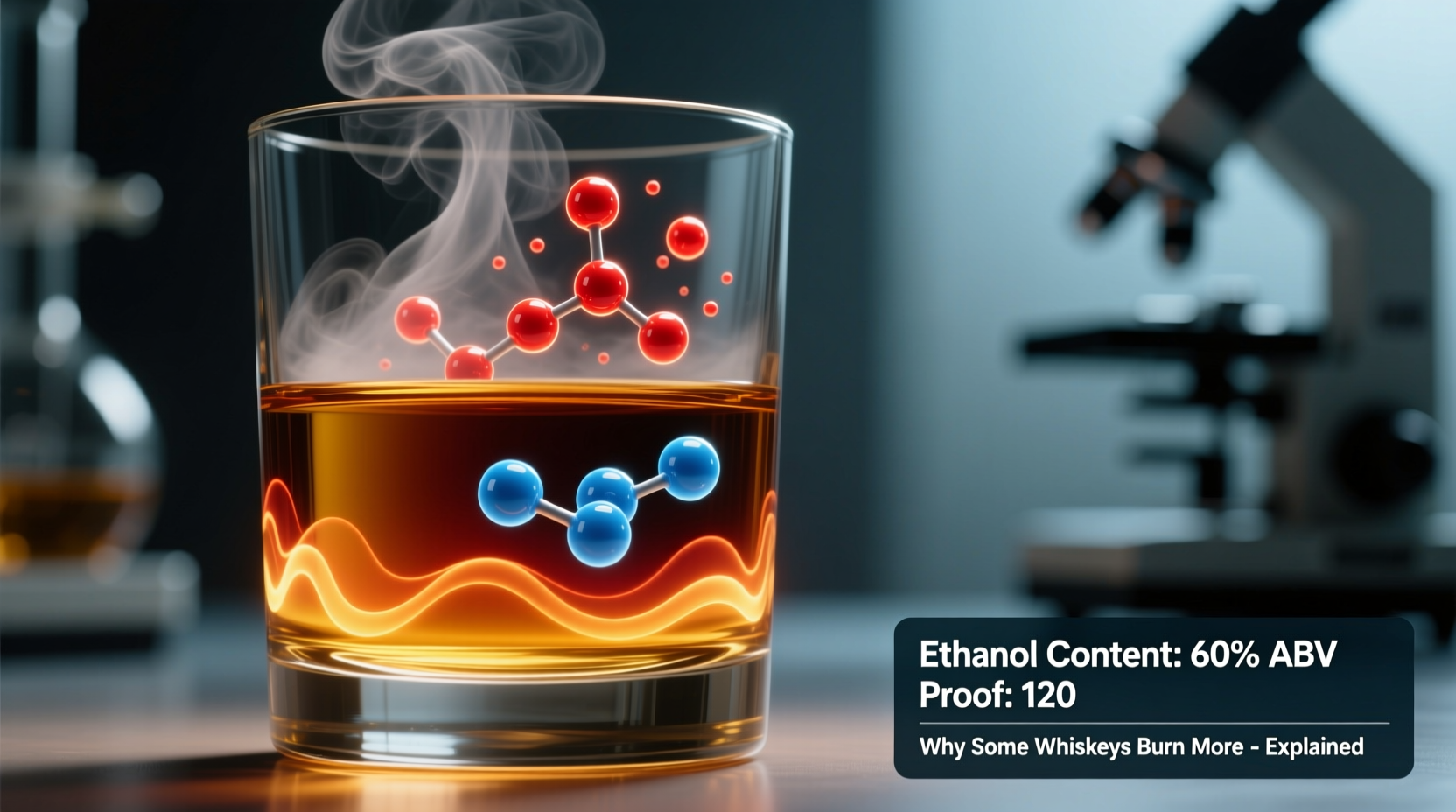
The “burn” isn’t taste—it’s chemesthesis: a chemical irritation sensed by the trigeminal nerve, specifically through TRPV1 receptors (the same ones activated by capsaicin in chili peppers and high heat). Ethanol is a potent agonist of these receptors. When ethanol concentration rises, so does receptor activation—triggering that familiar warmth, sting, or even pain. But sensitivity varies widely: genetics influence TRPV1 expression, hydration status lowers your threshold for irritation, and prior exposure can induce mild desensitization.
Crucially, ethanol doesn’t act alone. Congeners—flavor compounds like fusel oils (isoamyl alcohol, propanol), esters, aldehydes, and tannins—modulate its impact. Some congeners (e.g., higher alcohols) amplify ethanol’s pungency; others (e.g., certain lactones from oak) soften perception by adding texture and masking volatility. A whiskey rich in heavy fusels may burn sharply at 46% ABV, while a cleaner, lower-congener spirit at 52% ABV might feel rounder and more approachable.
Tip: Chill your glass—not the whiskey—for 30 seconds before pouring. A cooler surface slightly suppresses ethanol vapor release, reducing initial burn without dulling flavor.Proof vs. ABV: Decoding the Numbers—and Why They Mislead
In the U.S., “proof” is simply twice the alcohol-by-volume percentage (e.g., 100 proof = 50% ABV). This system originated in 18th-century Britain, where gunpowder soaked in spirit would ignite only if the alcohol content was high enough—“proof” that it hadn’t been watered down. Today, proof is a regulatory label—not a sensory predictor. Two 100-proof bourbons can deliver wildly different mouthfeels because proof says nothing about:
- Distillation cut points: How tightly the distiller separated the harsh “heads” (acetone, methanol) and oily “tails” (fusels) from the clean “hearts.” A wide cut includes more fusels, increasing perceived heat.
- Barrel entry strength: Whiskey entering the barrel at 125 proof (62.5% ABV) extracts more wood compounds—but also more tannins and lignin derivatives, which can accentuate ethanol’s bite when undiluted.
- Dilution water quality and method: Adding distilled water post-barrel versus spring water with minerals affects ethanol clustering and vapor pressure. Hard water can make ethanol feel sharper.
- Aging duration and warehouse conditions: Hot, humid warehouses accelerate evaporation (“angel’s share”), concentrating alcohol and fusels in the remaining liquid—especially in upper-rack barrels.
Proof is a starting point—not the full story. Always consider it alongside production transparency: look for distilleries that disclose barrel-entry proof, cut points, and water source.
How Production Choices Amplify—or Muffle—the Burn
Every stage of whiskey making influences ethanol’s sensory impact. Here’s how key decisions shape heat perception:
| Production Stage | Heat-Amplifying Choice | Heat-Reducing Choice |
|---|---|---|
| Fermentation | Short fermentation (<48 hrs); high-temp yeast strains | Long fermentation (72–120+ hrs); wild or slow-fermenting yeasts |
| Distillation | Narrow reflux; fast run; wide cuts (including tails) | High reflux; slow run; precise hearts cut; copper contact time |
| Aging | Small barrels (higher surface-to-volume ratio); hot warehouse zones; high entry proof (125+) | Standard 53-gallon barrels; consistent mid-warehouse temps; entry at 115 proof or lower |
| Reduction | Distilled water added rapidly at room temp | Spring water added gradually over days; cold stabilization |
| Bottling | Cask strength (no reduction); unchill-filtered (retains fatty acids that carry ethanol) | Light chill filtration; reduction to 43–46% ABV with mineral-balanced water |
For example, a craft rye distilled in a small pot still with rapid fermentation and wide cuts will likely emphasize ethanol’s sharpness—even at modest proof. Conversely, a Speyside single malt aged 18 years in first-fill sherry casks, reduced slowly with Highland spring water, may deliver intense flavor at 50% ABV with minimal burn, thanks to decades of esterification and polymerization softening volatile compounds.
Real-World Example: The Case of Two Kentucky Bourbons at 110 Proof
Consider two real-world 110-proof (55% ABV) bourbons released in the same year by neighboring Kentucky distilleries:
Distillery A: Ferments for 60 hours using a proprietary yeast strain optimized for speed. Distills in column-pot hybrid stills with minimal reflux, taking broad cuts into the tails. Barrels enter at 125 proof and age in metal-clad warehouses with summer temperatures exceeding 100°F. Bottled uncut and unfiltered.
Distillery B: Ferments for 96 hours with native air-borne yeasts. Distills in traditional copper pot stills with high reflux and narrow hearts cut. Barrels enter at 110 proof and age in brick warehouses with passive ventilation. Reduced to 110 proof with limestone-filtered water, then lightly chill-filtered.
Tasters consistently rate Distillery A as “fiery,” “astringent,” and “alcohol-forward”—even with water. Distillery B earns descriptors like “silky,” “integrated,” and “spice-warm rather than burning.” Lab analysis confirms Distillery A has 3.2× more isoamyl alcohol (a major fusel oil) and 2.7× higher total higher alcohol concentration. The proof is identical—but the burn isn’t.
“The number on the label is just the beginning. What matters is how much ethanol is *free* to irritate your nerves—and how many other molecules are riding along with it. A well-made 60% ABV whiskey can feel gentler than a poorly balanced 48% ABV one.” — Dr. Sarah Lin, Senior Flavor Chemist at the Scotch Whisky Research Institute
Practical Strategies to Reduce Perceived Burn (Without Diluting Flavor)
You don’t need to avoid higher-proof whiskeys to enjoy them. With mindful technique, you can tame the burn while preserving complexity. Follow this step-by-step approach:
- Start at room temperature (68–72°F): Cold whiskey suppresses aroma but concentrates ethanol vapor upon warming in the mouth—increasing burn. Let it breathe for 2 minutes after pouring.
- Add water incrementally: Use a pipette or eyedropper. Begin with 1 drop per 15 mL whiskey. Swirl gently. Wait 30 seconds. Repeat until the alcohol sting recedes but flavor remains vivid. Most whiskeys peak between 1–3 drops.
- Choose the right glass: Tulip-shaped glasses (like Glencairn or Copita) concentrate vapors away from the nose’s most sensitive areas. Avoid wide-mouth tumblers that flood the olfactory bulb with ethanol.
- Sip—not shoot: Hold 5–8 mL in your mouth for 10–15 seconds. Let saliva emulsify ethanol and coat your tongue. Swirl gently. Exhale through your nose to assess aromatic balance.
- Pair strategically: A small bite of unsalted almond or a sip of still mineral water between sips resets your trigeminal receptors. Avoid citrus or spicy foods—they prime TRPV1 receptors.
FAQ: Addressing Common Misconceptions
Does higher proof always mean more burn?
No. While ethanol concentration is the primary driver, congener composition, pH, and mouthfeel modifiers (like glycerol formed during fermentation) significantly modulate perception. A 63% ABV Islay single malt with high phenolic content may feel less aggressively hot than a 46% ABV young corn whiskey loaded with fusels—because smoke phenols distract from ethanol’s sting, while fusels directly stimulate TRPV1 receptors.
Is chill filtration responsible for “smoother” whiskey?
Partially. Chill filtration removes fatty acid esters and long-chain alcohols that cloud whiskey when chilled. Some of these compounds contribute to a waxy, coating mouthfeel that buffers ethanol. Removing them can make the spirit feel thinner and more “exposed”—potentially increasing perceived burn at high proof. However, many unchill-filtered whiskeys are exceptionally smooth due to superior distillation and aging, proving process quality outweighs filtration alone.
Can aging eliminate the burn entirely?
Aging reduces *harshness*, not ethanol concentration. Over time, ethanol reacts with wood-derived compounds to form new esters (e.g., ethyl lactate), which are less irritating. Tannins polymerize into softer, less astringent forms. Volatile alcohols slowly evaporate or oxidize. But the fundamental ethanol molecule remains—and will always activate TRPV1 receptors above ~35% ABV. Aging refines the context around the burn; it doesn’t erase the cause.
Conclusion: Respect the Alcohol, Understand the Craft
The burn isn’t a flaw—it’s information. It tells you about distillation rigor, fermentation discipline, barrel management, and water philosophy. Rather than seeking “no burn” as an ideal, aim for *balanced burn*: ethanol that delivers warmth without overwhelming, heat that frames flavor instead of flattening it. Next time you pour a cask-strength bourbon or a peated Islay, pause before adding water. Smell deeply. Sip slowly. Ask not “why does this burn?” but “what is this burn telling me about how it was made?” That shift—from consumer to connoisseur—transforms irritation into insight. And once you understand the why, you gain real control: over your glass, your palate, and your appreciation.
💬 Have you tasted a high-proof whiskey that surprised you with its smoothness—or a low-proof one that shocked you with its heat? Share your experience, distillery, and proof in the comments. Your insight could help another enthusiast decode the burn.








