Walk into any home freezer set to −18°C (0°F), and you’ll likely find a bottle of vodka sitting unfrozen—clear, cold, and perfectly pourable. Yet occasionally, someone reports pulling out a slushy, semi-frozen bottle, or worse, one cracked by ice expansion. This inconsistency isn’t random. It’s rooted in physical chemistry—not marketing claims, distillation mystique, or “premium” labeling. The freezing behavior of vodka hinges almost entirely on its ethanol–water ratio, governed by the colligative property known as freezing point depression. Understanding this reveals why 40% ABV vodka stays liquid in most freezers, while a 30% ABV “light” version may solidify—and why craft distillers, home mixologists, and even lab technicians must treat alcohol content as a functional specification, not just a number on a label.
The Physics of Freezing: Why Pure Water Isn’t the Benchmark
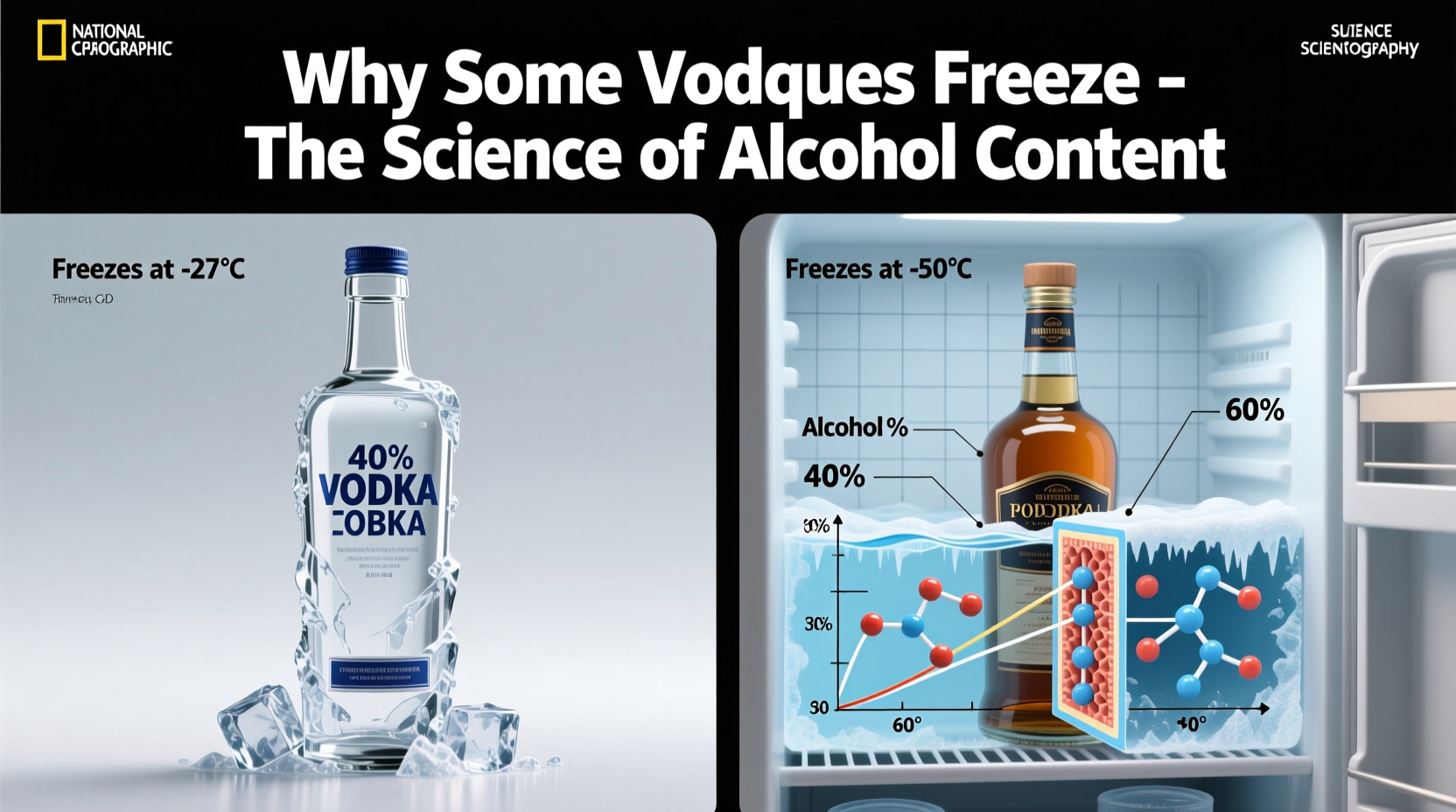
Water freezes at 0°C under standard atmospheric pressure. Ethanol—the primary alcohol in vodka—freezes at −114°C. When mixed, however, the two substances form a solution whose freezing point lies somewhere between those extremes—but never linearly. Instead, it follows a predictable thermodynamic curve shaped by molecular interactions: ethanol molecules disrupt the hydrogen-bonded lattice water forms when cooling, making crystallization energetically harder. The more ethanol present (up to a point), the lower the temperature required for solidification.
This phenomenon is called freezing point depression, a colligative property—it depends solely on the *number* of solute particles dissolved in a solvent, not their identity. In vodka, ethanol acts as the solute; water, the solvent. But because ethanol and water associate strongly via hydrogen bonding—and even form transient hydrates—the relationship isn’t ideal. Real-world vodka behaves more like a non-ideal binary mixture, requiring empirical data rather than simple textbook formulas.
Crucially, the lowest possible freezing point for an ethanol–water mixture occurs near 92–93% ethanol by weight (≈78% ABV), where the eutectic point sits at approximately −130°C. Below that concentration, freezing points rise steadily. At 40% ABV (the global standard for vodka), the theoretical freezing point is about −26.5°C. That’s well below the −18°C typical of household freezers—explaining why most vodkas stay fully liquid. But drop to 30% ABV, and the freezing point climbs to roughly −12°C—now *above* standard freezer temperatures. That’s where freezing begins.
Why Alcohol Content Varies—and Why It Matters More Than You Think
Vodka is legally defined in most jurisdictions by minimum alcohol content (e.g., 37.5% ABV in the EU, 40% ABV in the U.S. and Russia), but *no upper limit* exists. Distillers may bottle at 35%, 45%, or even 50% ABV—each with distinct thermal behavior. Further complicating matters are formulation variables:
- Residual congeners: Though vodka is distilled to high purity, trace compounds (esters, aldehydes, higher alcohols) affect viscosity and intermolecular forces—even at parts-per-trillion levels.
- Mineral content: Water source matters. Hard water (high in calcium, magnesium) slightly elevates freezing points versus deionized or reverse-osmosis water.
- Sugar or glycerol additives: Some “smooth” or flavored vodkas contain minute sweeteners (<0.1%) or texture enhancers. These act as additional solutes, further depressing freezing points—but unpredictably, since they’re non-volatile and alter phase separation behavior.
- Bottling temperature & thermal history: Rapid chilling can induce supercooling—where liquid remains metastable below its equilibrium freezing point until nucleation (e.g., vibration or impurity contact) triggers sudden crystallization.
These factors explain why two vodkas labeled identically at 40% ABV may behave differently in the same freezer: one pours cleanly at −18°C, while the other develops a viscous, cloudy haze. The haze isn’t spoilage—it’s microcrystalline ice forming around localized solute clusters, a sign the solution is nearing its practical freezing threshold.
Tip: If your vodka clouds or thickens in the freezer, remove it immediately and let it warm to room temperature before use. Repeated freeze-thaw cycles accelerate oxidation and may dull aromatic clarity—even if no visible damage occurs.Freezing Point Comparison Table: ABV vs. Practical Freezer Behavior
| ABV (% by volume) | Approx. Freezing Point (°C) | Behavior in Standard Home Freezer (−18°C) | Notes |
|---|---|---|---|
| 25% | −7°C | Fully frozen (solid or slush) | Common in “light” or ready-to-drink vodkas; avoid freezer storage. |
| 30% | −12°C | Partially frozen (slushy, cloudy) | May separate upon thawing; texture degradation likely. |
| 37.5% | −22°C | Liquid (may thicken slightly) | EU minimum; safe for freezer use in most climates. |
| 40% | −26.5°C | Fully liquid, crisp pour | Global benchmark; optimal balance of safety, mouthfeel, and stability. |
| 45% | −30°C | Liquid, slightly more viscous | Often used for premium expressions; enhances perceived “oiliness” and heat retention. |
| 50% | −35°C | Liquid, noticeably thicker body | Rare for neat sipping; common in base spirits for infusions or high-proof cocktails. |
A Real-World Case Study: The “Chill-Proof” Batch That Froze Anyway
In early 2022, a small-batch craft distillery in Vermont released a limited-edition vodka labeled 40% ABV, certified by third-party lab analysis. They marketed it as “chill-proof”—guaranteed stable down to −20°C. Within three weeks, over 200 customer complaints arrived: bottles shipped to Minnesota and North Dakota had arrived partially frozen, some with cracked glass. Internal investigation revealed the cause wasn’t mislabeling—it was water sourcing.
The distillery used spring water from a local aquifer rich in dissolved calcium bicarbonate (hardness ≈ 180 ppm). While safe and approved for bottling, the mineral content subtly raised the solution’s effective freezing point by nearly 1.5°C compared to distilled water batches. Simultaneously, the winter shipping containers lacked climate control, exposing bottles to −22°C ambient temperatures during transit. The combination pushed the batch just past its practical freezing threshold.
The distillery responded transparently: reformulated future batches using reverse-osmosis water, added a “not recommended for sub-zero transport” note to cold-climate shipments, and offered full refunds. Their transparency earned industry praise—and underscored a key truth: ABV alone doesn’t dictate freeze resistance. Water quality, thermal history, and packaging all participate in the outcome.
Expert Insight: What Chemists and Distillers Actually Measure
“The label says ‘40% ABV’—but what matters for stability is the *actual molal concentration* of ethanol in that specific water matrix, adjusted for ionic strength and trace volatiles. We run differential scanning calorimetry (DSC) on every production lot now. A 0.3% ABV variance? Negligible. But a 15 ppm sodium shift? That changes nucleation kinetics. Freezing isn’t binary—it’s a spectrum of phase behavior.”
— Dr. Lena Petrova, Senior Analytical Chemist, Spiritus Labs & Former Lead, Diageo Global Standards Division
Dr. Petrova’s team routinely tests commercial vodkas using DSC, which measures heat flow as samples cool. Their data shows that even among 40% ABV vodkas, onset of crystallization varies by up to 4°C depending on mineral profile and congener fingerprint. This explains why premium vodkas often undergo multiple charcoal or quartz filtration passes—not just for taste, but to remove nucleation sites (micro-particles that trigger premature ice formation).
Practical Action Checklist: Storing & Serving Vodka Safely
Use this checklist to ensure your vodka remains stable, flavorful, and physically intact—whether stored in a freezer, bar fridge, or pantry.
- Verify ABV before freezer storage: Never assume—check the label. If it’s below 37.5% ABV, avoid freezer storage entirely.
- Check your freezer’s actual temperature: Use a calibrated thermometer. Many domestic units fluctuate between −15°C and −22°C; older models often run warmer than labeled.
- Pre-chill gradually: Place vodka in the refrigerator (4°C) for 2 hours before transferring to the freezer—reduces thermal shock and supercooling risk.
- Store upright, not on its side: Prevents ethanol migration and cap seal degradation, especially in cork-finished specialty vodkas.
- Discard after 2 years unopened (or 6 months opened): Oxidation accelerates above 15°C, but even frozen, slow ester hydrolysis alters aroma profile over time.
FAQ: Your Freezer Questions, Answered
Can I refreeze vodka after it thaws?
Yes—but with caveats. Thawed vodka won’t spoil microbiologically, but repeated freeze-thaw cycles promote oxidation and may encourage phase separation if additives (e.g., glycerol) are present. Flavor and mouthfeel degrade measurably after three cycles. For best quality, freeze only once and consume within 3 months.
Why does my vodka get cloudy when chilled—even if it doesn’t freeze?
Cloudiness (louching) occurs when fatty acids or esters—naturally present in grain or potato base materials—precipitate at low temperatures. It’s harmless and reversible upon warming. High-quality vodkas minimize this via winterization (chilling + filtration) or advanced distillation cuts. If cloudiness persists after warming, the bottle may be contaminated or exposed to excessive heat pre-bottling.
Does freezing vodka make it “stronger” or change its proof?
No. Freezing does not concentrate alcohol. Unlike fractional freezing of wine (which *can* concentrate ethanol in ice-free liquid), vodka’s narrow freezing range means ice crystals formed are nearly pure water—leaving the remaining liquid slightly *more* alcoholic, but only in microscopic, non-practical amounts. Any measurable proof increase would require industrial-scale cryo-concentration equipment—not a home freezer.
Conclusion: Knowledge Is the Best Chiller
Vodka’s resistance to freezing isn’t magic—it’s measurable, predictable, and deeply tied to its composition. Whether you’re a bartender optimizing service temperature, a home enthusiast building a freezer-ready cocktail station, or a curious consumer decoding labels, understanding the science behind ABV and freezing point empowers smarter choices. Don’t rely on folklore about “Russian cold tolerance” or “glacial filtration.” Look at the number on the label, know your freezer’s true temperature, and respect the physics at play. A properly stored 40% ABV vodka will reward you with clean chill, consistent texture, and uncompromised integrity—every single pour.
💬 Have you encountered a frozen vodka mystery—or discovered an unexpected ABV quirk? Share your experience in the comments. Real-world observations help refine our collective understanding of spirit science.








