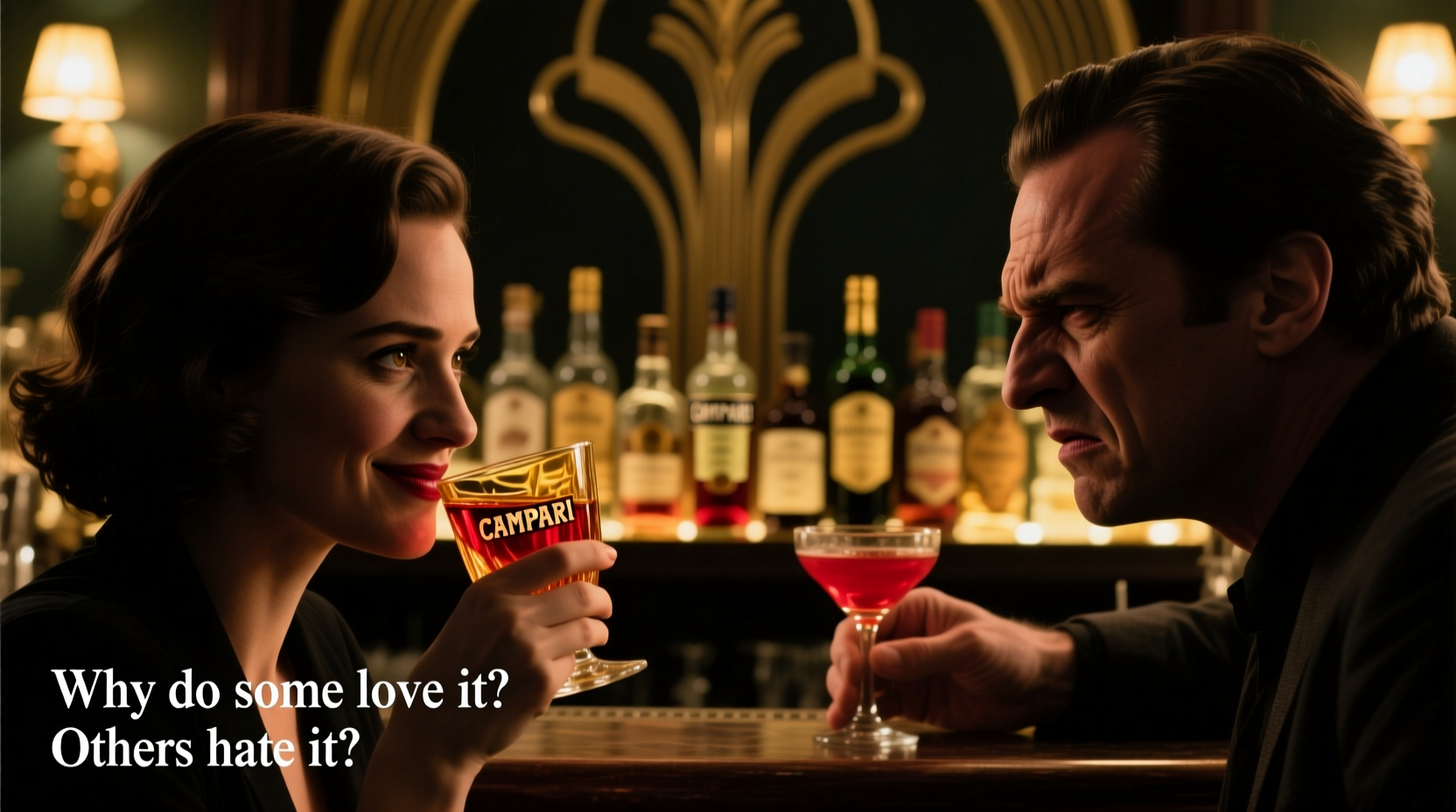
Bitterness is the most polarizing of the five basic tastes—not because it’s rare or subtle, but because it carries deep evolutionary baggage. For millennia, bitterness signaled potential toxicity: alkaloids in plants like nightshade or hemlock warned our ancestors to stop eating. Yet today, millions seek out intensely bitter drinks—Campari, Aperol, Cynar, Suze—with near-devotional enthusiasm. They stir them into Negronis, sip them over ice with soda, or even drink them neat before dinner. Meanwhile, others recoil at the first sip, describing Campari as “medicinal,” “burnt,” or “like licking a battery.” This isn’t mere preference—it’s biology meeting culture, genetics intersecting with habit, and neurochemistry shaped by experience.
The Bitter Gene: TAS2R38 and Your Taste Threshold
At the heart of this divide lies a single gene: TAS2R38. It codes for a bitter taste receptor on the tongue that detects compounds like propylthiouracil (PROP) and phenylthiocarbamide (PTC)—chemical cousins of the sesquiterpene lactones and quinolines found in Campari’s botanical blend (including chinotto orange peel, rhubarb root, and gentian). People inherit two copies of this gene—one from each parent—and fall into three broad categories:
- Supertasters: Carry two functional (PAV/PAV) alleles. Experience bitterness up to six times more intensely than average. Often find Campari overwhelmingly harsh, even nauseating.
- Moderate tasters: One functional and one nonfunctional (PAV/AVI) allele. Perceive bitterness clearly but tolerably—especially when balanced with sugar, citrus, or dilution.
- Non-tasters: Two nonfunctional (AVI/AVI) alleles. Detect little to no bitterness in these compounds. May describe Campari as “fruity” or “spicy,” missing its defining edge entirely.
A 2019 study in Chemical Senses found that supertasters were 4.7 times more likely to reject unsweetened bitter aperitifs outright—and 3.2 times more likely to avoid them socially—even after repeated exposure. Crucially, this genetic variation affects not just perception, but also oral sensation: supertasters often have higher fungiform papillae density, amplifying both bitterness and burn (a trigeminal response Campari’s alcohol and quinine-like compounds provoke).
Tip: If you instinctively dislike unsweetened grapefruit juice, dark chocolate above 85%, or raw endive, you’re likely a supertaster—meaning Campari’s intensity may need careful calibration (e.g., longer dilution, lower proof, or pairing with fat).How Exposure Rewires the Brain: The Palate-Training Effect
Genetics sets the starting line—but experience determines the finish. Neuroimaging studies show that repeated, low-dose exposure to bitter stimuli activates the brain’s reward circuitry over time. Dopamine release increases not in response to the bitterness itself, but to the *anticipation* of its resolution—the citrus lift, the herbal finish, the satisfying “cleanse” it delivers before food.
This is why cultural context matters profoundly. In Italy, children are introduced to diluted Campari-and-soda (“Campari Soda”) as early as age 8—not as alcohol, but as a digestive ritual. The bitterness is framed as functional, sophisticated, and communal. Contrast that with the U.S., where bitter flavors are largely absent from childhood diets (think: hyper-sweet cereals, fruit juices, and processed snacks), and where Campari is often first encountered in a high-proof cocktail at age 21, without context or guidance.
Dr. Dana Small, Director of the Modern Diet & Physiology Lab at Yale, explains:
“Taste isn’t fixed. It’s a predictive model the brain builds from repeated pairings. When bitterness consistently precedes satiety, digestion, or social pleasure, the brain begins to associate it with reward—not threat.” — Dr. Dana Small, Neuroscientist & Taste Researcher
The Campari Formula: Why Its Bitterness Is Uniquely Challenging
Campari isn’t just bitter—it’s *complexly* bitter. Its signature profile emerges from over 60 botanicals, but three elements create its distinctive resistance:
| Component | Role in Campari’s Challenge | Why It Divides Palates |
|---|---|---|
| Quinoline derivatives | Natural compounds derived from cinchona bark and gentian root | Trigger deep, lingering bitterness that coats the tongue—unlike the quick fade of coffee or dark chocolate. |
| Chinotto orange peel | Provides sharp, resinous citrus top notes | Amplifies perceived bitterness through contrast; sourness enhances bitter receptors’ sensitivity. |
| Alcohol (20.5–28.5% ABV) | Solvent for bitter compounds + trigeminal irritant | Alcohol’s burn distracts from flavor nuance, making bitterness feel aggressive rather than layered. |
| Low residual sugar (≈11 g/L) | Less than half the sugar of Aperol | Offers minimal buffer—unlike sweeter aperitifs, Campari doesn’t mask bitterness; it frames it. |
This combination creates what sensory scientists call “bitter dominance”: no single element overshadows another, yet none softens the core impression. For supertasters, it’s sensory overload. For non-tasters, it’s an intriguing puzzle—where others taste warning, they taste complexity.
A Real-World Shift: How One Bartender Changed Her Relationship with Campari
Maria Rossi, a Milan-born bartender now based in Portland, Oregon, hated Campari for 12 years. “My grandfather served it straight in his bar in Liguria,” she recalls. “I’d try it every summer, wince, and go back to my spritz. I thought it was just… wrong.”
Her turning point came not from drinking more Campari—but from *making* it. At age 29, she began deconstructing the Negroni for a menu project: tasting each component separately, then in precise ratios. She started with 1 part Campari to 3 parts soda water, adding a twist of orange zest—not for flavor, but to anchor the aroma. Over six weeks, she reduced dilution incrementally, always pairing with a small bite of aged pecorino (fat cuts bitterness perception). By week seven, she drank a 1:1 Campari-and-soda—no garnish, no food—and felt not revulsion, but recognition: “It wasn’t about liking the bitterness anymore. It was about hearing the whole sentence—the citrus, the herb, the mineral dryness. The bitterness was the period at the end.”
Maria now teaches “bitter literacy” workshops, emphasizing that acceptance isn’t about overriding biology—it’s about expanding the frame of reference so bitterness becomes one note in a chord, not the entire symphony.
Your Practical Path to Appreciating Bitter Aperitifs
Whether you’re genetically predisposed to resist Campari or simply haven’t found your entry point, these steps build tolerance *without forcing palate change*. This is not about “getting used to it”—it’s about uncovering the structure beneath the shock.
- Start with the lowest-intensity expression: Choose Aperol (11% ABV, 135 g/L sugar) over Campari. Its gentler bitterness comes from rhubarb and bitter orange, not gentian or quinine.
- Dilute intentionally: Mix 1 part aperitif to 4 parts chilled soda water. Serve in a large wine glass—not a rocks glass—to allow aroma to open. The carbonation lifts volatile citrus notes, distracting from base bitterness.
- Anchor with aroma: Express an orange or grapefruit twist over the drink, then rub the peel along the rim. Citrus oil contains limonene, which binds to olfactory receptors and signals “freshness,” counterbalancing bitter signals in the brain.
- Pair with fat or umami: Serve alongside marinated olives, aged cheese, or cured meat. Fat coats the tongue, reducing bitter compound contact; umami triggers salivation, which rinses bitterness faster.
- Wait 15 minutes post-sip: Bitterness lingers, but its *affective response* (the “ugh” feeling) fades within 90 seconds. Note what remains: warmth? Orange peel? Licorice? That’s where appreciation begins.
FAQ: Addressing Common Misconceptions
Is Campari’s bitterness “artificial” or added?
No. Campari’s bitterness is entirely botanical and natural—derived from gentian root, rhubarb, cinchona bark, and chinotto orange. The brand has never used synthetic bitterants. Its vivid red color originally came from cochineal insects (now replaced with carmine and caramel coloring), but the bitterness remains plant-based and unadulterated.
Does drinking Campari regularly make you “less sensitive” to bitterness?
Not biologically—your TAS2R38 receptors don’t change. But neural pathways adapt: repeated exposure strengthens connections between bitterness and positive outcomes (digestion, social bonding, flavor complexity). You don’t taste less bitterness—you interpret it differently. Think of it like learning a new language: the sounds don’t change, but meaning emerges.
Can children safely try diluted aperitifs?
Legally and ethically, no—alcohol is inappropriate for minors. However, non-alcoholic bitter tonics (like San Pellegrino’s Chinotto or artisanal gentian sodas) offer the same aromatic-bitter profile without ethanol. These are excellent tools for palate education in teens and adults alike.
Conclusion: Bitterness as a Bridge, Not a Barrier
Liking Campari—or any bold bitter aperitif—is rarely about “acquiring a taste.” It’s about recognizing that bitterness, in its highest expressions, functions as punctuation: a crisp, cleansing pause before abundance. It’s the reason we crave arugula in salads, espresso after meals, and grapefruit in mimosas. It’s not the absence of sweetness that makes these things compelling—it’s the presence of contrast, clarity, and intention.
If Campari still feels like a wall, don’t break against it. Step back. Try it with more ice, a wider glass, a different orange, or beside something savory. Notice how the bitterness shifts—not in strength, but in character. That shift is where understanding lives. And if, after thoughtful exploration, it still doesn’t resonate? That’s valid too. The world of aperitifs is vast: Cynar’s artichoke earthiness, Suze’s bright gentian snap, or even non-alcoholic options like Fentimans Curiosity Cola offer equally rich, complex alternatives.
What matters isn’t universal love for one bottle—but curiosity about why flavor moves us, divides us, and connects us across tables and generations. So pour thoughtfully. Sip slowly. And next time someone pushes their Campari aside, don’t offer advice—ask what they *do* taste. That question, more than any Negroni ratio, opens the real conversation.
💬 Have you had a breakthrough moment with bitter flavors? Share your story—how you met Campari, resisted it, or finally understood it—in the comments below. Your insight might be the exact bridge someone else needs.








