When you look up at a clear sky and see aircraft trails stretching across the horizon, you might notice that some fade within seconds while others linger for hours, spreading into wispy clouds. These persistent streaks are more than just visual curiosities—they're indicators of invisible atmospheric conditions. The lifespan of a contrail, or condensation trail, depends on a delicate balance of moisture, temperature, pressure, and air stability. Understanding why some contrails last longer reveals how human activity interacts with Earth's atmosphere in real time.
The Science Behind Contrail Formation
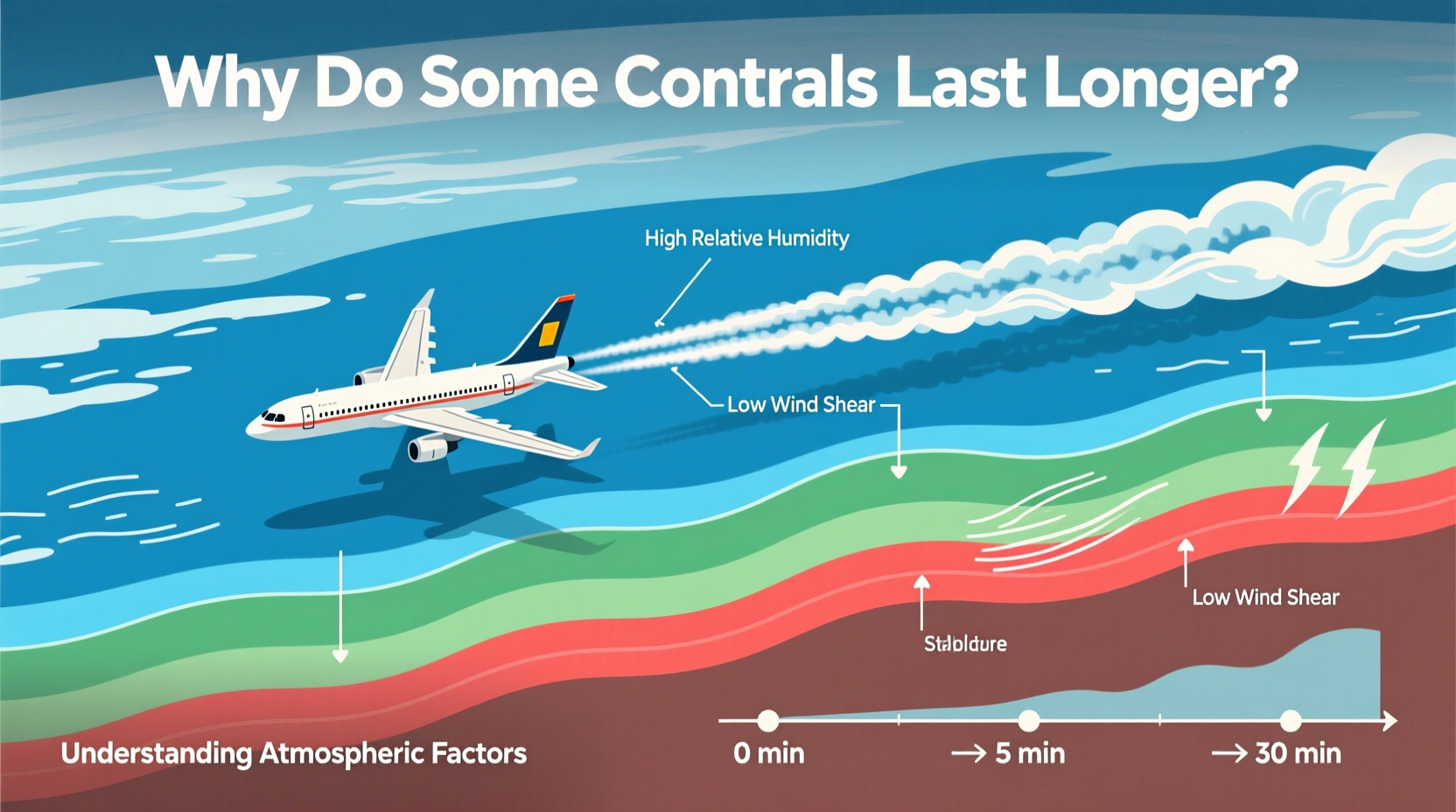
Contrails form when hot, humid exhaust from jet engines mixes with cold, low-pressure air at high altitudes—typically above 26,000 feet (8,000 meters). This exhaust contains water vapor and tiny particles (soot, sulfates) that act as nuclei for ice crystal formation. When ambient temperatures are below -40°C (-40°F), the water vapor rapidly freezes into microscopic ice crystals, creating a visible trail.
However, not all contrails behave the same way. Their duration hinges on whether the surrounding air is saturated with respect to ice. If the air is dry, the ice crystals sublimate—turning directly from solid to vapor—and the contrail vanishes quickly. But if the air is near or above saturation, the ice crystals persist and can even grow by drawing moisture from the environment.
“Persistent contrails are essentially man-made cirrus clouds. They form under specific thermodynamic conditions and can influence local radiative balance.” — Dr. Patrick Minnis, Atmospheric Scientist, NASA Langley Research Center
Key Atmospheric Factors That Influence Contrail Longevity
Several interrelated atmospheric variables determine whether a contrail will disappear in minutes or evolve into a widespread cloud layer. These include:
- Relative Humidity with Respect to Ice (RHI): This is the most critical factor. When RHI exceeds 100%, the air is supersaturated, allowing ice crystals to remain stable or grow. In such conditions, contrails can persist for several hours.
- Ambient Temperature: Temperatures colder than -40°C favor ice formation and reduce sublimation rates, increasing contrail lifespan.
- Atmospheric Stability: Stable layers inhibit vertical mixing, preventing drier air from diluting the contrail. This allows it to remain intact longer.
- Wind Shear: Low wind shear helps maintain the contrail’s structure, while strong shear disperses it faster—but may also spread it over a larger area.
- Aircraft Altitude: Flights cruising in the upper troposphere, especially near the tropopause, are more likely to produce persistent contrails due to favorable temperature and humidity profiles.
Types of Contrails and Their Lifespans
Contrails fall into three broad categories based on their behavior:
| Type | Description | Lifespan | Atmospheric Conditions |
|---|---|---|---|
| Short-lived | Narrow, faint trails that dissipate within minutes | Less than 5 minutes | Dry air, low humidity, moderate instability |
| Persistent (non-spreading) | Visible for 10+ minutes without significant widening | 10–30 minutes | High humidity, stable layer, minimal shear |
| Persistent spreading | Gradually widens into a hazy sheet resembling cirrus clouds | 1–6 hours | Supersaturated with respect to ice, stable atmosphere, possible wind shear |
Persistent spreading contrails are particularly significant because they can contribute to cloud cover and affect Earth’s energy balance—a phenomenon studied under the term \"aviation-induced cloudiness.\"
Real-World Example: A Day of Persistent Contrails Over the Midwest
In early spring 2023, residents across Illinois and Indiana reported an unusual number of long-lasting contrails that evolved into thin, milky cloud layers by midday. Weather data revealed a slow-moving warm front advancing from the south, bringing moist air into the upper troposphere. Upper-air soundings showed relative humidity with respect to ice exceeding 120% between 30,000 and 40,000 feet, with temperatures around -50°C.
Commercial flights along major transcontinental routes were cruising right through this saturated layer. As a result, nearly 70% of observed contrails persisted beyond 30 minutes, and many spread into cirrus-like formations. Satellite imagery later confirmed a measurable increase in high-cloud cover over the region—directly linked to air traffic under these favorable atmospheric conditions.
This case illustrates how routine aviation operations can amplify natural processes when atmospheric conditions align just right.
How Scientists Monitor and Predict Contrail Persistence
Meteorologists and climate researchers use a combination of tools to forecast contrail formation and longevity:
- Radiosonde Data: Weather balloons provide vertical profiles of temperature, humidity, and wind, helping identify layers conducive to persistent contrails.
- Satellite Imagery: Infrared and water vapor channels detect high-level moisture and track the evolution of contrail-induced cloudiness.
-
Tools like the Global Forecast System (GFS) simulate humidity and temperature fields, enabling contrail forecasts up to 48 hours in advance. - Contrail Frequency Index (CFI): Some aviation weather services use indices combining temperature and humidity thresholds to estimate contrail probability.
Emerging research is integrating these models with flight path data to develop “contrail avoidance” routing—where aircraft slightly alter altitude or route to minimize persistent trail formation, especially in climate-sensitive regions.
FAQ: Common Questions About Contrail Longevity
Why do some contrails disappear almost instantly?
Contrails vanish quickly when the surrounding air is dry. The ice crystals sublimate (turn directly into vapor) due to low relative humidity with respect to ice, causing the trail to dissipate within minutes.
Can contrails turn into real clouds?
Yes. Persistent spreading contrails can evolve into cirrus-like clouds, especially in humid, stable air masses. These are sometimes called \"contrail cirrus\" and can cover large areas, affecting sunlight and heat exchange in the atmosphere.
Do long-lasting contrails impact the climate?
Research indicates that persistent contrails have a net warming effect. They trap outgoing infrared radiation more effectively than they reflect sunlight, contributing to radiative forcing. Some studies suggest aviation-induced cloudiness may have a greater short-term climate impact than the sector’s CO₂ emissions alone.
Actionable Checklist: Observing and Understanding Contrails
Whether you're a weather enthusiast, pilot, or environmentally conscious observer, use this checklist to better understand what you're seeing in the sky:
- ✅ Note the time and altitude of aircraft sightings
- ✅ Observe how long contrails last (under 5 min vs. over 30 min)
- ✅ Check if contrails spread out or remain narrow
- ✅ Consult upper-air humidity forecasts (available via NOAA or weather websites)
- ✅ Compare your observations with surface weather patterns (e.g., approaching fronts)
- ✅ Log your findings to identify trends over time
Conclusion: Seeing More Than Just a Trail in the Sky
The next time you see a contrail stretching across the sky, remember—it’s not just exhaust. It’s a temporary window into the state of the upper atmosphere. Whether it fades or flourishes tells a story of humidity, temperature, and stability far above our heads. These fleeting lines are both a testament to human engineering and a subtle reminder of our interaction with the planet’s complex climate system.
💬 Start observing contrails in your area. Track their behavior, correlate them with weather reports, and share your insights. Every observation contributes to a deeper public understanding of our atmosphere and the skies we share.








