
Joint cracking is one of those bodily quirks that most people experience but few fully understand. Whether it’s your knuckles, knees, shoulders, or spine making a sharp pop during a morning stretch, the sound can be startling—especially if it’s loud. While many dismiss it as harmless, others worry it might signal damage or early arthritis. The truth lies somewhere in between: most joint noise is normal, but certain patterns and symptoms warrant attention.
This article explores the mechanics behind joint cavitation, differentiates benign crepitus from warning signs, and offers practical guidance on when to relax—and when to consult a professional.
The Science Behind Joint Cracking
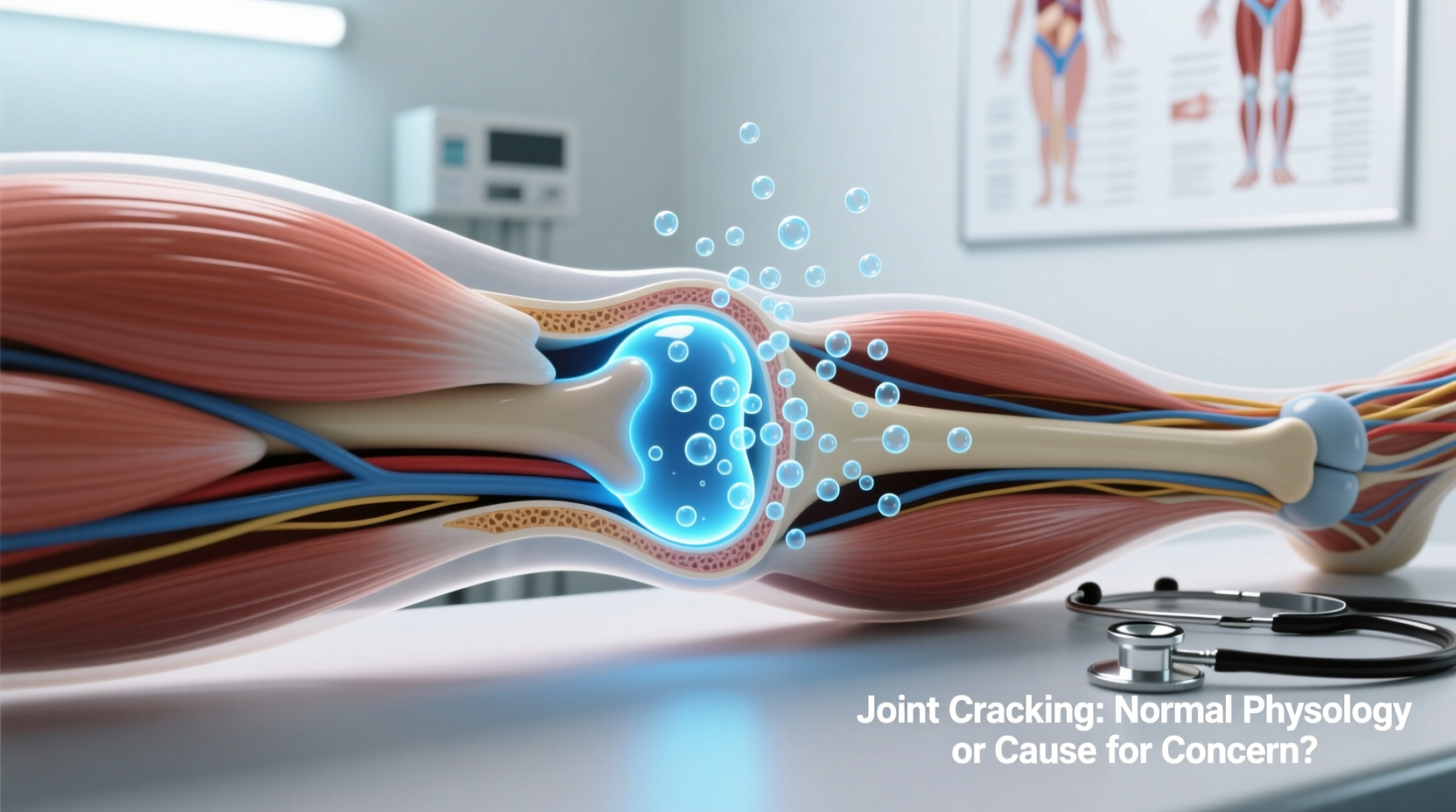
When you stretch or move a joint and hear a popping or cracking sound, what you're likely experiencing is called cavitation. This occurs when gas dissolved in the synovial fluid—the lubricating liquid inside your joints—rapidly forms a bubble and then collapses. The sudden change in pressure within the joint capsule causes the audible \"pop.\"
Synovial fluid contains gases like nitrogen, oxygen, and carbon dioxide. When a joint is stretched or manipulated, the pressure inside drops quickly, causing these gases to come out of solution and form a temporary cavity. Once the gas dissolves back into the fluid, the joint cannot be \"cracked\" again for about 15 to 30 minutes—a refractory period confirmed by imaging studies.
“Cavitation is a physical phenomenon, not tissue damage. It’s similar to opening a soda can—the release of pressure creates a burst.” — Dr. Rebecca Lang, Sports Medicine Physician
Not all joint noises are due to gas bubbles, however. Some sounds arise from tendons snapping over bony structures or rough cartilage surfaces rubbing together. These types of crepitus (joint noise) may be more concerning depending on context.
Is Loud Joint Cracking Normal?
Loudness alone does not determine whether joint cracking is problematic. A forceful stretch, especially after prolonged inactivity, can generate a louder-than-usual pop simply because more tension has built up in the joint capsule. Morning stretches often produce pronounced sounds due to overnight stiffness and increased intra-articular pressure.
In healthy individuals, painless, occasional joint cracking—even if loud—is typically benign. Studies have repeatedly shown no link between habitual knuckle cracking and arthritis. One notable long-term study followed a man who cracked the knuckles on one hand for over 60 years and found no difference in arthritis rates between his hands.
Tip: If your joints crack but don’t hurt, swell, or feel unstable, it’s almost certainly normal physiological noise.However, volume can sometimes correlate with joint mobility or hypermobility. People with looser ligaments or greater range of motion may experience more dramatic pops due to increased joint excursion. This is common among dancers, gymnasts, and those with conditions like benign joint hypermobility syndrome (BJHS).
When Joint Cracking Becomes a Concern
While most joint noise is harmless, certain red flags suggest underlying issues. Pain accompanying the sound is the most important indicator. Other warning signs include:
- Pain during or after movement
- Swelling or warmth around the joint
- Reduced range of motion
- Feeling of instability or “giving way”
- Repetitive grinding or grating sensation (not just an occasional pop)
These symptoms may point to conditions such as:
- Osteoarthritis: Degeneration of cartilage leads to roughened joint surfaces that create crackling or grinding noises (crepitus).
- Tendonitis or tenosynovitis: Inflamed tendons catching on bone or other tissues cause snapping sensations, commonly felt in wrists, hips, or ankles.
- Meniscus tears: In the knee, a torn meniscus can cause clicking, locking, or catching during movement.
- Labral tears: Shoulder or hip labrum injuries often result in deep, painful clicks during rotation.
- Patellar tracking issues: Misalignment of the kneecap can lead to repetitive popping, especially when squatting or climbing stairs.
If any of these symptoms accompany your joint noise, medical evaluation is recommended. Early diagnosis can prevent further degeneration and improve outcomes through targeted therapy.
Checklist: Assessing Your Joint Health
Use this simple checklist to evaluate whether your joint cracking warrants concern:
- Does the sound happen only once per movement and not repeat immediately? → Likely normal
- Is there no pain associated with the noise? → Reassuring sign
- Do you maintain full range of motion without stiffness? → Positive indicator
- Are both sides of the body symmetrical in sound and function? → Suggests balance
- Have you noticed recent changes in intensity, frequency, or new discomfort? → Worthy of monitoring
- Is there swelling, redness, or warmth? → Seek evaluation
- Does the joint ever lock, catch, or give out? → Requires professional assessment
If you answered “yes” to questions 1–5 and “no” to 6–7, your joint sounds are likely part of normal physiology. If concerns persist despite a clean checklist, consider consulting a physical therapist or orthopedic specialist.
Expert Insight: What Clinicians Look For
Medical professionals differentiate between types of joint noise based on quality, timing, and context. A single, sharp pop during stretching differs significantly from continuous grinding during weight-bearing activities.
“We listen not just to the sound, but to the story. A patient saying ‘my knee clicks every time I go down stairs and now it hurts’ tells us far more than the noise itself.” — Dr. Alan Zhou, Orthopedic Surgeon
During exams, clinicians assess:
- Location: Is the sound deep within the joint or superficial near tendons?
- Rhythm: Does it occur at a specific point in motion?
- Provocation: Can it be reproduced with certain movements?
- Accompanying symptoms: Pain, swelling, weakness?
Imaging such as MRI or ultrasound may be used if structural damage is suspected. However, imaging isn't always necessary; clinical judgment often suffices for diagnosis.
Real Example: Sarah’s Knee Popping Journey
Sarah, a 34-year-old yoga instructor, began noticing a loud pop in her right knee during downward dog poses. Initially painless, she ignored it for months. Over time, the sound became accompanied by a dull ache and occasional swelling after class.
She visited a sports medicine clinic where the physician observed the pop occurred consistently when she bent her knee past 90 degrees. There was mild tenderness along the medial joint line. An MRI revealed a small meniscal tear. With physical therapy focused on strengthening the quadriceps and improving patellar alignment, Sarah reduced both pain and noise within eight weeks.
Her case illustrates how a seemingly minor sound can evolve into a symptom of mechanical stress—especially under repetitive load. Early intervention prevented progression to surgery.
Do’s and Don’ts of Joint Cracking
| Do’s | Don’ts |
|---|---|
| Do stretch gently and regularly to maintain joint mobility. | Don’t forcefully manipulate joints daily in search of pops. |
| Do strengthen muscles around noisy joints to improve stability. | Don’t ignore persistent pain or swelling. |
| Do stay hydrated—synovial fluid health depends on water intake. | Don’t assume all joint noise means arthritis. |
| Do monitor changes in sound or sensation over time. | Don’t compare your joint sounds to others—everyone’s anatomy differs. |
Step-by-Step Guide to Managing Noisy Joints
If you're concerned about joint cracking, follow this evidence-based approach:
- Observe and Document: Note when, where, and how often the sound occurs. Is it linked to activity? Any pain?
- Assess Function: Test your range of motion and strength. Can you perform daily tasks without limitation?
- Modify Activity: Reduce high-impact or repetitive motions that aggravate the joint.
- Begin Strengthening Exercises: Focus on low-resistance, high-repetition training for surrounding muscles (e.g., straight-leg raises for knee support).
- Incorporate Mobility Work: Use foam rolling and dynamic stretching to improve tissue glide and reduce tendon snapping.
- Hydrate and Nourish: Support connective tissue with adequate protein, vitamin C, and omega-3 fatty acids.
- Seek Evaluation if Needed: Consult a healthcare provider if symptoms worsen or fail to improve in 4–6 weeks.
This gradual process empowers self-management while identifying cases requiring professional input.
Frequently Asked Questions
Can cracking my joints cause arthritis?
No, scientific research has found no causal link between habitual joint cracking and osteoarthritis. A landmark study published in the Journal of the American Board of Family Medicine compared knuckle crackers and non-crackers and found no increased risk of hand arthritis.
Why do my knees crack so loudly when I stand up?
This is often due to patellofemoral crepitus—noise generated as the kneecap glides over the femur. After sitting, the joint fluid redistributes, and initial movement can create a noticeable pop. As long as it’s pain-free, it’s generally harmless.
Should I stop stretching if my joints crack?
No—you should not avoid stretching due to joint noise. Stretching improves circulation, flexibility, and joint nutrition. Only discontinue if pain, swelling, or mechanical symptoms develop.
Conclusion: Listen to Your Body, Not Just the Sounds
Your joints will make noises throughout life—some loud, some subtle, most meaningless. The key is learning to interpret them within the broader context of how your body feels and functions. A thunderous pop during a deep stretch isn’t alarming if it brings relief and no discomfort. But when sound becomes a harbinger of pain or dysfunction, it’s time to pay closer attention.
By staying informed, maintaining strength and mobility, and knowing when to seek help, you can preserve joint health for years to come. Don’t fear the crack—understand it.
💬 Have a question about your joint sounds or personal experience to share? Join the conversation below and help others navigate their own joint health journey.








