
In recent years, mail-in voting has become a standard and trusted method for millions of Americans to participate in elections. As more voters receive ballots by mail, many have noticed small but deliberate design features on the return envelopes���one of which is the presence of tiny holes. At first glance, these perforations may seem odd or even concerning, especially when they appear near sensitive areas like the voter’s signature or ballot window. However, these holes are not manufacturing flaws—they are intentional security and processing features designed to protect the integrity of the election system.
Understanding why mail-in ballot envelopes have holes requires looking beyond surface-level assumptions. These features serve multiple functional roles: enabling secure verification, preventing fraud, facilitating automated sorting, and maintaining voter privacy. This article breaks down the real reasons behind the holes, explains how election systems use them responsibly, and addresses common concerns with factual clarity.
The Purpose Behind the Perforations
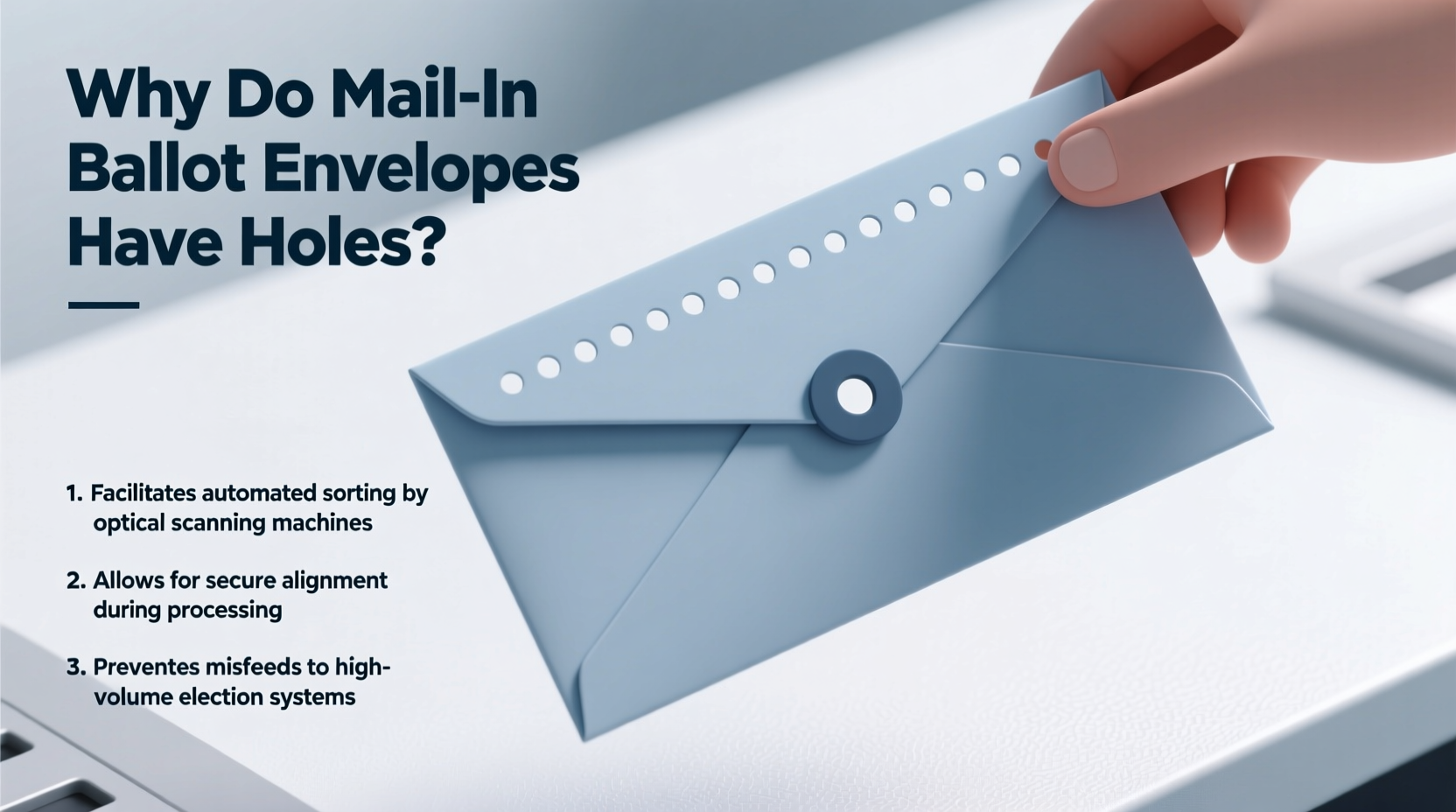
The holes found on official mail-in ballot envelopes are typically part of a dual-envelope system used in most states that offer vote-by-mail. Voters place their completed ballot into a secrecy sleeve (inner envelope), then seal that inside a return envelope (outer envelope) that includes identifying information such as name, address, and signature. The holes are usually located in specific zones of the outer envelope and serve one or more of the following functions:
- Barcode alignment and scanning: Many jurisdictions print barcodes on the inner secrecy envelope. Holes in the outer envelope allow high-speed optical scanners to detect and align the inner barcode without opening the package manually.
- Signature verification access: Some envelope designs include die-cut windows or micro-perforated zones that let election workers view the voter’s signature through the outer envelope while keeping the ballot itself concealed.
- Automated mail processing compatibility: Postal automation equipment uses sensors and cameras to sort mail. Small registration holes help machines orient the envelope correctly during sorting and tracking.
- Fraud detection and tamper resistance: In certain cases, specialized perforation patterns act as tamper-evident indicators—if someone attempts to open or reseal the envelope improperly, the hole pattern will be disrupted.
These design choices are not arbitrary. They result from collaboration between election officials, envelope manufacturers, and postal engineers to balance security, efficiency, and accessibility.
Tip: If you're concerned about privacy, remember that no personal information is visible through the holes—only pre-designated areas like signature blocks or machine-readable codes.Security vs. Privacy: How Holes Protect Your Vote
A common concern among voters is whether these holes compromise ballot secrecy. The answer lies in how election systems separate identification from the actual vote.
When a mail-in ballot arrives at an elections office, staff first verify the voter's identity using the outer envelope. This includes checking the signature against voter records—a process known as \"signature adjudication.\" Once verified, the outer envelope is separated from the inner secrecy sleeve before the ballot is ever seen. The inner envelope, containing only the voted ballot and no identifying details, is then opened and prepared for counting. This two-step process ensures anonymity during tabulation.
The holes support this system by allowing early-stage verification without exposing the ballot. For example:
- A scanner reads a unique identifier through a perforated area to log the ballot into the system.
- Election workers compare the visible signature (through a secure window or aligned via holes) to official records.
- After approval, the outer envelope is set aside, and the inner envelope proceeds to counting.
This layered approach maintains both accountability and confidentiality—holes included.
“Modern ballot envelope design reflects decades of refinement. Every feature, including perforations, serves a documented purpose in securing elections.” — Dr. Rebecca Stone, Election Systems Analyst, Brennan Center for Justice
Real-World Example: Colorado’s High-Volume Mail Voting System
Colorado conducts nearly all its elections entirely by mail, processing over 3 million ballots per general election. To manage this volume efficiently and securely, the state uses standardized ballot envelopes with precision-engineered perforations.
In Denver County, the return envelope includes three small alignment holes along one edge. These don’t expose any data directly but work with internal guides in automated sorting machines to position each envelope so that the barcode on the inner sleeve can be scanned through a designated window. Without these holes, machines would require manual adjustment, slowing down processing and increasing human error risk.
During the 2020 election, when misinformation about ballot handling surged, local officials launched a public demonstration showing how the holes functioned. Using transparent overlays, they illustrated that no voter information or ballot markings were visible through the perforations. The campaign helped reduce confusion and increased public trust in the system.
Do’s and Don’ts When Handling Your Mail-In Ballot Envelope
| Do | Don’t |
|---|---|
| Sign the outer envelope clearly and match it to your registered signature. | Write notes or extra marks near the holes or barcode areas. |
| Place the ballot in both envelopes as instructed—inner for secrecy, outer for delivery. | Cover or obscure the holes, as this may interfere with scanning. |
| Return your ballot early via mailbox or drop box to ensure timely processing. | Assume the holes mean your vote isn’t private—remember the separation process. |
| Contact your local elections office if you notice damage or irregularities. | Try to remove or alter parts of the envelope, including perforated sections. |
Step-by-Step: How Election Officials Process Envelopes With Holes
To demystify the journey of your ballot, here’s what happens after you mail it back:
- Collection: Ballots are collected from mail routes or drop boxes and transported to a central elections facility.
- Imaging & Scanning: Each outer envelope passes through a high-resolution imaging system. Sensors use the holes to align the envelope so the barcode on the inner sleeve can be read through the outer layer.
- Signature Verification: A trained team reviews the voter’s signature, often enhanced digitally for accuracy. If discrepancies exist, voters are notified for correction (cure process).
- Separation: Verified ballots move to a secure room where the outer envelope is removed. Only the anonymous inner envelope advances to counting.
- Tabulation: Inner envelopes are opened, ballots flattened, and fed into optical scanners that record votes without linking them to any voter.
- Audit Trail: Throughout the process, digital logs track each step, ensuring transparency and enabling post-election audits.
This sequence highlights how the holes streamline operations without compromising security or privacy.
Frequently Asked Questions
Can someone see my vote through the holes?
No. The holes are strategically placed to avoid any area where the ballot or identifying marks could be viewed. They are used primarily for machine alignment and barcode reading, not visual access.
Are all mail-in ballot envelopes required to have holes?
No. Design standards vary by state and jurisdiction. Some use alternative methods like full-window envelopes with opaque shielding or manual processing. Holes are just one solution among several.
What should I do if the holes look torn or damaged?
If the envelope appears tampered with before you’ve sealed it, contact your local elections office immediately for a replacement. Once mailed, minor wear during transit won’t disqualify your ballot if the contents remain intact and verifiable.
Conclusion: Trust Through Transparency
The presence of holes in mail-in ballot envelopes is not a flaw—it’s a feature born from careful engineering and operational necessity. These small perforations play a meaningful role in ensuring ballots are processed quickly, accurately, and securely. By understanding their purpose, voters can cast their ballots with greater confidence, knowing that every aspect of the system, down to the tiniest detail, has been designed to protect democracy.
Rather than fuel suspicion, these design elements reflect a mature, adaptive election infrastructure capable of handling complex challenges at scale. As voting technology continues to evolve, so too will the tools that keep our elections resilient and trustworthy.
🚀 Stay informed, vote safely, and share accurate information. Help build public trust in our democratic processes—one well-understood envelope at a time.








