
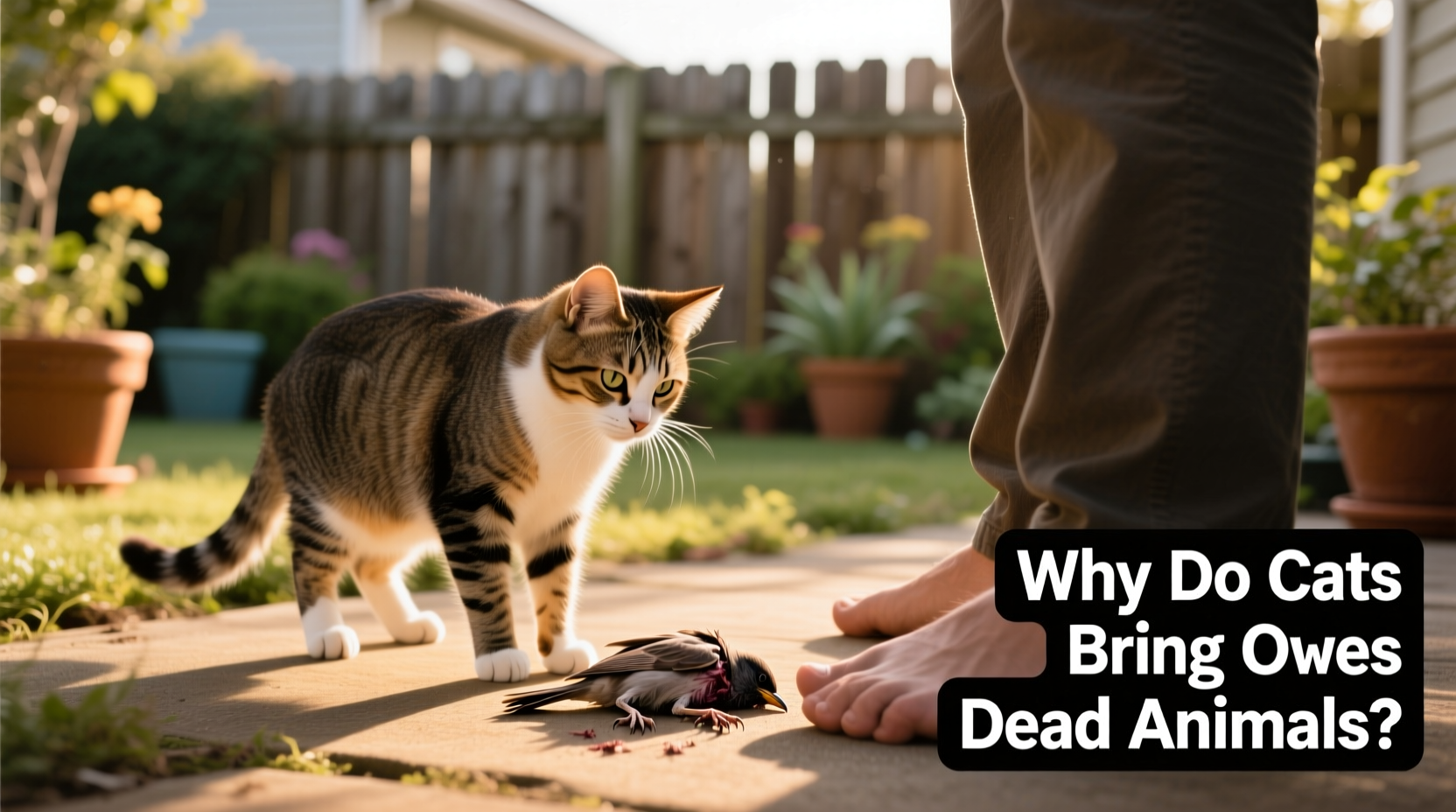
If you’ve ever walked into your home to find a half-chewed mouse on the doormat or a limp bird by your pillow, you’re not alone. Many cat owners have faced this unsettling yet common behavior: their feline companion proudly presenting a freshly caught—or recently deceased—animal. While it may seem gruesome, this act is deeply rooted in feline instinct, social structure, and communication. Understanding why cats bring dead animals to their humans reveals not cruelty or indifference, but often a complex blend of affection, teaching, and natural hunting drive.
This behavior can be difficult to accept, especially for those who love wildlife or are unsettled by death. Yet dismissing it as mere bloodlust overlooks the emotional and evolutionary layers behind the gesture. Whether your cat leaves prey at your doorstep, drops it at your feet, or simply stares at you with what seems like pride, there’s meaning in the moment—one that speaks to thousands of years of feline adaptation and bonding.
The Evolutionary Roots of Feline Hunting
Cats are obligate carnivores, meaning their biology requires a meat-based diet to survive. Even well-fed domestic cats retain the instincts of their wild ancestors. The domestic cat (*Felis catus*) evolved from solitary hunters in arid regions of the Middle East, where stealth, precision, and independent survival were essential. Unlike pack animals that share food for social cohesion, early felines hunted alone and consumed prey immediately to avoid competition.
Despite generations of domestication, these instincts remain intact. A study published in *Applied Animal Behaviour Science* found that hunger is not the primary motivator for hunting in domestic cats—opportunity and instinct are. In fact, research shows that even cats fed regularly will engage in predatory behaviors when given access to outdoor environments. This suggests that hunting is less about sustenance and more about hardwired behavior shaped by evolution.
Bringing prey back to a central location—like a den or human home—is also observed in wild felids. Female wildcats often carry kills back to secluded dens to feed kittens safely away from scavengers. In a domestic setting, your home becomes that “den,” and you, the trusted caregiver, become part of the social unit the cat protects and provides for.
A Gift of Affection: The Social Interpretation
One of the most compelling explanations for why cats bring dead animals to their owners is that they view us as part of their social group—possibly even as inept members needing instruction. Dr. John Bradshaw, a leading expert in anthrozoology and author of *Cat Sense*, explains:
“Cats don’t see humans as fellow cats, but they do integrate us into their social framework. When a mother cat brings injured prey to her kittens, she’s teaching them how to eat and hunt. If your cat brings you a mouse, it might be trying to ‘teach’ you—because in its mind, you’re a clumsy, furless kitten who needs help surviving.” — Dr. John Bradshaw, Anthrozoology Researcher
This theory aligns with observations of cats who gently place prey near their owners, sometimes nudging it forward or vocalizing softly. These behaviors mirror how mother cats interact with kittens during feeding lessons. The cat isn’t mocking you; it’s attempting to care for you in the only way its instincts allow.
In other cases, the act may serve as a form of bonding. By sharing prey—even if uneaten—the cat reinforces trust. In the wild, sharing food strengthens social ties among cooperative species. While cats aren’t naturally cooperative hunters like wolves, they do form close-knit colonies in resource-rich areas, where kinship and tolerance develop over time. Your presence in the cat’s territory signals inclusion, making you a recipient of its spoils.
Tip: Never punish your cat for bringing dead animals—it may interpret this as rejection and become anxious or secretive.Hunting Practice and Mental Stimulation
Another key reason cats deliver dead (or dying) animals is to fulfill their need for mental and physical engagement. Indoor-outdoor cats, in particular, use hunting as a form of environmental enrichment. The process—from stalking and chasing to capturing—activates neural pathways linked to focus, coordination, and reward.
Even when the kill is made, the act of transporting the prey home adds another layer of cognitive activity. It involves spatial memory, risk assessment (avoiding larger predators), and decision-making about safe zones. For a cat, your house represents safety—a place where threats are minimal and resources are reliable.
Some researchers suggest that repeated delivery of prey indicates a surplus of opportunity rather than necessity. Neighborhoods with high rodent or bird populations provide ample targets, especially if the cat has free outdoor access. In such cases, the behavior is less about nutrition and more about routine, skill reinforcement, and environmental mastery.
Interestingly, neutered and spayed cats are just as likely to hunt as intact ones, further supporting the idea that reproduction doesn’t drive the behavior—it’s the instinct itself that persists regardless of hormonal status.
How to Respond: Practical Guidance for Cat Owners
Finding a lifeless creature on your pillow isn’t easy to handle emotionally or hygienically. But reacting with anger or disgust can damage the bond you’ve built with your cat. Instead, consider these compassionate and practical responses.
Step-by-Step Guide to Handling Prey Gifts
- Stay calm. Avoid yelling or showing strong negative reactions. Your cat won’t understand punishment in this context.
- Remove the animal safely. Use gloves and disinfect the area afterward to prevent disease transmission (e.g., toxoplasmosis, parasites).
- Thank your cat quietly. Say something soothing like “Good job” or offer gentle petting. This acknowledges the intent without encouraging repetition.
- Redirect the energy. Engage your cat in play using wand toys or puzzle feeders to simulate hunting indoors.
- Monitor outdoor access. Consider supervised outings or a catio to reduce hunting opportunities while still allowing enrichment.
| Action | Why It Works | Risk of Not Doing It |
|---|---|---|
| Use interactive toys daily | Mimics hunting sequence, reducing outdoor pursuit | Increased killing due to unmet stimulation |
| Attach a bell to collar | Alerts prey, reduces catch rate by up to 50% | Higher wildlife impact |
| Feed meals via food puzzles | Engages problem-solving, satisfies predatory drive | Boredom leading to excessive hunting |
| Keep cat indoors at dawn/dusk | Peak hunting times for cats and vulnerable prey | More kills of birds and small mammals |
Checklist: Reducing Unwanted Prey Delivery
- ✅ Provide 10–15 minutes of interactive play twice daily
- ✅ Install window perches for safe wildlife viewing
- ✅ Use a breakaway collar with a bell
- ✅ Feed a high-protein, meat-based diet to support natural needs
- ✅ Limit unsupervised outdoor time, especially during breeding seasons for birds
- ✅ Consider microchipping and ID tags if allowing outdoor access
Real-Life Example: Sarah and Her Rescue Cat Luna
Sarah adopted Luna, a three-year-old tabby, from a rural shelter. Within weeks, Luna began leaving shrews and sparrows on the back porch. Distressed, Sarah considered keeping her indoors full-time—but worried about stress.
After consulting a feline behaviorist, she implemented changes: adding two daily play sessions with feather wands, installing a screened-in balcony garden, and switching to timed puzzle feeders. She also started praising Luna calmly whenever prey appeared, then removing it without drama.
Over three months, the number of kills dropped from nearly weekly to once every six weeks. More importantly, Luna seemed more relaxed and engaged indoors. “I realized she wasn’t being cruel,” Sarah said. “She was just doing what felt natural. Once I gave her other outlets, she didn’t feel the need to prove herself as much.”
This case illustrates that while we can’t eliminate instinct, we can guide it toward healthier expressions. The goal isn’t to stop a cat from being a cat—but to coexist with compassion for both pets and wildlife.
FAQ: Common Questions About Cats and Dead Animals
Is my cat trying to feed me?
Possibly. Cats often bring prey to people they care for, especially if they were raised around kittens or had nurturing mothers themselves. They may perceive you as part of their family unit and attempt to provide for you, even though you clearly don’t need it.
Does this mean my cat is unhappy or underfed?
Not necessarily. Most cats who bring dead animals are well-fed and content. Hunting is driven more by instinct than hunger. However, ensuring your cat receives adequate protein and mental stimulation can help reduce compulsive hunting behavior.
Can I train my cat not to hunt?
You can't erase the instinct, but you can reduce the behavior. Strategies include using collars with bells, keeping cats indoors during peak wildlife activity (dawn and dusk), increasing indoor enrichment, and providing structured play that mimics the hunt-catch-kill-eat sequence.
Conclusion: Understanding Over Judgment
The sight of a dead animal delivered by your beloved cat can evoke shock, sadness, or frustration. But beneath the surface lies a story millions of years in the making—one of survival, connection, and instinctual loyalty. Whether motivated by affection, teaching, or the thrill of the chase, your cat isn’t acting out of malice. It’s communicating in the only language it knows.
By responding with empathy instead of punishment, you honor the complexity of feline nature. You also open the door to solutions that protect local wildlife, improve your cat’s quality of life, and strengthen your relationship. Simple steps—like enriching play, safer outdoor options, and consistent routines—can make a meaningful difference.
💬 Have a story about your cat’s “gifts”? Share your experience or tips in the comments—your insight could help others navigate this puzzling but profound behavior.








