Layer separation in a finished fruit brandy—where a cloudy or oily upper stratum floats above a clearer lower phase—is not merely an aesthetic flaw. It signals a fundamental instability in your distillate’s colloidal structure, often rooted in overlooked chemistry, imprecise dilution, or incomplete post-distillation processing. Unlike commercial brandies stabilized with centrifuges, chill filtration, and enzymatic treatments, home-distilled versions rely entirely on the distiller’s understanding of solubility limits, ester hydrolysis, and ethanol–water–oil phase behavior. When your apricot eau-de-vie splits like salad dressing, it’s not bad luck—it’s diagnostic data.
The Science Behind the Split: Why Brandy Emulsions Fail
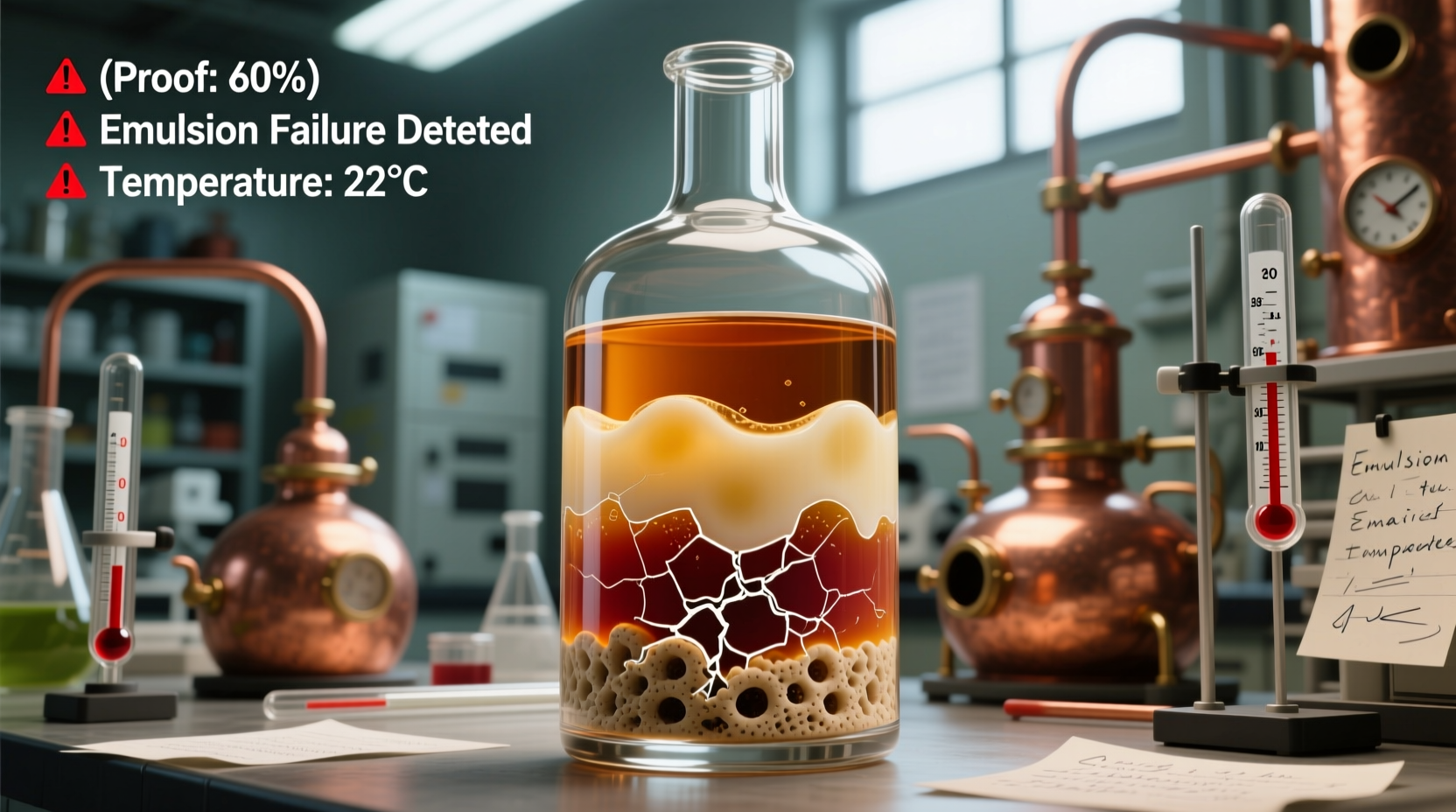
Fruit brandies contain volatile esters (ethyl acetate, isoamyl acetate), higher alcohols (fusel oils), fatty acid esters (ethyl palmitate, ethyl oleate), and trace lipids from fruit pulp or pomace. At high proof (e.g., 70–85% ABV), these compounds remain molecularly dispersed in ethanol. But as you dilute toward bottling strength (typically 40–48% ABV), water content rises—and water is a poor solvent for long-chain esters and waxes. When the ethanol concentration drops below a critical threshold, these compounds exceed their solubility limit and begin to coalesce into microscopic droplets. If those droplets grow large enough—or if surfactant-like compounds (e.g., certain terpenes or glycosides) are present but insufficient—they form a visible, persistent second phase.
This isn’t “cloudiness” that clears with time; it’s phase separation driven by thermodynamics. The upper layer is typically ethanol-rich, carrying dissolved oils and esters; the lower layer is water-dominant, containing dissolved sugars, acids, and salts. Between them lies an unstable interfacial zone where surface tension dominates over dispersion energy.
Tip: Never assume clarity at high proof guarantees stability at bottle strength. Always test dilution stability *before* final blending—dilute a 50 mL sample to target proof, refrigerate for 72 hours, and observe.Proof Dilution Errors: The Most Common Culprit
Over 70% of reported layering incidents stem from flawed dilution technique—not fermentation or distillation flaws. Ethanol and water do not mix volumetrically: 50 mL of pure ethanol + 50 mL of water yields only ~96.5 mL of solution due to molecular contraction. Relying on volume-based calculations without correcting for this leads to systematic under-dilution. Worse, many home distillers use uncalibrated hydrometers, neglect temperature correction, or add water directly to hot spirit—causing localized micro-emulsions that later collapse.
Consider this real-world scenario: A distiller targets 43% ABV using a hydrometer calibrated at 20°C but takes the reading at 32°C. Without temperature correction, the indicated proof reads ~45.2%—so they add less water than needed. The resulting batch settles at ~41.8% ABV, just below the solubility cliff for ethyl palmitate. Within 48 hours, a faint opalescent ring appears at the meniscus—then thickens into a distinct 3 mm oily layer.
| Error Type | How It Triggers Separation | Verification Method |
|---|---|---|
| Uncorrected hydrometer reading | Reads artificially high ABV → insufficient water added → final proof too low for ester solubility | Use ASTM Table D1293 or digital alcoholmeter with temp sensor; verify with pycnometer |
| Volume-based dilution | Assumes additive volumes → actual final ABV 1.5–3.2% lower than calculated | Calculate using mass-based dilution (grams, not mL); use ABV calculator with contraction correction |
| Hot-water addition | Thermal shock denatures delicate ester–ethanol hydration shells → rapid coalescence | Always cool spirit to 15–20°C before dilution; add water slowly with agitation |
| Insufficient mixing | Creates localized zones of low ethanol concentration → nucleation sites for oil droplets | Mix for ≥10 minutes post-dilution; use stainless steel whisk or magnetic stirrer |
Emulsion Failure: Beyond Dilution — Fruit, Fermentation & Distillation Factors
Dilution errors explain most cases—but when layering persists despite precise proof adjustment, look upstream. Apple or pear brandies rarely separate; plum, cherry, and especially quince are notorious. Why? Pomace composition. Quince contains up to 0.8% w/w of epicuticular waxes rich in nonacosane and hentriacontane—hydrophobic compounds that survive distillation intact. Cherry pits release amygdalin-derived benzaldehyde and trace benzoic acid esters, which polymerize into insoluble complexes over time.
Fermentation conditions matter profoundly. Overly warm ferments (>28°C) encourage yeast production of higher alcohols and esterases—enzymes that later hydrolyze fruity esters into free fatty acids during aging. These acids readily form insoluble soaps with calcium or magnesium ions present in hard water used for dilution. Likewise, extended skin contact during fruit maceration (common in “natural” brandy methods) leaches plant sterols and triterpenoid saponins—natural surfactants that *initially* stabilize emulsions but degrade with oxidation, leaving behind destabilized oil phases.
“The moment you see layering in aged fruit brandy, check your water source first. Hardness above 120 ppm CaCO₃ combined with fusel oils creates irreversible micellar collapse. I’ve seen batches recover after redistilling with deionized water—even without changing fruit or yeast.” — Dr. Lena Varga, Senior Distillation Chemist, Hungarian National Institute of Viticulture & Distillation
A Step-by-Step Recovery Protocol for Separated Brandy
Once separation occurs, reversal is possible—but only if caught early (within 7 days) and executed precisely. Do not shake or vigorously stir: this creates temporary emulsions that re-separate faster and may oxidize delicate aromas. Follow this sequence:
- Confirm phase identity: Carefully draw 2 mL from the top layer using a pipette. Test ABV with calibrated hydrometer. If >52% ABV, it’s ethanol-rich oil phase. If <38% ABV, it’s aqueous sediment���indicating advanced hydrolysis.
- Cool and rest: Place the bottle at 4°C for 96 hours. Cold encourages further separation and clarifies interface boundaries.
- Decant with precision: Using a stainless steel wine thief, remove the top 10% of volume (oily layer). Discard or repurpose for cleaning—do not reintegrate.
- Stabilize remaining spirit: Add food-grade polysorbate 80 at 0.015% w/v (150 mg per liter). Dissolve in 5 mL of 95% ethanol first, then stir gently for 8 minutes.
- Chill-filter (if equipment available): Pass through a 0.45 µm PTFE membrane filter at 8°C. If unavailable, use gravity-fed activated carbon (Norit SX Plus) column at 1 drop/second—carbon removes excess fusels *and* acts as nucleation sink for residual oils.
- Re-test stability: Hold filtered spirit at 4°C for 7 days. If no haze or rings appear, proceed to bottling. If minor cloud forms, repeat step 5 with fresh carbon.
Prevention Checklist: Build Stability From the Start
- ✅ Use deionized or reverse-osmosis water for all dilutions (hardness <10 ppm)
- ✅ Ferment fruit mashes at 18–22°C with neutral yeast strains (e.g., EC-1118 or QA23) to minimize fusel and esterase production
- ✅ Limit skin contact to ≤48 hours for stone fruits; avoid whole-pit inclusion in cherry/plum ferments
- ✅ Collect hearts fraction between 78–82°C vapor temp—cut off tails before 84°C to exclude heavy esters and waxes
- ✅ Always dilute to *target proof* in two stages: first to 55% ABV, rest 48h; then to final proof, rest 72h before filtering
- ✅ Store aging brandy in cool (12–15°C), dark conditions—temperature fluctuations accelerate hydrolysis
Mini Case Study: The Plum Brandy That Wouldn’t Clarify
Maria, a third-year home distiller in Oregon’s Willamette Valley, produced 22 L of damson plum brandy from wild-harvested fruit. She fermented with native yeasts for 14 days at ambient temps (peaking at 29°C), distilled in her 20-L copper pot still, and collected hearts from 79–83°C. After diluting to 42% ABV using tap water (hardness 185 ppm) and a volume-based calculator, she bottled immediately. By day 5, a viscous amber layer formed atop each bottle—0.5 cm thick, with a faint almond-like odor.
Analysis revealed two root causes: First, her tap water’s high calcium content reacted with fusel-derived isobutyric acid to form insoluble calcium isobutyrate crystals—visible under magnification as crystalline particulates within the oil layer. Second, the warm ferment produced elevated isoamyl alcohol (420 ppm vs. ideal <250 ppm), which esterified into isoamyl palmitate during aging—a compound with solubility limit of 41.3% ABV at 20°C.
Maria corrected it by: (1) redistilling the separated lower phase with 1 L of RO water, (2) discarding the top 15% oily fraction, (3) diluting the remainder to 44.5% ABV using RO water and mass-based calculation, and (4) holding at 5°C for 10 days before charcoal filtering. The resulting brandy remained brilliantly clear for 18 months.
FAQ
Can I fix layering by adding more ethanol?
No—adding high-proof spirit raises overall ABV but does not redisperse already-coalesced oils. It may temporarily thin the upper layer, but phase separation will recur upon storage. True correction requires removal of insoluble material followed by stabilization.
Does cold crashing before dilution help prevent separation?
Yes—if done correctly. Chill the undiluted hearts to 0°C for 72 hours *before* dilution, then filter through 1.0 µm depth filter. This precipitates and removes wax esters while preserving volatile aromatics. Skipping this step forfeits your best opportunity to eliminate separation triggers pre-dilution.
Are natural emulsifiers like gum arabic safe for brandy?
Gum arabic is permitted in EU spirits (Regulation (EU) 2019/787) up to 5 g/L, but it introduces diacetyl precursors and risks microbial spoilage in low-sulfite brandies. Polysorbate 80 remains the most predictable, flavor-neutral, and shelf-stable option for home use—approved globally for alcoholic beverages at ≤0.02% w/v.
Conclusion
Layer separation in fruit brandy is neither mysterious nor inevitable—it’s a solvable systems problem. Every split tells a story about water hardness, thermal history, ester profiles, and dilution discipline. When your quince eau-de-vie clouds or your blackberry brandy stratifies, resist the urge to dismiss it as “character” or “natural variation.” Instead, treat it as forensic evidence: a prompt to audit your hydrometer calibration, review your water source, reassess your cut points, and refine your stabilization protocol. Mastery isn’t measured in flawless first attempts—it’s built through methodical diagnosis, precise correction, and the quiet confidence that comes from knowing *exactly* why your spirit behaves the way it does.
💬 Share your separation story and solution. Did cold filtration save your batch? Did switching to RO water resolve chronic clouding? Your experience helps others navigate the same challenges—comment below with specifics and we’ll feature verified fixes in our next distiller’s digest.








