Place a bicycle upright on flat ground and let go. If it’s not moving, it will almost certainly tip over within seconds. This simple observation raises a fascinating question: why can’t a bike stand up on its own? While riders manage to balance effortlessly once in motion, that same machine becomes unstable at rest. The answer lies in a blend of physics, engineering, and human input — not magic, but mechanics.
Bicycle balance is often misunderstood. Many assume gyroscopic forces from the spinning wheels are solely responsible for keeping a bike upright. While they play a role, the full picture is more nuanced. Understanding why a stationary bike falls — and how it stays up when moving — reveals insights into dynamics, stability, and even robotics research.
The Myth of Self-Balancing Bikes
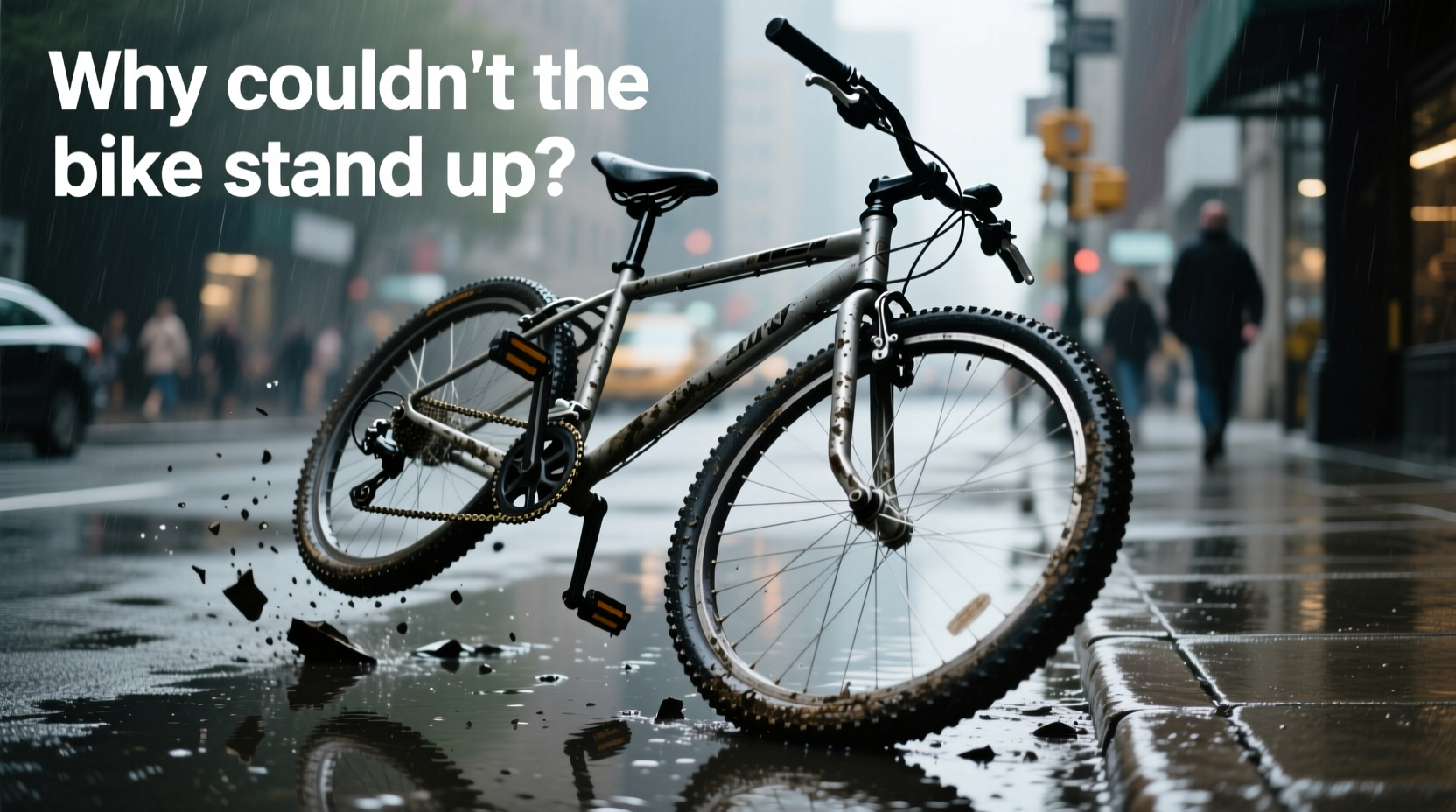
Unlike motorcycles with kickstands or training wheels, standard bicycles lack any mechanical aid to remain upright when parked. Without a rider or external support, two thin tires and a narrow frame offer minimal resistance to tipping forces. Even slight imbalances in weight distribution or minor surface irregularities cause the center of gravity to shift outside the bike’s small base, triggering a fall.
At rest, a bicycle behaves like an inverted pendulum — inherently unstable. Gravity pulls downward, but because the contact points (tires) are narrow and close together, any tilt increases the torque pulling the bike further down. There’s no self-correcting mechanism in place until motion begins.
Tip: To prevent your bike from falling over when parked, always lean it against a wall or use a kickstand on level ground.How Motion Enables Balance
Once a bicycle starts moving, several dynamic effects come into play that make balance possible — even intuitive for most riders. These include steering correction, forward momentum, trail geometry, and limited gyroscopic stabilization.
When riding, a rider constantly makes micro-adjustments to the handlebars. Leaning slightly left? The front wheel turns left, shifting the contact patch beneath the center of mass and restoring equilibrium. This corrective steering happens subconsciously and rapidly, allowing smooth navigation even at low speeds.
Forward speed itself contributes to stability. At higher velocities, small steering inputs produce quicker shifts in the bike’s path, giving the system more time and space to correct imbalances before tipping occurs. It's not that the bike balances itself — it’s that the rider has more time to react, and the physics of motion allow for dynamic recovery.
The Role of Trail and Frame Geometry
One of the most critical design elements influencing bicycle stability is “trail” — the distance between where the front wheel touches the ground and where the steering axis would intersect the ground if extended. Positive trail creates a caster effect, similar to shopping cart wheels, which naturally aligns the front wheel behind the direction of travel.
This alignment causes the front wheel to automatically steer into a lean. For example, if the bike starts leaning to the right, the trail geometry helps turn the front wheel to the right, bringing the bike back under the rider. This passive self-aligning feature significantly reduces the effort needed to maintain balance.
| Factor | Effect at Rest | Effect in Motion |
|---|---|---|
| Gyroscopic Forces | None | Minor stabilizing influence |
| Trail Geometry | No correction possible | Enables automatic steering correction |
| Rider Input | Required to prevent fall | Subconscious micro-adjustments |
| Momentum | Zero | Increases control window |
| Center of Gravity | Easily shifted outside base | Continuously corrected via steering |
Debunking the Gyroscopic Myth
For decades, scientists believed the primary reason bikes stay upright was due to gyroscopic precession — the effect created by spinning wheels resisting changes in orientation. However, a landmark 2011 study published in *Science* challenged this idea.
“Even without gyroscopic effects or trail, a bicycle can be self-stable under certain conditions.” — Dr. Andy Ruina, Cornell University Biomechanics Lab
Researchers built a special bicycle with counter-rotating wheels to cancel out gyroscopic forces and negative trail to eliminate caster effects. Surprisingly, this bike could still stabilize itself when pushed without a rider — proving that multiple factors interact in complex ways to create balance. The key wasn’t one single principle, but the interplay between mass distribution, speed, and feedback mechanisms.
This experiment demonstrated that while gyroscopic forces contribute, they aren’t necessary for stability. Instead, the entire system — frame, wheels, steering, and motion — functions as a dynamic controller that can achieve passive stability under specific configurations.
Real-World Example: Learning to Ride
Consider a child learning to ride their first two-wheeler. Initially, they wobble uncontrollably, often stopping too soon and falling over. What’s happening? They haven’t yet developed the muscle memory to make rapid steering corrections. Their brain hasn’t learned to interpret body tilt as a signal to turn the handlebars in the same direction.
Over time, through repetition, the child internalizes the relationship between lean and steer. They begin to understand that to avoid falling left, they must briefly steer left — a counterintuitive maneuver known as \"countersteering.\" Once mastered, balance feels automatic. But it’s not the bike doing the work; it’s the rider becoming part of a closed-loop control system.
In fact, experienced cyclists rarely think about balance at all. They focus ahead, navigate traffic, adjust posture — all while their nervous system continuously processes sensory input and adjusts steering and body position dozens of times per minute.
Step-by-Step: How a Rider Maintains Balance
- Sense imbalance: The rider feels a slight lean via inner ear (vestibular system) and body pressure on the saddle/handlebars.
- Initiate corrective steer: The brain signals hands to turn the front wheel slightly in the direction of the lean.
- Shift contact patch: Turning moves the tire’s contact point beneath the center of mass, halting the fall.
- Realign: As the bike straightens, the rider steers back to center, preventing overcorrection.
- Repeat continuously: This cycle repeats hundreds of times during a short ride, often without conscious thought.
Common Misconceptions About Bicycle Stability
- Myth: Bikes stay up because the wheels spin fast.
Reality: Gyroscopic forces exist but are relatively weak compared to steering and geometry effects. - Myth: Wider tires provide more balance.
Reality: Tire width affects grip and comfort, but not fundamental balance mechanics. - Myth: Heavier bikes are more stable.
Reality: Excess weight can make steering sluggish, reducing responsiveness to corrections.
Frequently Asked Questions
Can a bike balance itself without a rider?
Under very specific conditions — such as the right speed, mass distribution, and geometry — yes, some bikes can exhibit self-stability. However, most standard bicycles will fall over without rider input or external support.
Why do bikes wobble at very high speeds?
At extreme speeds, minor misalignments or resonant frequencies in the frame and wheels can trigger oscillations known as \"speed wobbles\" or \"tank slappers.\" These occur when the steering response becomes too sensitive, overwhelming the rider’s ability to correct.
Do training wheels help kids learn balance?
Paradoxically, no — they delay it. Training wheels prevent children from experiencing real balance challenges. Alternatives like balance bikes (without pedals) allow kids to practice steering and weight shifting earlier, leading to faster, more confident transitions to pedal bikes.
Practical Tips for Better Bike Control
- Keep your eyes focused ahead
- Looking down at your front wheel narrows your reaction window. Focus 10–20 meters ahead to anticipate balance adjustments.
- Relax your grip
- Tension in your arms reduces fine motor control. Keep hands loose to allow natural handlebar movements.
- Practice track stands
- Stopping momentarily without putting a foot down improves low-speed balance and coordination.
- Adjust your seat height properly
- A correctly positioned saddle allows optimal weight distribution and easier dismounts if balance is lost.
Conclusion
A bicycle cannot stand up on its own because it lacks inherent static stability. Its narrow base and high center of gravity make it prone to tipping when motionless. But once moving, a combination of rider input, steering geometry, and dynamic forces transforms instability into controlled equilibrium. The magic isn’t in the machine — it’s in the interaction between human and physics.
Understanding why a bike falls when still deepens appreciation for the subtle engineering and biological coordination required to keep it upright in motion. Whether you're a casual rider or an enthusiast, recognizing these principles can improve your control, confidence, and safety on every ride.
💬 What was your biggest challenge when learning to ride? Share your story and help others feel less alone in their wobbles!