
It’s no coincidence that elite swimmers often tower over the competition—both in and out of the pool. From Michael Phelps to Katie Ledecky, many top-tier swimmers share a common trait: above-average height. While talent, training, and technique are critical, physical attributes like height play a significant role in swimming success. But why are swimmers so tall, and what specific advantages does height offer in the water? This article explores the biomechanical, physiological, and strategic benefits of being tall in competitive swimming.
The Biomechanics of Height in Water
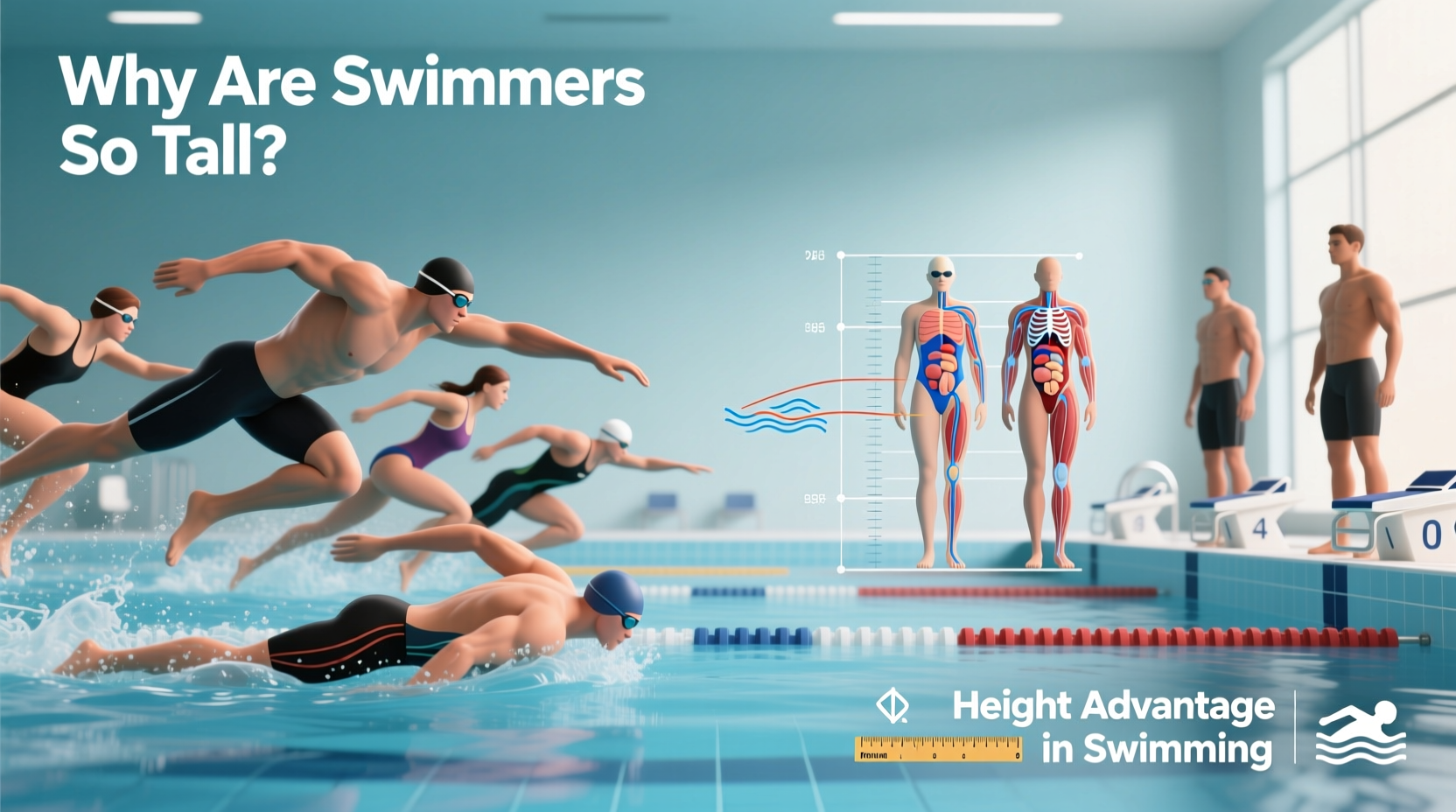
In swimming, propulsion comes from moving water efficiently with minimal resistance. Taller swimmers typically have longer limbs and larger wingspans, which translate into greater reach per stroke. This means they can cover more distance with each pull, reducing the total number of strokes needed to complete a lap. Fewer strokes mean less energy expenditure over time and lower drag accumulation from repeated arm movements breaking the surface.
A swimmer’s height also correlates with body length, allowing for a longer glide phase during starts and turns. After pushing off the wall or diving in, taller athletes stay submerged in streamline position longer, maintaining speed before resuming strokes. This extended glide is particularly advantageous in short-course events where turns are frequent.
Tip: Even if you're not tall, maximizing your streamline form can help compensate for shorter reach—focus on tight core engagement and pointed toes.How Height Enhances Stroke Efficiency
One of the most direct advantages of height is improved stroke efficiency. Consider freestyle: a taller swimmer with long arms can \"catch\" more water earlier in the stroke cycle, generating greater propulsion. The increased leverage allows them to apply force over a longer path through the water, creating more forward momentum per stroke.
This doesn’t mean shorter swimmers can’t be efficient—they often rely on higher stroke rates to maintain pace. However, elite-level races frequently favor those who combine power with economy, and taller swimmers naturally achieve this balance more easily.
| Swimmer Attribute | Advantage for Tall Swimmers | Compensation for Shorter Swimmers |
|---|---|---|
| Arm Length | Greater reach, longer stroke | Higher stroke rate, refined catch technique |
| Leg Length | Stronger kick propulsion, better streamline | Faster flutter/kick tempo, improved ankle flexibility |
| Wingspan | Often exceeds height (e.g., Phelps), enhancing pull strength | Focus on underwater dolphin kick efficiency |
| Body Surface Area | More surface to generate lift and propulsion | Reduced drag through superior body position |
Real-World Example: Michael Phelps – The Ultimate Anomaly
Michael Phelps stands at 6'4\" (193 cm), but his wingspan measures an extraordinary 6'7\" (201 cm)—longer than his height. His size contributed significantly to his dominance in the pool. With such reach, he could maintain a high stroke length while keeping a relatively low stroke count, conserving energy across grueling Olympic races.
Phelps also had unusually large feet—size 14—which acted like natural flippers, increasing propulsion with every kick. Combined with his height and hypermobile joints, these traits created a rare physical profile optimized for swimming. While not every tall swimmer reaches Olympic glory, Phelps exemplifies how height, when paired with ideal proportions and training, becomes a powerful asset.
“Height gives certain swimmers a structural edge—more paddle, more leverage, more glide. But it's the coordination of those elements that wins medals.” — Dr. James Counsilman Jr., Sports Biomechanist and former USA Swimming Science Advisor
Do You Need to Be Tall to Succeed in Swimming?
While height offers clear advantages, it is not a prerequisite for success. Many elite swimmers defy the tall stereotype. Dara Torres, a 12-time Olympic medalist, competed at 5'9\"—tall by general standards but shorter than many of her peers. More notably, Chad le Clos, who defeated Phelps in the 200m butterfly at the 2012 Olympics, is only 5'10\", relying on exceptional underwater dolphin kicks and race strategy to overcome physical disadvantages.
Shorter swimmers often excel in events requiring rapid turnover, such as sprint freestyle or breaststroke, where quick starts and explosive power matter more than stroke length. Their lower center of mass can also improve stability during turns and underwater phases.
Actionable Checklist for Swimmers of All Heights
- ✅ Maximize streamline position after every start and turn
- ✅ Refine hand entry and catch mechanics to increase stroke efficiency
- ✅ Develop strong underwater dolphin kicking (critical for all body types)
- ✅ Focus on core strength to maintain horizontal alignment in water
- ✅ Analyze stroke rate vs. stroke length to find optimal balance
Developmental Factors: Why Tall Kids Excel Early
Youth swimming programs often see taller children rise to the top early due to their physical maturity. A 13-year-old who is already 5'8\" will naturally move faster through water than a peer who is 5'2\", even with identical technique. This early advantage can lead to more coaching attention, faster progression, and greater confidence—creating a feedback loop that accelerates development.
However, this doesn’t always translate to long-term success. Late bloomers with exceptional work ethic and technical precision often surpass early standouts once growth evens out. Coaches emphasize that while height may open doors, consistency, mental toughness, and skill refinement determine who stays at the top.
Tip: Young swimmers should focus on skill development rather than results—technical mastery lasts longer than early growth spurts.Frequently Asked Questions
Are all competitive swimmers tall?
No, not all competitive swimmers are tall. While many elite athletes are above average height, there are numerous successful swimmers of average or below-average stature. Success depends on a combination of technique, training, physiology, and race strategy—not just height.
Does height matter more in some strokes than others?
Yes. Height tends to benefit freestyle, backstroke, and butterfly more due to the emphasis on long, sweeping arm movements. In breaststroke, where timing and kick power are crucial, shorter limbs can sometimes offer mechanical advantages in quick recovery phases.
Can shorter swimmers beat taller ones?
Absolutely. Shorter swimmers can outperform taller competitors through superior starts, turns, underwater kicking, and pacing. Race intelligence and conditioning often level the playing field, especially in middle-distance and sprint events.
Conclusion: Leveraging Your Unique Physiology
Height undeniably provides structural advantages in swimming—longer reach, reduced stroke count, and enhanced propulsion. It’s one reason so many elite swimmers appear statuesque. Yet, swimming remains one of the most inclusive sports, where dedication and technique can overcome physical limitations. Whether tall or short, every swimmer can optimize performance by mastering fundamentals, refining stroke mechanics, and building endurance.
The key is not to wish for a different body, but to train the one you have to its fullest potential. Focus on what you can control: effort, consistency, and attention to detail. In the water, excellence isn't measured in inches—it's measured in seconds.
🚀 Ready to improve your swim performance? Assess your stroke efficiency, work on your underwater kicks, and track your progress—because greatness isn’t about height, it’s about heart.








