
Skeletal muscles power every movement we make—from walking and lifting to breathing and blinking. Unlike most cells in the human body, which contain a single nucleus, skeletal muscle fibers are unique: they are multinucleated. This structural feature isn’t random; it’s a critical adaptation that enables these cells to meet the high metabolic and functional demands of voluntary movement. Understanding why skeletal muscles have multiple nuclei reveals fundamental insights into how our bodies build strength, recover from injury, and maintain long-term muscular health.
The Structure of Skeletal Muscle Cells
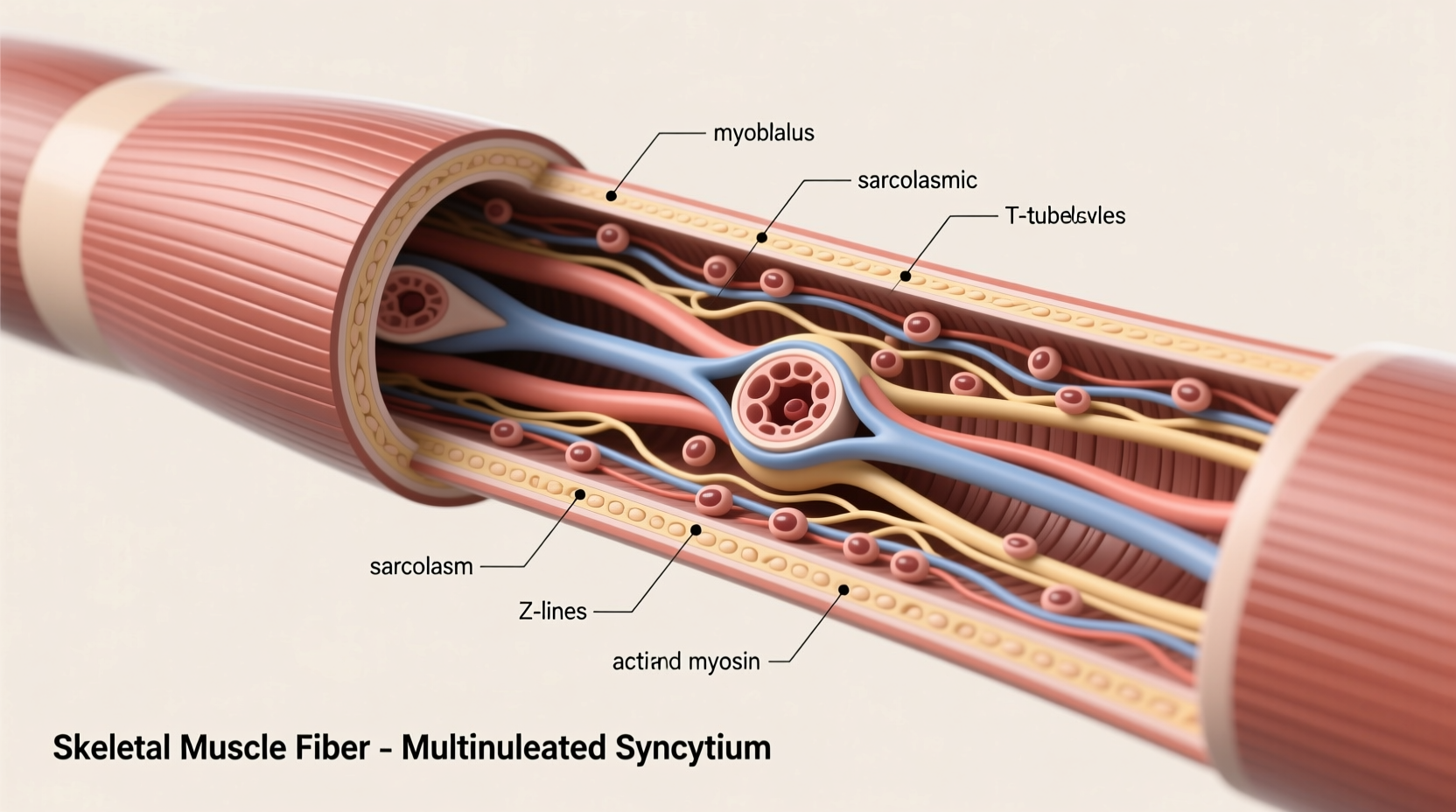
Skeletal muscle tissue is composed of long, cylindrical cells called muscle fibers or myofibers. These fibers are not typical cells. During development, individual precursor cells—known as myoblasts—fuse together to form a single, elongated syncytium. This fusion process results in a cell with multiple nuclei positioned just beneath the plasma membrane (sarcolemma), while the bulk of the cell is packed with contractile proteins organized into myofibrils.
Each nucleus governs a specific region of the cytoplasm, known as a myonuclear domain. This arrangement ensures efficient gene expression and protein synthesis across the vast volume of the muscle fiber. Because skeletal muscle cells can extend several centimeters in length and contain thousands of myofibrils, relying on a single nucleus would create logistical bottlenecks in producing the proteins needed for contraction, repair, and metabolism.
Tip: Think of each nucleus in a muscle fiber like a local manager in a large warehouse—distributed leadership allows faster response and better coordination.Why Multinucleation Is Essential for Function
Multinucleation directly supports three core functions of skeletal muscle: force generation, endurance, and regeneration.
- High Protein Demand: Contractile proteins like actin and myosin must be constantly synthesized and replaced. Multiple nuclei allow simultaneous transcription of muscle-specific genes across different regions of the fiber.
- Rapid Response to Stress: During exercise or injury, muscle fibers experience mechanical stress and microtears. Having multiple nuclei enables localized repair without overburdening a single genetic control center.
- Growth and Hypertrophy: When you train resistance exercises, your muscles grow larger through hypertrophy—not by increasing cell number, but by enlarging existing fibers. To support this growth, new nuclei are added via satellite cells, ensuring adequate genomic capacity.
This biological design maximizes efficiency. A mononucleated cell of similar size would struggle to maintain homeostasis due to diffusion limits and transcriptional delays. The multinucleated architecture solves this problem through distributed control.
The Role of Satellite Cells in Nuclei Addition
Satellite cells are muscle-specific stem cells located between the sarcolemma and basal lamina of muscle fibers. They remain quiescent under normal conditions but activate in response to mechanical strain, damage, or hormonal signals (such as those released during resistance training).
Once activated, satellite cells proliferate and either:
- Fuse with existing muscle fibers to donate their nucleus, expanding the myonuclear domain capacity.
- Self-renew to maintain the satellite cell pool for future needs.
This process is crucial during adolescence, recovery from atrophy, and strength training. Research shows that individuals who engage in consistent resistance exercise accumulate more myonuclei over time—even after detraining, these nuclei persist, providing a “muscle memory” effect that accelerates retraining later in life.
“Muscle nuclei are not lost during atrophy—they remain dormant, ready to reactivate when stimulus returns. This is the foundation of muscle memory.” — Dr. Kristian Gundersen, Department of Physiology, University of Oslo
Comparison: Skeletal vs. Other Muscle Types
Not all muscle types are multinucleated. Comparing skeletal muscle with cardiac and smooth muscle highlights the functional significance of nuclear number.
| Muscle Type | Nuclei per Cell | Control | Location | Regeneration Capacity |
|---|---|---|---|---|
| Skeletal Muscle | Multinucleated (dozens to hundreds) | Voluntary | Attached to bones | High (via satellite cells) |
| Cardiac Muscle | Typically one or two nuclei | Involuntary | Heart | Limited |
| Smooth Muscle | Single nucleus | Involuntary | Walls of internal organs | Moderate |
The contrast underscores an evolutionary trade-off: skeletal muscle prioritizes regenerative potential and adaptability, while cardiac muscle emphasizes stability and rhythmic precision. Smooth muscle, though capable of division, operates under less extreme mechanical loads and thus doesn’t require multiple nuclei.
Real-World Example: Athlete Recovery and Training Adaptation
Consider a professional weightlifter preparing for competition. Over months of progressive overload training, their quadriceps fibers experience repeated microtrauma. In response, satellite cells activate, fuse with damaged fibers, and contribute new nuclei. These additional nuclei boost the fiber’s ability to synthesize contractile proteins, leading to hypertrophy and increased strength.
If the athlete takes a six-week break due to injury, the muscles may atrophy—losing size and strength. However, studies show that upon returning to training, gains occur much faster than during initial training. Why? Because the extra nuclei acquired during prior training persist, allowing rapid resumption of protein synthesis. This phenomenon explains why former athletes often regain fitness quicker than beginners, even after long layoffs.
Key Factors Influencing Myonuclear Dynamics
Several lifestyle and physiological factors influence how effectively muscle maintains and utilizes its multinucleated structure:
Tip: Resistance training is the most effective way to increase myonuclear number and enhance long-term muscle adaptability.- Exercise Type: Eccentric and resistance training generate the greatest mechanical stress, triggering robust satellite cell activation.
- Nutrition: Adequate protein intake, especially leucine-rich sources, supports muscle protein synthesis and satellite cell function.
- Sleep: Growth hormone release during deep sleep enhances muscle repair and satellite cell proliferation.
- Aging: Older adults experience reduced satellite cell activity, contributing to sarcopenia. However, resistance training can partially offset this decline.
Checklist: Supporting Healthy Muscle Cell Structure
To maintain optimal muscle function and leverage the benefits of multinucleation, follow this evidence-based checklist:
- ✅ Perform resistance training at least 2–3 times per week
- ✅ Consume 1.6–2.2 grams of protein per kilogram of body weight daily
- ✅ Prioritize 7–9 hours of quality sleep each night
- ✅ Include eccentric movements (e.g., slow lowering phase) in workouts
- ✅ Stay hydrated and maintain electrolyte balance for proper membrane function
- ✅ Avoid prolonged immobilization or sedentary behavior
Frequently Asked Questions
Can muscle cells divide like other cells?
No, mature skeletal muscle fibers cannot undergo mitosis due to their specialized structure and multinucleated state. Instead, growth and repair occur through the addition of nuclei from satellite cells and enlargement of existing fibers.
Do all multinucleated cells come from fusion?
In the case of skeletal muscle, yes. Multinucleation results from the fusion of mononucleated myoblasts during development and later from satellite cell fusion during repair. Other multinucleated cells, like osteoclasts in bone, form through similar fusion mechanisms.
Is more nuclei always better for muscle?
Generally, higher myonuclear content correlates with greater growth potential and resilience. However, there appears to be an upper limit to the myonuclear domain size each nucleus can manage efficiently—around 2,000–3,000 µm³. Beyond this, adding more nuclei becomes necessary to sustain further hypertrophy.
Conclusion: Embracing the Biology of Strength
The multinucleated nature of skeletal muscle is not a curiosity—it’s a cornerstone of human mobility, strength, and adaptability. By housing multiple nuclei, muscle fibers overcome the limitations of size and demand, enabling everything from fine motor control to explosive athletic performance. This cellular design reflects millions of years of evolutionary refinement, balancing durability with regenerative potential.
Understanding this biology empowers smarter training, better recovery practices, and informed decisions about long-term muscle health. Whether you're an athlete, a fitness enthusiast, or someone navigating aging, recognizing the role of muscle cell structure can transform how you approach physical well-being.
💬 What changes will you make to support your muscle’s natural design? Share your thoughts or experiences below—your journey could inspire others to move stronger and live healthier.








