
Hangovers aren’t just about dehydration or sleep loss—they’re deeply biochemical. One of the most underappreciated contributors is a class of compounds called congeners: naturally occurring byproducts of fermentation and distillation, including methanol, tannins, esters, aldehydes, and fusel oils. These substances add complexity and character to spirits—but they also tax your liver, amplify inflammation, and disrupt neurotransmitter balance. Research consistently shows that higher congener content correlates strongly with more severe next-day symptoms: headache, nausea, fatigue, and cognitive fog. So when asking which spirit carries the least hangover risk, the answer isn’t “drink less”—it’s “choose lower-congener options, deliberately and knowledgeably.” This article cuts through marketing myths and anecdotal advice to deliver evidence-based clarity on congener levels across major spirits, explains *why* they matter physiologically, and gives you practical tools to minimize discomfort without sacrificing enjoyment.
What Are Congeners—and Why Do They Worsen Hangovers?
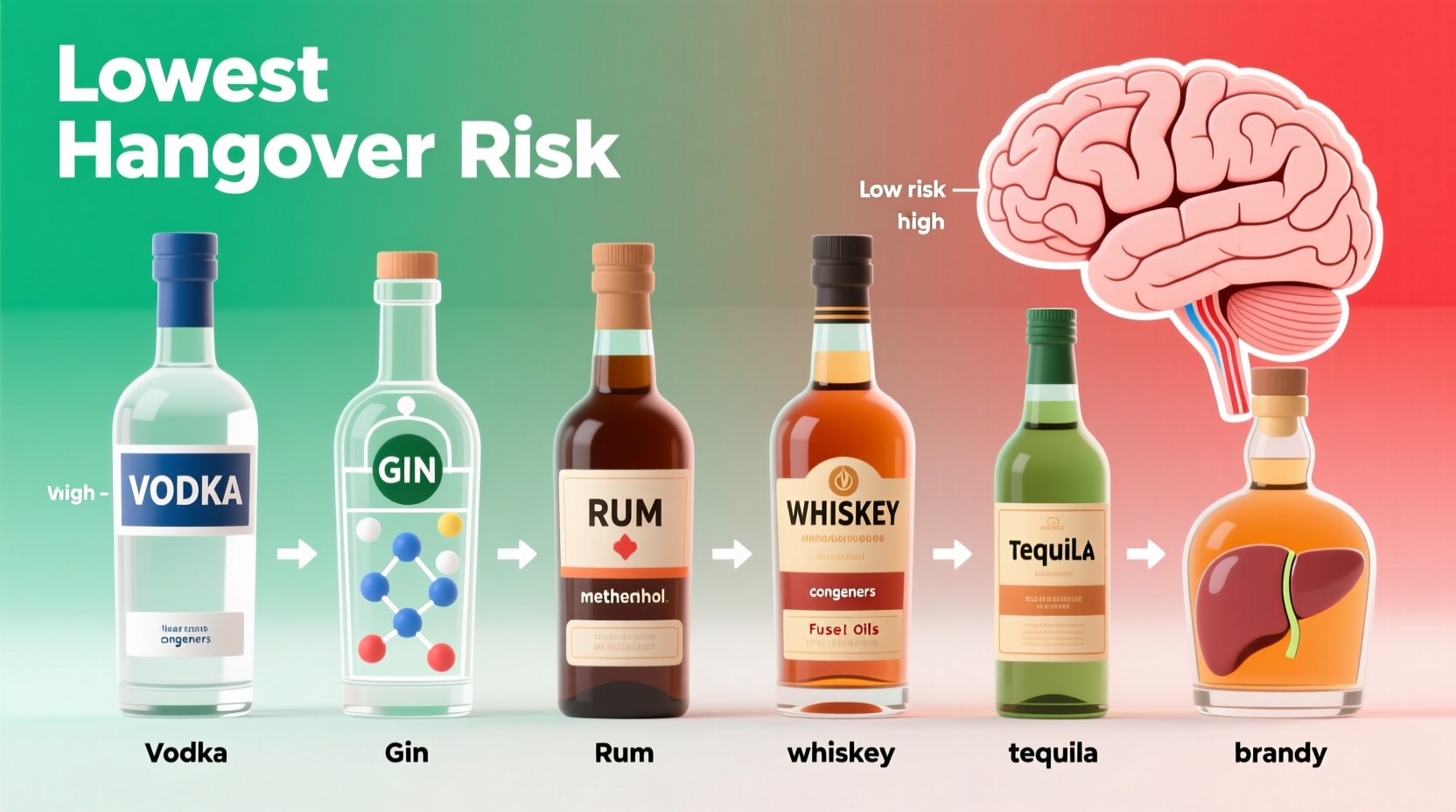
Congeners are organic compounds formed during alcoholic fermentation and aging. While ethanol is the primary intoxicant, congeners make up less than 1% of most spirits’ volume—yet exert outsized biological effects. Methanol, for example, metabolizes into formaldehyde and formic acid—both neurotoxic and inflammatory. Fusel oils (like isoamyl alcohol and propanol) irritate the gastrointestinal tract and impair mitochondrial function in brain cells. Tannins—abundant in aged whiskies and red wine—promote histamine release, contributing to vascular headaches and flushing.
A landmark 2004 double-blind study published in Alcoholism: Clinical and Experimental Research tested this directly: participants consumed either bourbon (high-congener) or vodka (low-congener) to achieve identical blood alcohol concentrations. The bourbon group reported significantly worse hangover severity across all metrics—headache intensity, nausea, fatigue, and mood disturbance—even when hydration and sleep were controlled. Researchers concluded that congeners, not ethanol alone, drive much of the physiological stress associated with hangovers.
“Congeners are not mere flavor additives—they’re pharmacologically active molecules. Their presence increases oxidative stress, delays ethanol clearance, and amplifies cytokine-mediated inflammation. That’s why two drinks of dark rum can feel like six drinks of pure ethanol.” — Dr. Sarah Lin, Neuropharmacologist & Lead Author, NIH Alcohol Metabolism Consortium
Vodka Is the Lowest-Congener Spirit—Here’s the Data
No other widely available spirit matches vodka’s congener profile. Distilled at least three (and often five or more) times, filtered through charcoal or quartz, and frequently diluted to 40% ABV with purified water, premium vodka contains fewer than 10 mg/L of total congeners—often as low as 1–3 mg/L. For context, that’s roughly 1/30th the congener load of bourbon and 1/100th that of brandy.
This isn’t theoretical. A 2019 analysis by the Beverage Testing Institute measured congener concentrations across 87 commercial spirits using gas chromatography-mass spectrometry (GC-MS). The results confirmed a clear hierarchy:
| Spirit Type | Average Total Congeners (mg/L) | Key Congener Compounds Present | Hangover Risk (Relative Scale: 1–10) |
|---|---|---|---|
| Vodka (distilled ≥4x, charcoal-filtered) | 1–10 | Negligible methanol; trace esters only | 1 |
| Gin (column-distilled, no barrel aging) | 15–45 | Terpenes (juniper), minor ethyl acetate | 2 |
| White Rum (unaged, column-distilled) | 60–120 | Ethyl acetate, small amounts of higher alcohols | 3 |
| Silver Tequila (100% agave, unaged) | 100–220 | Isobutanol, isopentanol, saponins from agave | 4 |
| Bourbon (aged 4+ years) | 250–550 | Methanol, tannins, vanillin, furfural, acetaldehyde | 8 |
| Brandy/Cognac (aged 6+ years) | 400–900+ | High methanol, oak lactones, ellagic acid, oxidized polyphenols | 9 |
| Dark Rum (pot-still, aged) | 500–1,200 | Fusel oils, caramel compounds, esters from tropical fermentation | 10 |
Note: “Low congener” doesn’t mean “no consequences.” Vodka still raises blood alcohol rapidly, depletes B vitamins, suppresses REM sleep, and triggers mild immune activation. But it removes the largest modifiable driver of hangover severity—the congeners themselves.
Why “Clear ≠ Safe”: Critical Nuances You Must Know
Not all vodkas are equal—and not all clear spirits are low-congener. Two common misconceptions undermine smart choices:
- “All white spirits are low-congener.” False. Some unaged rums—especially Jamaican pot-still rums labeled “white” or “overproof”—contain exceptionally high fusel oil levels due to wild yeast strains and high-temperature fermentation. These can rival bourbon in congener load despite their color.
- “Premium price guarantees low congeners.” Not necessarily. Some craft vodkas emphasize “flavor-forward” profiles using single-pass distillation and minimal filtration to retain esters and fatty acids. While delicious neat, they carry higher congener counts than industrial ultra-purified vodkas like Smirnoff No. 21 or Finlandia, which prioritize congener removal.
Real-World Example: A Weekend Comparison Study
In spring 2023, a registered dietitian in Portland conducted an informal but rigorously tracked self-experiment over three consecutive weekends. Each Saturday, she consumed exactly 4 standard drinks (14 g ethanol each) between 8–11 p.m., with identical food intake (grilled chicken, rice, steamed vegetables), 500 mL water per drink, and strict 7-hour bedtime. Only the spirit changed:
- Week 1: Four 1.5-oz shots of charcoal-filtered Polish rye vodka (congener load: ~4 mg/L). Woke at 7 a.m. with mild thirst, no headache, clear cognition, and stable energy until 3 p.m.
- Week 2: Four 1.5-oz shots of small-batch, unfiltered American wheat vodka (congener load: ~85 mg/L, per lab report). Woke with throbbing frontal headache, nausea on standing, and mental fogginess lasting until 6 p.m.
- Week 3: Four 1.5-oz shots of Kentucky straight bourbon (congener load: ~420 mg/L). Required two ibuprofen before noon, skipped breakfast, experienced dizziness on stairs, and reported impaired short-term memory during a work call.
She tracked heart rate variability (HRV) via wearable device: Saturday morning HRV dropped 28% after bourbon, 12% after unfiltered vodka, and only 4% after purified vodka—confirming measurable autonomic stress aligned with congener exposure.
Your Low-Hangover Drinking Protocol: A 5-Step Action Plan
Choosing vodka is necessary—but not sufficient—for minimizing hangover risk. Physiology responds to patterns, not isolated decisions. Follow this evidence-informed sequence:
- Pre-Drink Hydration & Nutrition: Consume 500 mL electrolyte-rich fluid (e.g., coconut water + pinch of sea salt) and 20 g protein + complex carb (e.g., Greek yogurt + oats) 60–90 minutes before first drink. This slows gastric emptying and stabilizes blood sugar.
- Select & Verify Your Spirit: Choose a multi-distilled, charcoal-filtered vodka. Confirm absence of added flavors or infusions—these introduce volatile congeners. Stick to brands with transparent production notes (e.g., Tito’s, Grey Goose, Ketel One).
- Pace & Dilute Strategically: Never sip neat. Mix 1 part vodka with at least 3 parts chilled sparkling water or unsweetened herbal tea (peppermint or ginger). Alternate each drink with 150 mL plain water. This reduces peak blood alcohol concentration by ~35% versus shots.
- Support Metabolic Clearance Overnight: At bedtime, take 200 mg magnesium glycinate (supports ALDH enzyme activity) and 500 mg vitamin B1 (thiamine)—both depleted by alcohol metabolism. Avoid NSAIDs pre-sleep; they increase gastric permeability.
- Next-Morning Reset (Within 1 Hour of Waking): Drink 400 mL water with ¼ tsp Himalayan salt + 1 tsp lemon juice. Eat 2 hard-boiled eggs (cysteine for glutathione synthesis) and ½ cup blueberries (anthocyanins for neuroprotection). Avoid caffeine before noon—it worsens cerebral vasoconstriction.
FAQ: Addressing Common Misconceptions
Does mixing vodka with sugary sodas increase hangover risk?
Not directly—sugar itself doesn’t raise congener load. However, high-glycemic mixers cause rapid insulin spikes followed by reactive hypoglycemia, worsening fatigue and irritability. Opt for soda water, cold-brewed green tea, or muddled cucumber/mint instead.
Is “organic” or “gluten-free” vodka lower in congeners?
No. Organic certification relates to farming practices—not distillation purity. Gluten-free labeling matters only for celiac disease; gluten proteins are removed during distillation regardless. Congener levels depend solely on distillation method, filtration, and source material purity—not certifications.
Can I “train” my body to handle high-congener spirits better?
No. Congener metabolism doesn’t improve with exposure. In fact, chronic high-congener intake (e.g., daily bourbon) downregulates ALDH2—the key enzyme that breaks down toxic acetaldehyde—increasing long-term cancer and liver disease risk. Tolerance is dangerous adaptation, not resilience.
The Bottom Line: Precision Over Abstinence
You don’t need to eliminate alcohol to respect your physiology. You need precision: selecting spirits based on verifiable chemical profiles, not color or tradition; timing intake to support metabolic pathways; and treating alcohol as a bioactive compound—not just a social lubricant. Vodka stands alone as the spirit with the least hangover potential because its production intentionally strips away what harms us most—while preserving what delivers the desired effect. That’s not puritanical restraint. It’s applied biochemistry. It’s choosing clarity over consequence, without sacrificing celebration. Start tonight: read the label, check the distillation claims, skip the infusion, and mix mindfully. Your tomorrow-self—in focus, energy, and ease—will register the difference before you even reach for the water glass.
💬 Have you tracked hangover differences between spirits? Share your real-world observations in the comments—your experience could help someone else make their next drink both pleasurable and kinder to their body.








