Archery demands precision, consistency, and an intimate understanding of your equipment. Among the most critical components for achieving tight groupings and reliable shot placement is the bow sight. While instinctive aiming has its place, especially in traditional archery, modern compound and recurve archers rely heavily on mechanical sights to improve accuracy. But knowing how and when bow sights deliver peak performance can make the difference between a clean hit and a missed opportunity.
Bow sights function optimally under specific conditions—when properly tuned, used with consistent form, and matched to the right shooting environment. Understanding these factors empowers archers to maximize their effectiveness whether on the range or deep in the woods.
Understanding How Bow Sights Enhance Accuracy
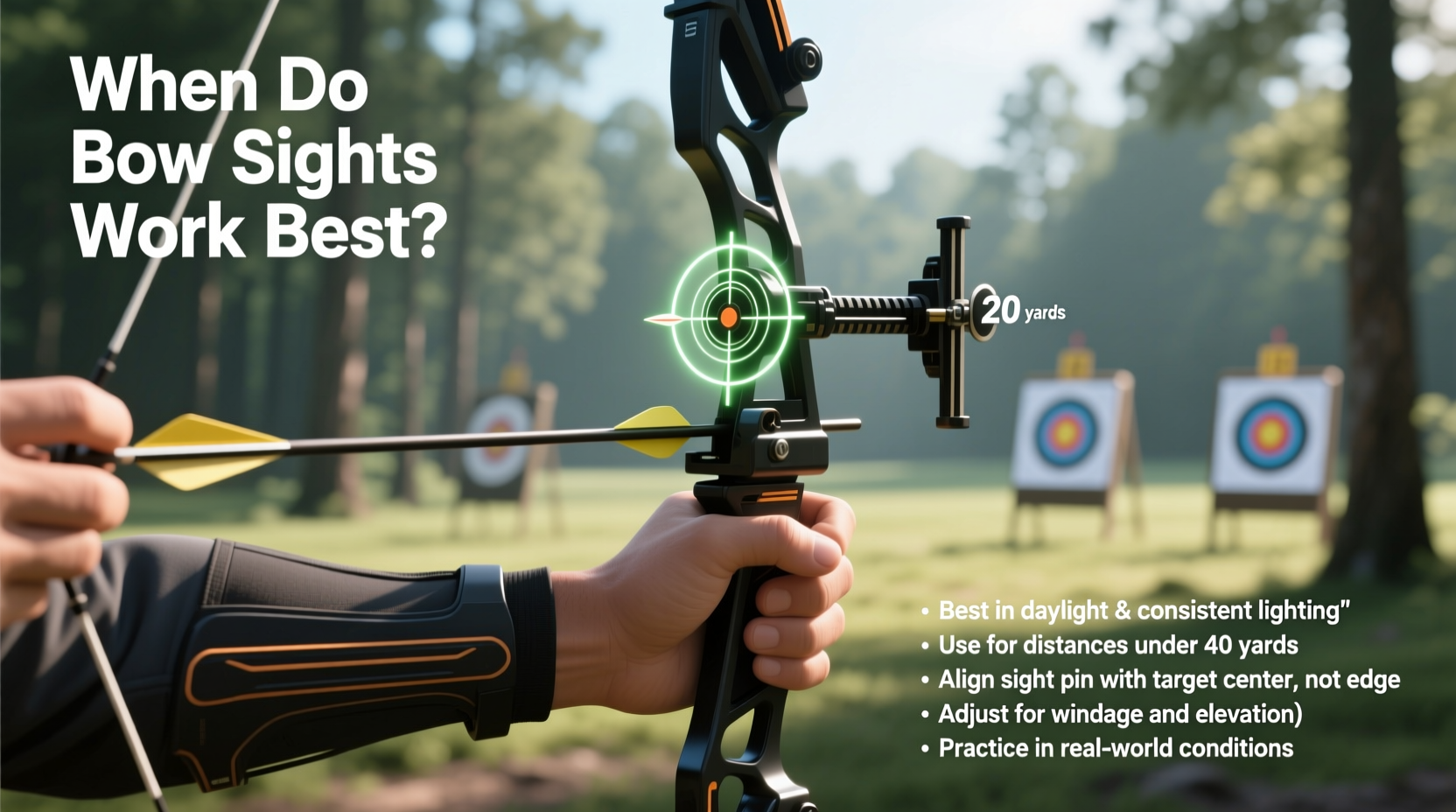
A bow sight provides a visual reference point aligned with your arrow’s trajectory at known distances. Unlike instinctive shooting, which depends on muscle memory and subconscious spatial awareness, a sight allows you to aim precisely by aligning pins or a single movable pin with your target.
The physics behind effective sighting involves matching the arc of your arrow’s flight path to pre-set pin positions. Most multi-pin sights feature fixed pins calibrated for 20, 30, 40, and sometimes 50 yards. Single-pin sliders allow vertical adjustment across a broader range, ideal for variable-distance shots common in hunting.
When properly set up, a bow sight removes guesswork. However, it only works as well as the shooter’s ability to maintain consistent anchor points, draw length, and release mechanics. A misaligned sight or inconsistent form will negate even the most advanced sighting system.
Tip: Always verify your sight alignment after changing strings, cables, or broadheads—small shifts affect point-of-impact significantly.Optimal Conditions for Bow Sight Performance
Bow sights perform best when three core elements are in balance: environmental stability, mechanical consistency, and shooter discipline.
- Stable Lighting: Bright, even lighting enhances pin visibility. Fiber-optic pins glow brighter in daylight but may be too harsh under low light unless equipped with tritium inserts.
- Controlled Distance: Sights excel when shooting at measured ranges. In field archery or hunting, this means using rangefinders to confirm yardage before adjusting your aim.
- Minimal Wind Interference: While sights help with elevation, they don’t compensate for wind drift. Calm conditions ensure horizontal accuracy isn’t compromised.
- Consistent Anchor Points: Repeating the same head position and hand-to-mouth anchor ensures the sight picture remains unchanged from shot to shot.
Indoor ranges offer ideal sight usage due to controlled environments. Outdoor shooters must adapt by learning how terrain, lighting angles, and weather affect sight clarity and alignment.
Step-by-Step Guide to Maximizing Sight Accuracy
- Zero Your Top Pin at 20 Yards: Start close. Use a stable rest and shoot five arrows at a bullseye. Adjust windage and elevation until your group centers the target.
- Progressively Set Remaining Pins: Move to 30, 40, and 50 yards, firing groups at each distance. Fine-tune each corresponding pin without altering previous settings.
- Check Level Alignment: Attach a bubble level to your sight or riser. Tilted stances cause left-right deviations, especially at longer distances.
- Simulate Real-World Angles: Practice uphill and downhill shots. Gravity affects trajectory differently on inclines; adjust aim accordingly (aim lower on steep angles).
- Test Broadhead vs. Field Point Flight: Broadheads often fly differently than field tips. Confirm all pins remain true when switching to hunting setups.
This process should be repeated whenever major changes occur in your setup—new arrows, different fletching, or cam timing adjustments.
Common Mistakes That Reduce Sight Effectiveness
Even experienced archers fall into habits that undermine their sighting systems. Recognizing these pitfalls is half the battle.
| Mistake | Impact | Solution |
|---|---|---|
| Inconsistent anchor point | Pins appear misaligned even when sight is correct | Use kisser button or consistent touch reference |
| Ignoring parallax in magnified sights | Crosshair shifts with eye position | Center your eye behind the scope; use adjustable objective lenses |
| Over-tightening mounting screws | Distorts housing, causes erratic pin movement | Tighten just enough to secure—use thread locker sparingly |
| Shooting beyond calibrated range | No pin available; guessing leads to misses | Carry a drop chart or memorize holdover gaps |
Expert Insight: The Role of Technology in Modern Aiming
“Today’s bow sights aren’t just about visibility—they’re integrated tools for precision. Features like micro-adjustments, light-gathering fibers, and anti-parallax scopes have turned aiming into a science. But none of it matters if the archer doesn’t practice disciplined fundamentals.” — Mark Reynolds, Professional Bow Technician and NASP Coach
Reynolds emphasizes that while technology improves margin for error, mastery still lies in repetition and form control. He recommends dry-firing (with a bow-safe dummy nock) daily to reinforce muscle memory linked to sight picture acquisition.
Real Example: Hunting Scenario Where Sight Precision Mattered
Daniel, a seasoned whitetail hunter in Wisconsin, had been tracking a mature buck for weeks. On opening morning, the deer stepped into a clearing at 38 yards—beyond his second pin but short of the third. Instead of guessing, Daniel used a slight gap method below his 40-yard pin, factoring in a minor downhill angle.
He held steady, focused on pin sharpness against the gray dawn light, and released cleanly. The arrow struck high shoulder, resulting in a quick, ethical harvest. Afterward, he credited his success not just to patience, but to having practiced exact holdover techniques during off-season sessions.
This illustrates how precise knowledge of your sight’s limitations and capabilities translates directly to real-world outcomes.
Tip: Memorize the space between your 30- and 40-yard pins—it’s often equivalent to the holdover needed for 35-yard shots.Essential Checklist for Reliable Bow Sighting
- ✅ Sight is securely mounted and level
- ✅ All pins aligned with arrow impact at designated distances
- ✅ Consistent anchor point verified
- ✅ Rangefinder used to confirm actual shooting distance
- ✅ Proper peep sight alignment maintained throughout draw cycle
- ✅ Practice performed from elevated stands to simulate hunting angles
- ✅ Broadhead flight tested and sight adjusted if necessary
Frequently Asked Questions
Can I use the same sight settings for field points and broadheads?
Not always. Mechanical broadheads usually fly closer to field points, but fixed-blade models often require windage or elevation tweaks. Always test both under identical conditions before assuming compatibility.
How often should I check my sight alignment?
Before every hunt and weekly during active shooting seasons. Even minor jostling—from climbing a stand or transporting gear—can shift pins slightly. A quick verification at 20 yards takes two minutes and prevents costly errors.
Are illuminated pins worth it for hunting?
Yes, particularly in low-light conditions like early morning or heavy timber. Tritium-powered pins provide constant glow without batteries. Fiber-optic models brighten in daylight but fade in darkness unless paired with light sources.
Master Your Aim, Maximize Your Results
Bow sights work best when treated not as standalone gadgets, but as part of a holistic shooting system. Their value emerges through preparation, calibration, and disciplined execution. Whether you're preparing for tournament competition or waiting for that once-in-a-lifetime elk at dusk, confidence in your sight means confidence in your shot.
Take time this season to re-zero your pins, validate your distances, and rehearse under realistic conditions. The woods don’t forgive rushed setups or neglected tuning—and neither does the scoreboard.
🚀 Ready to refine your accuracy? Grab your rangefinder, head to the range, and spend one hour fine-tuning your sight this week. Small efforts now lead to perfect shots later.








