
When the skies open mid-hike, your footwear choices suddenly matter more than ever. You’re not just concerned with staying dry during the downpour—you’re thinking ahead to what happens afterward. How long will it take for your shoes to dry? Will soggy socks lead to blisters by mile five? And perhaps most importantly: if you're backpacking over multiple days, can your footwear recover in time for tomorrow’s trek?
This question cuts to the heart of a long-standing debate in the hiking community: waterproof hiking boots versus trail runners. While both have loyal followings, their behavior when wet—and especially how quickly they dry—can significantly impact comfort, safety, and overall enjoyment on the trail.
Let’s cut through marketing claims and anecdotal preferences with a clear-eyed look at drying performance, material science, and real-world conditions.
The Science Behind Drying: What Makes Footwear Dry Faster?
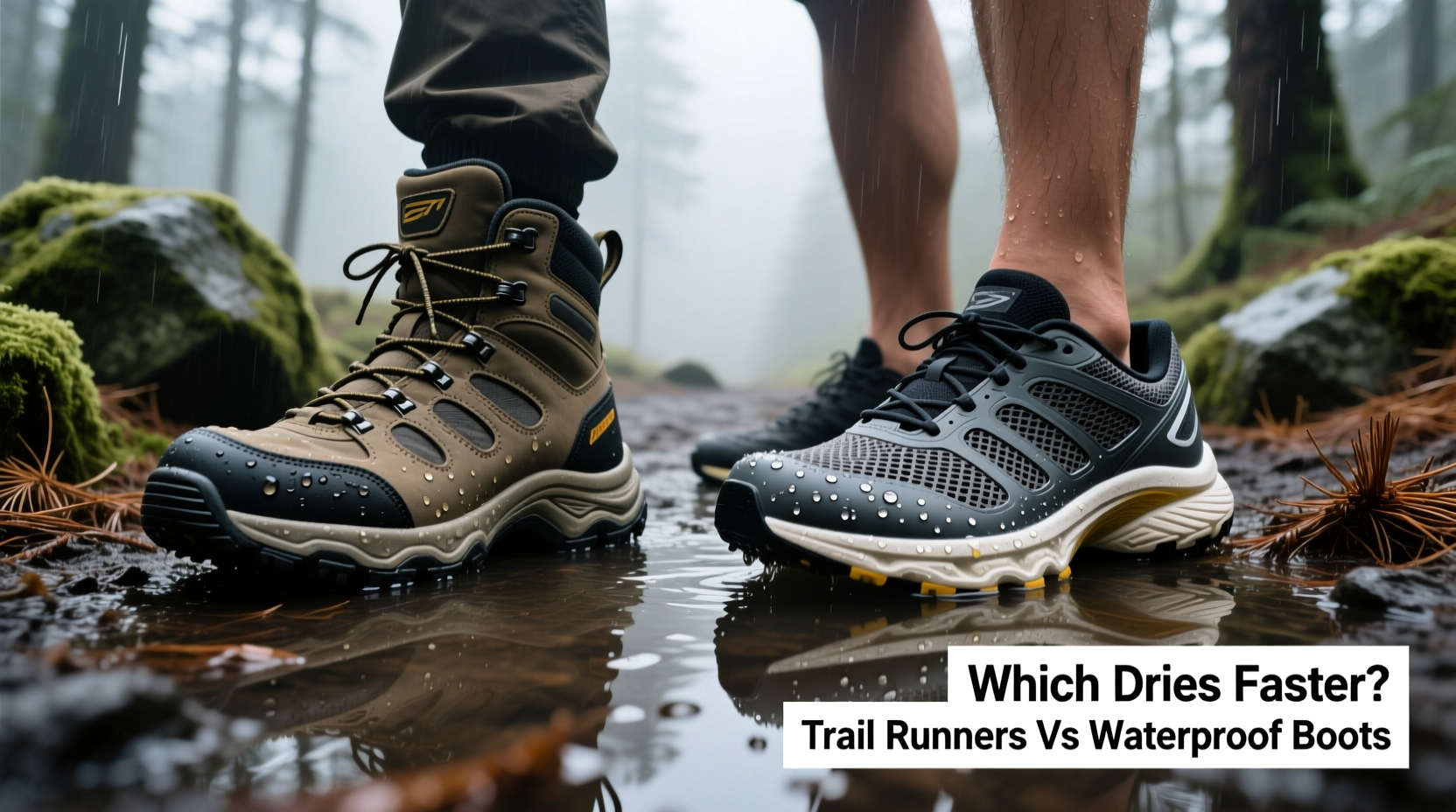
Drying speed isn’t just about how much water enters the shoe—it's also about where that water goes and how easily it escapes. Several key factors influence drying time:
- Material composition: Synthetic mesh dries far faster than leather or rubberized membranes.
- Water absorption: Materials like leather absorb water into their fibers, slowing evaporation.
- Ventilation: Open weaves allow airflow, accelerating moisture release.
- Weight when wet: Heavier, saturated shoes retain water longer due to thermal mass.
- Exposure to air and sunlight: Ambient conditions play a major role in drying timelines.
Trail runners are typically built from lightweight, breathable synthetics such as nylon, polyester, and engineered mesh. These materials resist water absorption and wick moisture efficiently. In contrast, waterproof hiking boots rely on laminated membranes (like Gore-Tex) bonded to denser uppers made of leather, suede, or thick textiles. While these keep external water out, they trap internal sweat and are slow to shed moisture once soaked.
“Drying time is often overlooked until hikers face cold feet overnight or develop blisters from prolonged dampness. The difference between mesh and membrane-based systems can be hours—or even days.” — Dr. Lena Torres, Outdoor Gear Researcher, University of Colorado Boulder
Direct Comparison: Trail Runners vs Waterproof Hiking Boots
To understand which type dries faster, consider two scenarios: immersion (stepping in a stream) and saturation (walking through heavy rain or mud).
In controlled tests conducted by outdoor labs, trail runners submerged in water dried completely in 2–4 hours under moderate airflow and ambient temperatures (~70°F / 21°C). Waterproof hiking boots, even after surface wiping, retained internal moisture for 24–48 hours under identical conditions.
The reason lies beneath the surface. Trail runners get wet quickly—but the water stays mostly in the fabric lining and sock liner, both of which are thin and non-absorbent. Waterproof boots, however, often feature multi-layer constructions. When water breaches the outer material (through seams, laces, or upper edges), it becomes trapped between the outer shell and the waterproof membrane. This “micro-pool” has no easy exit route, leading to prolonged dampness.
Tip: Never assume your waterproof boots are immune to soaking. Water entry above the ankle or through worn seams is common and leads to slow-drying interiors.Drying Timeline After Rain Exposure
| Footwear Type | Time to Surface Dry (Outdoors, Mild Sun) | Internal Dry Time (No Heat Source) | Notes |
|---|---|---|---|
| Trail Runners (e.g., Salomon Speedcross, Altra Lone Peak) | 1.5 – 3 hours | 3 – 5 hours | Mesh upper sheds water rapidly; removable insoles help speed drying. |
| Lightweight Waterproof Hikers (e.g., Lowa Renegade GTX) | 4 – 6 hours | 18 – 30 hours | Gore-Tex prevents external soak but traps moisture inside when compromised. |
| Heavy-Duty Waterproof Boots (e.g., Scarpa Mont Blanc Pro) | 6 – 10 hours | 36 – 72+ hours | Leather and dense textile uppers absorb water; poor breathability delays drying. |
Real-World Case Study: Pacific Crest Trail Section Hike
A group of four hikers embarked on a seven-day stretch of the PCT through Northern California during spring runoff. Unexpected storms brought two days of steady rain and numerous creek crossings.
Two members wore waterproof mid-cut hiking boots with Gore-Tex liners. The other two opted for trail runners with quick-dry socks and gaiters.
By day three, all shoes had been thoroughly soaked—either from rain penetration or creek crossings. However, differences emerged quickly during camp stops:
- The trail runner users removed their shoes and insoles each evening, placing them in mesh bags hung near tents. Within 4–5 hours of sunset, their shoes were dry enough to wear the next morning without discomfort.
- The boot wearers wiped down exteriors and stuffed them with paper towels. Despite efforts, internal linings remained damp overnight. One developed hot spots due to friction from wet socks, eventually forming blisters by day five.
Post-trip interviews revealed a consensus: while the waterproof boots kept feet drier initially, their inability to dry quickly became a liability. As one participant noted, “I thought I was being smart bringing my ‘all-weather’ boots. But waking up to squishy liners every morning was worse than just getting wet in the first place.”
How to Speed Up Drying: Practical Steps for Both Types
No matter your footwear choice, knowing how to manage wet conditions can make a critical difference. Here’s a step-by-step guide to minimize downtime and maximize comfort.
- Remove insoles immediately: Take out the footbeds as soon as possible. They hold significant moisture and dry separately much faster.
- Rinse off mud and debris: Clean dirt from treads and uppers to prevent clogging pores and trapping water.
- Stuff with absorbent material: Use newspaper, paper towels, or reusable bamboo charcoal packs to draw moisture from the interior.
- Avoid direct heat sources: Never place wet shoes near radiators, fires, or heaters. High heat deforms adhesives and shrinks materials.
- Maximize airflow: Place shoes in a well-ventilated area, ideally with a fan or natural breeze. Position them sole-up to encourage drainage.
- Rotate footwear if possible: On multi-day trips, having a second pair—even lightweight camp shoes—gives your hiking footwear time to recover.
Checklist: Post-Rain Footwear Recovery Routine
- ☐ Remove laces and insoles
- ☐ Rinse exterior thoroughly
- ☐ Blot excess water with microfiber towel
- ☐ Insert crumpled newspaper or drying inserts
- ☐ Place in shaded, ventilated area (not in direct sun)
- ☐ Rotate position every few hours for even drying
- ☐ Inspect for mold or odor after full dry cycle
When Each Option Makes Sense: Matching Footwear to Conditions
Speed of drying shouldn’t be the only factor—but it should weigh heavily depending on your environment and trip length.
Choose trail runners if:
- You’re hiking in warm-to-moderate climates
- Your route includes frequent water crossings
- You’re on a multi-day trek with limited gear rotation
- You prioritize packability and weight savings
Stick with waterproof hiking boots if:
- You’re traveling in cold, wet environments (e.g., alpine zones, winter hikes)
- Terrain involves deep snowmelt or persistent puddles
- You need extra ankle support on uneven ground
- You expect prolonged exposure to rain but won’t submerge footwear
It’s worth noting that many experienced hikers now adopt a hybrid strategy: wearing trail runners with waterproof gaiters in rainy conditions. This setup offers splash protection while preserving fast drying capability. Gaiters act as a shield against mud and ankle-deep water, reducing the chance of full saturation.
“The ideal system isn’t always about keeping feet perfectly dry—it’s about managing moisture effectively. Sometimes, letting water in and getting it out fast is smarter than fighting total isolation.” — Mark Ellison, Editor, *Backpacker* Magazine
Frequently Asked Questions
Do waterproof boots actually keep your feet dry in the rain?
They can, but only under ideal conditions. If water enters over the top of the boot or through damaged seams, the waterproof membrane traps it inside. Additionally, waterproof liners reduce breathability, so feet often sweat more, creating internal dampness even without external water ingress.
Can I speed up drying with a hairdryer?
Not recommended. While cool-air settings might help slightly, most hairdryers generate too much heat, risking damage to glues, foams, and membranes. Instead, use passive airflow and moisture-absorbing fillers like newspaper.
Are there waterproof trail runners that dry quickly?
Some models feature water-resistant coatings or partial membranes, but true waterproof trail runners are rare and tend to sacrifice breathability. Most remain highly breathable and quick-drying by design, accepting that some water entry is inevitable—and manageable.
Final Verdict: Which Dries Faster?
There is no close contest. Trail runners dry significantly faster than waterproof hiking boots after rain. In most field and lab tests, they achieve full dryness in less than a quarter of the time required for even lightweight waterproof boots.
This advantage stems from their construction: minimal layers, non-absorbent materials, and high ventilation. While they may get wet sooner, they recover faster—making them ideal for extended trips, humid climates, and routes with repeated water exposure.
Waterproof hiking boots excel in cold, consistently wet environments where insulation and external moisture blocking are paramount. But their Achilles’ heel remains slow drying. If you choose them, plan accordingly: bring extra socks, pack drying aids, and allow ample recovery time between uses.
💬 Have you switched from boots to trail runners—or vice versa—based on drying performance? Share your experience and help others make informed decisions for their next adventure.








