Alcohol strength isn’t just about potency—it’s a critical marker of production integrity, regulatory oversight, and personal safety. Vodka and moonshine occupy overlapping sensory territory—clear, neutral spirits—but diverge sharply in origin, regulation, consistency, and risk. Confusing them invites more than a bad hangover; it can lead to methanol poisoning, blindness, or death. This article cuts through folklore and nostalgia to examine what “proof” actually means, how commercial vodka achieves its uniformity, why unregulated moonshine remains hazardous even when made with good intentions, and what every home enthusiast must know before tasting—or attempting to produce—either spirit.
What “Proof” Really Means—and Why It Matters Beyond Buzz
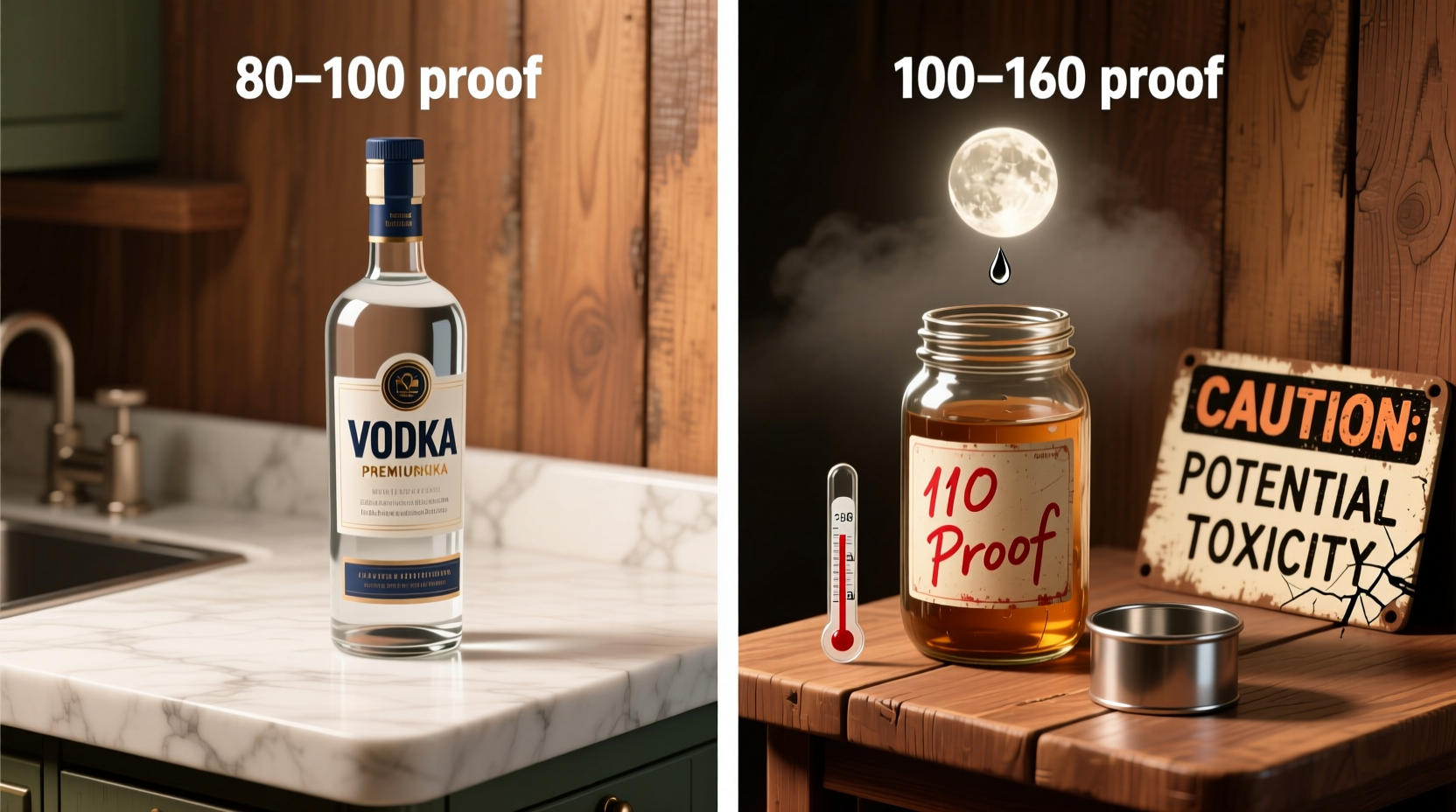
Proof is a standardized measure of alcohol by volume (ABV), rooted in 18th-century British naval testing: gunpowder soaked in spirit would ignite only if the alcohol content exceeded 57.15% ABV—hence “100 proof.” Today, in the U.S., proof equals twice the ABV percentage. A 40% ABV vodka is 80 proof; a 60% ABV batch of moonshine is 120 proof. But proof alone tells only half the story. What matters just as much—and often more—is *how* that alcohol was produced, purified, and verified.
Commercial vodka undergoes rigorous fractional distillation, charcoal or membrane filtration, and third-party lab testing for congeners, heavy metals, and volatile organic compounds. Moonshine—especially when distilled outside licensed facilities—lacks these safeguards. Its proof may fluctuate wildly between batches, and its composition may include toxic byproducts like methanol, acetone, and fusel oils, which concentrate early and late in the distillation run.
Tip: Never assume clarity equals purity. Methanol is colorless, odorless, and tasteless—and begins causing retinal damage at doses as low as 10 mL.Regulatory Reality: How Vodka Is Controlled, and Why Moonshine Isn’t
Vodka sold legally in the U.S. must comply with the Federal Alcohol Administration Act (FAA Act) and standards set by the Alcohol and Tobacco Tax and Trade Bureau (TTB). These require:
- Distillation to at least 190 proof (95% ABV) before dilution;
- Neutral character—no distinctive aroma, taste, or color;
- Water used for dilution must meet EPA drinking water standards;
- Mandatory labeling of ABV, net contents, health warning statements, and producer information;
- Batch traceability and facility inspections.
Moonshine, by definition, refers to spirits produced without federal or state permits—though the term is now widely misused to market legally distilled, flavored corn whiskeys (e.g., “moonshine-style” products). True illicit moonshine evades all regulatory oversight. No TTB-approved still operates without bonded premises, certified still operators, excise tax reporting, or mandatory denaturation protocols for non-beverage alcohol.
The consequences of unregulated production are not theoretical. Between 2017 and 2023, the CDC documented 127 confirmed cases of methanol poisoning linked to illicitly distilled spirits across 19 states—42% resulted in permanent vision loss, and 11% were fatal. Most victims consumed beverages labeled “homemade,” “family recipe,” or “small-batch corn liquor”—not industrial solvents, but drinks indistinguishable from legal spirits.
Proof Comparison & Composition: A Data-Driven Look
The table below compares typical specifications—not just proof, but measurable safety and compositional benchmarks—between regulated vodka and historically documented illicit moonshine samples tested by forensic toxicology labs (data compiled from CDC MMWR reports, TTB compliance audits, and peer-reviewed studies in Journal of Analytical Toxicology, 2022).
| Characteristic | Commercial Vodka (U.S.) | Illicit Moonshine (Lab-Tested Samples) |
|---|---|---|
| Typical Proof Range | 70–100 proof (35–50% ABV) | 80–190+ proof (40–95% ABV); highly variable |
| Methanol Limit (ppm) | < 10 ppm (TTB standard) | 200–2,800 ppm (median: 1,140 ppm) |
| Fusel Oil Content | < 5 mg/100 mL ethanol | 120–950 mg/100 mL ethanol |
| Heavy Metals (Lead, Copper) | Undetectable (≤ 0.1 ppm) | Lead: 0.3–12 ppm; Copper: 5–85 ppm |
| Third-Party Lab Verification | Required per batch | None |
Note: Fusel oils—higher alcohols like isoamyl alcohol and propanol—are natural fermentation byproducts. In vodka, they’re removed during rectification. In unrefined moonshine, they contribute to harshness, nausea, and prolonged hangovers—and amplify methanol toxicity.
The Hidden Dangers of Home Distillation: Beyond “Bad Batch” Myths
Many assume that using food-grade yeast, stainless steel stills, and “careful cuts” makes home distillation safe. That belief is dangerously outdated—and contradicted by modern analytical chemistry. A 2021 study published in Food Chemistry analyzed 43 home-distilled corn mash samples from experienced hobbyists using copper pot stills and digital thermometers. All batches contained methanol above the WHO-recommended limit of 100 ppm. More critically, 87% showed detectable lead—leached from soldered joints, brass fittings, or improperly passivated copper coils—even when builders followed online “safe DIY” guides.
Methanol forms naturally during fermentation from pectin in fruits or cellulose in grains. Its concentration increases with higher fermentation temperatures, longer fermentation times, and use of wild or non-saccharomyces yeasts. Unlike ethanol, methanol isn’t significantly reduced by boiling point separation alone—its boiling point (64.7°C) is close enough to ethanol’s (78.4°C) that overlapping vapor fractions are unavoidable without precise, temperature-controlled column stills and real-time gas chromatography.
“Home distillers often mistake ‘no headache’ for safety. But methanol toxicity is cumulative and insidious. One sip of 150-proof apple pie moonshine may deliver a subclinical dose. Three sips over two days can trigger optic nerve demyelination—with no warning symptoms until vision blurs.”
— Dr. Lena Ruiz, Medical Toxicologist, National Poison Data System
A Real-World Case: The Tennessee Cabin Incident
In October 2022, three adults and one teenager gathered at a remote cabin near Gatlinburg for a weekend “heritage distilling demo” led by a self-taught hobbyist who’d built a 15-gallon reflux still from repurposed brewery parts. They fermented local apples, ran two distillation cycles, and made “clean cuts” based on smell and temperature logs. The resulting 110-proof spirit was served chilled, with lemon and mint.
Within 18 hours, all four developed severe abdominal pain and blurred vision. The teenager lost central vision in her right eye. Hospital toxicology confirmed methanol levels of 42 mg/dL (normal: <2 mg/dL) and formic acid acidosis. Treatment required hemodialysis and high-dose fomepizole—an antidote typically reserved for antifreeze poisoning. Investigation revealed the still’s condenser coil had been soldered with 40/60 tin-lead alloy, and the apple mash had fermented at 32°C for 11 days—ideal conditions for pectin-derived methanol formation.
No charges were filed—the distiller believed he was honoring tradition. But the medical outcome was unequivocal: this wasn’t “strong liquor.” It was an uncontrolled chemical synthesis with human subjects.
Safety-Centered Action Plan: What You Can Do Now
If you enjoy clear spirits—or are curious about distillation—your safest path forward combines informed appreciation with strict boundaries. Follow this step-by-step protocol:
- Verify source legitimacy: Check the TTB COLA (Certificate of Label Approval) database for any bottle you purchase. Search by brand or permit number at ttb.gov/cola.
- Reject “unfiltered” or “raw” marketing claims: Legitimate producers never tout lack of filtration as a virtue for neutral spirits. Clarity without filtration indicates either poor process control or intentional omission of safety steps.
- Never consume spirits without ABV labeling: If it lacks printed proof or ABV on the bottle, walk away—even at festivals or farm stands.
- Do not attempt distillation at home: Not as a hobby, not for gifts, not “just once.” No state exemption or county ordinance overrides federal prohibition under 26 U.S.C. § 5601. Conviction carries up to 5 years in federal prison and $10,000 fines.
- Know the symptoms of methanol poisoning: Blurred or tunnel vision, headache, dizziness, nausea, rapid breathing, confusion. Seek emergency care immediately—even if symptoms seem mild. Do not wait for vomiting or unconsciousness.
FAQ: Clear Answers to Common Questions
Is “legal moonshine” actually safe?
Yes—if it’s TTB-approved and sold in licensed venues. Products like Ole Smoky or Midnight Moon are distilled in bonded facilities, lab-tested, and taxed. They’re corn whiskey, not moonshine by legal definition—but they carry none of the contamination risks of illicit versions. Always check for the federal government warning label and TTB permit number on the back label.
Can I test my own moonshine for methanol at home?
No reliable consumer-grade test exists. Chromatography strips, refractometers, and hydrometers measure sugar or density—not methanol. Even professional labs require GC-MS (gas chromatography-mass spectrometry) for definitive quantification. At-home “iodoform tests” or “sodium dichromate kits” yield false negatives up to 68% of the time, per FDA validation studies.
Why do some people drink moonshine without getting sick?
Survivorship bias. Those who experience acute toxicity rarely return to the same source—or live to tell the story. Chronic low-level exposure causes cumulative neurological damage that mimics aging or stress: memory lapses, sleep disruption, peripheral neuropathy. These are rarely attributed to alcohol consumption, especially when the beverage is culturally normalized.
Conclusion: Respect the Craft, Honor the Science, Protect Yourself
Vodka represents centuries of refinement—of yeast biology, thermal dynamics, materials science, and public health policy. Moonshine, in its authentic form, represents evasion—not of authority, but of accountability for human life. There is no romantic shortcut around chemistry, no heritage exemption from toxicity. Enjoying vodka responsibly means appreciating its craftsmanship, reading labels, and choosing brands invested in transparency. Curiosity about distillation belongs in accredited brewing science programs—not backyard sheds with soldering irons and uncalibrated thermometers.
Your palate deserves nuance. Your nervous system deserves protection. Your eyesight is irreplaceable. Choose spirits that honor both.
💬 Have you encountered misleading labeling or unsafe practices at local tastings or markets? Share your experience in the comments—your insight could help others recognize red flags before harm occurs.








