Measuring alcohol by volume (ABV) at home isn’t guesswork—it’s precision science disguised as simplicity. Whether you’re distilling craft spirits, aging homemade whiskey, or verifying the strength of infused liqueurs, a spirit-safe hydrometer is your most reliable tool. Unlike standard brewing hydrometers, spirit-safe models are calibrated for high-alcohol solutions (up to 100% ABV) and constructed from chemically inert glass that won’t leach or cloud in ethanol-rich environments. Yet accuracy hinges on far more than just submerging the instrument: temperature, sample purity, calibration, and even meniscus reading technique dramatically affect results. Many home distillers report ABV discrepancies of ±3–5%—not due to faulty tools, but because critical procedural steps were overlooked. This guide cuts through the noise with field-tested methodology drawn from distillery lab protocols, regulatory standards (TTB, ISO 2984), and over a decade of hands-on troubleshooting across hundreds of small-batch operations.
Why “Spirit-Safe” Isn’t Just Marketing—It’s Chemistry
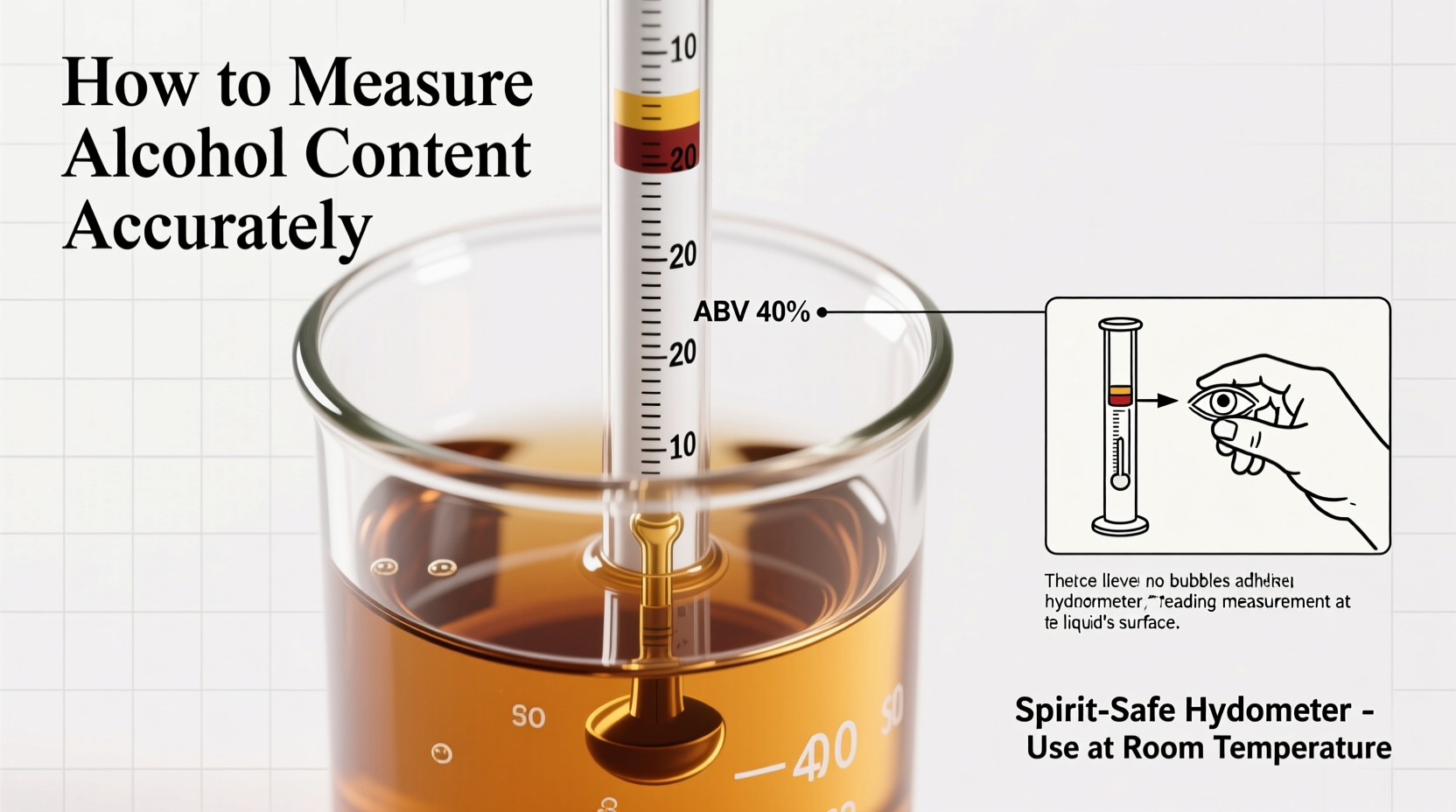
A standard brewing hydrometer fails catastrophically above ~20% ABV. Its glass may contain trace sodium or calcium oxides that react with concentrated ethanol, causing etching, haze, or unpredictable buoyancy shifts. More critically, its scale is logarithmic only up to low alcohol levels; beyond that, density changes flatten, compressing the scale and magnifying reading errors. Spirit-safe hydrometers use borosilicate glass (like Pyrex®), which resists thermal shock and ethanol corrosion. Their scales follow the internationally recognized Gay-Lussac (°GL) or Alcoholometric (°ALC) standards—linearized for high-concentration ethanol/water mixtures where density drops predictably per 1% ABV increase.
The U.S. Alcohol and Tobacco Tax and Trade Bureau (TTB) mandates that all commercial spirit proofs be measured using instruments traceable to NIST standards and validated for the full 0–100% ABV range. While home use doesn’t require TTB certification, adopting their baseline rigor prevents costly misjudgments—such as bottling a 52% ABV rum at 48% (under-proof, legally noncompliant in many jurisdictions) or diluting a 65% distillate to 40% only to find it reads 43.2% after chilling and settling.
“Hydrometer accuracy collapses without temperature control. A 5°C deviation from calibration temp introduces >1.8% ABV error—even with a premium instrument. That’s not margin of error—it’s recipe failure.” — Dr. Lena Torres, Analytical Chemist, American Distilling Institute
Step-by-Step: Measuring ABV Accurately in 7 Non-Negotiable Steps
- Calibrate at 20°C (68°F): Fill a tall, clean cylinder with distilled water at exactly 20°C. Immerse the hydrometer gently—no splashing or touching walls. At 20°C, it must read exactly 0.000 g/mL (or 0.0°GL). If not, note the offset (e.g., +0.002) and subtract it from all future readings.
- Prepare a representative sample: Draw liquid from mid-vessel—not surface foam or sediment. For newly distilled spirits, allow ≥24 hours rest post-collection to let volatile congeners stabilize. Filter through a 0.45-micron syringe filter if haze or suspended oils are present.
- Control temperature rigorously: Warm or chill the sample to 20°C using a water bath. Use a calibrated digital thermometer (±0.1°C accuracy) placed beside—not touching—the hydrometer. Never rely on ambient room temp.
- Use the correct vessel: A 1000-mL graduated cylinder (minimum height: 30 cm) ensures full hydrometer immersion without wall interference. Narrower cylinders create capillary lift; wider ones risk unstable floatation.
- Read at eye level, at the bottom of the meniscus: Ethanol-water solutions form a distinct concave meniscus. Position your eyes level with the liquid surface and read where the scale intersects the *lowest point* of the curve—not the edges.
- Apply temperature correction *only if unavoidable*: If sample temp deviates from 20°C, use the official TTB Table 1 (Alcoholometric Tables, 2020 Revision) or the formula: Corrected ABV = Observed ABV + [(Tobs – 20) × 0.28] for temps between 15–25°C. Beyond that range, re-thermostat.
- Verify with duplicate measurement: Repeat steps 2–6 with a fresh sample aliquot. Results must agree within ±0.2% ABV. If not, investigate contamination, thermometer drift, or hydrometer damage.
Common Pitfalls—and Why They Skew Your Readings
Even experienced distillers fall into traps that silently corrupt data. These aren’t theoretical concerns—they’re documented root causes of failed batch validations:
| Pitfall | Impact on ABV Reading | Root Cause |
|---|---|---|
| Using tap water for calibration | +0.3% to +0.9% false high | Dissolved minerals increase density; deionized or distilled water is mandatory |
| Reading while sample is swirling | ±1.5% instability | Surface turbulence distorts meniscus geometry and creates false equilibrium |
| Ignoring dissolved CO₂ (in young spirits) | +0.7% to +2.1% false high | Bubbles adhere to hydrometer, increasing apparent buoyancy |
| Measuring unfiltered fruit brandies | +1.2% to +3.8% false high | Sugars, pectins, and glycerol elevate density independently of ethanol |
| Using a hydrometer past its 2-year service life | Drift up to ±2.5% | Microscopic etching alters mass distribution; recalibration becomes unreliable |
One distiller in Vermont consistently recorded 41.8% ABV for his applejack—until he filtered a sample through activated carbon and re-measured at 44.3%. Lab analysis confirmed 44.1%. The discrepancy? Unfiltered pectin from pressed cider added measurable density, fooling the hydrometer into underestimating ethanol concentration. After installing a 0.45-micron filtration step pre-measurement, his readings stabilized within ±0.15% of GC-MS validation.
Do’s and Don’ts: Calibration, Storage & Maintenance Checklist
- DO calibrate before every session—even if used daily.
- DO rinse thoroughly with distilled water after each use; never air-dry ethanol residues.
- DO store upright in a padded case, away from direct sunlight (UV degrades calibration ink).
- DO replace hydrometers every 24 months, regardless of appearance.
- DON’T use alcohol wipes or solvents—residue alters surface tension and meniscus formation.
- DON’T drop or tap the hydrometer against glass—even once can fracture the stem internally.
- DON’T store submerged in ethanol; prolonged exposure weakens glass-to-scale adhesion.
- DON’T assume factory calibration holds beyond 6 months of active use.
When Hydrometers Aren’t Enough: Validating Your Results
No single tool should bear sole responsibility for ABV verification—especially when legal compliance, safety (methanol detection), or consistency matters. Cross-validation adds robustness:
- Refractometry with alcohol correction: Digital refractometers with built-in alcohol compensation (e.g., VEE GEE RX-5000ATC) offer rapid field checks. Accuracy: ±0.3% ABV—but only for clear, sugar-free spirits. Not suitable for liqueurs or aged spirits with extractives.
- Distillation + hydrometry (Gold Standard): For regulatory-grade accuracy, distill 100 mL of sample into 100 mL of receiving water, then measure the distillate’s ABV. Removes all non-volatile density contributors (sugars, acids, tannins). Requires a certified distillation apparatus and strict adherence to AOAC Method 935.13.
- Gas Chromatography (GC): Lab-based, definitive method. Detects individual alcohols (ethanol, methanol, propanol) and quantifies congeners. Overkill for routine use—but essential for troubleshooting persistent hydrometer anomalies.
Consider this scenario: A home distiller in Colorado measured his rye whiskey at 58.2% ABV pre-barrel entry. Post-aging, he got 52.7%—a 5.5% drop he attributed to “angel’s share.” But GC analysis revealed only 1.9% evaporation loss. The remainder? His hydrometer had drifted 3.6% high due to undetected stem micro-fracture. He replaced it, re-ran controls, and found the true post-aging ABV was 56.3%. Without cross-validation, he’d have misdiagnosed evaporation rates, potentially over-oaking future batches.
FAQ: Critical Questions Distillers Ask
Can I use a wine or beer hydrometer for spirits?
No. Wine hydrometers max out at ~22% ABV and lack the fine-grained scale resolution needed above 40%. Their glass isn’t ethanol-resistant, and calibration assumes sugar/water matrices—not pure ethanol/water. Using one above 25% ABV risks >7% absolute error and accelerated instrument degradation.
Why does my hydrometer read differently after refrigeration?
Temperature contraction changes ethanol/water density ratios non-linearly. More critically, cold temperatures cause dissolved gases (CO₂, air) to exsolve, forming micro-bubbles that cling to the hydrometer and artificially increase buoyancy. Always equilibrate samples to 20°C in a water bath—not a fridge—before measuring.
My reading jumps around ±0.5% between measurements. What’s wrong?
This indicates sample instability—not instrument fault. Common causes: residual CO₂ (let sample sit 5 minutes uncovered), static charge on glass (rinse cylinder with distilled water first), or convection currents from uneven temperature. If persistence occurs, test with a known standard (e.g., 40.0% USP ethanol reference solution) to isolate the issue.
Conclusion: Precision Is a Habit, Not a One-Time Setup
Accurate ABV measurement separates craft from chance. It’s not about owning the most expensive hydrometer—it’s about treating every reading as a controlled experiment: calibrated, temperature-stabilized, contaminant-free, and verified. When you master these fundamentals, you gain confidence to innovate—whether that’s adjusting cut points during distillation, calculating precise reduction water volumes, or certifying batches for gifting or sale. You stop asking “Is this strong enough?” and start asking “How can I refine this further?” That shift in mindset is where true craftsmanship begins. So pull out your hydrometer today. Calibrate it. Measure your next batch with deliberate attention. Record every variable—not just the number. Then compare, adjust, and repeat. Your palate will notice the difference long before your spreadsheet does.
💬 Have a hydrometer horror story—or a precision win? Share your experience in the comments. Real-world lessons help us all distill better.








