Staying connected in the backcountry isn’t just about convenience—it can be a matter of safety. Whether you're navigating with GPS, sharing your location, or capturing memories on long-distance trails, a charged phone is essential. But when miles from an outlet, how do you keep your device powered? The two most common solutions are solar-powered chargers and traditional power banks. Each has strengths and limitations, but determining which is more reliable depends heavily on your hiking style, environment, and preparedness.
This article breaks down the practical realities of both options, drawing on field-tested experiences, technical specifications, and expert insights to help hikers make an informed decision.
Understanding the Core Differences
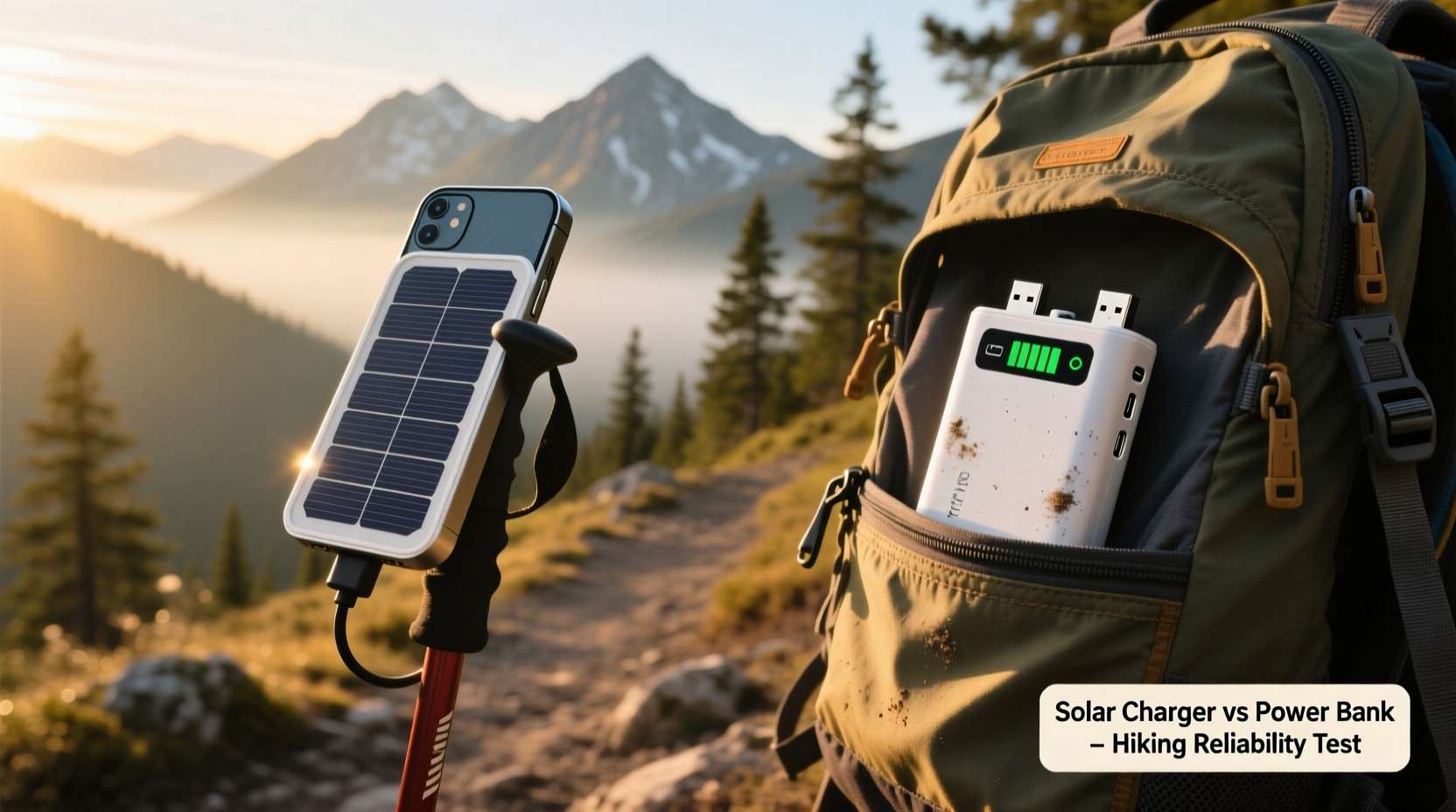
A power bank is essentially a portable battery pack that stores electrical energy for later use. You charge it at home or via a USB port before your trip, then use it to recharge your devices on the go. In contrast, a solar-powered phone charger converts sunlight into electricity using photovoltaic cells, allowing you to generate power during daylight hours without relying on pre-stored energy.
The fundamental difference lies in energy sourcing: one is storage-based, the other generation-based. This distinction shapes their reliability under different conditions.
Power banks deliver consistent output regardless of weather or time of day—as long as they’re charged beforehand. Solar chargers, however, depend entirely on environmental factors like sunlight intensity, cloud cover, angle of incidence, and duration of exposure. On a sunny alpine ridge, solar performs well; deep in a forested canyon on a cloudy day, it may produce little to no power.
“Solar chargers are excellent in theory, but their real-world utility hinges on predictable sun exposure. For multi-day treks through variable terrain, many seasoned backpackers still prefer the certainty of a fully charged power bank.” — Daniel Reeves, Outdoor Gear Engineer and Thru-Hiker
Performance in Real Hiking Conditions
Reliability isn't just about peak performance—it's about consistency across unpredictable environments. Let’s examine how each option holds up under typical hiking scenarios.
Power Banks: Predictable but Finite
Modern lithium-ion or lithium-polymer power banks offer high energy density and stable voltage output. A 10,000mAh unit can typically charge a smartphone two to three times, depending on model and usage. They’re compact, lightweight (most under 200g), and work instantly—no setup required.
However, their biggest limitation is capacity. Once drained, they’re useless until recharged externally. For trips longer than three to four days without access to grid power, this becomes a critical constraint. Some ultralight hikers carry multiple power banks, but this increases weight and bulk.
Tip: Maximize your power bank’s efficiency by enabling airplane mode or low-power mode on your phone while charging in the wild.Solar Chargers: Renewable but Unpredictable
Solar chargers eliminate the need to pre-charge, offering theoretically unlimited power as long as the sun shines. Foldable panel models range from 10W to 25W and weigh between 300g and 600g. They’re designed to attach to backpacks or lay flat during rest stops.
In practice, though, solar efficiency drops significantly under suboptimal conditions. Even light cloud cover can reduce output by 50%. Shading from trees, incorrect panel angles, or dirt accumulation further diminish returns. Charging a phone directly from a solar panel often takes twice as long as from a wall outlet—even in full sun.
Additionally, most solar panels don’t store energy themselves unless paired with a built-in battery. Standalone solar sheets require direct connection to your device, meaning they only work when the sun is shining and your phone is exposed—an impractical combination during active hiking.
Comparison Table: Key Features at a Glance
| Feature | Power Bank | Solar-Powered Charger |
|---|---|---|
| Energy Source | Pre-charged battery | Sunlight (photovoltaic) |
| Charging Speed | Fast and consistent | Slow, varies with light |
| Weight (avg) | 150–250g | 300–600g |
| Weather Dependence | None | High (sunlight needed) |
| Durability | High (sealed units) | Moderate (panels prone to scratches) |
| Best For | Short to medium hikes, predictable trips | Long expeditions, sunny climates |
Real-World Example: The Pacific Crest Trail Test
Consider Sarah Lin, a solo hiker who completed 800 miles of the Pacific Crest Trail over six weeks. She began with a 20W foldable solar charger attached to her pack, hoping to stay off-grid indefinitely. Her plan worked well in the Mojave Desert—ample sun allowed daily charging during lunch breaks. But once she entered the Cascade Mountains, persistent cloud cover and dense forest canopies reduced solar input to less than 20% of rated capacity.
For three consecutive days, her phone battery dropped below 10%, forcing her to ration GPS use. She eventually resorted to skipping map navigation altogether, relying solely on paper maps and trail signs—a risky move on poorly marked stretches.
In contrast, a fellow hiker carried a 20,000mAh power bank. Though heavier, it provided two full charges per cycle and remained unaffected by weather. He used his GPS freely and even shared emergency contact capabilities with others when needed.
Sarah learned that solar isn’t inherently unreliable—but it demands backup planning. After reaching a town, she purchased a compact power bank and used the solar panel only to top off the bank during rest days. This hybrid approach restored confidence in her power strategy.
Hybrid Strategy: Best of Both Worlds?
The most reliable solution for extended hiking often combines both technologies. Use a power bank as your primary source and a solar charger as a secondary replenishment tool. This approach offers redundancy and extends total energy availability.
For example, a 10,000mAh power bank paired with a 15W solar panel allows you to:
- Charge your phone normally from the bank at camp
- Recharge the power bank itself during daylight hours
- Extend usability beyond its initial capacity
This method reduces dependence on either system alone. If clouds roll in, you still have stored power. If the solar panel fails, the bank remains functional.
Step-by-Step: Building a Reliable Off-Grid Charging Routine
- Assess your trip length and terrain – Will you pass through shaded forests or open ridges? How many days between resupply points?
- Select a power bank with sufficient capacity – Aim for at least 1.5x your expected phone usage (e.g., 15,000mAh for heavy GPS users).
- Choose a solar panel with built-in battery if possible – These store solar energy for night-time use, increasing flexibility.
- Test your gear before departure – Simulate a full charge cycle outdoors under varying light conditions.
- Optimize placement during hikes – Angle the panel toward the sun, avoid shading, clean dust regularly.
- Conserve phone battery aggressively – Disable background apps, lower screen brightness, and use offline maps.
Frequently Asked Questions
Can a solar charger fully replace a power bank on long hikes?
Not reliably. While possible in ideal conditions (consistent sun, efficient panel, low device usage), solar alone lacks the consistency required for safety-critical applications. It should supplement, not replace, stored power.
Are solar chargers durable enough for rugged trails?
Most modern foldable panels are built with reinforced PET and water-resistant coatings, making them reasonably durable. However, sharp rocks, abrasion from pack straps, and repeated folding can degrade performance over time. Always inspect for micro-cracks and delamination after extended use.
How much solar wattage do I need for effective charging?
A minimum of 10W is recommended for smartphones. For faster charging or powering tablets, 15–25W panels are better. Note that “rated” wattage assumes perfect lab conditions—real-world output is typically 50–70% of stated capacity.
Action Checklist: Choosing Your Hiking Power Solution
- ✅ Determine total power needs based on device type and expected usage
- ✅ Choose a power bank with adequate capacity and high efficiency (look for >90% conversion rate)
- ✅ Evaluate your route’s sun exposure—open deserts favor solar, forested mountains do not
- ✅ Consider a solar charger with integrated battery for added flexibility
- ✅ Pack a USB-C to USB-C cable (or appropriate connector) and verify compatibility
- ✅ Practice charging routines at home to understand timing and heat buildup
- ✅ Carry a backup plan—know where resupply points with electricity are located
“Redundancy saves trips. I always carry a small power bank even when using solar. One failed connection or stormy day shouldn’t leave you powerless.” — Lena Torres, Search and Rescue Volunteer and Long-Distance Backpacker
Final Verdict: Which Is More Reliable?
When measured purely by reliability—consistent performance under diverse conditions—the **power bank wins**. It delivers predictable power on demand, regardless of weather, time, or environment. For most hikers, especially those on short to medium-length trips or traveling through shaded or unpredictable climates, a high-capacity power bank is the smarter, safer choice.
Solar chargers shine in specific contexts: extended expeditions in sunny regions, basecamp setups, or for eco-conscious travelers minimizing reliance on grid power. But they introduce variables that compromise reliability. Sunlight isn’t guaranteed, and charging efficiency fluctuates too widely to depend on exclusively.
The most resilient approach blends both. Use a power bank as your core power source and leverage solar to extend its life. This dual-system strategy maximizes uptime, minimizes risk, and ensures your phone stays alive when it matters most.
Take Action Today
Don’t wait until you’re lost on a remote trail with a dead phone to evaluate your charging strategy. Review your next hike’s route, estimate your power needs, and test your chosen solution under realistic conditions. Whether you go all-in on stored energy or harness the sun, preparation is what turns gear into reliability.
💬 Have experience with solar vs. power banks on the trail? Share your story, lessons learned, or favorite combo setup in the comments—your insight could help another hiker stay powered and safe.








