When you're miles from the nearest outlet, keeping your devices charged during a camping trip can mean the difference between a smooth adventure and a dangerous situation. Whether it's navigating with GPS, capturing memories on your phone, or staying in touch via satellite communicator, access to power is non-negotiable. The two most common solutions—solar powered chargers and power banks—both promise energy independence, but they function very differently and suit distinct needs. Understanding their strengths, limitations, and practical applications ensures you choose the right tool for reliable off-grid juice.
How Solar Powered Chargers Work in the Wild
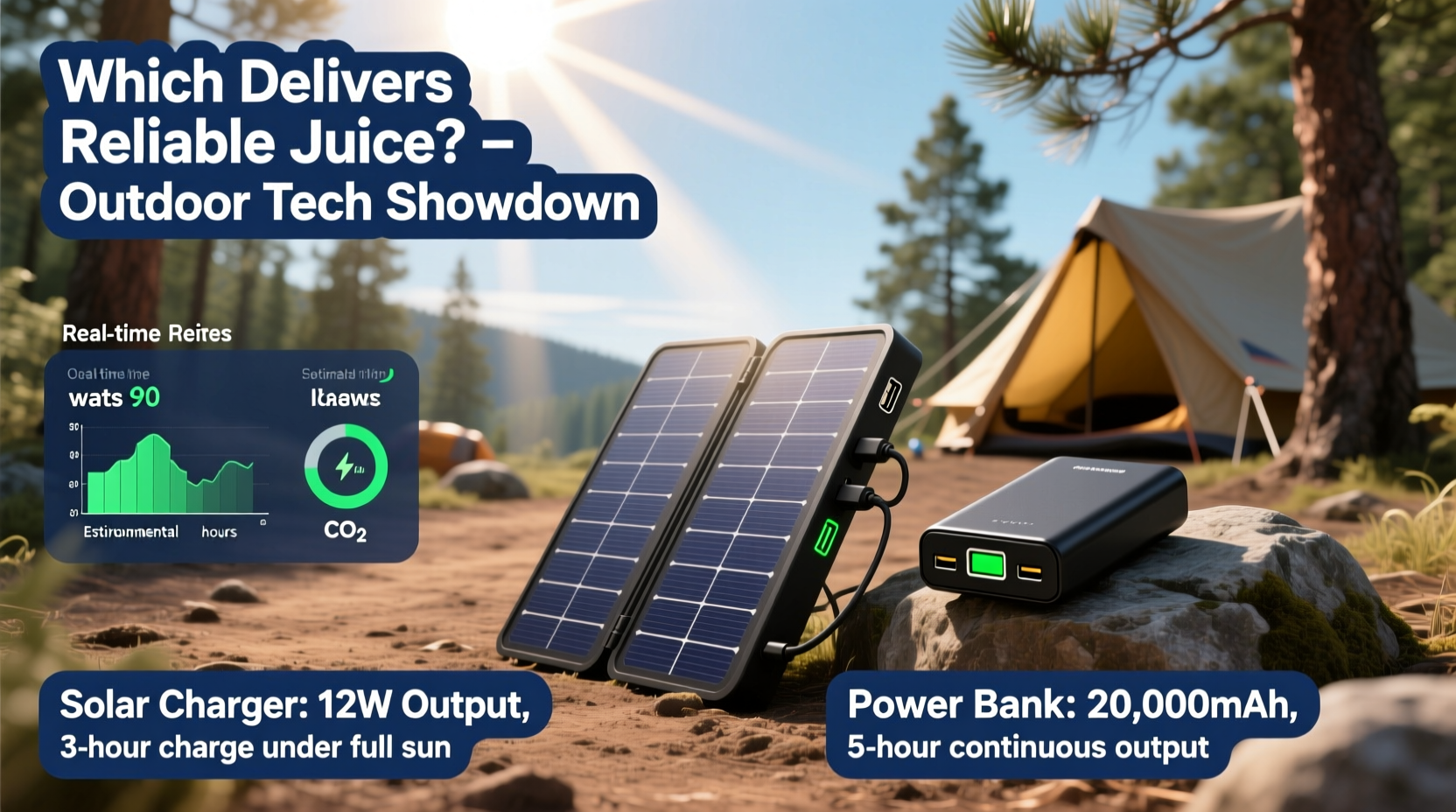
Solar powered chargers convert sunlight into electrical energy using photovoltaic cells. Most models designed for outdoor use are portable, foldable, and equipped with USB ports to charge smartphones, GPS units, headlamps, and small battery packs. Their primary advantage lies in sustainability: as long as the sun shines, they can generate power indefinitely without needing to be recharged beforehand.
However, real-world performance depends heavily on environmental conditions. Direct sunlight yields optimal output, while overcast skies, tree cover, or improper panel angle can reduce efficiency by 50% or more. Charging speed is also slower than wall outlets—typically taking 4–6 hours under ideal conditions to fully charge a smartphone.
Tip: Position solar panels at a 30–45 degree angle toward the sun and reposition every few hours to maximize exposure.Many solar chargers include a built-in battery (hybrid models), allowing them to store energy during the day for use at night. These offer more flexibility but add weight and cost. Pure solar panels without storage require direct sun-to-device connection, making them less convenient after sunset.
The Role of Power Banks in Off-Grid Charging
Power banks are essentially portable batteries that store electrical energy for later use. They come in various capacities measured in milliampere-hours (mAh) or watt-hours (Wh). A standard 10,000mAh power bank can recharge an average smartphone two to three times before depletion. High-capacity models (20,000mAh+) can support tablets, cameras, or even small laptops.
Unlike solar chargers, power banks deliver consistent, fast charging regardless of weather or time of day. Once pre-charged at home or via car adapter, they’re ready to use immediately upon arrival at camp. This makes them highly reliable when immediate power is needed.
Their main limitation is finite capacity. Once drained, they cannot regenerate power unless connected to an external source—something often unavailable in remote areas. Some adventurers carry multiple power banks to extend runtime, but this increases pack weight significantly.
“Power banks give you predictable energy reserves, which is critical in emergency scenarios where device uptime matters.” — Dr. Lena Torres, Outdoor Technology Researcher, National Institute of Wilderness Safety
Comparing Key Factors: Solar vs Power Bank
| Factor | Solar Powered Charger | Power Bank |
|---|---|---|
| Energy Source | Sunlight (renewable) | Pre-stored electricity (finite) |
| Charging Speed | Slow (highly variable) | Fast and consistent |
| Weather Dependency | High (useless at night/cloudy days) | None |
| Lifetime Use | Nearly unlimited (with care) | Limited to charge cycles (~500 full cycles) |
| Pack Weight & Size | Moderate to bulky (panels unfold) | Compact and lightweight |
| Upfront Cost | $$–$$$ (higher for efficient models) | $–$$ (affordable entry-level options) |
| Best For | Long trips, sunny climates, eco-conscious users | Short trips, emergencies, convenience-focused campers |
Real-World Example: A Weeklong Backpacking Trip in the Rockies
Consider Sarah, an experienced hiker planning a six-day trek through Colorado’s Maroon Bells-Snowmass Wilderness. She carries a GPS watch, smartphone, headlamp, and satellite messenger. Her goal is complete self-sufficiency with no resupply.
She opts for a 25,000mAh power bank and a 20W foldable solar charger used together. Each morning, she hangs the solar panel on her backpack while hiking. By late afternoon, it has typically generated enough to partially recharge both her devices and the power bank. At camp, she uses the stored energy in the power bank for faster evening charging.
This hybrid strategy gives her the reliability of stored power and the renewal capability of solar. On cloudy days, the power bank sustains her needs, while sunny stretches replenish reserves. After six days, all devices remain functional, proving that combining both technologies maximizes resilience.
Tip: Use a dual-output solar charger to simultaneously power a device and refill a power bank for maximum efficiency.Step-by-Step Guide: Choosing the Right Solution for Your Trip
- Assess trip duration: Trips under 3 days usually don’t require solar; a high-capacity power bank suffices. For longer expeditions, consider renewable input.
- Evaluate expected weather: Cloudy or forested regions limit solar effectiveness. In such cases, prioritize power banks or bring backup options.
- List your devices and their power draw: Calculate total mAh needed. A smartphone (~3,000mAh), GPS (~1,500mAh), and headlamp (~2,000mAh) may require 10,000–15,000mAh per full recharge cycle.
- Determine charging frequency: Will you charge nightly or only every few days? Frequent charging favors solar integration.
- Weigh portability concerns: If minimizing pack weight is crucial, compact power banks win. If space allows, solar adds long-term value.
- Budget for redundancy: Never rely on a single point of failure. Carry one primary solution and a secondary backup—e.g., a small solar panel plus a mid-sized power bank.
Hybrid Approach: Best of Both Worlds?
The most dependable setup often combines solar and power banks. Think of solar not as a direct phone charger, but as a way to recharge your power bank throughout the day. This decouples energy generation from usage, allowing you to collect power whenever the sun shines and deploy it when needed.
For example, a 20W solar panel can generate about 8,000–10,000mAh of usable energy on a clear 8-hour day, enough to refill a large power bank. That stored energy then powers your devices quickly at night. This method avoids slow direct solar charging and leverages the consistency of battery storage.
Look for solar chargers with pass-through charging—a feature that allows the panel to charge the power bank while the bank simultaneously charges a device. Not all models support this due to voltage regulation issues, so verify compatibility before purchase.
Common Pitfalls to Avoid
- Overestimating solar output: Marketing claims often reflect lab conditions. Real-world output is typically 60–70% of rated wattage.
- Ignoring battery degradation: Power banks lose capacity over time. A 3-year-old unit may hold only 70% of its original charge.
- Failing to protect gear: Moisture, dust, and drops damage both solar panels and power banks. Choose rugged, water-resistant models rated IP67 or higher.
- Using incompatible cables: Poor-quality or non-standard USB cables can block charging or reduce speed dramatically.
- Not testing before departure: Always simulate your charging plan at home to confirm compatibility and estimate actual runtime.
Checklist: Preparing Your Charging System for Camping
- ☐ Determine total device power requirements (sum of mAh needs)
- ☐ Select either solar, power bank, or hybrid based on trip length and environment
- ☐ Verify solar panel wattage and power bank capacity match your needs
- ☐ Test all components together before leaving home
- ☐ Pack durable, weather-rated cables and adapters
- ☐ Include a protective case or dry bag for electronics
- ☐ Label each device and cable for easy identification
- ☐ Plan daily charging windows (e.g., “solar collects 9 AM–3 PM, devices charge at camp”)
Frequently Asked Questions
Can I charge a power bank with any solar panel?
Most modern power banks can be charged via USB from a solar panel, but check voltage and current compatibility. Panels should output at least 5V/2A for efficient charging. Avoid mismatched systems that trigger error shutdowns or overheat.
Do solar chargers work on cloudy days?
Yes, but output drops significantly—often to 10–25% of rated capacity. Thin cloud cover allows some UV penetration, but heavy storm systems may halt generation entirely. Always have a backup plan.
How long do power banks last in storage?
Lithium-ion power banks retain charge best when stored at 50% capacity in cool, dry places. Avoid full discharge or constant full charge. With proper care, they remain functional for 3–5 years.
Final Recommendation: Match Tool to Terrain
There’s no universal winner between solar powered chargers and power banks. The choice hinges on context. For weekend campers near vehicle access, a simple power bank offers unmatched convenience and reliability. For thru-hikers, expedition leaders, or those venturing into sun-rich remote zones, solar provides essential energy renewal that batteries alone cannot sustain.
The smartest approach blends foresight with redundancy. Start with a quality power bank sized to your needs. Then, if your trips exceed three days or venture deep off-grid, add a solar charger as a refill mechanism—not a primary charger. This layered strategy ensures you never run out of juice when it matters most.
🚀 Ready to power your next adventure? Audit your current gear, calculate your energy needs, and build a resilient charging system today. Share your favorite setup in the comments to help fellow campers stay charged and safe!








