When you're deep in the wilderness with no access to a wall outlet, keeping your devices charged can mean the difference between staying connected and being stranded. Whether it’s powering a GPS, smartphone, headlamp, or camera, reliable electricity is essential on any extended camping trip. Two popular options dominate the off-grid charging scene: solar powered chargers and traditional power banks. But when push comes to shove—especially over several days of rugged terrain and unpredictable weather—which one actually delivers more usable energy?
The answer isn’t as simple as comparing watt-hours or milliampere-hours. Real-world performance depends on environmental conditions, usage patterns, device compatibility, and even how prepared you are before leaving home. This article dives into the technical and practical differences between solar chargers and power banks, helping you decide which solution offers more juice when it matters most.
Understanding Capacity and Output
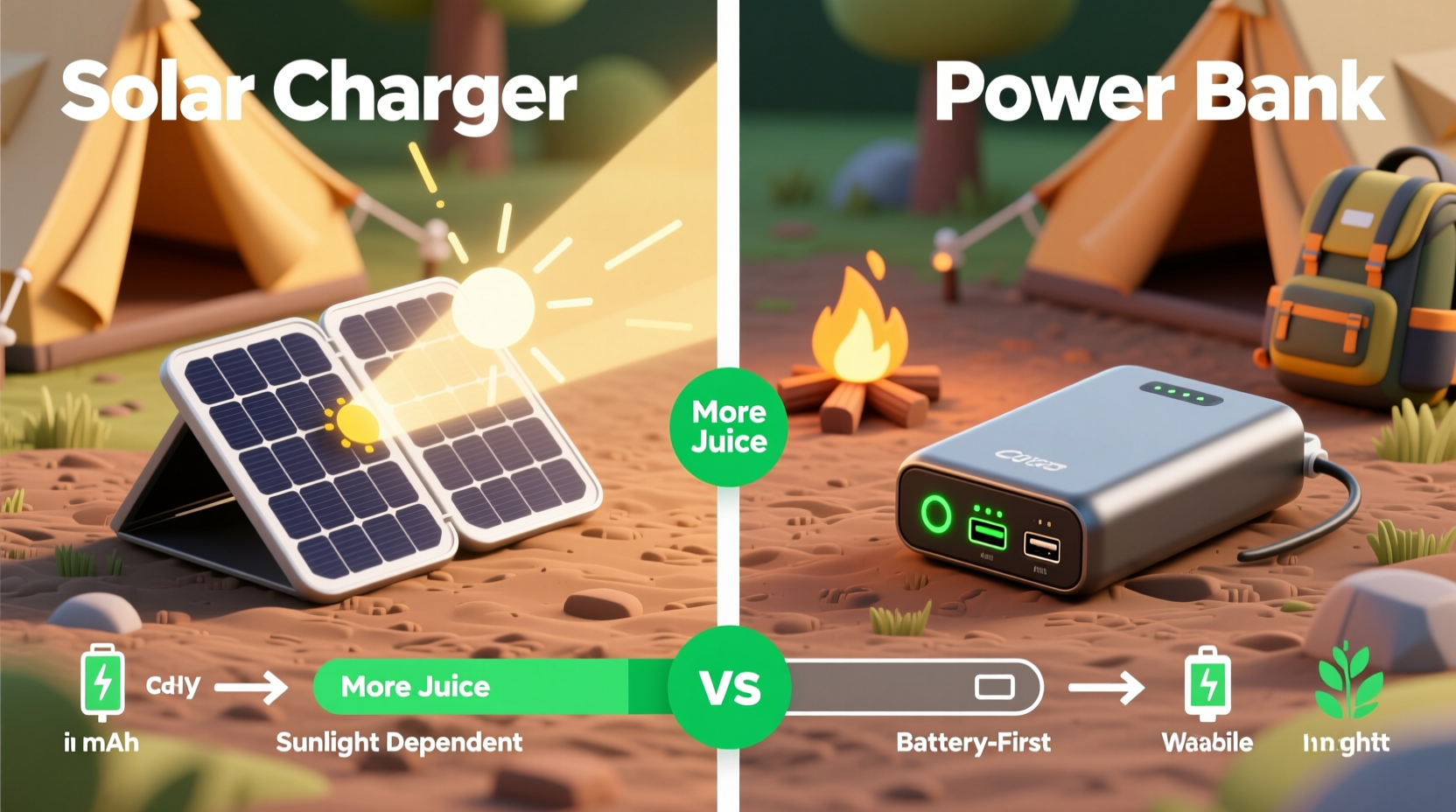
At first glance, comparing battery capacity seems straightforward. Most portable power sources list their capacity in milliampere-hours (mAh) or watt-hours (Wh). A 20,000 mAh power bank at 3.7V stores roughly 74 Wh of energy. Solar panels, on the other hand, are rated by output—say, 20 watts peak under ideal sunlight—but don’t store energy themselves unless paired with a built-in battery.
This distinction is critical. A power bank comes pre-charged and ready to deliver its full capacity immediately. A solar charger must generate power over time, meaning its total \"juice\" depends entirely on exposure to sunlight during your trip.
For example, a 20W solar panel receiving six hours of direct midday sun might produce around 80–100 watt-hours per day under optimal conditions. That sounds impressive—more than many standalone power banks. But in reality, factors like cloud cover, angle of incidence, shading from trees, and seasonal sun intensity drastically reduce actual output.
Tip: Always assume your solar panel will perform at 50–70% of its rated output due to real-world inefficiencies.Power Banks: Reliable but Finite
Power banks offer simplicity and predictability. You charge them fully before departure, pack them securely, and use them as needed. Their advantages are clear:
- Predictable output: If your power bank has a 15,000 mAh capacity, you know exactly how many charges you can get from it.
- All-weather usability: They work just as well inside a tent during rain as they do beside a campfire.
- High efficiency: Modern USB-C PD models transfer energy quickly and safely to compatible devices.
- Compact design: Many high-capacity models fit easily in a backpack pocket.
However, their biggest limitation is also obvious: once drained, they’re useless until recharged. Unless you carry multiple units or have another way to recharge them (like a car adapter or portable generator), your electrical lifeline ends when the battery hits zero.
Consider this scenario: a typical smartphone uses about 15Wh per full charge. A 20,000 mAh (74Wh) power bank could theoretically charge an iPhone 14 about four times. In practice, accounting for conversion losses, that drops to three full charges. After that, you’re out of luck—unless you brought backups.
“Battery capacity is only useful if it’s accessible when you need it. For multi-day trips without resupply points, redundancy is key.” — Dr. Lena Torres, Outdoor Electronics Researcher, National Institute of Wilderness Safety
Solar Powered Chargers: Renewable but Unreliable
Solar chargers shine where power banks fail: sustainability. As long as the sun rises, you have a chance to generate more power. There are two main types:
- Portable solar panels without storage – These connect directly to your device or an external power bank.
- Solar generators/power stations with integrated panels – These include both solar input and internal batteries.
The former relies entirely on real-time generation, making them inefficient unless used during peak sun hours. The latter combines the best of both worlds—storage plus renewable input—but adds weight and cost.
A 25W foldable solar panel may take 6–8 hours to fully recharge a depleted 20,000 mAh power bank under good conditions. That means if you start hiking early and set up camp by noon, you might only get half that charge unless you adjust the panel throughout the day.
Moreover, solar efficiency plummets in suboptimal conditions:
- Cloudy skies reduce output by 50–90%
- Morning and late afternoon sun provides less intense light
- Dust, dirt, or moisture on the panel surface further diminishes performance
- Indirect lighting (e.g., forest canopy) severely limits energy harvest
So while solar chargers promise infinite energy in theory, their real-world yield is often inconsistent and insufficient to keep pace with heavy device usage.
Direct Comparison: Juice Delivery Over 3 Days
To illustrate the difference, consider a realistic 3-day backcountry trek with moderate electronics use:
| Device | Daily Energy Use | Total (3 Days) |
|---|---|---|
| Smartphone (GPS + photos) | 15 Wh | 45 Wh |
| Headlamp (LED, 4 hrs/night) | 2 Wh | 6 Wh |
| Handheld GPS unit | 8 Wh | 24 Wh |
| Camera (mirrorless, intermittent) | 10 Wh | 30 Wh |
| Total Estimated Demand | 35 Wh/day | 105 Wh |
Now let’s compare how each system handles this load.
Scenario 1: High-Capacity Power Bank Only
You bring a 30,000 mAh (111 Wh) power bank, fully charged. It meets your total demand with a small buffer. No additional charging occurs. By the end of day three, the bank is nearly empty. You’ve delivered all available juice reliably and consistently.
Scenario 2: Solar Charger + Smaller Power Bank
You carry a 15,000 mAh (55 Wh) power bank and a 20W solar panel. Each day, you lay the panel out for 5 hours during peak sun. Assuming 60% efficiency due to angle and partial clouds, daily solar input is roughly:
20W × 5h × 0.6 = 60 Wh per day
But not all of that goes to devices—some replenishes the power bank. Over three days, you generate about 180 Wh of solar energy, potentially exceeding your needs. However, if Day 2 is rainy and you only get 1 hour of weak sun, your solar input drops to ~10 Wh that day. Suddenly, you fall behind.
In this case, solar offers greater potential but carries higher risk. Without perfect conditions, it may fail to deliver enough juice when needed.
Tip: Pairing a solar charger with a mid-sized power bank creates a hybrid system that balances reliability and renewability.Hybrid Approach: Best of Both Worlds
Experienced backpackers and expedition leaders often adopt a hybrid strategy. Instead of choosing one technology over the other, they combine them:
- Start with a fully charged power bank (e.g., 20,000 mAh)
- Use a solar panel to recharge the power bank during daylight
- Keep critical devices topped up from the bank, not directly from solar
This method leverages the stability of stored energy while extending runtime through renewable input. Even on cloudy days, partial solar gains help stretch battery life. On sunny days, you may even finish your trip with surplus power.
For instance, REI’s long-term field tests found that hikers using a 20W solar panel with a 15,000 mAh power bank maintained 80% device uptime over seven-day treks in the Sierra Nevada—compared to just 55% for those relying solely on a single power bank.
Mini Case Study: Pacific Crest Trail Section Hike
Emma R., a thru-hiker attempting a 10-day leg of the PCT, relied solely on a 25W solar blanket and her phone for navigation. She experienced two consecutive overcast days in Northern California. Despite leaving the panel unrolled all day, she managed only 20 minutes of GPS tracking before her phone died. Stranded without a map, she had to backtrack to the last trail marker.
In contrast, her friend Mark carried a 20,000 mAh power bank and a smaller 10W solar panel. He used the bank to charge his phone each night and placed the panel on his backpack during hikes. Though he didn’t fully recharge the bank daily, he gained enough supplemental power to maintain communication and navigation throughout the stretch—even on cloudy days.
The lesson? Redundancy and realistic expectations matter more than peak specifications.
Checklist: Choosing the Right Charging Solution
Before your next camping trip, evaluate your needs with this checklist:
- ✅ How many days will you be off-grid?
- ✅ What devices need charging, and how much energy do they consume?
- ✅ Will you have consistent access to sunlight?
- ✅ Can you afford extra weight for backup power?
- ✅ Are you willing to manage panel positioning during the day?
- ✅ Do you need fast charging for emergencies?
- ✅ Is weight or portability your top priority?
If you answer “yes” to the first four questions, a hybrid system is likely your best bet. If you prioritize simplicity and short trips, a high-capacity power bank wins. For ultra-light, long-duration treks in sunny regions, solar becomes more viable—but never rely on it exclusively.
Frequently Asked Questions
Can I charge my phone directly from a solar panel?
Yes, but it's inefficient. Direct charging only works in strong sunlight and often results in interrupted connections as clouds pass. It’s better to charge a power bank first, then use that to charge your phone.
How long does it take to charge a power bank with a solar panel?
It depends on the panel wattage and bank capacity. A 20W solar panel typically takes 6–10 hours to fully charge a 20,000 mAh power bank under good sun. Expect longer in suboptimal conditions.
Are solar chargers worth it for weekend campers?
For weekend trips, probably not. Most people return home with plenty of battery left. A simple 10,000 mAh power bank is lighter, cheaper, and more reliable. Save solar for trips lasting three days or more.
Final Verdict: Which Delivers More Juice?
In terms of guaranteed, usable energy, **power banks deliver more juice** in most real-world camping scenarios. They provide immediate, predictable power regardless of weather or location. Solar chargers, while offering renewable potential, are subject to too many variables to be fully trusted as a primary source.
That said, solar excels as a supplement. When paired with a quality power bank, it extends your total energy budget and reduces dependency on pre-trip charging. For trips longer than four days, especially in sunny climates, solar can effectively double or triple your available power over time.
Ultimately, the winner depends on your definition of “more juice.” If you mean *guaranteed* energy on demand, go with a high-capacity power bank. If you mean *maximum possible* energy over an extended period with favorable conditions, solar has the edge—provided you manage it wisely.
“The most reliable power system isn't the one with the highest specs—it's the one you understand and use correctly.” — James Wu, Lead Instructor at Mountain Tech Expeditions
Conclusion
Don’t gamble your safety or comfort on unproven gear assumptions. Whether you choose solar, power banks, or a smart combination of both, make sure your decision is based on realistic energy needs and environmental conditions. Test your setup at home, calculate your device consumption, and always pack a margin of error. With thoughtful preparation, you can stay powered, connected, and confident no matter how far off-grid you go.
🚀 Ready to upgrade your camping power strategy? Share your favorite charging setup in the comments below and help fellow adventurers stay juiced up in the wild!








