
When venturing into remote wilderness areas where electricity is nonexistent, keeping your devices charged becomes a critical part of trip safety and navigation. Hikers rely on GPS units, smartphones, headlamps, and emergency beacons—all of which demand consistent power. The two most common solutions are solar-powered chargers and traditional power banks. But when you're days away from the nearest outlet, which option truly lasts longer off-grid? The answer isn’t as simple as battery capacity—it depends on environment, usage patterns, and equipment quality.
This article breaks down the strengths and limitations of both technologies, evaluates real-world endurance, and provides practical guidance for choosing the right solution based on your hiking style and conditions.
Battery Capacity vs. Rechargeability: The Core Difference
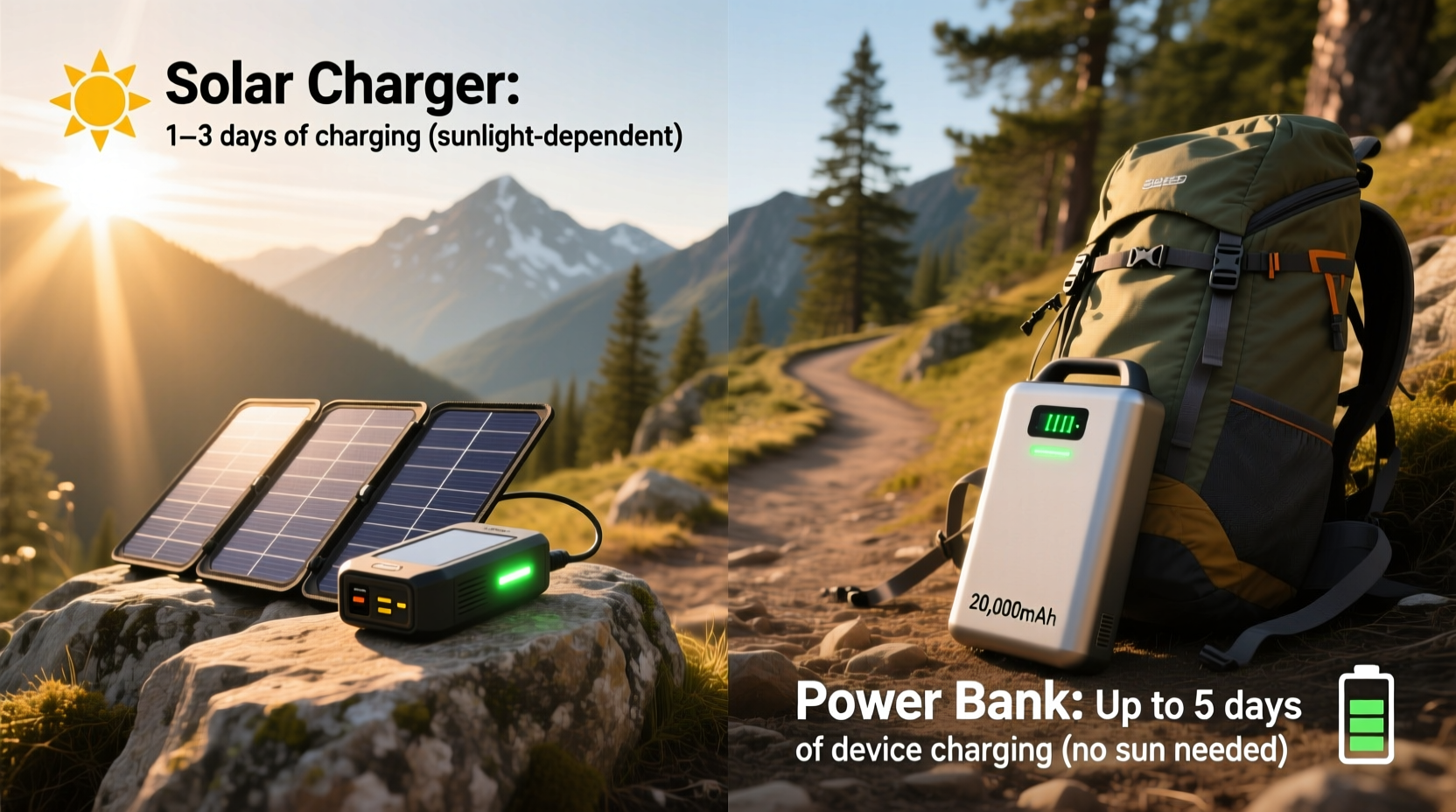
The fundamental distinction between a solar-powered charger and a power bank lies in energy replenishment. A power bank stores a fixed amount of energy—measured in milliampere-hours (mAh) or watt-hours (Wh)—and once depleted, it must be recharged via an electrical outlet. In contrast, a solar-powered charger converts sunlight into electricity, theoretically allowing indefinite recharging under ideal conditions.
However, \"indefinite\" doesn't mean \"unlimited.\" Solar panels depend on weather, time of day, angle to the sun, and panel efficiency. Most portable solar chargers used by hikers generate between 5W and 20W of power, which translates to slow charging—especially compared to wall outlets that deliver 18W to 60W or more.
A high-capacity power bank might offer 20,000 mAh (about 74Wh), enough to fully charge a smartphone three to four times. But once drained, it’s a dead weight unless you have access to grid power. A solar charger with a built-in battery can also store energy, but its effective capacity is often smaller, and recharging it via sun alone may take six to ten hours under optimal conditions.
Tip: Pair a moderate-capacity power bank with a lightweight solar panel for hybrid reliability—use stored power first, then recharge during daylight.Performance in Real-World Hiking Conditions
Theoretical specs rarely match field performance. Let's examine how each device performs under typical backcountry scenarios.
Power Bank: Predictable but Finite
Power banks excel in predictability. If your model has a 15,000 mAh capacity and your phone draws 4,000 mAh per charge, you know exactly how many full charges you have—roughly three, minus conversion losses. This makes planning straightforward.
But their limitation is obvious: no recharge capability. On a multi-day trek without resupply options, you’re constrained by initial charge. Some ultralight backpackers mitigate this by carrying multiple small power banks, but this increases weight and complexity.
Solar-Powered Charger: Renewable but Unreliable
Solar chargers offer the tantalizing promise of endless power—as long as the sun shines. However, real-world variables quickly erode that advantage:
- Cloud cover: Even light overcast can reduce solar output by 50–80%.
- Angle and movement: Panels need direct, perpendicular exposure. Mounting them on a moving backpack reduces efficiency significantly.
- Time of day: Charging only occurs during peak sunlight hours (typically 10 a.m. to 3 p.m.), limiting daily energy harvest.
- Cold temperatures: While solar panels perform better in cold, clear conditions, low temperatures can reduce battery efficiency within the charger itself.
In dense forests, deep canyons, or during shoulder seasons with shorter daylight, solar input can be negligible. A 10W solar panel might produce only 20–30 watt-hours per day in suboptimal conditions—barely enough to charge a phone once.
“On a week-long trek through the Sierra Nevada, I relied solely on a 15W solar charger. Despite clear skies, I could only charge my phone halfway each day—and only if I stopped hiking by noon to set up the panel.” — Daniel Reyes, Long-Distance Backpacker & Gear Tester
Comparison Table: Key Features at a Glance
| Feature | Power Bank | Solar-Powered Charger |
|---|---|---|
| Energy Source | Pre-charged battery | Sunlight (with or without internal battery) |
| Recharge Capability Off-Grid | No | Yes, weather-dependent |
| Typical Capacity | 5,000–26,000 mAh | 5,000–20,000 mAh (if battery included) |
| Charging Speed (Sun/Outlet) | Fast (via outlet) | Slow (2–10 hours for full charge) |
| Weight | 200–500g | 300–700g (plus bulk) |
| Durability | High (solid-state) | Moderate (panels prone to cracking) |
| Best For | Short to medium hikes, predictable use | Long expeditions, sunny climates, backup top-up |
Hybrid Strategy: Maximizing Off-Grid Endurance
For extended trips where both reliability and longevity matter, the best approach is often a hybrid system. Combine a high-capacity power bank with a foldable solar charger to get the benefits of both: immediate power from stored energy and gradual replenishment from sunlight.
This strategy allows you to:
- Use the power bank to charge devices at night or during rest breaks.
- Deploy the solar panel during lunch stops or while setting up camp.
- Extend total energy availability beyond what either device could provide alone.
For example, a 20,000 mAh power bank paired with a 10W solar panel can sustain a hiker’s communication and navigation needs for 7–10 days in mixed conditions. Even with partial sun, the solar component can recover 30–50% of the power bank’s capacity daily, creating a semi-closed loop.
Step-by-Step: Optimizing Your Charging Routine on the Trail
- Start fully charged: Ensure both your power bank and devices are at 100% before departure.
- Prioritize essential devices: Only charge GPS, emergency beacon, and primary phone; disable non-essential electronics.
- Use airplane mode: Reduce device power consumption by turning off cellular data when not needed.
- Charge during downtime: Set up the solar panel while eating, resting, or during camp setup.
- Angle the panel correctly: Position it perpendicular to the sun, ideally using a reflective surface to boost input.
- Monitor battery levels: Use apps or built-in indicators to track remaining capacity and adjust usage accordingly.
- Conserve power at night: Avoid unnecessary screen use; charge devices only when necessary.
Case Study: Pacific Crest Trail Section Hike
Consider a real-world scenario: Sarah, an experienced hiker, embarked on a 12-day solo section hike along the southern PCT. She carried a Garmin inReach Mini 2, iPhone 14, and headlamp—all essential for navigation and safety.
Her initial plan was to use a 15,000 mAh power bank alone. After five days, her phone dropped below 20%, and she had no way to recharge. Forced to conserve power, she turned off GPS tracking and limited communication, increasing risk.
On a subsequent trip, she switched to a hybrid setup: a 10,000 mAh power bank paired with a 12W foldable solar charger. Though lighter than her previous bank, this system allowed her to recharge the power bank partially each day. By positioning the panel outside her tent during lunch, she gained 40–60% of the bank’s capacity daily. Over 12 days, she maintained all devices above 50% charge without anxiety.
The lesson? Total capacity matters less than sustained availability. Renewable input—even if partial—can dramatically extend functional lifespan off-grid.
Expert Insight: What Industry Leaders Say
“Most hikers overestimate solar efficiency and underestimate power consumption. A 10W panel won’t keep up with heavy device use. The smartest users treat solar as a supplement, not a primary source.” — Dr. Lena Patel, Outdoor Electronics Researcher at REI Co-op Labs
This perspective underscores a crucial mindset shift: solar chargers aren’t magic solutions. They require behavioral adaptation—planning stops, managing expectations, and accepting slower recharge rates.
Frequently Asked Questions
Can a solar charger fully replace a power bank?
Not reliably. While possible in ideal conditions (high sun exposure, low device usage), most hikers still benefit from having stored energy. Solar should be viewed as a backup or supplementary source, not a complete replacement.
How long does it take to charge a phone with a solar charger?
Under direct, midday sun, a 10W solar panel typically takes 3–5 hours to charge a modern smartphone from 0% to 100%. Cloudy conditions or indirect light can double or triple that time. Using a power bank buffer speeds up the process.
Are solar chargers durable enough for backpacking?
Quality varies widely. Rigid-panel chargers are more efficient but fragile. Foldable, fabric-based models with ETFE coating are better suited for backpacking due to flexibility and drop resistance. Look for IP65 or higher water resistance ratings for trail use.
Checklist: Choosing the Right Solution for Your Hike
- ☐ Assess trip length: Under 3 days? Power bank likely sufficient. Over 5 days? Consider solar or hybrid.
- ☐ Evaluate expected weather: Sunny regions favor solar; rainy or forested areas favor power banks.
- ☐ Calculate total device power needs: Add up mAh requirements for all devices and multiply by number of uses.
- ☐ Check weight budget: Solar panels add bulk; every extra 100g counts on long hikes.
- ☐ Prioritize reliability: If mission-critical devices (e.g., PLB, GPS), lean toward redundant power banks.
- ☐ Test gear before leaving: Simulate trail conditions to verify performance.
Conclusion: Which Lasts Longer Off-Grid?
The question isn’t which device lasts longer in isolation—but which system provides the most usable energy over time in real hiking conditions. A standalone power bank offers finite but reliable power. A solar charger provides renewable energy but with significant variability.
In most cases, a high-capacity power bank will deliver more consistent, immediate power over a week-long trip than a solar charger relying on unpredictable sun. However, on expeditions lasting two weeks or more, especially in sunny environments, a solar charger—or better yet, a solar + power bank combo—will outlast even the largest battery pack.
Ultimately, longevity off-grid isn’t just about hardware. It’s about strategy: minimizing power drain, optimizing charging opportunities, and preparing for the unexpected. Whether you choose solar, a power bank, or both, the key is matching your power solution to your route, weather, and personal risk tolerance.
🚀 Ready to optimize your next off-grid adventure? Audit your current gear, calculate your power needs, and test a hybrid setup on a weekend hike. Share your experience or ask questions in the comments—your insights could help fellow hikers stay powered and safe in the wild.








