
When you're deep in the backcountry with no access to electricity, keeping your devices charged can mean the difference between a smooth navigation experience and getting lost. As hikers increasingly rely on GPS units, smartphones, and satellite communicators, portable power has become essential gear. The market offers two main options: traditional power banks and solar-powered variants. But when it comes to hiking, is solar charging truly viable—or just a well-marketed convenience?
This article dives into the practical realities of using solar power banks versus regular ones on the trail. We’ll compare energy efficiency, charging speed, durability, weight, and real-world performance under varying conditions. Whether you’re planning a weekend trek or a multi-week thru-hike, understanding the trade-offs will help you make an informed decision.
How Power Banks Work: A Quick Primer
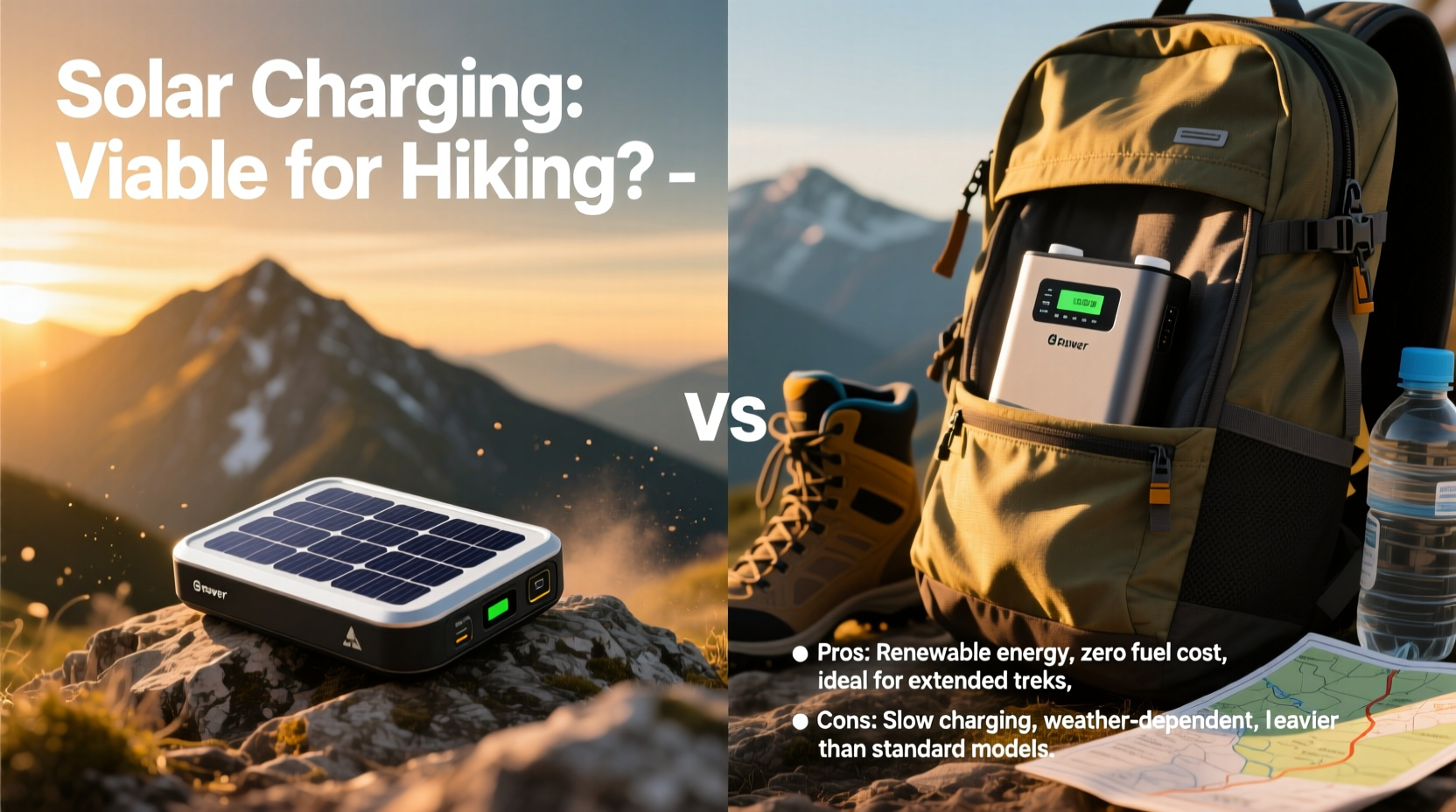
All power banks store electrical energy in lithium-ion or lithium-polymer batteries, which they later dispense through USB ports to charge devices. The key difference lies in how they themselves are recharged.
- Regular power banks must be plugged into a wall outlet, car charger, or computer to recharge. They offer high capacity (measured in milliamp-hours, mAh) and fast output but depend entirely on pre-charged energy.
- Solar power banks integrate photovoltaic panels that convert sunlight into electricity. Some have built-in panels; others come with detachable solar chargers. They promise renewable charging in remote areas—but with significant caveats.
Theoretically, solar power banks eliminate reliance on grid power. In practice, their effectiveness hinges on environmental conditions, panel quality, and user expectations.
Performance Comparison: Solar vs Regular Power Banks
To assess viability, we need to compare core performance metrics relevant to hikers:
| Metric | Regular Power Bank | Solar Power Bank |
|---|---|---|
| Recharge Speed (from outlet) | 1–4 hours (fast with USB-C PD) | 4–8+ hours (slower due to lower input efficiency) |
| Charging While Hiking | No—must be pre-charged | Limited—requires direct sun, proper angle, no shade |
| Energy Efficiency | High (85–95% charge retention) | Low to moderate (30–60% conversion loss in sunlight) |
| Weight & Portability | Lighter per mAh (e.g., 200g for 10,000mAh) | Heavier (added solar panel, protective casing) |
| Durability | Generally rugged; sealed against moisture | Vulnerable panels; prone to cracking or delamination |
| Cost | $20–$60 for reliable models | $50–$120+, often less value per watt |
The data shows a clear pattern: solar power banks sacrifice efficiency, speed, and portability for the potential of off-grid recharging. But does that potential translate into real utility on the trail?
Tip: Never rely solely on solar charging during a hike—always carry a fully charged power bank as your primary source.Real-World Solar Charging: What Conditions Are Needed?
Solar panels require ideal conditions to generate meaningful power. On a hike, these conditions are rarely met consistently.
A typical 15W solar power bank might claim “full charge in 6 hours,” but this assumes:
- Direct, unobstructed sunlight (no clouds, trees, or terrain blocking light)
- Optimal panel angle (perpendicular to the sun’s rays)
- No dust, moisture, or shadows on the surface
- Midday sun (peak UV intensity between 10 a.m. and 2 p.m.)
In reality, most hikers move through shaded forests, mountain valleys, or dense canopies—environments where solar input is minimal. Even in open terrain, backpack movement causes the panel to shift away from optimal angles. Wind, rain, or condensation further reduce efficiency.
Field tests show that under mixed conditions, a solar power bank may generate only 10–30% of its rated output. That means a 15W panel might deliver just 1.5–4.5 watts—barely enough to offset device drain, let alone recharge the battery.
“Solar charging on the move is more about trickle top-ups than full replenishment. It’s supplemental, not primary.” — Dr. Lena Torres, Renewable Energy Researcher at Alpine Institute for Outdoor Tech
Mini Case Study: A 7-Day Trek Through the Sierra Nevada
Consider Alex, an experienced backpacker hiking the John Muir Trail over seven days. His gear includes a smartphone for navigation (GPS active), a headlamp, and a Garmin inReach Mini for emergency signaling. Total daily power consumption: approximately 20,000mAh.
He carries two options for testing:
- Option A: 26,800mAh regular power bank (Anker PowerCore), fully charged before departure.
- Option B: 20,000mAh solar power bank with 12W panel (BigBlue Solar Charger).
Day 1–2: Both perform well. Option A provides full phone recharge plus headlamp power. Option B charges one phone cycle but gains only ~2,000mAh from solar exposure during daylight hikes.
Day 3–4: Cloud cover increases. Option B receives minimal sun due to forest cover. No measurable solar gain. Battery depletes faster than expected.
Day 5: Clear skies return. Alex stops for lunch and props the solar bank facing south for 3 hours. Gains ~3,500mAh—enough to extend emergency beacon life by one day.
Outcome: Option A lasted the entire trip with reserve. Option B ran out of stored power by Day 6, despite partial solar top-ups. Solar helped—but didn’t replace the need for pre-charged capacity.
This case illustrates a consistent trend: solar charging can extend usability marginally, but it cannot reliably substitute for high-capacity storage.
When Solar Power Banks Make Sense
Solar isn’t useless—it has niche applications where it shines:
- Ultra-long expeditions (3+ weeks): When resupply points are nonexistent, even small daily gains add up over time.
- Basecamp scenarios: If you set up camp early, you can lay panels in direct sun while cooking or resting.
- Emergency redundancy: A solar bank won’t die completely if drained—given enough sun, it can slowly recover.
- Off-grid travel in sunny climates: Desert hikes (e.g., Arizona, Sahara) offer better solar yield than forested or alpine zones.
However, for most weekend or weeklong hikes in temperate or wooded regions, solar charging delivers marginal returns.
Step-by-Step Guide: Choosing the Right Power Solution for Your Hike
Follow this decision framework to pick the best option:
- Assess your total power needs: Add up the mAh required by all devices. Example: Phone (3,500mAh) × 2 full charges = 7,000mAh; GPS (2,000mAh); Headlamp (1,000mAh). Total: ~10,000mAh.
- Add a 30% buffer: Account for cold weather (reduces battery efficiency) and unexpected usage. Target capacity: ~13,000mAh.
- Evaluate your route: Will you pass through shaded forests, high deserts, or alpine meadows? More sun = better solar viability.
- Decide on recharging strategy:
- If passing towns every 4–5 days → Use a regular power bank + recharge at cafes.
- If no access for 10+ days → Consider a solar model as backup, but still start with full charge.
- Prioritize weight vs. function: Every extra 100g matters. A 20,000mAh solar bank may weigh 500g; a regular one just 350g. Is the 150g worth uncertain solar gains?
- Test before you go: Simulate conditions. Charge both types, use them on a weekend trip, and track actual performance.
Checklist: Picking the Right Power Bank for Hiking
- ✅ Determine total device power needs (in mAh)
- ✅ Choose capacity with 30% buffer
- ✅ Prefer USB-C PD (Power Delivery) for faster charging
- ✅ Check IP rating for water and dust resistance (IP67 ideal)
- ✅ Avoid cheap solar models—look for monocrystalline panels (more efficient)
- ✅ Consider separate solar panel + regular power bank (modular setup)
- ✅ Pack a lightweight solar charger only if expecting prolonged sun exposure
Frequently Asked Questions
Can a solar power bank charge my phone while I hike?
Technically yes, but very slowly. Most solar power banks generate 2–5 watts under real hiking conditions—less than a standard wall charger (10–18W). You’ll likely lose more power from phone usage than the solar input gains. It’s better used during rest breaks or camp downtime.
Are solar power banks worth it for weekend hikes?
Generally, no. For trips under 5 days, a high-capacity regular power bank is lighter, cheaper, and more reliable. Solar adds bulk and complexity without meaningful benefit unless you're in constant direct sunlight.
What’s the best alternative to solar charging on long hikes?
A modular system: a high-capacity regular power bank paired with a foldable solar panel. This allows you to charge the bank during daylight stops without integrating fragile panels into the battery itself. Brands like Goal Zero and Anker offer compatible kits.
Final Verdict: Solar Charging Is Supplemental, Not Standalone
Solar power banks are not yet a practical replacement for regular power banks in most hiking scenarios. Their charging speed is too slow, their efficiency too low, and their dependence on perfect conditions too great. However, they serve a valuable role as emergency backups or secondary sources in extended off-grid adventures.
The smart approach combines the reliability of a high-capacity regular power bank with strategic use of solar for minor top-ups. Think of solar not as your main power source, but as a safety net—one that works best when deployed intentionally at camp, not strapped awkwardly to a moving backpack.
As solar technology improves, we may see higher-efficiency flexible panels and better energy storage. Until then, prioritize proven performance over marketing promises.
💬 Have you tried solar power banks on the trail? Share your experience—what worked, what didn’t—and help fellow hikers make smarter gear choices!








