When venturing into remote wilderness areas, staying connected isn’t just about convenience—it can be a matter of safety. Hikers, backpackers, and outdoor enthusiasts often rely on their smartphones for navigation, emergency communication, and capturing memories. But with limited or no access to electricity, keeping devices charged becomes a critical challenge. Two popular solutions dominate the conversation: solar phone chargers and traditional power banks. While both serve the same fundamental purpose—powering your electronics—their performance in off-grid conditions varies significantly. Understanding the strengths and limitations of each is essential for choosing the right option based on trip duration, weather patterns, terrain, and energy demands.
How Power Banks Work Off Grid
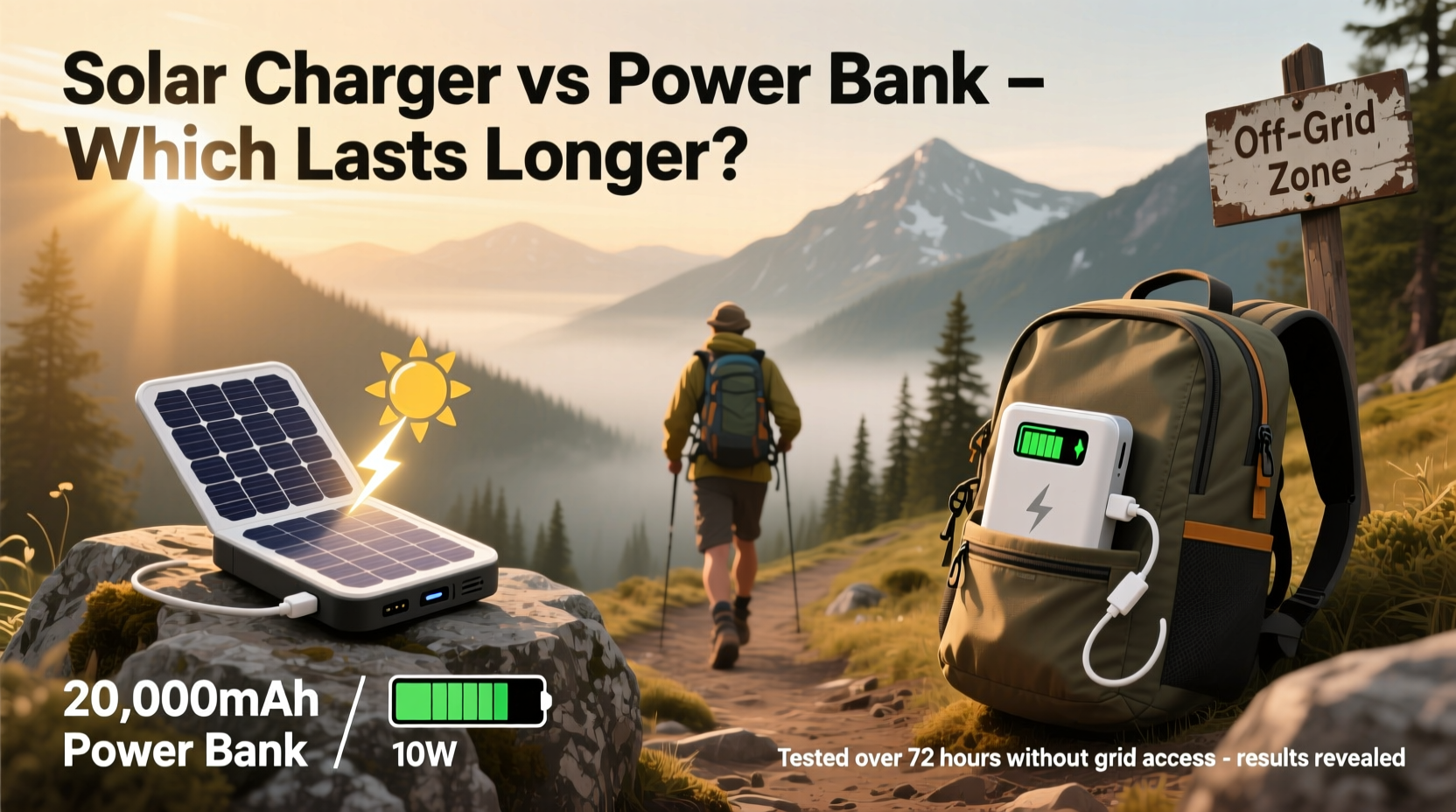
Power banks are portable batteries that store electrical energy for later use. They come in various capacities measured in milliampere-hours (mAh) or watt-hours (Wh). A typical 10,000 mAh power bank can fully charge a modern smartphone two to three times before needing a recharge itself. Their primary advantage lies in their simplicity and reliability. Once charged at home or via a car adapter, they deliver consistent output regardless of environmental conditions.
For short to medium-length hikes lasting one to three days, a high-capacity power bank is often the most practical solution. It’s lightweight, compact, and immune to weather fluctuations. You don’t need sunlight to extract its stored energy, making it ideal for forested trails, overcast regions, or nighttime use. However, this convenience comes with a hard limit: once depleted, it cannot regenerate power unless recharged through an external source—something rarely available deep in the backcountry.
Tip: Choose a power bank with at least 20,000 mAh capacity if planning multi-day trips without resupply points.Solar Chargers: Harnessing the Sun in the Wild
Solar phone chargers convert sunlight into electrical energy using photovoltaic cells. Most models designed for hiking are foldable, lightweight panels that connect directly to your device or charge an integrated battery. Unlike power banks, solar chargers offer the potential for unlimited energy—as long as the sun shines. This makes them theoretically better suited for extended expeditions where resupply isn’t possible.
However, real-world performance rarely matches theoretical output. Solar charging efficiency depends heavily on multiple factors: time of day, cloud cover, angle of incidence, shade from trees or mountains, and panel orientation. Even under optimal conditions, a small 10–20 watt solar panel may take 4–6 hours to fully charge a smartphone. In suboptimal light—common during early mornings, late afternoons, or rainy seasons—charging slows dramatically or stops altogether.
Many hikers opt for hybrid solar chargers that include a built-in battery. These allow users to collect solar energy throughout the day and store it for evening use. While more versatile than direct-charging models, they add weight and complexity, blurring the line between pure solar solutions and enhanced power banks.
“Solar charging works best when integrated into a broader energy strategy—not relied upon as a sole lifeline.” — Dr. Lena Torres, Renewable Energy Researcher at Mountain Tech Institute
Comparative Analysis: Key Factors That Determine Longevity Off Grid
To determine which option truly lasts longer in off-grid scenarios, several key variables must be evaluated beyond raw capacity or wattage ratings. Real endurance depends on usability across diverse environments and mission profiles.
| Factor | Power Bank Advantage | Solar Charger Advantage |
|---|---|---|
| Weather Dependency | None – works in rain, shade, or night | Highly dependent on sunlight; ineffective in clouds or dense canopy |
| Energy Replenishment | Limited by initial charge; no regeneration off-grid | Potential for continuous recharging if sun is available |
| Trip Duration Suitability | Ideal for trips up to 5 days | Better for trips exceeding 7–10 days with consistent sun exposure |
| Weight & Portability | Compact and light per unit of stored energy | Bulkier due to panel size; fragile components |
| Reliability | Consistent output; predictable performance | Variable output; requires user intervention for optimal positioning |
The data shows a clear trade-off: power banks win on consistency and ease of use, while solar chargers offer sustainability over time—but only under favorable conditions. For most weekend backpackers, a high-capacity power bank provides sufficient juice without added uncertainty. For thru-hikers on month-long treks like the Pacific Crest Trail or Appalachian Trail, especially in arid, sunny climates, solar becomes a compelling supplement—or even primary—energy source.
Real-World Scenario: A Weeklong Trek Through the Sierra Nevada
Consider Alex, an experienced hiker undertaking a seven-day solo trek through California’s High Sierra. The route includes alpine meadows, shaded pine forests, and exposed ridgelines. His gear list includes a GPS app, headlamp, camera, and emergency beacon—all powered by his smartphone and backup battery pack.
He begins with a fully charged 20,000 mAh power bank. Over the first four days, he uses it sparingly—just enough to top off his phone each evening. By day five, the power bank is nearly empty. There’s no way to recharge it until he reaches a ranger station on day seven.
This year, Alex decides to test a 25-watt foldable solar charger instead. Each morning, he hangs the panel from his backpack while hiking south-facing slopes. On clear days, he gains 30–50% charge by mid-afternoon. On cloudy days or when traveling through deep canyons, gains drop to 10% or less. Still, cumulative daily input allows him to maintain his phone above 40% throughout the trip—enough for navigation and periodic check-ins.
The result? The solar charger outlasted the single-use power bank in terms of total usable energy delivered over the week. But it required active management, patience, and ideal conditions. Had the trip occurred during spring snowmelt with persistent cloud cover, the outcome might have been different.
Tip: Always carry a backup charging method—even if relying primarily on solar. Combine a small power bank with a solar panel for redundancy.Best Practices for Maximizing Off-Grid Charging Efficiency
No matter which technology you choose, smart usage habits extend battery life and reduce dependency on external charging. Follow these steps to get the most from your gear:
- Minimize device usage: Turn off Bluetooth, Wi-Fi, and location services when not needed. Use airplane mode during long stretches without signal.
- Use low-power apps: Download offline maps (e.g., Gaia GPS or OsmAnd) to avoid constant data syncing.
- Charge during peak sun hours: If using solar, deploy panels between 10 a.m. and 2 p.m., when sunlight intensity is highest.
- Optimize panel angle: Position solar chargers perpendicular to the sun’s rays. Even small adjustments improve efficiency by 20–30%.
- Insulate in cold weather: Batteries lose capacity in freezing temperatures. Keep power banks close to your body overnight.
- Use efficient cables: Carry short, high-quality USB-C cables with minimal resistance to reduce energy loss.
Checklist: Preparing Your Charging System for Extended Hikes
- ✅ Assess trip length and expected sunlight exposure
- ✅ Calculate total device power needs (in Wh)
- ✅ Select a power bank with 1.5x your estimated consumption
- ✅ If using solar, verify panel wattage and compatibility with your devices
- ✅ Pack a dual-output charger to power multiple devices simultaneously
- ✅ Test all equipment together before departure
- ✅ Bring a lightweight carabiner or strap to hang solar panels
- ✅ Include a waterproof dry bag to protect electronics and chargers
Frequently Asked Questions
Can solar chargers work on cloudy days?
Yes, but with significantly reduced efficiency—typically 10% to 30% of rated output. Modern monocrystalline panels perform better in diffuse light than older polycrystalline types. However, prolonged overcast conditions will severely limit charging capability.
Is it safe to leave a solar charger in direct sun all day?
Most solar panels are designed for full sun exposure and won’t overheat under normal conditions. However, connecting devices directly for extended periods can risk voltage fluctuations. Using a regulated solar controller or charging a buffer battery first is safer than direct-to-phone charging.
Which lasts longer: a 20,000 mAh power bank or a 20W solar panel?
It depends on context. The power bank delivers ~74 watt-hours immediately and stops when drained. The solar panel generates ~100 watt-hours per day in full sun (5 hours × 20W), meaning it surpasses the power bank’s total output within two sunny days. Beyond that, solar continues generating, giving it superior longevity on long trips.
Final Recommendation: Match Technology to Mission Profile
There is no universal winner between solar phone chargers and power banks. The choice hinges on your specific adventure parameters. For weekend hikes, urban escape routes, or trips through heavily forested zones, a high-capacity power bank remains the simplest, most reliable solution. Its plug-and-play nature removes guesswork and ensures predictable performance.
For extended backcountry journeys lasting more than five days—especially in high-altitude deserts, open tundra, or dry summer conditions—a quality solar charger offers unmatched endurance. When paired with conservative power management, it enables true energy independence. Many seasoned adventurers now adopt a hybrid approach: carrying a moderate-sized power bank charged incrementally by a compact solar panel. This balances weight, reliability, and sustainability.
Ultimately, lasting longer off-grid isn’t just about hardware specs—it’s about system resilience. Redundancy, adaptability, and informed preparation matter more than any single gadget. Whether you choose solar, battery, or both, understanding their limits in real-world conditions empowers safer, more confident exploration.
💬 What’s your go-to charging setup for long hikes? Share your experiences, favorite gear, or lessons learned in the wild—we’d love to hear how you stay powered off the grid!








