
When preparing for a multi-day hiking trip, one of the most critical decisions involves how to keep your electronic devices powered. GPS units, smartphones, headlamps, and emergency beacons all depend on battery life—and running out in the backcountry can compromise safety and navigation. Two popular solutions dominate the market: solar chargers and power banks. While both serve the purpose of delivering energy off-grid, they operate under vastly different principles and suit different types of hikes. Understanding their strengths, limitations, and ideal use cases ensures you don’t end up with a dead phone at 10,000 feet.
How Solar Chargers Work in the Wild
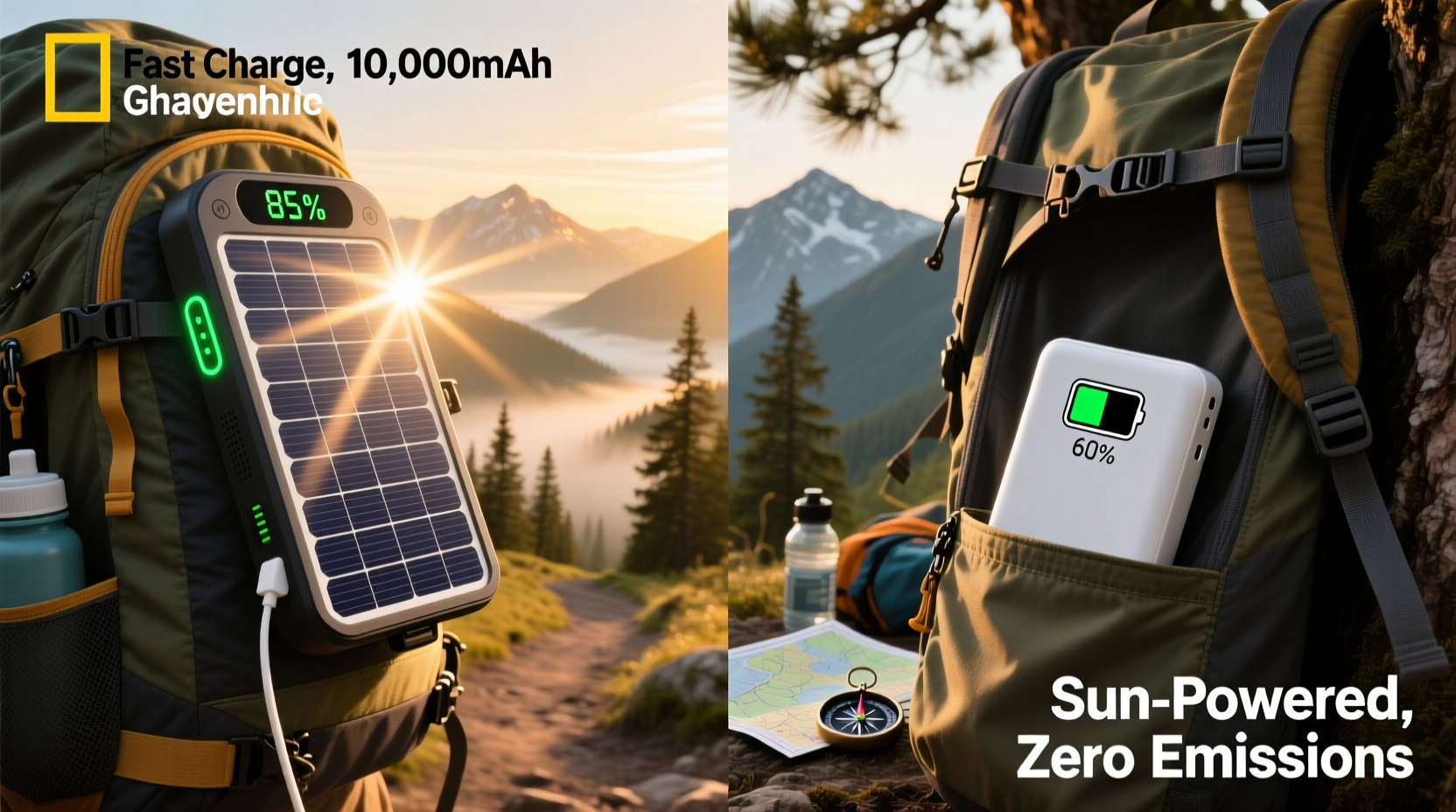
Solar chargers convert sunlight into electrical energy using photovoltaic cells. Most models designed for hiking are lightweight, foldable panels that connect directly to devices or charge an internal battery. They’re marketed as “infinite” power sources because, in theory, the sun recharges them endlessly. However, real-world conditions drastically affect performance.
Efficiency depends on several environmental factors: cloud cover, tree density, time of day, and panel angle. A solar charger rated at 15 watts may only produce 3–5 watts under partial shade or during early morning hours. Additionally, most hikers don’t have the luxury of pausing their trek to set up a panel at optimal angles. As a result, solar charging tends to be supplemental rather than primary.
Tip: For best results, position your solar panel at a 30–45 degree angle toward the sun and avoid placing it inside backpacks or shaded areas.Modern solar chargers often include USB ports and built-in batteries, allowing them to store energy during the day and charge devices at night. These hybrid models bridge the gap between pure solar and traditional power banks, but they still face inherent limitations tied to weather and exposure.
The Reliability of Power Banks Off-Grid
Power banks, also known as portable batteries, store electrical energy in lithium-ion or lithium-polymer cells. You charge them before your trip, then use them to recharge devices via USB. Their main advantage is consistency—what you pack is what you get. A 20,000mAh power bank will deliver approximately 60–70% of its rated capacity to a smartphone, regardless of weather or terrain.
They come in various sizes and capacities. Compact models (5,000–10,000mAh) fit easily in a jacket pocket and can fully charge a phone once or twice. Larger units (20,000mAh+) may weigh more but support multiple charges and even power small laptops or satellite messengers.
Unlike solar chargers, power banks do not require sunlight or setup time. You plug in and go. This makes them ideal for fast-paced hikes, unpredictable weather, or routes through dense forests where sunlight is limited. The downside? Once depleted, they can’t be recharged unless you carry a secondary source like a solar panel or return to civilization.
“On alpine traverses, I rely on high-capacity power banks. Solar is unreliable above treeline when storms roll in fast.” — Daniel Reyes, Wilderness Guide & NOLS Instructor
Comparative Analysis: Solar Charger vs Power Bank
| Feature | Solar Charger | Power Bank |
|---|---|---|
| Energy Source | Sunlight (renewable) | Premade charge (finite) |
| Recharge Capability | Yes, during daylight | No, unless paired with solar |
| Weather Dependence | High (clouds, shade reduce output) | None |
| Weight & Portability | Moderate to heavy (panels + cables) | Light to moderate (compact designs available) |
| Charging Speed | Slow (varies with light) | Fast and consistent |
| Lifespan | 3–5 years (UV degradation) | 2–4 years (battery cycles) |
| Best For | Long expeditions, sunny climates, ultralight resupply avoidance | Short-to-mid trips, variable weather, reliability-focused hikes |
This comparison highlights a fundamental trade-off: sustainability versus reliability. If your hike spans two weeks across open desert terrain with abundant sun, a solar charger might eliminate the need to carry multiple power banks. Conversely, if you're navigating Pacific Northwest rainforests or planning a five-day trek with storm forecasts, a pre-charged power bank offers peace of mind solar simply can't match.
Real-World Scenario: The Colorado Trail Test
In summer 2023, long-distance hiker Mara Lin completed a 450-mile segment of the Colorado Trail from Durango to Leadville. She carried both a 25,000mAh power bank and a 20-watt foldable solar charger. Her goal was to evaluate which device provided better value over rugged, high-altitude terrain.
During the first week, clear skies allowed her solar panel to generate enough power to top off her phone and GPS each afternoon while she cooked meals. However, in week two, persistent afternoon thunderstorms and forested sections reduced solar input by 70%. On three consecutive days, she gained less than 30 minutes of usable charging time from the panel.
Meanwhile, her power bank delivered consistent output. It fully charged her phone twice and topped off her Garmin inReach messenger daily. By the end of the segment, she concluded that while the solar charger extended her total energy availability, it couldn’t replace the dependability of stored power. She now uses solar only as a backup for trips exceeding 10 days.
Choosing Based on Trip Duration and Conditions
The decision between solar and power banks should align with your itinerary, environment, and risk tolerance.
For Short Trips (1–3 Days)
A single high-quality power bank is almost always sufficient. Charge your phone halfway before departure, limit screen time, and enable airplane mode overnight. Most smartphones last 2–3 days under conservative use. Add a 10,000mAh power bank, and you’ve doubled your margin of safety without extra weight.
For Medium-Length Hikes (4–7 Days)
Consider carrying two options: a large power bank (e.g., 20,000mAh) plus a compact solar charger (6–10W). Use the power bank first, and deploy the solar panel during rest breaks or camp downtime. This hybrid strategy balances reliability with renewal capability.
For Extended Expeditions (8+ Days)
Solar becomes more viable here. Carrying enough power banks to last two weeks adds significant weight and bulk. A durable solar charger—especially one with its own battery buffer—can offset this. Look for models with MPPT (Maximum Power Point Tracking) technology, which improves efficiency in low-light conditions.
Tip: Pair your solar charger with a battery case for your phone. This allows trickle-charging during movement, maximizing exposure.Step-by-Step: Planning Your Charging Strategy
- Assess your device needs: List all electronics (phone, GPS, headlamp, camera) and estimate daily consumption in mAh.
- Determine trip length: Multiply daily usage by number of days to find total energy required.
- Evaluate terrain and climate: Will you be in open sun or shaded forests? Check historical weather patterns.
- Select primary solution: Choose power bank(s) based on total capacity needed. Add solar only if sun exposure is reliable.
- Optimize usage: Enable battery saver modes, disable Bluetooth/Wi-Fi when unused, and take screenshots of maps offline.
- Test before departure: Simulate a full day’s use in the field to verify your system performs as expected.
Hybrid Approach: Best of Both Worlds?
Many experienced backpackers now adopt a dual-system approach. They carry a high-capacity power bank as their main energy source and a lightweight solar charger as a backup. Some advanced users even bring a small solar panel solely to recharge the power bank during lunch stops or midday rests.
This method combines immediate access to power with the potential for renewal. It’s particularly effective on long-distance trails like the Appalachian Trail or Pacific Crest Trail, where hikers face mixed environments and extended durations between towns.
However, this strategy increases cost and complexity. You must manage multiple devices, cables, and charging cycles. For casual hikers, simplicity often trumps marginal gains in sustainability.
Frequently Asked Questions
Can I charge my phone directly from a solar panel while hiking?
Technically yes, but inefficiently. Movement causes inconsistent sun exposure, and most phones pause charging below a certain wattage threshold. It's better to charge a power bank during the day and use it to charge devices later.
Do power banks lose charge when not in use?
Yes, all power banks experience self-discharge over time—typically 2–5% per month. Always charge them fully before departure and consider topping them off the night before a long trip.
Are solar chargers worth it for weekend hikes?
Rarely. Weekend trips rarely deplete modern smartphones completely, especially with conservative use. A small power bank weighs less and charges faster than a solar panel. Save solar for longer journeys.
Final Recommendation: Match Tool to Terrain
There is no universal winner in the solar charger vs power bank debate. The right choice depends on context. For most hikers on trips under a week, a quality power bank remains the superior option due to its reliability, speed, and ease of use. Solar chargers shine in specific scenarios: prolonged expeditions, sun-rich environments, and situations where minimizing resupply stops is crucial.
If you prioritize certainty over sustainability, go with a high-capacity power bank. If you're aiming for self-sufficiency on a month-long trek across the Southwest, invest in a robust solar setup. And for those in between, a hybrid model—power bank first, solar as backup—offers balanced resilience.
Ultimately, the best charging solution is the one that keeps your devices alive when you need them most. Whether powered by photons or pre-stored electrons, your gear should support your adventure—not hinder it.
🚀 Ready to optimize your next hike? Audit your current charging setup today. Swap outdated gear, test new combinations, and share your findings with fellow adventurers.








