When you're deep in the wilderness, a dead phone or GPS can mean more than inconvenience—it can be a safety risk. Staying connected, navigating trails, capturing memories, or simply checking weather updates all depend on charged devices. That’s why choosing the right power source is critical. Two popular options dominate the backpacker’s gear list: solar chargers and power banks. But which one truly keeps your devices alive longer during extended camping trips?
The answer isn’t straightforward. It depends on trip duration, weather conditions, energy needs, and how much weight you’re willing to carry. Understanding the strengths and limitations of each will help you make an informed decision—especially when every ounce counts and sunlight isn't guaranteed.
How Solar Chargers Work in Real Camping Conditions
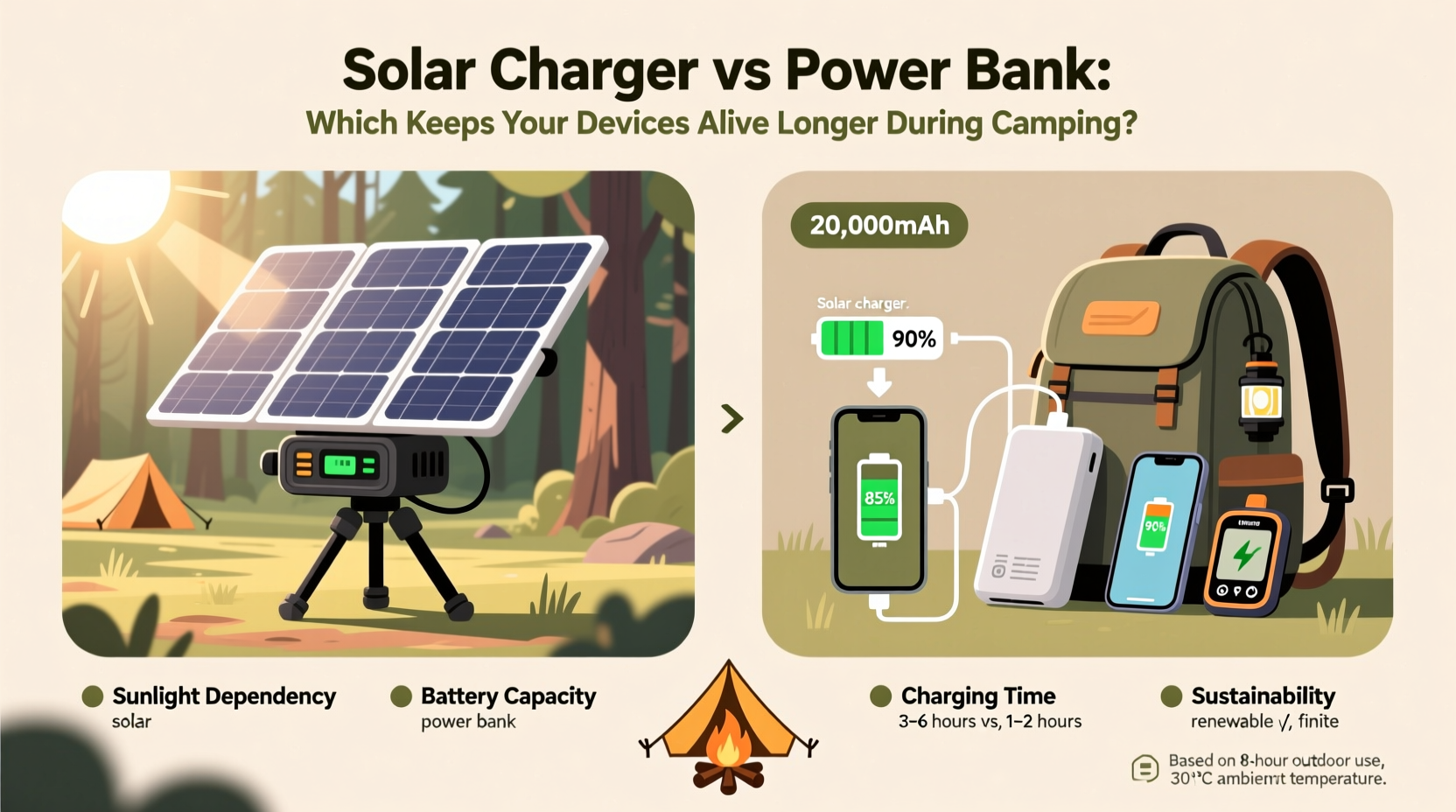
Solar chargers convert sunlight into electrical energy using photovoltaic cells. They range from small foldable panels (5–10W) to larger rigid units (20W+), often paired with built-in batteries or designed to charge external devices directly. Their appeal lies in their ability to generate power indefinitely—as long as the sun shines.
However, real-world performance rarely matches lab conditions. Cloud cover, tree canopy, dust on panels, and suboptimal angles reduce efficiency. A 10W solar panel might only deliver 3–5 watts under partial shade or overcast skies. Charging a smartphone could take 6–8 hours instead of the advertised 2–3.
Moreover, solar charging isn’t passive. You must position the panel correctly, secure it against wind, and ensure it receives direct sunlight for several hours. This means hanging it on your backpack while hiking or setting it up at camp—activities that require time and attention.
Tip: For best results, angle your solar panel south (in the northern hemisphere) and clean the surface daily to remove dust and debris.Power Banks: Reliable Energy in a Compact Package
Power banks are portable batteries that store electricity for later use. Measured in milliampere-hours (mAh) or watt-hours (Wh), they offer instant access to power regardless of weather or time of day. Modern models range from 5,000 mAh (enough for one phone charge) to 20,000+ mAh (multiple full charges for phones, tablets, or GPS units).
Their main advantage is consistency. A fully charged 10,000 mAh power bank delivers close to its rated capacity, especially if equipped with efficient circuitry and USB-C PD (Power Delivery). Unlike solar chargers, they work indoors, at night, or during rain—making them ideal for unpredictable environments.
But they have a hard limit: once depleted, they’re useless until recharged via wall outlet, car adapter, or—yes—paired with a solar panel. This makes them better suited for short trips (1–3 days) unless you carry multiple units or have a way to recharge them en route.
Direct Comparison: Solar Charger vs Power Bank
| Feature | Solar Charger | Power Bank |
|---|---|---|
| Energy Source | Sunlight (renewable) | Pre-charged battery (finite) |
| Lifespan per Trip | Indefinite with sun exposure | Limited by capacity; no recharge mid-trip without external source |
| Weather Dependency | High (clouds, shade reduce output) | None |
| Weight & Portability | Moderate to heavy (panels add bulk) | Light to moderate (compact designs available) |
| Charging Speed | Slow to moderate (varies with light) | Fast and consistent (depends on output specs) |
| Maintenance Needs | Panel cleaning, positioning, securing | Minimal (store charged, avoid extreme temps) |
| Best For | Extended trips, off-grid travel, sunny climates | Short trips, emergency backup, mixed-weather conditions |
Real-World Scenario: A 7-Day Backpacking Trip in the Rockies
Consider Alex, an experienced hiker embarking on a week-long trek through Colorado’s high country. His gear includes a smartphone for navigation and photos, a headlamp, and a satellite communicator. He needs reliable power but wants to minimize pack weight.
He starts with a 20,000 mAh power bank—enough for about four full phone charges. On day three, after heavy GPS use, the bank drops below 25%. Rain sets in on day four, lasting 36 hours. Without access to grid power and limited sunlight, he cannot recharge. By day six, his phone dies mid-hike, forcing him to navigate using paper maps.
In contrast, a fellow hiker carries a 15W foldable solar panel with a 10,000 mAh built-in battery. Each morning, she hangs the panel on her pack while hiking. Even under partial cloud cover, it generates 3–5 watts per hour. Over six hours of daylight, she gains 18–30Wh—enough to fully recharge her phone and keep her GPS running. On cloudy days, she supplements with stored energy in the internal battery.
This example illustrates a key insight: solar chargers extend usability over time, while power banks offer immediate but finite power. For trips beyond three days, especially in remote areas, solar provides a sustainability edge—if used strategically.
“On multi-day expeditions, energy renewal matters more than storage capacity. A well-designed solar setup can outlast multiple power banks combined.” — Dr. Lena Torres, Outdoor Technology Researcher, National Institute of Wilderness Safety
Hybrid Approach: Best of Both Worlds
The most effective solution for many campers isn’t choosing between solar and power banks—it’s combining them. A hybrid system uses a solar charger to replenish a high-capacity power bank during the day, creating a buffer for nighttime or low-light use.
For instance, a 10W solar panel connected to a 20,000 mAh power bank can refill it over two sunny days. Once charged, the power bank powers devices reliably at night. This setup balances efficiency, convenience, and resilience.
Some modern devices integrate both functions. All-in-one solar power banks feature built-in panels and large batteries, allowing simultaneous charging and storage. While heavier and pricier, they simplify logistics for less technical users.
Step-by-Step: Building Your Ideal Camping Power System
- Assess your device power needs. Calculate total watt-hours used per day. Example: iPhone 15 (~15Wh), headlamp (~5Wh), GPS (~10Wh) = ~30Wh/day.
- Determine trip length. Short trips (≤3 days): power bank sufficient. Long trips (≥4 days): consider solar or hybrid.
- Choose a primary power source. For reliability: high-capacity power bank (10,000–20,000 mAh). For sustainability: solar panel (10–20W) with or without integrated battery.
- Add redundancy. Carry a small backup power bank even if using solar—just in case of prolonged bad weather.
- Optimize charging habits. Charge devices during peak sun hours, use airplane mode to conserve battery, and avoid draining devices completely.
- Test before departure. Simulate conditions at home: expose solar panel to indirect light, measure actual output, and verify compatibility with your devices.
Expert Tips for Maximizing Device Battery Life
Regardless of your power source, conserving energy extends uptime. Small changes in usage can double your device runtime.
- Enable airplane mode or turn off cellular data when not needed—this alone can reduce phone power consumption by 30–50%.
- Lower screen brightness and set auto-lock to 30 seconds.
- Download offline maps (e.g., Gaia GPS, Maps.me) to avoid constant data transmission.
- Carry devices in insulated pockets to protect batteries from cold, which reduces lithium-ion efficiency.
- Charge during midday sun (10 a.m.–2 p.m.) when solar intensity peaks.
Frequently Asked Questions
Can I charge a power bank with a solar charger while using it?
Yes, most modern power banks support “pass-through charging,” meaning they can receive input from a solar panel while simultaneously powering a device. However, this may generate heat and slightly reduce efficiency. Check manufacturer specifications before relying on this feature.
Are solar chargers worth it for weekend camping trips?
For trips under 48 hours, a fully charged power bank is usually sufficient and more convenient. Solar chargers shine on longer excursions where recharging opportunities are nonexistent. If your weekends involve frequent backcountry travel, investing in a compact solar panel adds peace of mind.
How do I know if a solar charger is powerful enough?
Look at the wattage (W) rating. A 10W panel can charge a typical smartphone in 4–6 hours under good sunlight. For faster charging or larger devices (tablets, cameras), choose 15W or higher. Also check voltage compatibility—most devices need 5V USB output.
Final Verdict: Which Keeps Devices Alive Longer?
When it comes to longevity of device uptime, **solar chargers win for trips exceeding three days**, provided there is reasonable sun exposure. Their ability to continuously harvest energy creates a renewable power loop that no finite battery can match. In contrast, even the largest power banks eventually run dry without external recharging.
However, power banks deliver unmatched convenience, speed, and reliability in the short term. They’re ideal for quick getaways, emergencies, or supplementing solar systems during cloudy stretches.
The smartest approach blends both. Start with a fully charged high-capacity power bank as your primary reserve. Pair it with a lightweight solar charger to replenish energy daily. This hybrid strategy ensures your devices stay alive—not just for a few days, but for the duration of any adventure.
“The future of outdoor power isn’t about bigger batteries, but smarter energy cycles. Solar integration turns a power bank from a finite resource into a sustainable tool.” — Mark Rios, Senior Engineer at TrailJuice Electronics
Take Action: Power Smarter on Your Next Adventure
Your next camping trip doesn’t have to end with a dead phone or missed photo opportunity. Evaluate your typical energy use, trip length, and environmental conditions. Then build a power system that matches your real needs—not just advertised specs.
Start small: if you don’t own either, try a 10,000 mAh power bank first. Once you’ve gauged your consumption, add a solar panel for longer journeys. Document your charging patterns and refine your setup over time.
💬 What’s your go-to power solution for camping? Share your experience, favorite gear, or lessons learned in the comments below—help fellow adventurers stay powered and prepared!








