For urban commuters and recreational riders alike, personal mobility devices like skateboards and electric scooters have surged in popularity. They’re compact, eco-friendly, and often faster than walking. But when you're just starting out, a critical question arises: which is safer and easier to learn? The answer depends on several factors — including your age, coordination, environment, and risk tolerance. This article breaks down both options with real-world insights, safety data, and practical advice to help beginners make an informed decision.
Understanding the Basics: How Each Works
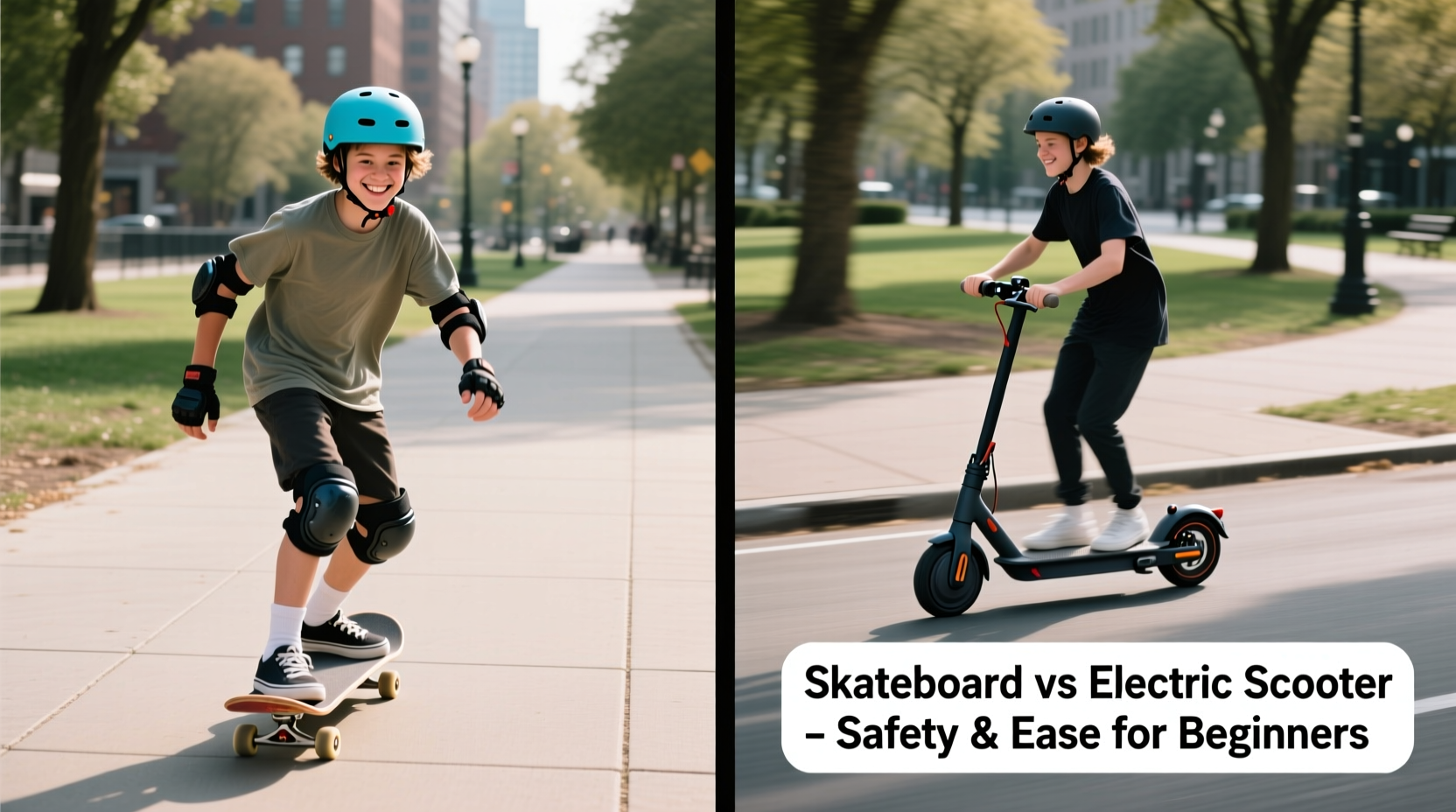
A traditional skateboard consists of a wooden deck, four wheels, and trucks (axles). It requires physical propulsion—usually by pushing with one foot—along with balance and coordination to steer and stop. Electric scooters, on the other hand, feature a motorized deck, handlebars, brakes, and a battery-powered system. Riders stand on the platform and control speed and braking via electronic throttles and levers.
The fundamental difference lies in control and input. Skateboarding demands full-body engagement from the start. Even basic movement requires coordination between balance, momentum, and leg strength. Electric scooters simplify this process: minimal physical effort is needed once the device is moving, and the handlebars provide directional stability that skateboards lack.
Tip: If you've never ridden either, try renting or borrowing before buying—many cities offer shared e-scooter services ideal for test runs.Safety Comparison: Injury Rates and Risk Factors
Safety is often the top concern for beginners. According to a 2023 study published in the journal *Injury Prevention*, e-scooter riders are more likely to suffer head injuries and fractures than skateboarders, primarily due to higher average speeds and delayed reaction times. However, skateboarding has its own risks—especially related to falls during balancing attempts and loss of board control at low speeds.
E-scooters typically travel between 10–15 mph, with some models reaching up to 20 mph. At these velocities, even minor obstacles like potholes or gravel can cause sudden instability. In contrast, beginner skateboarders usually move under 5 mph, reducing impact severity in case of a fall—but increasing the frequency of tipping over due to poor balance.
“Beginners on skateboards tend to fall more often but less severely. E-scooter crashes are less frequent but often result in more serious injuries due to speed and rigid frame design.” — Dr. Lena Torres, Urban Mobility Safety Researcher, UC Berkeley
Common Injuries by Device
| Device | Most Common Injuries | Average Speed | Hospitalization Rate* |
|---|---|---|---|
| Skateboard | Wrist sprains, scraped knees, ankle twists | 3–6 mph | Low (~5%) |
| Electric Scooter | Head trauma, facial lacerations, broken wrists | 10–15 mph | Moderate (~15%) |
*Based on aggregated ER data from U.S. cities (2020–2023). Rates reflect incidents requiring medical attention beyond first aid.
Learning Curve: Which Is Easier to Master?
When it comes to ease of use, electric scooters clearly have the edge for most beginners. Within 10–15 minutes, a new rider can learn to accelerate, turn gently, and brake safely—provided they maintain focus and avoid distractions. The handlebars act as a stabilizing anchor, giving users something to hold onto while adjusting their stance.
Skateboarding, by contrast, presents a steeper initial challenge. Standing still on a stationary board without rolling backward takes practice. Pushing off smoothly, maintaining balance while coasting, and stopping without jumping off require muscle memory development. Most beginners take several sessions—sometimes spanning weeks—to ride confidently for more than a few blocks.
First-Time Experience Breakdown
- Electric Scooter: Immediate usability with basic instructions. Balance is aided by two wide wheels and upright posture.
- Skateboard: High likelihood of wobbling or falling within the first five minutes. Requires repeated short sessions to build confidence.
Age and prior experience play significant roles. Children aged 8–14 often adapt faster to skateboards due to lower body weight and natural agility. Adults over 25, especially those with no board sports background, typically find electric scooters far more approachable.
Tip: Practice in a flat, traffic-free area like a parking lot or quiet sidewalk. Avoid hills until you’re confident with braking and turning.Environmental and Practical Considerations
Your local terrain and infrastructure heavily influence which device is safer and easier. Smooth pavement favors both, but uneven sidewalks, cracks, and debris pose greater risks to e-scooters because of their smaller front wheels and forward momentum. A sudden bump can launch a rider over the handlebars—a phenomenon known colloquially as \"endoing.\"
Skateboards, while also sensitive to surface quality, allow riders to dismount mid-roll more easily. Since there’s no motor, losing control rarely results in high-speed collisions. However, skateboards are harder to carry uphill and less efficient for longer distances—typically limited to 1–2 miles comfortably.
Portability matters too. Foldable e-scooters weigh 25–30 lbs but can be carried onto public transit or stored under desks. Traditional skateboards are lighter (7–10 lbs) and more compact, making them easy to stash in lockers or carry by hand—but impractical if you need to cover distance without riding.
Urban Navigation Challenges
- Curbs and Steps: E-scooters struggle with curbs; lifting 30 lbs repeatedly is tiring. Skateboards can be jumped or carried with technique.
- Traffic Zones: E-scooters may legally ride in bike lanes or roads in many cities, increasing exposure to vehicles. Skateboards are often restricted to sidewalks, reducing collision risk but raising pedestrian conflict concerns.
- Weather Resistance: Most e-scooters are water-resistant but not waterproof. Wet surfaces drastically reduce traction. Skateboards, especially with urethane wheels, perform slightly better in light dampness but still become slippery.
Essential Safety Gear Checklist
No matter which device you choose, protective equipment significantly reduces injury risk. Helmets alone cut the risk of head injury by up to 85%, according to the National Highway Traffic Safety Administration (NHTSA).
📋 **Beginner Safety Checklist**- ✅ Certified helmet (CPSC or ASTM standard)
- ✅ Wrist guards (especially crucial for skateboarding)
- ✅ Elbow and knee pads
- ✅ Closed-toe shoes with grippy soles
- ✅ Reflective clothing or lights (for low-light conditions)
- ✅ Bell or horn (required in some municipalities)
Many beginners skip wrist guards, yet wrist fractures are among the most common injuries across both activities. Investing in padded gloves or dedicated guards is a small price for avoiding a six-week recovery.
Real-World Example: Two Beginners, Two Choices
Consider the experience of Maya and Jordan, both 28-year-old office workers living in downtown Austin. They each wanted a fun, efficient way to commute the last mile from the train station to work.
Maya chose a foldable electric scooter. On her first day, she rode 0.8 miles with only minor wobbling. She appreciated the throttle control and brakes. However, on day three, she hit a crack at 12 mph and fell forward, scraping her hands and damaging the scooter’s front wheel. Fortunately, she wore a helmet and wrist guards. After replacing the tire, she slowed down and began scanning the road ahead more carefully.
Jordan opted for a classic popsicle-shaped skateboard. His first week involved daily falls—twice on grass, once on pavement resulting in a bruised elbow. But by week three, he was carving smoothly through the park. He found the physical effort rewarding and enjoyed the skill progression. However, after two months, he switched to an e-scooter for longer commutes, citing fatigue and time constraints.
Their stories highlight a key insight: e-scooters offer faster functional utility, while skateboards reward patience with long-term agility and fitness benefits.
Step-by-Step Guide to Getting Started Safely
🕒 **Your First 7 Days: A Beginner’s Roadmap**- Day 1: Choose your device and purchase essential safety gear. Read the user manual thoroughly.
- Day 2: Find a smooth, empty space (parking lot, tennis court, quiet street). Walk alongside the device to get a feel for its weight and balance.
- Day 3: For e-scooters: Practice mounting, throttling slowly, and using the brake. For skateboards: Stand on the board with feet shoulder-width apart. Practice shifting weight side to side.
- Day 4: Add motion. Push once on the skateboard and coast. Ride the e-scooter in short bursts, braking early.
- Day 5: Introduce gentle turns. Keep movements small and controlled.
- Day 6: Try stopping techniques—foot dragging (skateboard) or gradual brake application (e-scooter).
- Day 7: Combine skills. Ride a short loop, practicing starts, turns, and stops. Record your session if possible to review form.
Repeat this cycle weekly until you feel stable at moderate speeds. Never rush into traffic or high speeds before mastering emergency stops.
Frequently Asked Questions
Is it legal to ride skateboards or e-scooters on sidewalks?
Laws vary by city. In many urban areas, e-scooters are banned from sidewalks and must use bike lanes or roads. Skateboards are often permitted on sidewalks but may be restricted in business districts. Always check local ordinances before riding.
Which is better for exercise—skateboard or e-scooter?
Skateboards require constant leg movement and core engagement, offering moderate cardiovascular and balance training. E-scooters involve minimal physical effort unless you push manually. For fitness, skateboarding wins; for efficiency, e-scooters do.
Can children safely use either device?
Children under 12 should avoid e-scooters due to speed and complexity. Skateboards can be suitable with adult supervision, proper gear, and use of mini or cruiser boards designed for younger riders. Always prioritize helmets and pads.
Final Verdict: Which Should You Choose?
If your primary goal is convenience, speed, and minimal learning time, the electric scooter is the better choice. It’s easier to operate, covers distance efficiently, and integrates well with public transit. Just remember: higher speed means higher risk. Respect the machine, wear protection, and ride defensively.
If you value physical engagement, long-term skill development, and portability, a skateboard may suit you better—even if the beginning is frustrating. Falls are frequent but generally less severe. Over time, skateboarding builds exceptional coordination and confidence.
Ultimately, safety isn’t just about the device—it’s about behavior. A cautious e-scooter rider with full gear is safer than a reckless skateboarder doing tricks on a busy street. Environment, speed, awareness, and preparation matter more than the mode itself.
“The safest rider isn’t the one with the most advanced gear—it’s the one who respects momentum, wears protection, and knows their limits.” ��� Mark Delgado, Founder, CityRide Safety Initiative
Take Action Today—Safely
Whether you lean toward the responsive glide of a skateboard or the effortless hum of an electric scooter, the best way to begin is with intention. Equip yourself properly, start slow, and prioritize control over speed. Your first rides don’t need to be perfect—they just need to be safe. Try both if possible, and let your comfort level guide your decision. With the right mindset and precautions, either option can become a reliable, enjoyable part of your daily routine.
💬 Have a beginner story or tip to share? Join the conversation—your experience could help someone else start their journey with confidence.








