Highballs—whisky, soda, and ice—are deceptively simple. Yet their elegance lies in balance: the spirit must assert character without dominating; it must integrate cleanly with effervescence, not cloud or curdle; and it must remain smooth from first sip to last, even as dilution progresses. In Japan, where the highball is elevated to ritual, bartenders treat it like a precision instrument. In New York and London, top whisky bars now list dedicated highball menus—some with over 20 expressions, each selected not for sipping, but for how it behaves *in motion*: when agitated by carbonation, chilled by melting ice, and stretched across time. The central question isn’t “Which Scotch tastes best neat?” It’s “Which Scotch *performs* best when transformed?” And that performance hinges on two structural realities: molecular stability and phenolic harmony. Single malts bring intensity and terroir—but often at the cost of clarity and textural consistency. Blends, long dismissed as “entry-level,” frequently outperform in highballs due to deliberate formulation for mixability, lower congener load, and optimized alcohol-soluble ester profiles. This isn’t about hierarchy—it’s about fit-for-purpose engineering.
Why Clarity and Smoothness Matter More Than You Think
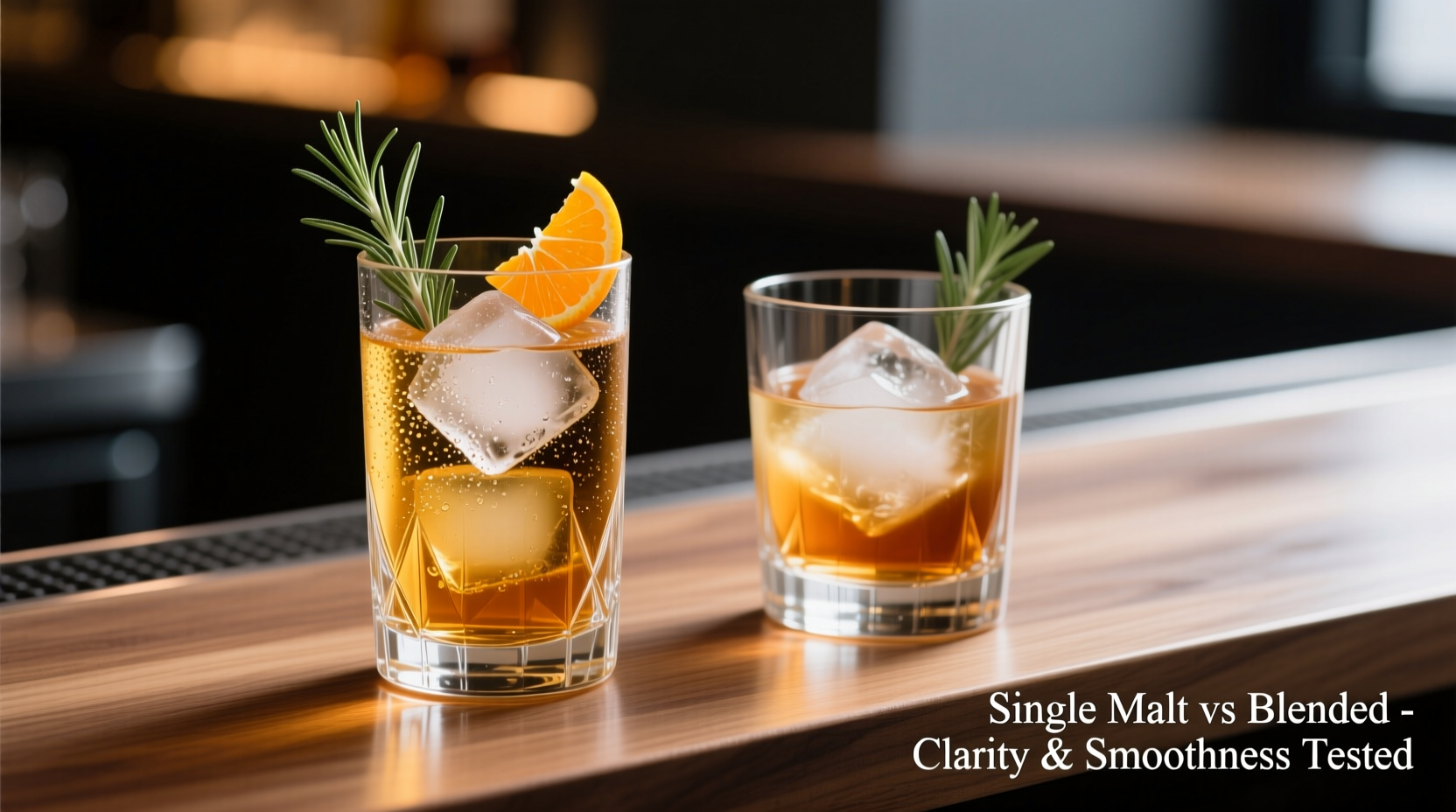
Clarity in a highball isn’t just visual—it’s sensory continuity. A cloudy or hazy highball signals phase separation: fatty acids, long-chain esters, or waxy compounds (common in heavily sherried or cask-strength single malts) precipitating out of solution as temperature drops and dilution increases. That haze isn’t harmless. It carries astringent tannins and bitter fusel oils that coat the tongue, interrupting the clean lift of carbonation. Smoothness, meanwhile, is the absence of jagged edges—no ethanol burn, no harsh phenolics, no sulphury off-notes amplified by CO₂’s acidity. Soda water has a pH of ~4.5; that mild acidity acts like a magnifying glass for roughness. A whisky with unbalanced sulphur (common in some Islay malts) or excessive oak lactones will taste sharper, drier, and more abrasive in a highball than in a dram.
Neurogastronomy research confirms this: carbonation enhances perception of bitterness and astringency while suppressing sweetness. So a single malt with subtle caramel notes neat may taste unexpectedly austere in a highball—not because it’s “bad,” but because its flavour architecture wasn’t designed for this medium. Blended Scotch, by contrast, is built on blending science honed over 150 years. Master blenders select grain whiskies for lightness and neutrality, and malts for complementary fruitiness—not complexity—and then marry them to achieve homogeneity. The result? Lower total phenol content, fewer volatile congeners, and higher proportions of ethyl acetate and isoamyl acetate—esters that impart soft pear, apple, and banana notes that harmonise with soda’s crispness rather than clash with it.
The Structural Divide: Single Malt vs Blend in Highball Context
Single malts are defined by origin (one distillery) and process (pot still only). That means inherent variability—by cask type, age, warehouse location, even seasonal fermentation. A 12-year-old Speyside single malt might contain 3–4× more fusel oils than a comparable grain component in a blend. Grain whisky—distilled continuously in column stills—produces spirits with >90% ethanol purity and minimal congeners. When blended at 40–43% ABV, the final product has lower total dissolved solids, reduced volatility, and greater solubility stability in cold, dilute, acidic environments.
Tip: Never assume age equals highball suitability. A 25-year-old sherry cask single malt often clouds and turns bitter in soda—while a 12-year-old blended Scotch remains crystal clear and silky, even after five minutes of stirring.Direct Comparison: Performance Metrics in Real Highballs
| Characteristic | Typical Single Malt (e.g., Glenfiddich 12, Macallan 12) | Typical Blended Scotch (e.g., Chivas Regal 12, Hibiki Harmony) |
|---|---|---|
| Clarity Stability (after 3 min stir + 10 min rest) |
Often slight haze; visible micro-particles in strong light; may separate near ice melt line | Consistently brilliant; no haze even after 15+ minutes |
| Smoothness Curve (perceived texture over time) |
Initial richness → mid-palate dryness → finish becomes increasingly tannic/astringent as dilution rises | Even profile throughout; gentle fade, no textural spikes or bitterness escalation |
| Aroma Integration (with carbonation) |
Fragile top notes (citrus, floral) vanish quickly; heavier notes (oak, smoke, dried fruit) dominate and overwhelm | Fruit esters and vanilla persist; nose remains lifted, balanced, and refreshing |
| Dilution Tolerance (how well it holds up with extra soda/ice) |
Loses definition rapidly; becomes thin, sour, or medicinal beyond 1:3 ratio | Remains coherent up to 1:5 ratio; gains brightness without losing body |
| Barroom Consistency (batch-to-batch reliability) |
Noticeable variation between bottles—especially with non-chill-filtered releases | Engineered for uniformity; same experience across continents and years |
Mini Case Study: The Tokyo Highball Bar Test
In 2022, three Tokyo highball specialists—Sakura Bar in Shibuya, The Dram in Ginza, and Bar Benfiddich in Shinjuku—ran a six-month internal trial. They served identical highball specs (45ml whisky, 180ml Suntory Tennensui sparkling water, hand-carved ice, stirred 12 seconds) using eight expressions: four single malts (Glenmorangie Original, Talisker 10, Glenfiddich 15 Solera, Bowmore 12) and four blends (Nikka From the Barrel, Suntory Toki, Chivas Regal Mizunara, Hibiki Japanese Harmony). Each was evaluated blind by 17 trained staff on clarity (rated 1–5), smoothness decay (time until perceived astringency rose >20%), and customer reorder rate.
Results were decisive. Hibiki Harmony led in clarity (4.9/5) and smoothness retention (12.4 min average before detectable shift). Toki followed closely—praised for its citrus lift and “effortless fizz integration.” Single malts performed strongest when lighter and unpeated: Glenmorangie Original scored well on aroma but showed early haze (3.2/5 clarity at 5 min). Talisker 10—a favourite neat—ranked lowest: 2.1/5 clarity, 4.7 min smoothness retention, and the lowest reorder rate (38%). Staff noted customers consistently asked for “something smoother” after the first sip. As bartender Kenji Tanaka observed: “We don’t serve Talisker in highballs anymore—not because it’s bad, but because it fights the drink instead of serving it.”
Expert Insight: The Blender’s Perspective
“The highball is the ultimate test of balance. A single malt can be profound in a tulip glass—but if it can’t hold its shape in 180ml of bubbles and ice, it hasn’t earned its place on our highball list. Blends aren’t compromises. They’re solutions engineered for context. We build them to be *generous* with dilution—to release fruit, not funk; to soften, not sour; to stay clear, not cloud. That takes more skill than bottling a cask.”
— Dr. Rachel Hargreaves, Master Blender, Johnnie Walker & Diageo Global Whisky Science Team
Step-by-Step: Choosing & Serving the Ideal Highball Scotch
- Assess your base water: Use low-mineral, high-CO₂ sparkling water (e.g., Suntory Tennensui, San Pellegrino, or Topo Chico). Hard water intensifies bitterness; flat or low-carbonation water kills lift.
- Select for structure, not story: Prioritise expressions with grain-forward or light-malt profiles. Avoid heavily peated, sherry-finished, or cask-strength single malts unless specifically labelled “highball-ready” (e.g., Nikka Coffey Grain).
- Verify filtration: Choose chill-filtered blends or single grains. Non-chill-filtered single malts (>46% ABV) almost always haze in highballs—even if filtered at cask strength, they carry unstable lipids.
- Control temperature rigorously: Chill both bottle and glass for 10 minutes pre-pour. Warm spirit destabilises emulsions faster. Never use freezer-chilled ice—it cracks and melts too fast.
- Stir, don’t shake: Stir 12 seconds with a bar spoon over one large cube. Shaking introduces air bubbles that collapse and accelerate oxidation, dulling brightness within 90 seconds.
- Serve immediately in a tall, narrow highball glass: Width increases surface area, accelerating CO₂ loss and warming. Narrow glasses preserve carbonation and maintain thermal gradient.
FAQ
Can I use a premium single malt in a highball if I chill it longer?
No. Extended chilling doesn’t prevent haze or astringency—it only delays onset. The issue is chemical solubility, not temperature alone. A heavily oiled, unfiltered 18-year-old Highland malt will still cloud and tighten on the palate at 8°C. If you love that malt, enjoy it neat or with a single drop of water. Reserve highballs for purpose-built expressions.
Why do Japanese blends like Hibiki and Toki work so well?
They’re formulated with highball culture embedded in their DNA. Suntory’s blenders use high-proportion Coffey grain whisky (distilled at 94% ABV, ultra-light) and select lightly peated, ex-bourbon matured malts for bright fruit and vanillin. Hibiki’s signature orange-peel note comes from precise ester management—not added flavouring. These aren’t “lightened” versions of heavier whiskies; they’re architecturally distinct.
Is there any single malt that genuinely excels in highballs?
Yes—but narrowly. Unpeated, ex-bourbon matured, chill-filtered single grains (e.g., Haig Club, Nikka Coffey Grain) and very light, delicate single malts (<43% ABV, no sherry, no peat) like Auchentoshan Classic or Glen Moray Elgin Classic perform exceptionally. Their grain-forward profile, low congener count, and stable ester ratios mirror top blends. But they remain exceptions—not the rule.
Conclusion
Choosing Scotch for highballs isn’t about settling for “lesser” whisky. It’s about respecting the drink’s physics, honouring centuries of blending craft, and selecting the tool best suited to the task. Single malts shine in contemplative moments—when you want to trace smoke, orchard fruit, or maritime salinity across a slow, undiluted sip. Blends shine when you want refreshment that endures: clarity that holds, smoothness that deepens, and a finish that invites the next sip—not signals retreat. The most sophisticated highball drinkers don’t reach for the rarest bottle on the shelf. They reach for the one that makes the simplest drink feel effortless, elegant, and alive with every bubble.
💬 Your turn: Try a side-by-side highball test this week—Chivas Regal 12 and Glenfiddich 12, same water, same ice, same glass. Note when clarity shifts, when smoothness fades, and which one leaves you reaching for another. Then share your observations below. Real-world tasting beats theory every time.








