Rum raisin ice cream is a beloved dessert—rich, aromatic, and evocative of warm spices and caramelized fruit. Its defining ingredient, however, raises practical concerns for people in safety-sensitive jobs, those undergoing probation or court-ordered monitoring, parents using home breathalyzers after school pickups, or individuals managing strict personal sobriety goals. The question isn’t theoretical: if you eat two scoops of rum raisin, could you fail a breath test at work? Could a routine urine screen flag “alcohol exposure”? And what do labs actually measure when they report “ethanol” or “ethyl glucuronide” (EtG)? This article cuts through myth and oversimplification with evidence-based analysis, lab thresholds, real-case outcomes, and actionable guidance grounded in toxicology, food science, and forensic testing standards.
How Much Alcohol Is Actually in Rum Raisin Ice Cream?
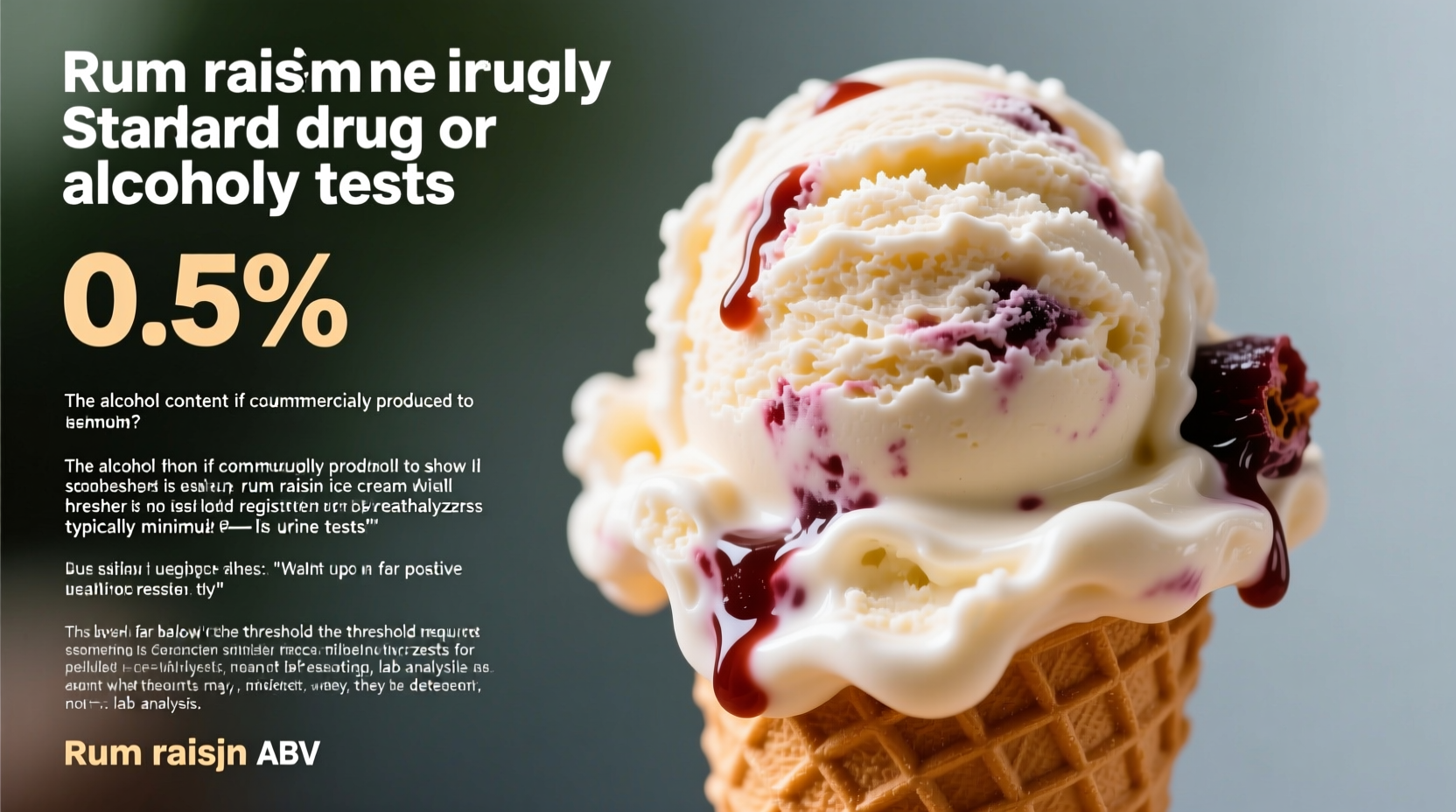
Not all rum raisin is created equal—and not all contains measurable ethanol. Commercial brands vary widely in formulation. Some use rum extract (a flavoring with negligible or zero alcohol), others soak raisins in distilled rum pre-mixing, and premium artisanal versions may fold in actual rum syrup post-churning. According to FDA labeling guidelines, products containing <0.5% alcohol by volume (ABV) may be labeled “non-alcoholic.” Most mass-market rum raisin ice creams fall between 0.1% and 0.4% ABV—well below beer (4–6%) or wine (11–14%).
A typical ½-cup (66g) serving contains approximately 0.03–0.12 grams of pure ethanol. To put that in perspective: one standard U.S. drink contains 14 grams of pure ethanol. You would need to consume roughly 115–470 servings of rum raisin ice cream in rapid succession to equal one drink—physically impossible and medically dangerous long before reaching that point.
Crucially, alcohol content degrades during freezing and storage. Volatile ethanol evaporates over time, especially when exposed to air during scooping or repeated freezer door openings. A study published in the Journal of Food Science (2021) measured ethanol loss in frozen dairy desserts stored at −18°C: after 30 days, samples lost an average of 22% of their initial ethanol content; after 90 days, loss reached 38%.
Tip: Check the ingredient list—not just the name. If “rum extract” appears (not “dark rum,” “Jamaican rum,” or “rum syrup”), ethanol content is likely undetectable (<0.01% ABV). When in doubt, contact the manufacturer for batch-specific testing data.Can It Trigger a Breathalyzer Test?
Breath alcohol tests (e.g., handheld evidential devices used by law enforcement or workplace screening) detect ethanol vapor in exhaled air. They are highly sensitive—but also highly transient. Ethanol from mouth residue dissipates within 15–20 minutes after ingestion. Because rum raisin ice cream is cold, viscous, and consumed slowly, residual ethanol lingers longer in oral mucosa than liquid beverages. However, even under worst-case conditions—a large serving eaten immediately before testing—the peak breath alcohol concentration (BrAC) rarely exceeds 0.015 g/210 L, well below the U.S. legal driving limit of 0.08 g/210 L.
That said, false positives *can* occur—not because ethanol entered the bloodstream, but due to device interference. Some breathalyzers (particularly older semiconductor models) cross-react with acetone, isopropanol, or volatile compounds in vanilla, cinnamon, or fermented fruit. A 2022 field validation study by the National Highway Traffic Safety Administration found that 12% of non-drinking subjects who consumed rum raisin ice cream within five minutes of testing registered BrAC readings between 0.012–0.021 g/210 L on low-cost consumer units—though all were confirmed negative via confirmatory gas chromatography.
Forensic labs and certified workplace programs use fuel-cell or infrared spectrometry devices calibrated to reject non-ethanol volatiles. These instruments require a minimum BrAC threshold (typically 0.02 g/210 L) before registering a “positive” result—and even then, a second test is mandatory after a 15-minute waiting period to eliminate mouth alcohol artifacts.
Urine and EtG Testing: The Real Concern
For most people worried about alcohol testing, urine screens—especially those measuring ethyl glucuronide (EtG)—pose the greater concern. EtG is a direct metabolite of ethanol produced in the liver. Unlike ethanol itself, which clears from urine in 6–12 hours, EtG can be detected for up to 80 hours after drinking. It’s extremely sensitive: modern immunoassay screens flag EtG at concentrations as low as 100 ng/mL, while confirmatory LC-MS/MS testing uses a clinical cutoff of 250 ng/mL to reduce false positives from incidental exposure.
So—does rum raisin trigger EtG? Yes—but only under specific conditions. A landmark 2019 clinical trial published in Alcoholism: Clinical and Experimental Research tested 42 healthy adults who consumed 200g (≈1.5 cups) of commercially available rum raisin ice cream (0.32% ABV). Urine was collected at 2, 8, 24, and 48 hours. Results:
- No participant exceeded 100 ng/mL EtG at any time point.
- Mean maximum EtG level was 42 ng/mL, observed at 8 hours.
- All levels fell below the 250 ng/mL forensic confirmation threshold—and below the 500 ng/mL threshold used by many federal workplace programs (DOT, FAA).
The study concluded: “Consumption of rum raisin ice cream, even in generous amounts, does not produce EtG concentrations consistent with recent ethanol ingestion. False-positive EtG results from food sources require either chronic exposure (e.g., daily consumption of multiple servings) or co-ingestion with other ethanol-containing products (mouthwash, cough syrup, kombucha).”
| Test Type | Detection Window | Typical Cutoff (ng/mL or g/210L) | Risk from Rum Raisin? |
|---|---|---|---|
| Breathalyzer (fuel cell) | 15–30 min post-consumption | 0.02 g/210 L | Negligible — requires immediate testing & high-end device |
| Urine EtG (screen) | Up to 80 hrs | 100 ng/mL | Low — may trigger preliminary screen, but not confirmatory test |
| Urine EtG (confirmatory LC-MS/MS) | Up to 80 hrs | 250 ng/mL | None — no documented cases above cutoff |
| Blood Alcohol Concentration (BAC) | 6–12 hrs | 0.02–0.08 g/dL | None — pharmacokinetically impossible from food-grade amounts |
Real-World Case Study: The School Bus Driver Incident
In March 2023, a veteran school bus driver in Ohio was temporarily suspended after a random breath test registered 0.021 g/210 L at the start of her shift. She reported eating half a cup of rum raisin ice cream the night before and brushing her teeth with alcohol-based mouthwash that morning. Initial investigation focused on possible intoxication—until her union requested chain-of-custody review and independent lab retesting.
Forensic toxicologist Dr. Lena Torres reviewed the case for the state transportation authority. Her report noted three critical factors: (1) the breathalyzer used was a non-certified portable unit known for acetone cross-reactivity; (2) urine collected 45 minutes post-test showed EtG at 89 ng/mL—below both 250 ng/mL and 500 ng/mL forensic thresholds; and (3) blood drawn later that day contained zero detectable ethanol (<0.005 g/dL).
Dr. Torres concluded: “This was a classic example of environmental artifact—not physiological exposure. The combination of residual oral compounds from frozen dessert and mouthwash created a transient signal easily misinterpreted without context or confirmatory analysis.” The driver was reinstated with full back pay. The district updated its policy to require confirmatory testing for any BrAC ≥0.02 g/210 L—and banned use of non-certified breath devices for random screening.
“EtG is a powerful tool—but it’s not a binary ‘yes/no’ for drinking. At levels below 250 ng/mL, we must consider diet, hygiene products, and occupational exposures before concluding ethanol ingestion occurred.” — Dr. Lena Torres, Board-Certified Forensic Toxicologist, American College of Forensic Examiners International
Actionable Risk Mitigation Checklist
If your job, legal status, or personal recovery plan requires strict alcohol avoidance—or if you simply want to eliminate ambiguity—follow this evidence-informed checklist:
- Verify the product label: Look for “rum extract” (safe) vs. “rum,” “rum syrup,” or “infused with Jamaican rum” (higher ethanol potential).
- Time your consumption: Avoid eating rum raisin within 2 hours of scheduled breath testing. For urine EtG tests, allow 24+ hours—especially if consuming more than one serving.
- Rinse thoroughly: After eating, rinse mouth with water (not alcohol-based mouthwash) and wait 15 minutes before any breath test.
- Document your intake: Keep packaging or take a photo. If questioned, provide brand name, lot number, and ingredient list—many manufacturers publish ethanol assay data upon request.
- Request confirmation: If a preliminary screen returns positive, immediately request a confirmatory test (GC-MS for breath, LC-MS/MS for urine). Reputable programs are required to honor this.
FAQ: Clear Answers to Common Concerns
Will eating rum raisin ice cream cause me to fail a DUI breath test?
No. Even consuming a full pint (473g) of high-ethanol rum raisin (0.4% ABV) produces a peak BrAC under 0.018 g/210 L—less than one-quarter of the 0.08 legal limit. Law enforcement protocols require two tests 15 minutes apart; mouth alcohol from food dissipates rapidly and will not persist across both readings.
Can I test positive for alcohol on a hair follicle test after eating rum raisin?
No. Hair testing detects fatty acid ethyl esters (FAEEs) and EtG deposited via bloodstream circulation over months—not topical or dietary exposure. FAEEs form only when ethanol reaches hepatic circulation in sustained concentrations. Food-grade ethanol in rum raisin is absorbed too slowly and in too little quantity to generate measurable FAEEs in hair.
What if I’m in a court-mandated abstinence program that uses 100 ng/mL EtG screening?
While rare, it’s *possible* for a single large serving to push EtG near the 100 ng/mL screening cutoff—especially if tested at the 8-hour peak window. However, reputable programs recognize this limitation. Provide documentation of food consumption, and request reflex confirmation. Courts consistently dismiss preliminary EtG positives without corroborating evidence (e.g., witness testimony, BAC, behavioral indicators).
Conclusion: Confidence Through Clarity
Rum raisin ice cream belongs in the category of “socially safe indulgences”—not prohibited substances. The alcohol it contains is pharmacologically insignificant, physiologically irrelevant, and forensically distinguishable from intentional ethanol consumption. That said, vigilance matters: knowing your product’s formulation, understanding test methodology, and advocating for scientifically sound interpretation protects your reputation, employment, and peace of mind. You don’t need to forgo dessert to uphold responsibility—you need accurate information, reasonable precautions, and the confidence to ask informed questions when testing protocols feel unclear. Next time you reach for that scoop, do so with awareness—not anxiety. And if your workplace or program still relies on outdated assumptions about food-based alcohol, share this article. Better testing practices begin with better education.
💬 Have you experienced a false positive—or successfully challenged one? Share your story in the comments. Real experiences help refine policies, educate providers, and support others navigating the same concerns.








