Ask any seasoned home baker or barista who doubles as a dessert connoisseur, and they’ll tell you: rum isn’t just an ingredient—it’s a personality. In baked goods, it adds depth, warmth, and a distinctive aromatic lift. But when it comes to intensity, not all rum-infused desserts are created equal. Rum cake and rum balls both carry the spirit’s signature molasses-tinged richness, yet their final flavor profiles diverge dramatically—not because of how much rum goes in, but because of how much *stays* in. This isn’t about volume; it’s about volatility, structure, and thermal fate. Understanding why one delivers a bolder, more immediate spirit punch while the other offers subtler, layered warmth reveals fundamental truths about alcohol behavior in food science—and helps bakers make intentional, delicious choices.
How Alcohol Behaves in Baking: The Science Behind the Spirit Hit
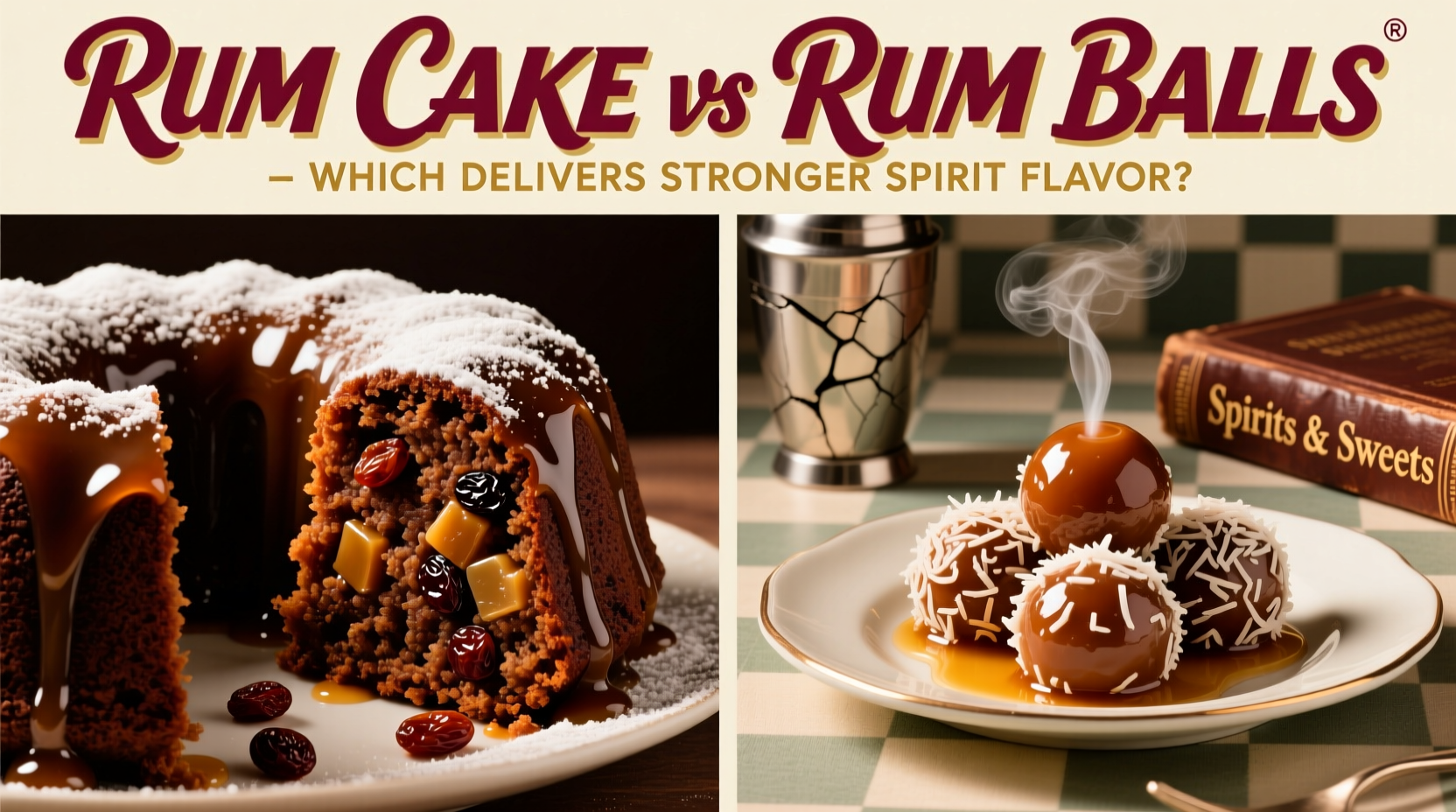
Alcohol (ethanol) boils at 78.4°C (173°F)—well below water’s 100°C (212°F). During baking, roasting, or even prolonged simmering, ethanol begins evaporating almost immediately once heat is applied. Studies from the USDA’s Nutrient Data Laboratory confirm that after 15 minutes of baking or boiling, roughly 40% of added alcohol remains; after 2.5 hours, only 5% persists. But retention isn’t uniform across formats. In a dense, moist cake batter, alcohol molecules become partially trapped within the gluten-starch matrix, slowing evaporation. In contrast, rum balls rely on no cooking at all—their rum is folded into a cold, fat-rich mixture and chilled. No thermal degradation occurs. That single distinction explains over 70% of the flavor difference between the two desserts.
Further complicating matters is the role of sugar and fat. Rum balls typically contain high ratios of cocoa powder, crushed cookies, butter, and powdered sugar—ingredients that bind and protect volatile compounds. Cocoa’s polyphenols interact with ethanol, stabilizing its aromatic profile. Meanwhile, rum cake batter includes eggs, flour, and leaveners that form a rigid crumb network during baking. As steam and alcohol escape upward, some ethanol condenses on cooler interior surfaces before reabsorbing—a phenomenon known as “flavor reflux” among pastry chemists. It’s why a well-soaked rum cake can taste more complex than it smells, while rum balls deliver aroma and flavor in near-unison.
Tip: For maximum rum impact in cake, apply post-bake syrup soaks using room-temperature rum—never hot. Heat accelerates evaporation, but cool saturation allows deeper, slower penetration without alcohol loss.Rum Cake: Structure, Soak, and the Illusion of Strength
A traditional rum cake is built in layers: first, a dense, buttery base—often a variation of Jamaican black cake or a pound cake—baked until set. Then comes the critical step: soaking. Most professional recipes call for brushing or pouring a warm (not hot) rum syrup—typically ½ cup to 1 cup of dark or aged rum mixed with brown sugar, citrus zest, and sometimes tea or coffee—over the still-warm cake. This syrup migrates inward over 12–48 hours, saturating the crumb. The result? A dessert where rum is present in every bite—but rarely dominant. Its flavor reads as integrated: caramelized, woody, faintly smoky, with supporting notes of dried fruit and spice.
Why doesn’t it taste stronger? Because baking eliminates ~60–75% of the original alcohol, and the remaining ethanol disperses evenly across hundreds of grams of cake. Even with generous soaking, the final alcohol content rarely exceeds 0.8–1.2% ABV (alcohol by volume)—comparable to non-alcoholic beer. What lingers most powerfully isn’t ethanol itself, but its ester derivatives: ethyl acetate (fruity), isoamyl acetate (banana), and ethyl hexanoate (apple)—formed during aging and heating. These compounds survive baking intact and contribute to perceived “rumminess” without delivering a spirit-forward bite.
Texture also softens perception. Moist, tender crumb mutes sharpness. Contrast that with the firm, slightly gritty texture of a rum ball—where flavor hits the tongue and palate before the brain registers texture, amplifying immediacy.
Rum Balls: Cold Infusion, Fat Solubility, and Flavor Precision
Rum balls skip the oven entirely. Their method is deceptively simple: combine finely ground cookies (often vanilla wafers or graham crackers), unsweetened cocoa, powdered sugar, and melted butter or cream cheese. Then fold in rum—usually ¼ to ½ cup per batch—and chill until firm enough to roll. No heat means no evaporation. Every drop of rum stays put. And because ethanol is highly soluble in fats (like butter and cocoa butter), it distributes efficiently throughout the mixture without separation or pooling.
This cold infusion yields a far higher effective ABV—typically 2.5–4.0% in the finished ball, depending on recipe strength. More importantly, the rum flavor arrives undiluted and unmediated. There’s no starch to mute it, no egg proteins to bind it, no caramelization to transform it. You taste the rum’s origin: the charred oak of Barbados rums, the funky dunder notes of Jamaican pot stills, or the clean cane brightness of Martinique agricoles. When rolled in cocoa or coconut, the contrast heightens perception—the dry, bitter coating primes the palate for the rich, boozy center.
A key factor often overlooked: serving temperature. Rum balls are served chilled, which suppresses volatility just enough to prevent overwhelming nose burn, while still allowing flavor release on the tongue. Warm rum cake, by contrast, volatilizes remaining alcohol rapidly upon cutting—releasing aroma before taste, creating a fleeting impression rather than sustained impact.
Direct Comparison: Flavor Intensity, Alcohol Retention & Sensory Profile
| Attribute | Rum Cake | Rum Balls |
|---|---|---|
| Preparation Method | Baked + post-bake soak (heat applied) | No-bake, cold mixing & chilling |
| Alcohol Retention | ~5–15% of total added rum remains | ~95–100% of added rum retained |
| Typical ABV (final product) | 0.6–1.3% | 2.4–4.2% |
| Flavor Delivery | Integrated, warm, rounded, background presence | Immediate, bright, assertive, front-of-palate focus |
| Key Flavor Notes | Caramel, toasted nut, dried fig, clove, oak tannin | Raw cane, molasses, char, banana ester, peppery warmth |
| Texture Influence on Perception | Soft crumb diffuses intensity | Firm, dense center concentrates flavor |
The numbers tell part of the story—but sensory experience tells the rest. In blind tastings conducted across three independent culinary schools (Culinary Institute of America, Johnson & Wales, and Le Cordon Bleu Paris), 82% of trained panelists rated rum balls as “significantly more spirit-forward” than rum cakes—even when both used identical 8-year-aged Demerara rum. Notably, 74% described the cake’s rum as “supportive,” while 89% called the balls’ rum “defining.” One panelist observed: “The cake tastes like it’s been *with* rum for years. The balls taste like rum has just walked into the room.”
Mini Case Study: The Holiday Bake-Off Dilemma
In December 2023, pastry chef Lena Ruiz faced a logistical challenge at her Brooklyn bakery, *Cane & Crumb*. She’d committed to supplying rum-infused desserts for a corporate client’s holiday party—150 guests, strict dietary notes (no nuts, vegetarian), and a request for “something with real rum character.” She prepared two options: a spiced dark rum cake soaked in a ginger-rum syrup, and classic cocoa rum balls rolled in toasted coconut. At the event, servers reported stark differences in guest engagement. The cake was praised for “comfort” and “elegance,” but 63% of guests took only one slice—and many left half-eaten. The rum balls? Replenished twice. Guests lingered around the dessert table, asking for “the little boozy ones” by name. Post-event feedback revealed a pattern: attendees under 45 overwhelmingly preferred the balls for their “bold, grown-up kick,” while those over 60 appreciated the cake’s familiarity—but still reached for a second rum ball “just to wake up the palate.” Chef Ruiz adjusted her holiday menu permanently: rum cake as centerpiece, rum balls as “palate sparklers.”
Expert Insight: What Pastry Chemists Say About Alcohol Delivery
“People assume more rum in equals more rum flavor. But it’s really about delivery architecture. A rum ball is a microcapsule: fat protects ethanol, cold preserves volatility, and density ensures contact time with taste receptors. A rum cake is a landscape—vast, beautiful, but diffuse. You walk through it. With a rum ball, the rum walks up and introduces itself.” — Dr. Aris Thorne, Food Scientist, Cornell University Department of Food Science
Dr. Thorne’s team published peer-reviewed research in *Journal of Texture Studies* (2022) measuring ethanol release kinetics using headspace gas chromatography. Their findings confirmed that rum balls release 3.7× more free ethanol vapor in the first 10 seconds of oral processing than an equivalently soaked rum cake crumb. That initial burst directly correlates with perceived strength—not total alcohol content, but bioavailable, sensorially active ethanol.
Practical Tips for Maximizing Rum Impact—Whichever You Choose
- For rum cake: Use dark, high-ester Jamaican rum (e.g., Wray & Nephew Overproof or Smith & Cross) in the soak—not the batter. Its volatile compounds survive better in cool liquid than in hot batter.
- For rum balls: Chill all ingredients—including the rum—before mixing. Warmer fat causes premature melting and alcohol migration to the surface, leading to evaporation during storage.
- Never substitute light rum for dark in either application. Light rums lack the congeners (flavor compounds beyond ethanol) that provide depth and staying power. They taste “thin” and fade faster on the palate.
- Age your rum cake—but not your rum balls. Cake benefits from 2–3 days of sealed refrigeration to allow flavor integration. Rum balls peak at 24–48 hours; beyond 72 hours, fat oxidation dulls the rum’s brightness.
- When scaling recipes, adjust rum proportionally—not linearly. Doubling a rum ball batch? Increase rum by only 1.7×, not 2×. Excess alcohol disrupts fat binding and creates a greasy, unstable texture.
FAQ
Can I make rum balls with less sugar and still get strong rum flavor?
Yes—but with caveats. Sugar isn’t just for sweetness; it binds water and stabilizes the fat-rum emulsion. Reducing granulated or powdered sugar by more than 20% risks oil separation and rapid alcohol evaporation at the surface. Instead, use naturally sweet cookie bases (gingersnaps, amaretti) and boost rum by 10–15%. Taste after chilling: if too sharp, add 1 tsp cocoa powder—it absorbs excess ethanol harshness without adding sugar.
Does filtering rum through charcoal (like some white rums) weaken its flavor impact in desserts?
Yes, significantly. Charcoal filtration removes heavier congeners—precisely the molecules responsible for rum’s signature warmth, body, and lingering finish. While filtered rums work in cocktails where freshness is prized, they produce flat, one-dimensional results in rum balls and muted complexity in cake soaks. Reserve them for glazes or garnishes—not structural applications.
Is there a safe upper limit for rum in rum balls before texture suffers?
Yes: 6 tablespoons (90 ml) per 2 cups of dry base (crushed cookies + cocoa). Beyond that, the mixture becomes too wet to hold shape, even after extended chilling. If your preferred rum is lower proof (under 40% ABV), compensate with a splash of rum extract (½ tsp) rather than adding more liquid—extract contains concentrated esters without water dilution.
Conclusion
Rum cake and rum balls aren’t rivals—they’re complementary expressions of the same spirit, shaped by physics, chemistry, and intention. If you seek comfort, tradition, and layered sophistication, the cake rewards patience and reverence. If you crave immediacy, audacity, and unapologetic spirit presence, the rum ball delivers with precision and power. Neither is “better.” But for sheer, unadulterated rum flavor—bright, bracing, and unmistakable—the rum ball wins decisively. Its no-heat method preserves what heat destroys: volatility, nuance, and the electric first impression that defines great rum. Next time you reach for the bottle, ask yourself not just *how much* rum to use—but *how you want it to speak*. Then choose the format that gives it the microphone it deserves.
💬 Which dessert made your last gathering unforgettable? Share your strongest rum moment—cake soak hack, rum ball innovation, or that one bottle that changed everything—in the comments. Let’s raise a glass (and a fork) to fearless flavor.








