For many people starting their strength training journey, the difference between pull ups and chin ups can be confusing — especially when one feels significantly harder than the other. While both are bodyweight exercises that target the upper back and arms, a common experience is that pull ups feel more difficult than chin ups. Yet, some individuals report the opposite: pull ups seem easier. This phenomenon isn't random. It's rooted in biomechanics, muscle recruitment patterns, grip positioning, and individual anatomy. Understanding these factors not only clarifies why pull ups might feel easier for you but also helps optimize your training for balanced upper-body development.
The Mechanics of Pull Ups and Chin Ups
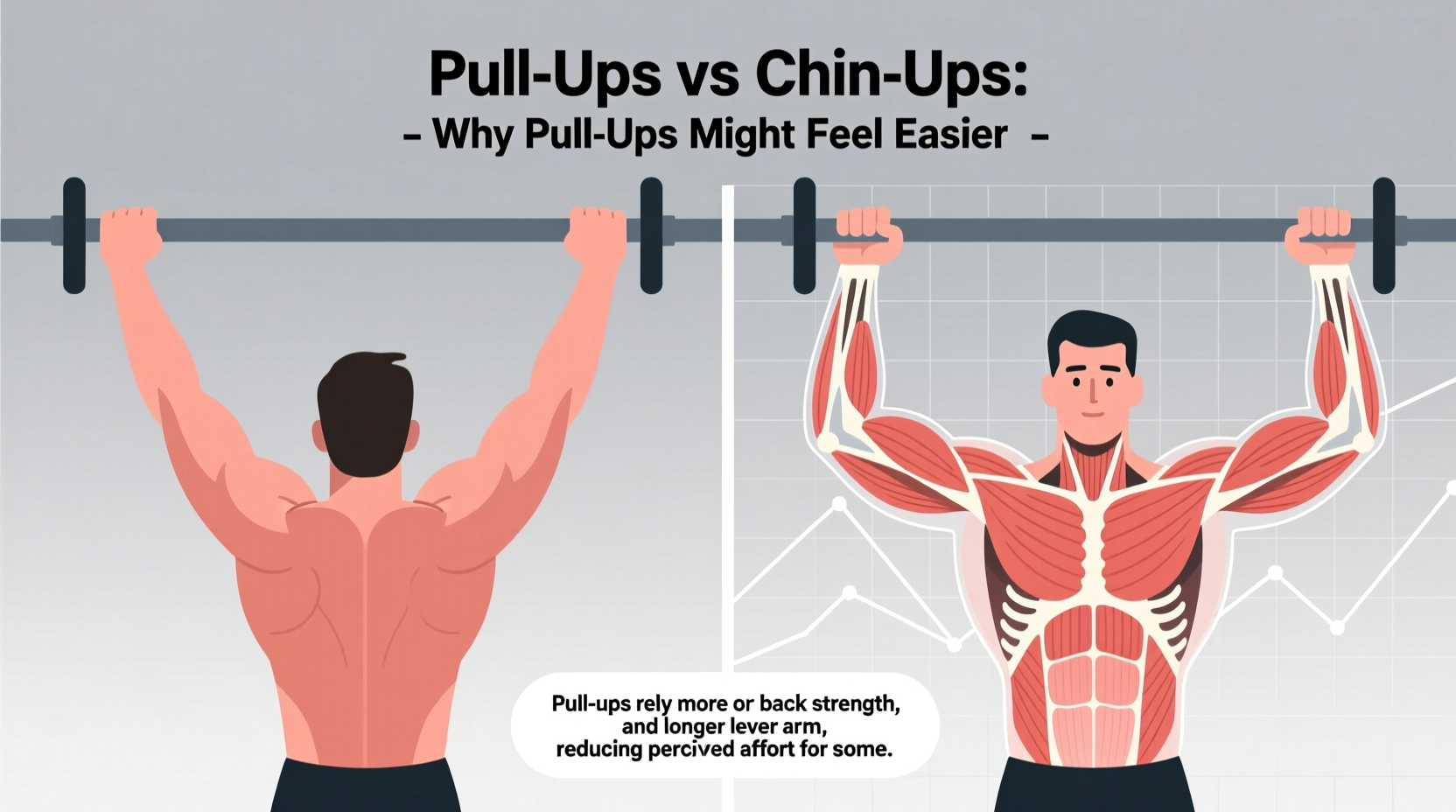
At first glance, pull ups and chin ups appear nearly identical. Both involve pulling your body upward until your chin clears the bar. The key difference lies in hand placement:
- Pull ups: Palms face away from you (overhand or pronated grip).
- Chin ups: Palms face toward you (underhand or supinated grip).
This subtle shift in grip dramatically alters which muscles bear the brunt of the movement. Pull ups emphasize the latissimus dorsi (lats), teres major, and lower trapezius, while chin ups place greater demand on the biceps brachii and upper chest due to the supinated grip.
“Grip width and orientation change the moment arm and torque requirements at the shoulder and elbow, directly influencing perceived difficulty.” — Dr. Jordan Lee, Biomechanics Researcher, University of Sport Science
Why Pull Ups Might Feel Easier: Key Factors
While conventional wisdom suggests chin ups are easier due to increased bicep involvement, a growing number of trainees report that pull ups feel more manageable. Several interrelated reasons explain this counterintuitive experience.
1. Shoulder Anatomy and Joint Leverage
Individual skeletal structure plays a crucial role. People with longer limbs or broader shoulders may find that the overhand grip of a pull up allows for a more mechanically advantageous path of motion. The external rotation in the shoulder during a pull up can reduce impingement risk and improve scapular retraction efficiency in certain body types.
2. Lat Dominance and Neural Efficiency
If your back muscles — particularly the lats — are stronger relative to your biceps, pull ups will naturally feel easier. Many lifters develop dominant lat activation through rowing movements, deadlifts, or prior calisthenics work, making the pull up’s primary movers already well-trained.
Tip: If pull ups feel easier, don’t avoid chin ups — use them as a tool to correct imbalances by strengthening weaker biceps and upper back coordination.3. Grip Width and Range of Motion
A wider grip in pull ups shortens the range of motion slightly compared to a standard chin up, especially if chin ups are performed with a closer grip. Less distance traveled means less total work required per rep, contributing to a perception of ease — assuming proper form is maintained.
4. Reduced Biceps Strain
The underhand grip of chin ups places the biceps in a position of peak contraction throughout the movement. For those with weaker biceps or elbow sensitivity (e.g., tendinitis), this can make chin ups disproportionately hard. In contrast, the neutral-to-stretched position of the biceps in pull ups reduces strain, allowing the larger back muscles to carry more load.
Comparative Analysis: Pull Ups vs Chin Ups
| Factor | Pull Ups | Chin Ups |
|---|---|---|
| Grip Type | Overhand (pronated) | Underhand (supinated) |
| Primary Muscles | Lats, lower traps, rear delts | Biceps, lats, upper chest |
| Biceps Involvement | Moderate | High |
| Range of Motion | Slightly shorter (wider grip) | Typically longer |
| Shoulder Stress | Higher external rotation demand | Less impingement risk for most |
| Common Difficulty Cause | Lat weakness, poor scapular control | Biceps fatigue, elbow strain |
Real-World Example: Alex’s Strength Curve
Alex, a 28-year-old software engineer and intermediate lifter, could perform five strict pull ups but struggled to complete even two chin ups. At first, he assumed his back was strong but his arms were weak. After a movement assessment, his coach noted that Alex had excellent lat engagement and scapular depression mechanics — ideal for pull ups — but relatively underdeveloped biceps due to a lack of curl variations in his routine.
Additionally, Alex’s shoulder structure favored external rotation, making the pull up’s top-end lockout smoother. His chin up struggle wasn’t due to poor technique but rather a muscular imbalance and favorable biomechanics for pull ups. Within eight weeks of adding hammer curls, negative chin ups, and scapular chin up holds, Alex matched his pull up performance on chin ups.
Step-by-Step Guide to Balancing Both Movements
To ensure balanced upper-body development and overcome discrepancies between pull ups and chin ups, follow this progressive plan:
- Assess Your Baseline: Test max reps of strict pull ups and chin ups with full range of motion. Record results.
- Identify Weak Links: If chin ups lag, suspect biceps or elbow limitations. If pull ups are weak, focus on lat activation and scapular control.
- Train the Lagging Movement First: Perform the harder variation early in your workout when fresh.
- Incorporate Eccentrics: Do 3–5 slow negatives (5 seconds down) of the harder exercise 2–3 times per week.
- Add Accessory Work: Include rows, face pulls, and bicep curls based on needs. Use resistance bands for assisted versions if necessary.
- Reassess Monthly: Retest every 4 weeks to track progress and adjust programming.
Checklist: Optimize Your Pull Up and Chin Up Performance
- ✅ Engage scapula before initiating the pull (retract and depress)
- ✅ Maintain a slight hollow body position (avoid excessive swinging)
- ✅ Control the eccentric phase (lower slowly)
- ✅ Avoid kipping unless training for gymnastics or CrossFit
- ✅ Train both variations weekly for balanced development
- ✅ Address mobility restrictions (shoulder, thoracic spine)
Frequently Asked Questions
Can someone be naturally better at pull ups than chin ups?
Yes. Differences in muscle fiber distribution, limb length, joint structure, and training history can make one variation feel easier. Genetic predispositions to lat dominance or bicep strength play a role.
Should I do pull ups or chin ups first in my workout?
Always perform the more challenging variation first when you’re freshest. If chin ups are harder, do them before pull ups to maximize effort and neural drive.
Are chin ups better for building biceps?
Yes. The supinated grip increases biceps brachii activation by up to 40% compared to pull ups, according to electromyography (EMG) studies. Chin ups are one of the most effective bodyweight bicep builders.
Conclusion: Embrace the Discrepancy, Improve the Balance
The fact that pull ups might feel easier than chin ups isn’t a flaw — it’s feedback. Your body is revealing its strengths and imbalances. Rather than favoring the easier movement, use this insight to build a more resilient, capable upper body. Both exercises are essential: pull ups build back thickness and scapular stability, while chin ups enhance arm strength and functional pulling power. By understanding the biomechanical and muscular nuances behind each, you can tailor your training to close the gap and achieve mastery in both.
🚀 Ready to level up your pull-up game? Start tracking your reps, add targeted accessory work, and reassess in four weeks. Share your progress in the comments — we’d love to hear your story!








