When you're miles from the nearest outlet, a reliable power source can make or break your weekend camping trip. Whether you’re charging a phone, running a small fridge, or powering lights through the night, having electricity in the wild is no longer a luxury—it’s a necessity. Two popular options dominate the off-grid scene: portable power stations and solar generators. While often used interchangeably, they are not the same. Understanding their differences, strengths, and ideal use cases will help you choose the right solution for your outdoor lifestyle.
Understanding the Basics: What Are They?
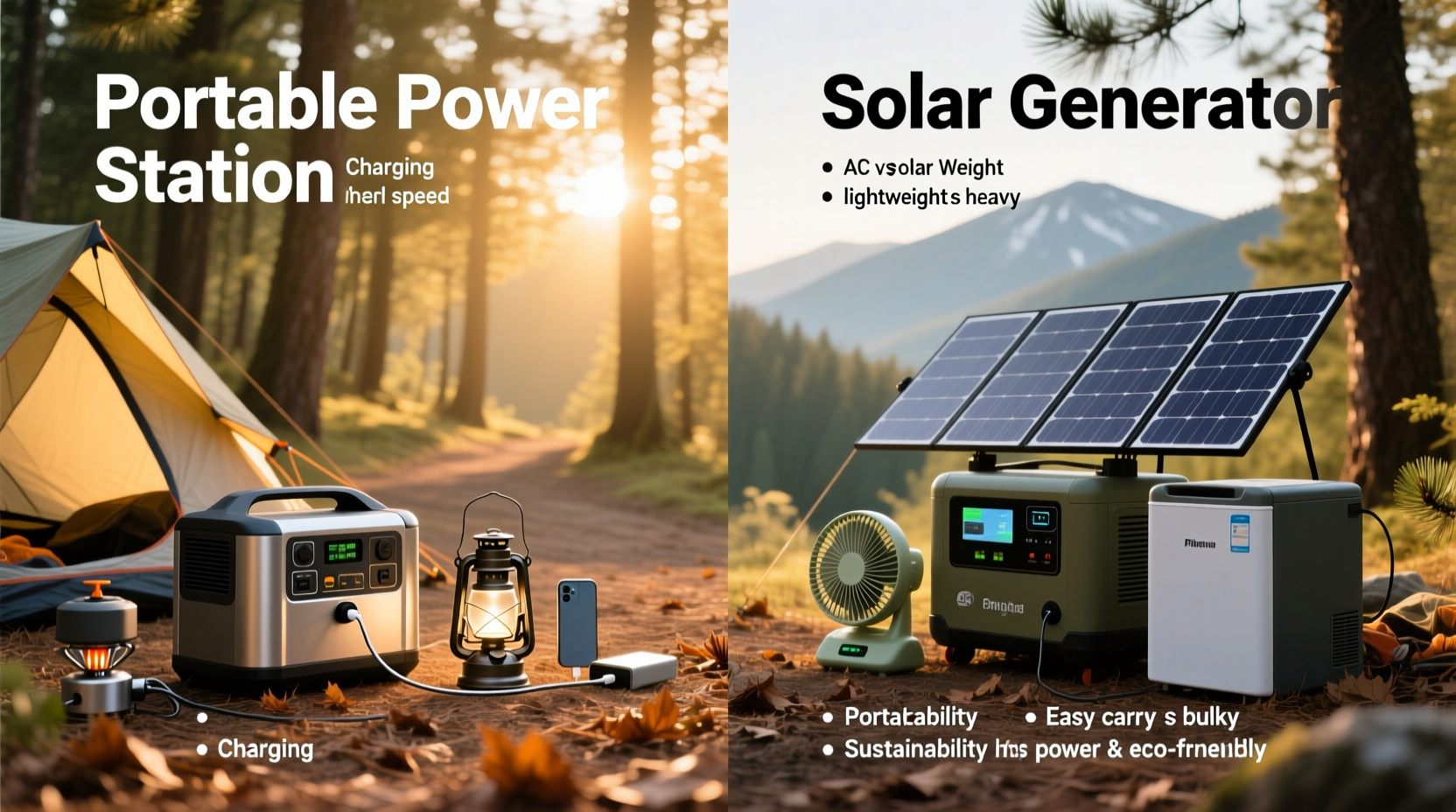
A portable power station is essentially a large-capacity battery pack with multiple output ports—AC outlets, USB-A/C, DC, and sometimes even car sockets. It stores energy internally and can be recharged via wall outlets, car chargers, or solar panels. Think of it as a high-powered version of a phone power bank, designed to run appliances for hours.
A solar generator, on the other hand, is a broader system that typically includes three components: a solar panel (or array), a charge controller, and a battery storage unit—often a portable power station itself. The term “solar generator” emphasizes the renewable aspect: it generates power from sunlight and stores it for later use. In practice, many people refer to a solar-ready power station paired with solar panels as a “solar generator.”
The key distinction lies in the charging method and long-term sustainability. A standalone power station relies on pre-charged grid energy, while a solar generator offers the ability to recharge using sunlight—making it more self-sufficient in remote environments.
Performance Comparison: Power, Runtime, and Recharge Options
To evaluate which option suits weekend camping best, consider real-world performance metrics: capacity (measured in watt-hours), output (watts), recharge speed, and weight.
| Feature | Portable Power Station | Solar Generator System |
|---|---|---|
| Typical Capacity | 300–2000 Wh | 500–2000 Wh (battery) + solar input |
| Recharge Methods | Wall outlet, car charger, solar (optional) | Solar panels (primary), wall, car |
| Full Recharge Time (Grid) | 3–8 hours | 4–10 hours |
| Solar Recharge Time (100W panel) | 5–12 hours (if solar-compatible) | 6–15 hours (depending on sun exposure) |
| Weight (Average) | 7–30 lbs | 15–40 lbs (including panels) |
| Best For | Short trips, predictable usage, quick setup | Remote locations, multi-day trips, off-grid independence |
The data shows that while both systems offer similar battery capacities, solar generators provide greater energy resilience. However, this comes at the cost of added complexity and weight due to solar panels. If your campsite has tree cover or you're traveling during cloudy seasons, solar charging may be inconsistent—making a fully charged power station a more reliable fallback.
Tip: Always oversize your capacity by 30%—devices draw more power than advertised, especially in cold weather.Practical Use Cases: Who Benefits From Which?
For weekend camping, most trips last 48 to 72 hours. During this time, typical power needs include:
- Smartphones (2–3 full charges): ~30Wh
- Lights (LED lantern, 4 hrs/night): ~20Wh
- Camera batteries: ~40Wh
- Mini fridge (12V, 24hrs): ~150–300Wh
- Drones or speakers: ~50Wh
Total estimated consumption: 250–500Wh, depending on appliance use.
A mid-range portable power station (e.g., 500Wh) fully charged before departure can handle these loads easily—even with some buffer. No setup is required beyond plugging in devices. This simplicity makes it ideal for casual campers who prioritize convenience over sustainability.
In contrast, a solar generator shines when access to grid charging is impossible. Imagine backpacking into a remote alpine lake where you’ll stay for two nights with no vehicle access. A lightweight 300Wh power station paired with a foldable 100W solar panel allows you to recharge critical gear—like GPS units or satellite messengers—during daylight. Over two sunny days, you could replenish 300–500Wh, effectively extending your usable power indefinitely.
“Solar integration transforms a finite battery into a renewable energy hub. For anyone spending more than one night off-grid, solar capability isn’t optional—it’s essential.” — Dr. Alan Reyes, Off-Grid Energy Researcher, National Renewable Energy Lab
Real Example: Sarah’s Mountain Getaway
Sarah planned a two-night solo camping trip in the Sierra Nevada. She brought her 500Wh portable power station, charged at home, to run a small fan, charge her phone, and power a CPAP machine (which consumes about 60Wh per hour). After two nights, the unit was nearly depleted—she had enough left for emergency calls but couldn’t have extended her trip.
On her next outing, she added a 100W foldable solar panel. Despite partial cloud cover, the panel delivered around 350Wh of energy over two days—enough to keep her CPAP running and recharge her phone twice. The extra 8 pounds were noticeable in her pack, but the peace of mind was worth it.
This illustrates a key insight: solar doesn’t always replace the need for a large battery—it complements it by enabling sustained operation.
Portability and Setup: Weight vs. Independence
Backpackers and minimalist campers must balance power needs with pack weight. A standalone 500Wh power station like the Jackery Explorer 500 weighs about 13 pounds. Add a 100W solar panel (5–7 lbs), and total weight jumps to nearly 20 pounds—equivalent to a full week of food.
For car campers, this is rarely an issue. You can park near your tent, set up the panel on the tailgate or ground, and enjoy continuous charging without physical strain. But for hikers covering 8+ miles to reach a site, every pound matters.
Consider this step-by-step decision timeline when choosing based on mobility:
- Assess your campsite access: Are you within 100 feet of your car, or hiking deep into the backcountry?
- List essential powered devices: Do you need only phone charging, or life-support equipment like CPAP?
- Estimate daily power draw: Multiply device wattage by hours of use. Sum all devices.
- Evaluate weather forecast: Will there be consistent sunlight, or overcast conditions?
- Decide on charging strategy: Pre-charge only? Or bring solar for regeneration?
Cost and Long-Term Value
Upfront cost is another deciding factor. A quality 500Wh portable power station starts around $400. A comparable solar generator setup—including panel—can range from $600 to $900. That premium buys long-term flexibility: once purchased, you can recharge anywhere there’s sunlight, reducing dependence on grid infrastructure.
Over time, this pays off. Campers who take frequent trips save money by avoiding hotel stays just to charge devices. Additionally, solar systems often feature longer lifespans due to smarter battery management and lower stress cycles when topped off daily.
However, if you camp only once or twice a year, investing in solar may not be cost-effective. In such cases, a portable power station charged at home delivers excellent value with minimal maintenance.
Checklist: Choosing the Right Option for Your Camping Style
- ☐ I camp primarily within driving distance of my vehicle → favors power station
- ☐ I need to run medical devices or refrigeration → favors higher capacity + solar backup
- ☐ My trips often extend beyond weekends → solar becomes more valuable
- ☐ I frequently camp in shaded forests or rainy seasons → solar less reliable; pre-charged battery preferred
- ☐ I want maximum energy independence → solar generator recommended
- ☐ I prioritize lightweight gear → avoid bulky panels unless absolutely necessary
- ☐ I already own solar panels → pairing with a compatible power station maximizes ROI
Frequently Asked Questions
Can I use a portable power station with solar panels later?
Yes, many modern power stations support solar input via MC4 or Anderson connectors. Check voltage and wattage compatibility—most accept 100–200W solar input. You don’t need to buy a complete solar generator kit upfront; start with the station and add panels later.
Do solar generators work on cloudy days?
They do, but efficiency drops significantly—typically to 10–30% of rated output. A 100W panel might generate only 10–30 watts under heavy overcast. Some advanced panels perform better in low light, but planning for reduced yield is crucial.
Are lithium-ion power stations safe for camping?
Yes, especially those using LiFePO4 (lithium iron phosphate) batteries. These are more thermally stable, last longer (3,000+ cycles), and pose lower fire risk than standard lithium-ion. Avoid leaving any unit in direct sun or enclosed hot spaces like car trunks.
Final Recommendation: Match the Tool to the Trip
So, which is better for weekend camping? The answer depends on your priorities.
If you're a casual camper who drives to established sites, uses modest electronics, and values ease of use, a **portable power station** is likely the best choice. It’s plug-and-play, lightweight compared to full solar kits, and sufficient for one to two nights off-grid.
If you venture deeper into nature, plan longer stays, or want energy resilience regardless of grid access, a **solar generator system** offers unmatched freedom. The ability to harvest sunlight turns a finite resource into a continuous supply, aligning perfectly with sustainable outdoor ethics.
Many experienced campers now adopt a hybrid approach: a mid-sized power station (500–1000Wh) paired with a compact, foldable solar panel. This gives them the convenience of pre-charged power plus the security of daytime recharging. It’s the sweet spot between simplicity and self-reliance.
“The future of outdoor power isn’t bigger batteries—it’s smarter energy harvesting. Solar isn’t just eco-friendly; it’s expedition-enabling.” — Lena Park, Outdoor Tech Editor, *Trail & Sky Magazine*🚀 Ready to upgrade your camping power setup? Start by calculating your actual watt-hour needs, then test a portable station on your next trip. When you feel the limitations, that’s the perfect time to add solar. Share your experience below—your journey might inspire someone else to go farther, stay longer, and live more freely off the grid.









