When planning an indoor camping trip—whether in a cabin, basement, garage, or enclosed shelter—the choice of power source becomes a critical safety decision. Many campers assume that any generator will do the job, but the reality is far more nuanced. Portable power stations and gas generators serve similar purposes, but their safety profiles, especially in enclosed spaces, are drastically different. Understanding these differences isn’t just about convenience—it’s about protecting your health and ensuring a safe experience.
Carbon monoxide (CO) poisoning, fire hazards, and noise pollution are serious risks associated with improper generator use. While both options can power lights, phones, small heaters, or medical devices, only one is truly suitable—and safe—for indoor environments. This article breaks down the key differences, compares real-world performance, and delivers clear guidance on which option to choose when camping indoors.
Safety First: The Hidden Dangers of Indoor Generator Use
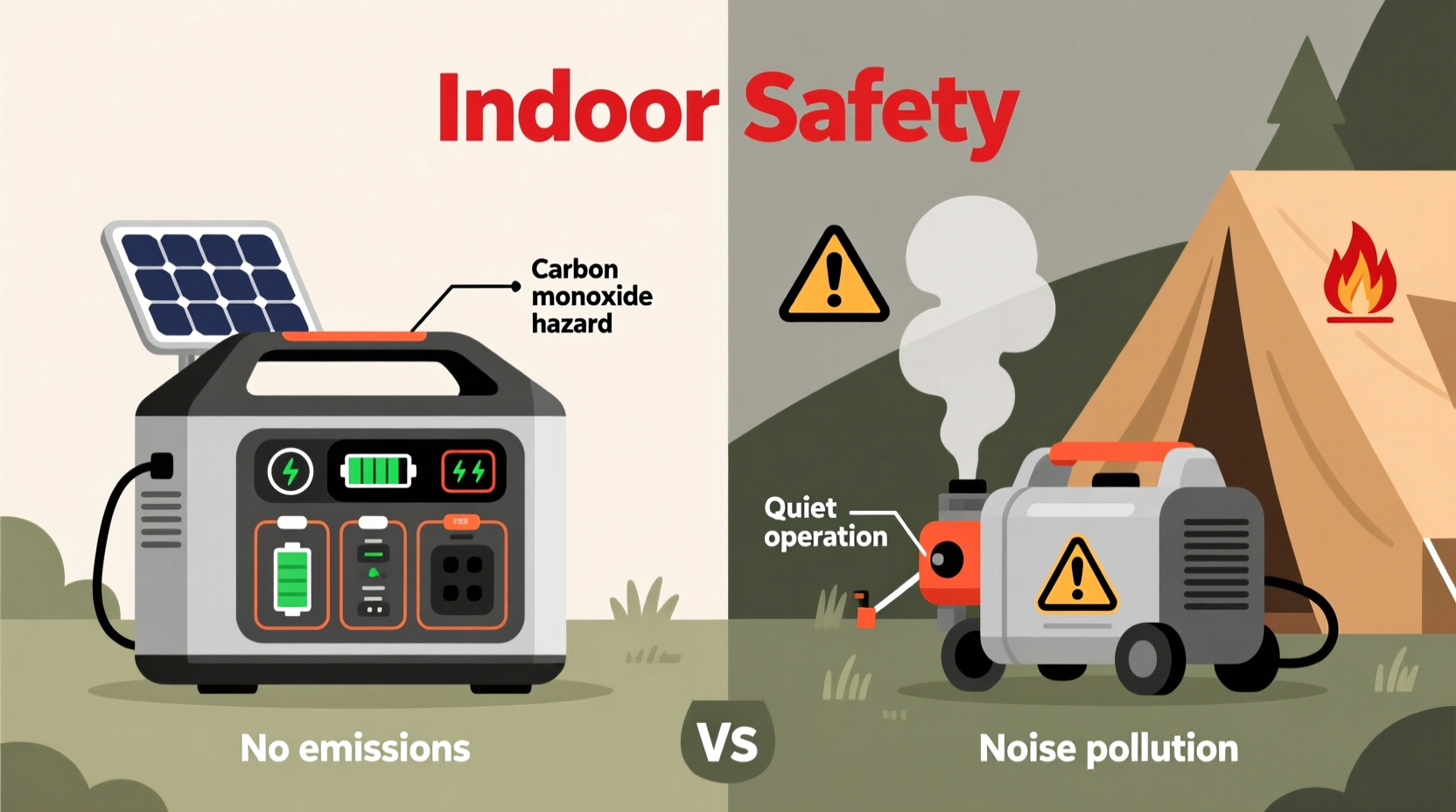
Every year, hundreds of people suffer from carbon monoxide poisoning due to improperly used generators. According to the Centers for Disease Control and Prevention (CDC), at least 50 deaths annually in the U.S. are linked to portable generator use during power outages—most occurring when units are operated indoors or in partially enclosed areas like garages or porches.
Gas-powered generators produce carbon monoxide as a byproduct of combustion. CO is a colorless, odorless gas that displaces oxygen in the bloodstream, leading to dizziness, nausea, unconsciousness, and even death within minutes at high concentrations. Even with ventilation, dangerous levels can accumulate quickly in confined spaces.
“Never operate a gasoline-powered generator inside your home, basement, garage, or near windows, doors, or vents.” — CDC Emergency Preparedness Team
In contrast, portable power stations—also known as solar generators or battery-based power banks—generate electricity without combustion. They store energy in lithium-ion or LiFePO4 batteries and release it through inverters. Because there’s no fuel burning involved, they emit zero carbon monoxide, making them inherently safer for indoor use.
Tip: If you must use a gas generator during an emergency, place it at least 20 feet from your structure and ensure exhaust flows away from windows and vents.How Portable Power Stations Work Indoors Without Risk
Portable power stations function like oversized rechargeable batteries. You charge them via wall outlets, car chargers, or solar panels, then use built-in AC outlets, USB ports, and DC outputs to power devices. Their operation is silent, emission-free, and thermally stable—making them ideal for sleeping areas, children’s rooms, or medical setups.
Modern models use advanced battery chemistry such as lithium iron phosphate (LiFePO4), which offers enhanced thermal stability and longer lifespan compared to standard lithium-ion. These batteries are less prone to overheating or catching fire, even under heavy loads or extreme temperatures.
Because they lack moving parts and combustion engines, power stations don’t require air intake or exhaust systems. They can be safely placed on a shelf, under a table, or tucked beside a sleeping bag without risk of fumes or heat buildup. Some models even include overcharge protection, short-circuit prevention, and temperature monitoring systems for added safety.
Key Safety Features of Top-Tier Power Stations
- Built-in Battery Management System (BMS)
- Overload and surge protection
- Thermal regulation to prevent overheating
- Zero emissions during operation
- No fuel storage required
These features make them not only safer but also more user-friendly for families, seniors, and individuals relying on powered medical equipment like CPAP machines or oxygen concentrators.
Why Gas Generators Are Unsafe Indoors—Even With Ventilation
Despite advances in muffler design and fuel efficiency, all internal combustion engines produce carbon monoxide. There is no such thing as a “safe” indoor gas generator—even if labeled “low-emission” or equipped with CO sensors.
Consider this scenario: A family sets up a weekend indoor camping experience in their finished basement. To power string lights, a mini-fridge, and a projector, they run a modern 2,000-watt inverter generator near a window with the sash open. Within two hours, occupants begin feeling lightheaded. Unbeknownst to them, wind direction shifts, drawing exhaust back into the room. CO levels rise silently. By the time symptoms worsen, it may be too late.
This is not hypothetical. In 2021, a family in Ohio was hospitalized after using a gas generator in a semi-enclosed sunroom during a storm. Despite opening doors and using fans, CO accumulated to dangerous levels. All three adults and two children required emergency treatment.
Ventilation does not eliminate risk—it only delays it. Carbon monoxide spreads rapidly and can linger long after the generator is turned off. Additionally, gas generators produce other pollutants such as nitrogen dioxide and particulate matter, which can aggravate asthma and respiratory conditions.
Tip: Install battery-operated CO detectors on every level of your home—and test them monthly. They are essential, but not a substitute for proper generator placement.Comparison: Portable Power Stations vs Gas Generators for Indoor Use
| Feature | Portable Power Station | Gas Generator |
|---|---|---|
| Indoor Safety | ✅ Safe – Zero emissions | ❌ Dangerous – Produces CO |
| Noise Level | Silent (0–40 dB) | Loud (60–75+ dB) |
| Fuel Required | No – Rechargeable | Yes – Gasoline, propane, or diesel |
| Maintenance | Minimal – No oil changes or spark plugs | High – Requires regular servicing |
| Lifespan | 5–10 years (2,000+ cycles for LiFePO4) | 5–15 years with proper care |
| Startup Time | Instant – Ready when charged | Manual pull-start or electric start |
| Portability | Lightweight to moderate (5–60 lbs) | Heavy (40–200+ lbs) |
| Eco-Impact | Low – Can be solar-charged | High – Burns fossil fuels |
The data is clear: for indoor applications, portable power stations win across every safety and usability metric. While gas generators offer higher continuous wattage and longer runtime with refueling, their operational constraints make them fundamentally incompatible with enclosed spaces.
Real-World Example: Indoor Camping with Kids
Jamie and her two children enjoy “glamping” in their insulated garage during winter weekends. They set up tents, fairy lights, a popcorn machine, and play movies using a projector. Initially, Jamie used a small gas generator outside but found extension cords cumbersome and noise disruptive. After researching alternatives, she invested in a 1,000Wh portable power station with solar charging.
Now, she pre-charges the unit at home and brings it into the garage. The kids sleep peacefully without engine noise, and Jamie uses it to safely power a space heater for short intervals. She recharges it the next day using a 200-watt solar panel on the roof. “It’s changed our whole experience,” she says. “No fumes, no cords snaking across the driveway, and I’m not worried about my kids breathing in exhaust.”
This case illustrates how switching to a battery-based system improves comfort, safety, and simplicity—all while reducing environmental impact.
Choosing the Right Power Station for Indoor Camping
Not all portable power stations are created equal. When selecting one for indoor use, consider the following factors:
- Capacity (Wh): Measured in watt-hours, this determines how long the unit can run your devices. For example, a 500Wh station can power a 50W light for 10 hours (factoring in inefficiencies).
- Output Ports: Look for multiple AC outlets, USB-A/C, and 12V DC ports to support various devices.
- Waveform: Pure sine wave inverters are essential for sensitive electronics like laptops and medical devices.
- Recharge Options: AC wall charging is fastest, but solar compatibility adds flexibility for off-grid scenarios.
- Battery Type: LiFePO4 batteries last longer and are safer than standard lithium-ion.
A mid-range model like the Jackery Explorer 1000 or EcoFlow Delta 2 offers excellent balance between capacity, portability, and price. For extended use, pair it with foldable solar panels to maintain charge during daylight.
Quick Checklist Before Buying
- ✔️ Does it have pure sine wave output?
- ✔️ Is the battery LiFePO4 or another stable chemistry?
- ✔️ Can it power your essential devices simultaneously?
- ✔️ Does it include overload and thermal protection?
- ✔️ Is it quiet and emission-free?
Frequently Asked Questions
Can I use a gas generator in a garage with the door open?
No. Even with the door wide open, carbon monoxide can accumulate to lethal levels. Wind patterns can draw exhaust back into the space. Garages are not safe locations for running gas generators.
How long can a portable power station last indoors?
Runtime depends on capacity and load. A 300Wh unit might power LED lights, a phone, and a fan for 6–8 hours. Larger units (1,000Wh+) can last a full day with moderate use. Recharging overnight restores full functionality.
Are portable power stations worth the cost?
While upfront costs are higher than basic gas generators, their longevity, safety, and versatility make them a better long-term investment—especially for indoor, recreational, or emergency use.
Final Verdict: Safety Should Decide Your Choice
When it comes to indoor camping, the question isn’t whether portable power stations or gas generators perform better—it’s which one keeps you alive. Gas generators are powerful tools for outdoor use, construction sites, or RV travel with proper ventilation. But they have no place in enclosed shelters, cabins, basements, or any area where people are sleeping or spending extended time.
Portable power stations eliminate the risk of carbon monoxide poisoning, operate silently, require minimal maintenance, and integrate seamlessly into indoor environments. They are the only truly safe option for powering your gear when camping indoors.
If you're preparing for emergencies, enjoying backyard glamping, or creating a cozy indoor adventure for kids, choose a reliable, battery-based power station. Your health, peace of mind, and quality of experience depend on it.
🚀 Ready to upgrade your indoor camping setup? Choose a portable power station with LiFePO4 battery and pure sine wave output today—your safest power source is just a charge away.








