Camping used to mean disconnecting from everything—no lights, no music, no phone charging. But today’s outdoor adventurers expect a little more convenience without sacrificing the serenity of nature. That’s where power comes in. For years, gas-powered generators filled that role, but now portable power stations are gaining ground. They’re quiet, emission-free, and increasingly capable. But are they actually worth choosing over traditional generators? The answer depends on your priorities, trip style, and energy needs.
This isn’t just about wattage or price tags. It’s about how you experience the outdoors. Is silence more valuable than raw power? Do you prioritize environmental responsibility, or is runtime above all else? Let’s break down the key differences and see which option truly delivers more value in a camping context.
Noise and Environmental Impact: A Game-Changing Difference
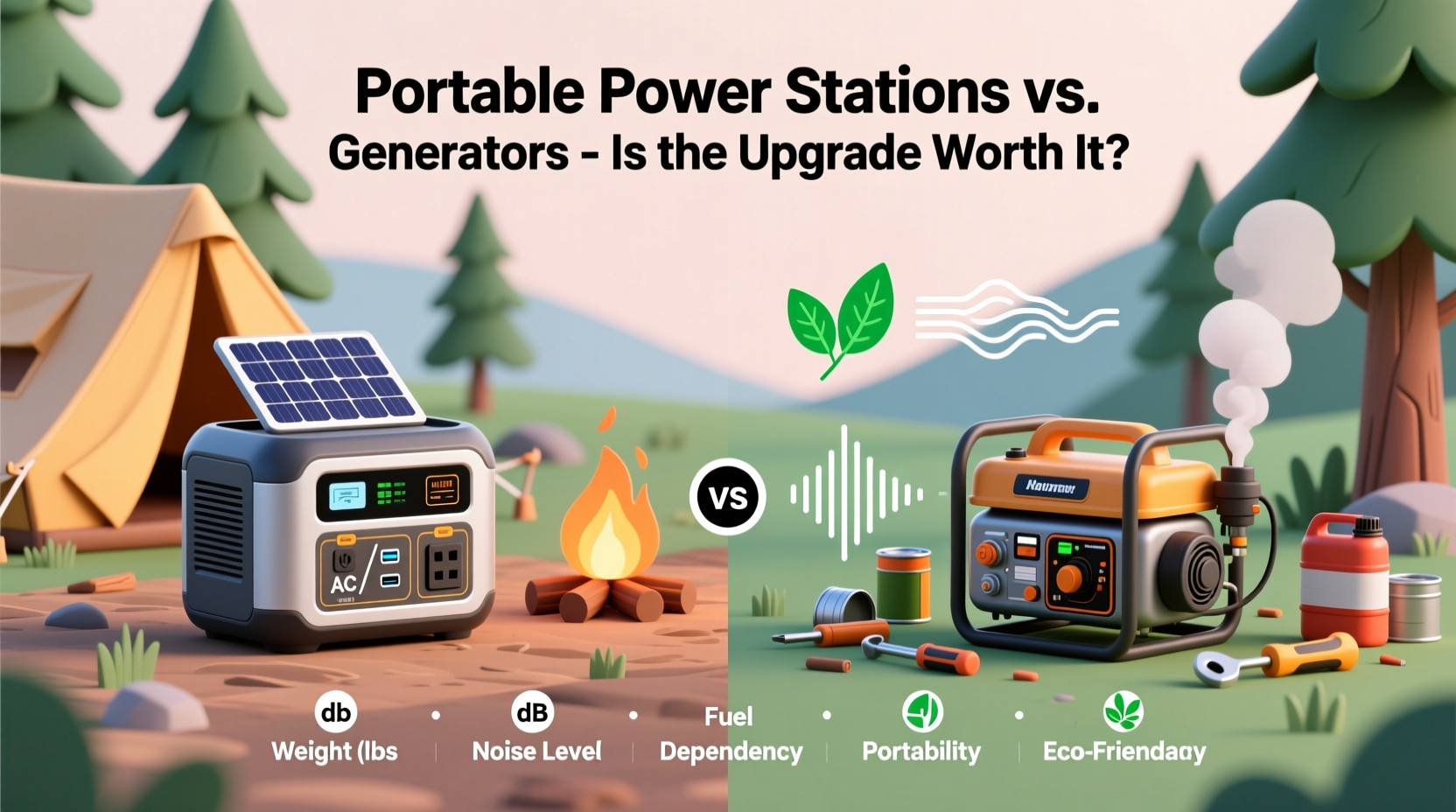
The most immediate difference between portable power stations and generators is sound—or rather, the lack of it. Generators run on internal combustion engines, typically fueled by gasoline or propane. Even “quiet” models operate at around 60–75 decibels, comparable to a normal conversation or a loud office environment. In the stillness of a forest or lakeside campsite, that noise cuts through like an intruder.
In contrast, portable power stations are completely silent. They store electricity in lithium-ion or LiFePO4 batteries and deliver it without moving parts or combustion. You can charge devices, run a fan, or power a small fridge without disturbing the natural ambiance—or your fellow campers.
“Peace and quiet are part of the camping experience. A generator disrupts that. With a solar generator, you get modern convenience without losing the soul of the trip.” — Daniel Reeves, Outdoor Gear Reviewer at Trail Current
Beyond noise, emissions matter. Gas generators release carbon monoxide, nitrogen oxides, and unburned hydrocarbons. Using them in enclosed spaces—even partially covered shelters—is dangerous. Many campgrounds restrict or ban their use during quiet hours. Portable power stations produce zero emissions at point of use. When charged via solar panels, they become a fully renewable solution.
Tip: Always operate gas generators at least 20 feet from tents and shelters—and never inside. Carbon monoxide poisoning is a real risk.Portability and Setup: How Easy Is It to Use?
For many campers, especially those hiking into remote areas or car camping with limited space, weight and size matter. Traditional generators range from 30 to over 100 pounds. While some have wheels and handles, they’re still bulky and awkward to maneuver across uneven terrain.
Portable power stations, by comparison, are designed for mobility. Models like the Jackery Explorer 300 weigh under 8 pounds; larger units like the EcoFlow Delta 2 land around 27–40 pounds. Most come with built-in handles and compact form factors. You can toss one in the back of an SUV or even carry it short distances without strain.
Setup is another advantage. Generators require fuel handling—transporting gas cans, checking oil levels, priming the engine. There’s also the hassle of starting a cold engine, which doesn’t always fire up on the first pull. Power stations? Turn them on, plug in your devices, and go. No maintenance, no fumes, no warm-up time.
If you're using solar input, setup takes slightly longer—positioning panels for optimal sun exposure—but once configured, it's a hands-off recharge process. Over a multi-day trip, that simplicity adds up.
Power Output and Runtime: Where Generators Still Shine
Let’s be honest: if you need serious power, generators still hold the edge. A mid-sized inverter generator can produce 2,000–3,500 watts continuously and run for 8–12 hours on a single tank. That’s enough to power high-demand appliances like electric kettles, coffee makers, or even small air conditioners.
Most portable power stations max out at 1,000–2,000 watts (with peak surges up to 2,200W), and their runtime is limited by battery capacity. A 1,000Wh unit might run a mini-fridge for 8–10 hours or charge a smartphone 30 times—but not both simultaneously. High-wattage devices drain them quickly.
However, for typical camping needs, this limitation is often overstated. Consider what you actually use:
- LED lights (5–10W)
- Phone/laptop charging (20–65W)
- Cooler or mini-fridge (50–70W average)
- Camera batteries (10–25W)
- CPAP machine (30–60W)
- Blender or electric kettle (600–1200W)
Unless you're running heavy-duty kitchen gear or heating systems, a 1,000Wh power station covers most off-grid scenarios. And unlike generators, they can be recharged during the day via solar, extending usable life indefinitely under good conditions.
Comparison Table: Typical Camping Power Needs vs. Device Compatibility
| Device | Avg. Wattage | Runs on Generator? | Runs on 1000Wh Station? |
|---|---|---|---|
| LED Lantern | 7W | Yes | Yes (100+ hrs) |
| Smartphone (full charge) | 10Wh | Yes | Yes (~100 charges) |
| Laptop | 60W | Yes | Yes (~15 hrs) |
| Mini Fridge | 60W avg | Yes | Yes (~15 hrs) |
| Electric Kettle | 1200W | Yes | Limited (less than 1 full boil) |
| Coffee Maker | 800–1000W | Yes | Possible (1–2 uses) |
As shown, power stations handle low-to-moderate draw devices exceptionally well. Only high-wattage, short-duration tools push their limits.
Real-World Example: A Weekend Family Campout
Consider the Thompson family, who camp every summer at a state park in Colorado. They bring two tents, a pop-up canopy, and a cooler. This year, they upgraded from a gas generator to a Bluetti AC200P (2,000Wh). Their goal: keep phones charged, run a small fridge for drinks, power LED string lights, and support a CPAP machine for Dad.
On day one, they charged the station fully at home. During the trip, they ran the fridge (65W) nonstop, used lights for 4 hours each night (10W), charged phones twice daily (~40Wh total), and powered the CPAP for 7 hours (50W). Total daily draw: roughly 700Wh. The unit lasted two full days before needing a top-up.
They brought a 200W solar panel, which delivered about 600Wh per sunny day. By midday on day three, the station was back to 80%. No refueling, no noise complaints from neighbors, and no smell of gasoline near their food prep area.
Had they used a 2,200W inverter generator, they could’ve run more devices simultaneously—but they didn’t need to. The peace of mind, clean operation, and ease of use made the switch worthwhile.
Cost and Long-Term Value: What’s the Real Investment?
At first glance, portable power stations seem expensive. A quality 1,000Wh unit costs $800–$1,200. Add solar panels, and you’re easily over $1,500. Gas generators in the same power class range from $500–$900.
But long-term ownership changes the equation. Generators require ongoing costs:
- Fuel purchases (gasoline or propane)
- Oil changes and filter replacements
- Spark plug maintenance
- Potential repairs from engine wear
- Storage risks (fuel degradation, corrosion)
Power stations have no moving parts and minimal maintenance. Charge them properly, avoid deep discharges, and they’ll last 5–10 years depending on battery chemistry. LiFePO4 models, like those from EcoFlow or Anker, often boast 3,000+ charge cycles—far exceeding traditional lithium-ion.
Tip: To extend battery life, avoid letting your power station drop below 10% regularly. Recharge when it reaches 20–30%.Checklist: Choosing Between a Power Station and Generator
Ask yourself these questions before deciding:
- What devices do I need to power? If mostly electronics and low-watt appliances, a power station suffices.
- How important is silence? If you value peace or camp in noise-sensitive areas, go power station.
- Do I want to use solar? Solar integration is seamless with power stations; generators can’t be solar-charged directly.
- How much weight can I carry? Under 30 lbs favors power stations.
- Am I running high-wattage tools? Electric grills, heaters, or power tools may require a generator.
- What’s my budget over 5 years? Factor in fuel and maintenance for generators.
FAQ: Common Questions About Camping Power Solutions
Can I run a CPAP machine off a portable power station?
Yes, absolutely. Most CPAP machines use 30–60 watts. A 500Wh station can power one for 6–10 nights, depending on pressure settings and usage. Many models even have dedicated CPAP modes with low-voltage cutoffs to preserve battery health.
Do portable power stations work in cold weather?
Lithium batteries lose efficiency in cold temperatures. Below 32°F (0°C), capacity can drop by 20–30%. Some models include battery heaters. Store your unit in a tent or insulated bag overnight to maintain performance.
Can I use a generator to charge a power station?
Technically yes, but it defeats the purpose. Generators can damage sensitive electronics if not pure sine wave compatible. It’s better to choose one primary power source unless you’re in a pinch.
Final Verdict: Are Portable Power Stations Worth More Than Generators?
“Worth more” doesn’t just mean cost—it means value in practice. For the majority of campers, portable power stations offer superior value despite higher upfront pricing. They deliver quiet, clean, and convenient energy that enhances rather than interrupts the outdoor experience.
Generators still have their place—especially for large groups, extended off-grid stays, or high-power demands. But for solo backpackers, weekend warriors, van lifers, and eco-conscious travelers, power stations represent the future of mobile energy.
The shift mirrors broader trends: quieter, cleaner, smarter technology replacing noisy, polluting alternatives. Just as smartphones replaced paper maps, power stations are redefining what’s possible in the wild—without compromising the wilderness itself.
💬 Ready to upgrade your camping power? Start by calculating your daily watt-hour needs, then explore solar-compatible stations. Share your favorite setup in the comments and help others make the quiet switch!








