
When planning a camping trip, one of the most critical decisions is how to keep your devices charged and essential appliances running. Whether you're powering a mini-fridge, charging a camera battery, or running lights through the night, having a reliable energy source makes all the difference. Two popular options dominate the market: portable power stations and traditional gas-powered generators. While both provide off-grid electricity, they differ significantly in design, performance, and suitability for outdoor adventures. Understanding these differences helps you choose the best solution based on your camping style, group size, and environmental priorities.
Noise and Campsite Experience
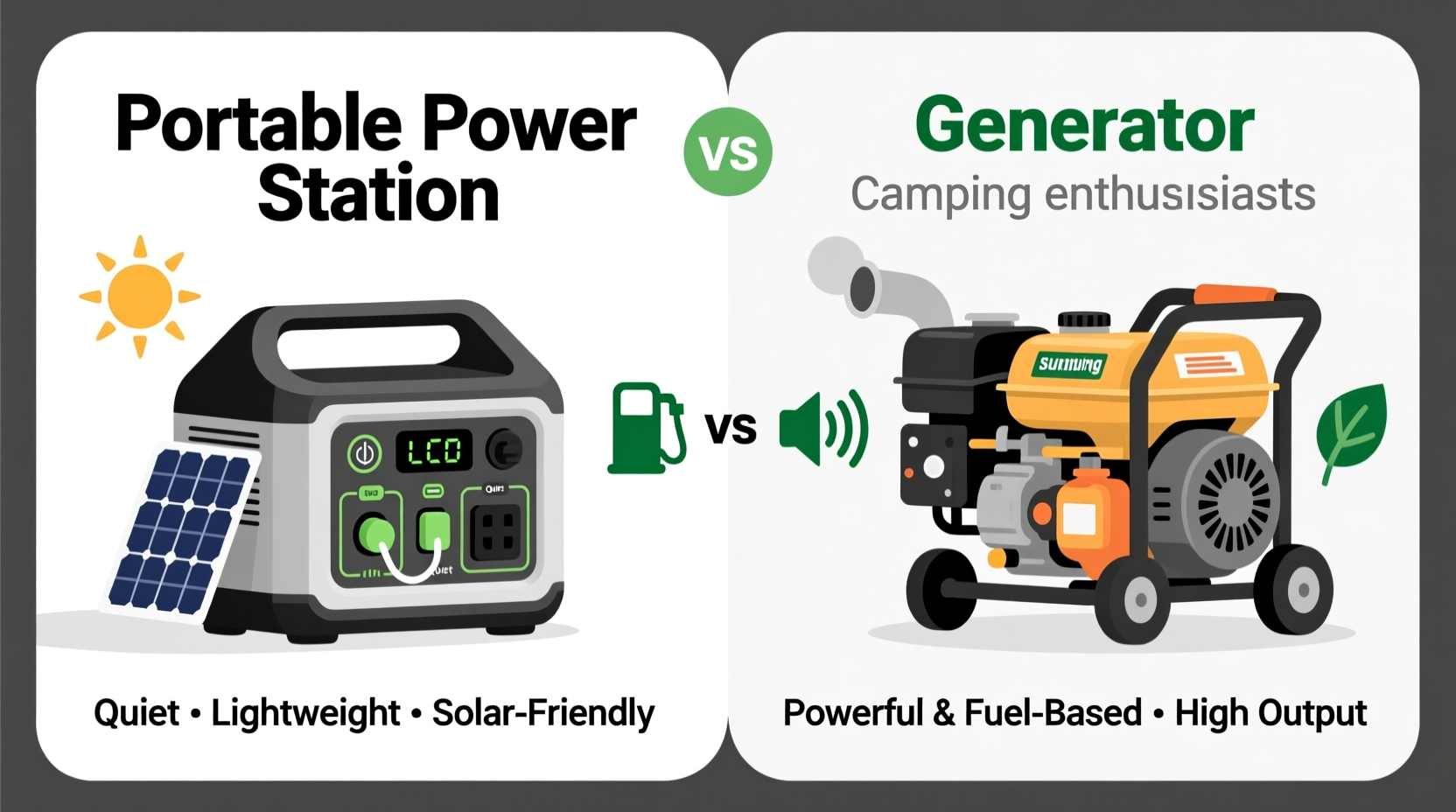
One of the most immediate distinctions between a portable power station and a generator is noise. Traditional generators rely on internal combustion engines that run on gasoline, propane, or diesel. These engines produce constant mechanical noise—often between 60 and 75 decibels—comparable to a vacuum cleaner or loud conversation. This level of sound disrupts the peaceful atmosphere of nature and can be frowned upon in crowded campgrounds with noise regulations.
In contrast, portable power stations operate silently. They use lithium-ion or LiFePO4 batteries to store and deliver energy without any moving parts. There’s no engine, no exhaust, and no vibration. This quiet operation enhances the camping experience, allowing you to enjoy birdsong, crackling fires, and starlit conversations without intrusive background hum.
Tip: If you're camping in a national park or shared campground, a silent power station avoids disturbing others and complies with strict noise ordinances.Fuel Type and Environmental Impact
Generators require fossil fuels—typically gasoline—which must be stored, transported, and replenished. Fuel handling introduces logistical challenges: spills, fumes, and fire risks are real concerns when camping near tents or dry vegetation. Gasoline also degrades over time, meaning unused fuel may need to be replaced after several months, adding to long-term costs and waste.
From an environmental standpoint, generators emit carbon dioxide, nitrogen oxides, and other pollutants. Even small units contribute to air pollution and leave a measurable carbon footprint—something increasingly at odds with eco-conscious outdoor ethics.
Portable power stations, on the other hand, are zero-emission devices. They charge via solar panels, wall outlets, or car chargers and release no exhaust during use. When paired with solar, they become fully renewable energy systems. Over time, this sustainability factor appeals to environmentally aware campers who aim to minimize their impact on natural spaces.
“Camping should connect us with nature, not pollute it. Silent, clean power solutions like modern power stations align perfectly with responsible outdoor recreation.” — Dr. Lena Patel, Outdoor Sustainability Researcher, National Parks Institute
Portability and Setup Ease
Weight and convenience matter when packing for the outdoors. Most portable power stations weigh between 10 and 30 pounds, making them easy to carry in a backpack or load into a vehicle. Many models feature built-in handles, compact designs, and even wheels for larger units. Setting up requires nothing more than pressing a button—no pull cords, oil checks, or priming needed.
Generators tend to be heavier, bulkier, and more complex. A mid-sized inverter generator can weigh 40 to 50 pounds or more. They require fuel tanks, oil reservoirs, and ventilation space. Starting often involves multiple steps: checking oil levels, opening the fuel valve, setting the choke, and pulling a recoil starter. In wet or cold conditions, starting difficulties increase, leading to frustration when you need power quickly.
| Feature | Portable Power Station | Gas Generator |
|---|---|---|
| Average Weight | 10–30 lbs | 35–60 lbs |
| Startup Process | Press power button | Pull cord, adjust choke, check oil |
| Noise Level | 0 dB (silent) | 60–75 dB (moderate to loud) |
| Fuel Required | No (rechargeable) | Yes (gasoline, propane, diesel) |
| Indoor Use Possible? | Yes (well-ventilated areas) | No (carbon monoxide risk) |
| Lifespan (cycles/years) | 500–3000+ charge cycles (~5–10 years) | Depends on maintenance (~5–15 years) |
Power Output and Runtime Comparison
While power stations excel in convenience and cleanliness, generators typically offer higher sustained power output and longer runtime. A standard portable generator can deliver 2,000 to 3,500 watts, enough to run high-demand appliances like electric kettles, microwaves, or large coolers simultaneously. Refueling takes minutes, restoring full power instantly.
Most portable power stations range from 300 to 2,000 watts. High-end models like the Jackery 2000 Pro or EcoFlow Delta series approach generator-level output but come at a premium price. Their runtime depends on battery capacity (measured in watt-hours). For example, a 1,000Wh unit running a 100-watt device lasts about 8–10 hours, factoring in inefficiencies.
Recharging a depleted power station can take several hours using AC power. Solar recharging extends this further—anywhere from 4 to 12 hours depending on panel wattage and sunlight. Generators don’t face this limitation; as long as fuel is available, they can run indefinitely.
Tip: Match your power needs realistically. Most campers use under 500 watts total—lights, phones, fans, and a small fridge. A 1,000Wh power station covers this easily for 1–2 days.Real Example: Weekend Camping Trip in the Rockies
Sarah and her family camp annually at a high-altitude site in Colorado. They bring LED lights, a CPAP machine, a mini-fridge, and multiple phones and cameras. Previously, they used a 2,200-watt inverter generator. It powered everything but disturbed nearby campers, especially at night. The smell of gasoline lingered around their tent, and storing extra fuel felt risky near their children.
Last summer, they switched to a 1,500Wh portable power station paired with a 200W foldable solar panel. During the day, the panel kept the station topped off. At night, the system ran their fridge and CPAP quietly. Phones and cameras charged throughout the weekend. Though they couldn’t run a coffee maker and microwave together, they adapted by using a French press. The result? A quieter, safer, and more enjoyable trip with less setup hassle.
Maintenance and Long-Term Ownership
Generators demand regular maintenance to remain functional. This includes changing oil, replacing spark plugs, cleaning air filters, and stabilizing fuel. Neglect leads to hard starts, poor performance, or permanent damage. Winter storage requires draining fuel or adding stabilizers. Even with care, engine wear reduces efficiency over time.
Portable power stations require almost no maintenance. The main consideration is battery health: avoid letting the unit drop to 0% regularly and store it at around 50–80% charge if unused for months. Lithium iron phosphate (LiFePO4) batteries last longer—up to 3,000 cycles—compared to standard lithium-ion (~500–1,000 cycles). No fluids, no moving parts, no tune-ups.
While power stations have a higher upfront cost ($300–$2,000), their lack of fuel and maintenance expenses lowers total ownership cost over five years—especially for occasional users. Generators may seem cheaper initially ($500–$1,200), but ongoing fuel, oil, and repair costs add up.
Step-by-Step Guide: Choosing the Right Option for Your Trip
- Assess your power needs: List all devices you plan to run. Note their wattage (found on labels or manuals). Add them up to estimate peak and continuous load.
- Determine trip duration: Short weekend trips favor power stations. Extended off-grid expeditions may require generator backup or large hybrid systems.
- Consider location: Are you in a crowded campground with noise rules? Or deep backcountry where silence and safety matter? Power stations win in regulated or sensitive areas.
- Evaluate recharging access: Will you have access to AC outlets between trips? Can you bring solar panels? If not, a generator offers faster turnaround.
- Budget for long-term use: Factor in fuel, maintenance, and expected lifespan. For infrequent campers, a mid-range power station offers best value.
- Test before you go: Charge your power station fully or service your generator ahead of time. Run your devices to confirm compatibility and runtime.
Checklist: What to Evaluate Before Buying
- ✅ Total wattage required (continuous and surge)
- ✅ Battery capacity in watt-hours (Wh) or kilowatt-hours (kWh)
- ✅ Recharge options (AC, DC, solar input compatibility)
- ✅ Weight and portability features (handle, wheels, size)
- ✅ Noise level tolerance (especially in shared spaces)
- ✅ Safety certifications (UL, CE, FCC)
- ✅ Number and type of output ports (AC, USB-A/C, 12V, etc.)
- ✅ Expected lifespan and warranty coverage
FAQ
Can I use a portable power station to jump-start my car?
Some high-capacity power stations include a built-in jump-start function with clamps. Check product specs—models like the Jackery Explorer 2000 Plus or Anker Solix C800 offer this feature. Standard units without dedicated jump-start circuits cannot safely perform this task.
Are portable power stations safe to use inside a tent?
Yes, because they emit no fumes and generate minimal heat. However, ensure ventilation and keep away from bedding or flammable materials. Never use a gas generator indoors or in enclosed spaces due to lethal carbon monoxide risk.
How long do portable power stations hold a charge when not in use?
Most retain 80–90% of charge after 3–6 months. LiFePO4 models degrade slower. For extended storage, recharge to 50–80% every few months to preserve battery health.
Conclusion: Which Is Better for Camping?
The answer depends on your priorities. For most recreational campers—especially those in family groups, established campgrounds, or nature-focused settings—the portable power station is the superior choice. It delivers silent, clean, and hassle-free energy with minimal learning curve. Advances in battery technology have closed the gap in capacity and output, making them viable for nearly all common camping applications.
Generators still hold advantages for heavy-duty use: prolonged off-grid stays, extreme weather requiring constant heating or cooling, or professional fieldwork needing industrial-grade power. But for the average camper seeking comfort, convenience, and harmony with nature, the portable power station represents the future of outdoor energy.
Technology continues to evolve rapidly. New models now support fast charging, app-based monitoring, and modular expansion. As solar efficiency improves and prices decline, the gap between battery-powered and fuel-based systems will only widen in favor of portables.
🚀 Ready to upgrade your camping experience? Start by calculating your watt-hour needs and explore top-rated power stations with solar compatibility. Make your next trip quieter, cleaner, and more efficient.








