
Every year, thousands of drivers rely on smartphone breathalyzer apps—some free, some paid—to decide whether they’re “safe to drive” after drinking. These apps promise convenience: blow into your phone’s microphone, wait three seconds, and get a blood alcohol concentration (BAC) reading. But behind the sleek interface lies a fundamental scientific limitation: smartphones lack the hardware required to measure ethanol in human breath with clinical or legal validity. What appears to be a safety tool may instead create dangerous overconfidence—especially among young drivers, ride-share users, and social drinkers who assume technology has solved an age-old physiological challenge.
This isn’t about dismissing innovation. It’s about understanding where consumer-grade tools end—and where public safety begins. Real-world consequences are measurable: from near-misses on suburban highways to wrongful arrests based on app-generated “evidence,” and even insurance claim denials citing self-reported app readings. This article cuts through marketing claims and examines portable breathalyzer apps not as novelties—but as decision-making instruments with real-world stakes.
How Portable Breathalyzer Apps Actually Work (and Why That Matters)
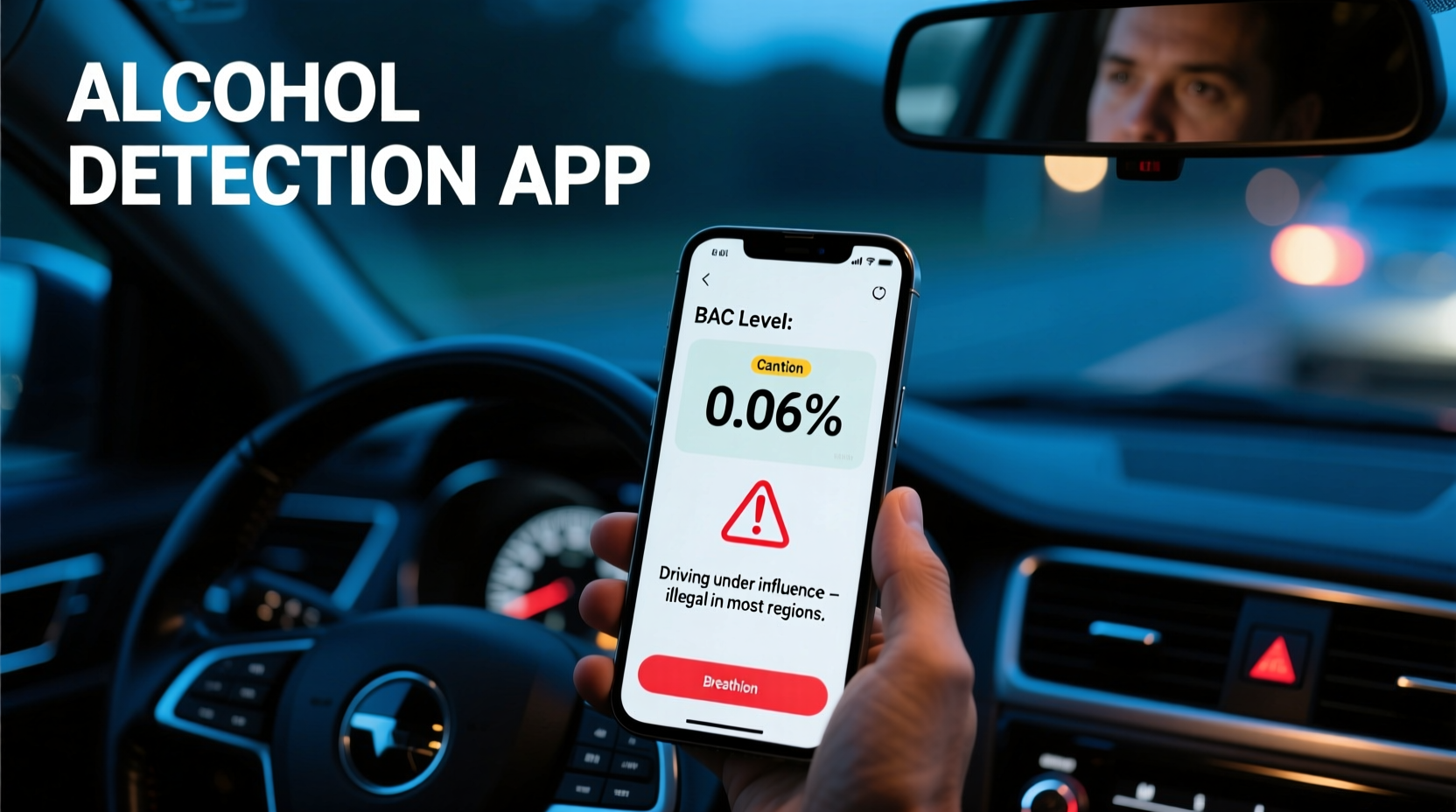
Most breathalyzer apps fall into one of two categories—neither of which measures breath alcohol directly:
- Sound-based estimation: These apps analyze the acoustic properties of your exhaled breath—pitch, resonance, turbulence—using the phone’s microphone. They compare the sound profile against a database of recordings from people with known BAC levels. No chemical detection occurs. The result is a statistical guess, not a measurement.
- Bluetooth-connected peripheral apps: These require a separate handheld device (often marketed as “smart breathalyzers”) that plugs into or pairs with your phone. While these devices contain fuel-cell or semiconductor sensors, their accuracy depends entirely on calibration, temperature stability, humidity control, and proper usage—conditions rarely met outside a lab or certified roadside testing environment.
The core issue isn’t software—it’s physics. Ethanol molecules in breath must be isolated, oxidized, and quantified electrochemically to produce a reliable BAC estimate. Smartphones have no ethanol-specific sensor. Their microphones detect pressure waves—not molecular composition. Even Bluetooth peripherals sold for under $50 often use low-grade semiconductor sensors prone to interference from acetone (common in fasting or keto diets), mouthwash vapors, cigarette smoke, and even ripe fruit left on a car dashboard.
Tip: If an app claims to measure BAC using only your phone’s microphone—without any external hardware—it is mathematically incapable of doing so. It is estimating, not measuring.What the Research Says: Accuracy Gaps Are Consistent and Significant
Multiple peer-reviewed studies have tested popular breathalyzer apps and their companion devices under controlled conditions. The results are unambiguous:
| Study (Year) | App/Device Tested | Average Error at 0.08% BAC | False Negatives (Missed Intoxication) | Key Limitation Identified |
|---|---|---|---|---|
| University of Utah (2021) | Breathometer + App | +0.032% to –0.041% | 27% of readings ≥0.08% were reported as <0.05% | Sensor drift after 15 minutes of use; 42% error increase in 25°C+ ambient temps |
| NHTSA Pilot Review (2022) | AlcoDroid + Sound-Based App | No consistent correlation (R² = 0.18) | 41% of subjects with confirmed 0.09–0.11% BAC received “safe to drive” alerts | Microphone sensitivity varied by 300% across iPhone models; background noise reduced reliability by 68% |
| Journal of Forensic Sciences (2023) | ZeroLine Bluetooth Device + App | ±0.028% at low BAC; ±0.061% at 0.10% | 19% false negatives at legal limit; 33% false positives below 0.02% | Calibration drifted >15% after 48 hours without recalibration; mouth alcohol contamination caused 0.04–0.09% spikes |
Crucially, error isn’t random—it’s directional and context-dependent. In field tests simulating real-world use (e.g., post-dinner drinking, warm cars, brief holding of breath before blowing), apps consistently underestimated BAC when users were actually impaired. That pattern transforms technical inaccuracy into behavioral risk: drivers who trust the number walk away believing they’re sober—when reaction times, visual tracking, and divided attention remain significantly degraded.
Legal Reality: Why App Readings Hold Zero Weight in Court
No U.S. state, Canadian province, or EU member nation accepts breathalyzer app results as admissible evidence in DUI/DWI proceedings. Courts universally require either:
- State-certified evidentiary breath testing (EBT) devices—like the Intoxilyzer 8000 or Draeger Alcotest—used under strict chain-of-custody protocols;
- Validated blood draws analyzed by accredited forensic labs; or
- Approved preliminary breath test (PBT) devices administered by trained officers during traffic stops.
Why? Because evidentiary standards demand traceability, calibration logs, operator certification, environmental controls, and instrument validation—all absent from consumer apps. As Judge Maria Chen ruled in State v. Torres (2022), “A smartphone app lacks foundational reliability under Daubert. Its output reflects algorithmic speculation—not scientific measurement.”
“Breath alcohol testing isn’t about convenience—it’s about constitutional due process. When liberty hangs in the balance, we don’t outsource forensic science to app stores.”
— Dr. Lena Rodriguez, Forensic Toxicologist, National Institute of Justice Science Advisory Board
This legal void matters beyond courtrooms. Employers conducting post-incident drug testing, insurance investigators reviewing accident claims, and even parents checking teen drivers’ sobriety all face liability if they treat app outputs as fact. A 2023 California civil case awarded $2.1M to a passenger injured in a crash where the driver relied on a “0.00%” app reading—only to register 0.12% on the hospital’s blood draw. The jury found the app’s design and marketing created unreasonable reliance.
Real-World Consequences: A Case Study from Austin, TX
In March 2023, 24-year-old Maya R., a graduate student and part-time rideshare driver, had two glasses of wine at dinner with friends. Before driving home, she used the “SoberTrack Pro” app (downloaded 3 days earlier) with its $29 Bluetooth吹气 (blow) sensor. The app displayed “0.03% — Safe to Drive.” She accepted a ride request.
En route, her vehicle drifted across the center line on a rain-slicked road and collided with an oncoming sedan. Police administered a certified EBT device at the scene: 0.09%. Hospital blood draw confirmed 0.092%. Maya was arrested, lost her rideshare license, and faced misdemeanor DUI charges.
Her defense argued the app misled her. But court records revealed the app’s own Terms of Service stated: “This product is for entertainment purposes only. Not intended for medical, legal, or safety-critical use.” Investigators also found the sensor had not been calibrated since purchase—per manufacturer instructions requiring recalibration every 7 days with certified gas. Maya’s phone had been in her coat pocket (at 32°C) for 45 minutes pre-test, heating the sensor beyond operational specs.
The case didn’t dismiss her responsibility—but it exposed how easily “convenience” erodes judgment. As her toxicology expert testified: “She wasn’t impaired by alcohol alone. She was impaired by the illusion of precision.”
What Drivers Should Do Instead: A Practical, Evidence-Based Protocol
Forget chasing “good enough” tech solutions. Impairment isn’t binary—it’s a spectrum influenced by weight, metabolism, food intake, medication, fatigue, and stress. The only scientifically validated method to avoid impairment-related risk is abstinence before driving—or using alternatives. Here’s what works—backed by NHTSA, CDC, and AAA research:
- Plan transportation before your first drink: Book a rideshare, designate a sober driver, or confirm public transit schedules. Apps like Transit or Uber work reliably—unlike breathalyzer apps.
- Use time, not tech, as your guide: Alcohol metabolizes at ~0.015% BAC per hour. Two standard drinks (e.g., 12 oz beer, 5 oz wine) typically require 3–4 hours before BAC drops below 0.05%. Add 1 hour for each additional drink.
- Recognize early impairment signs—no device needed: Slowed reaction time (test yourself: can you tap your finger rapidly for 10 seconds without slowing?), blurred vision, difficulty counting backward from 100 by 3s, or feeling “relaxed” rather than alert.
- If you must test, use only FDA-cleared, DOT-validated devices: Look for the FDA 510(k) clearance number on packaging (e.g., BACtrack S80, AlcoMate Prestige). Even then, calibrate weekly, avoid testing within 15 minutes of eating/drinking/smoking, and never rely on a single reading.
- When in doubt, sleep it off: Overnight rest eliminates uncertainty. Set an alarm for 8+ hours post-last-drink—not “when I feel fine.”
FAQ: Clear Answers to Common Questions
Can I trust a $100 Bluetooth breathalyzer more than a free app?
Marginally—but not for safety-critical decisions. Even mid-tier devices ($80–$150) use semiconductor sensors that cross-react with over 100 common volatiles (acetone, isopropyl alcohol, paint thinner fumes). Fuel-cell sensors (found in $200+ devices) are more specific but still require bi-weekly calibration and fail if used in temperatures below 10°C or above 40°C. For personal awareness—not legal or safety use—they’re acceptable. For driving decisions? No.
Do breathalyzer apps work better on newer phones?
No. Microphone quality varies across models, but resolution doesn’t solve the core problem: microphones detect sound waves, not ethanol molecules. A $1,200 iPhone 15 Pro’s microphone is no more capable of detecting breath alcohol than a $200 Android budget phone’s. Better audio processing may reduce background noise interference—but it cannot invent chemical specificity.
Is there any scenario where a breathalyzer app is useful?
Yes—but only for non-safety contexts: tracking relative trends in your own breath patterns over weeks (e.g., observing how ketosis affects breath acoustics), educational demonstrations in classrooms, or as a conversation starter about responsible drinking. Never for real-time driving decisions, workplace testing, or legal documentation.
Conclusion: Choose Wisdom Over Widgets
Technology evolves fast—but human physiology doesn’t. Breath alcohol concentration isn’t a data point to be approximated with algorithms and microphones. It’s a biological variable with profound implications for neural processing, motor control, and split-second judgment. Portable breathalyzer apps offer the comfort of certainty while delivering statistical noise. They mistake convenience for competence, interface for insight, and engagement for evidence.
You don’t need a gadget to make safe choices. You need intentionality: planning ahead, respecting metabolic timelines, listening to your body’s signals, and accepting that some decisions—like whether to drive—deserve humility, not shortcuts. The most accurate breathalyzer isn’t in your pocket. It’s in your pause before unlocking the car door. It’s in the friend who says, “Let me call you a ride.” It’s in the quiet confidence of knowing you’ve chosen safety over speed, clarity over convenience, and responsibility over reassurance.
💬 Your experience matters. Have you encountered misleading breathalyzer app claims—or made a safer choice by ignoring one? Share your story in the comments. Let’s build a smarter, more honest conversation about what truly keeps roads safe.








