When Google launched the Pixel 4 in 2019, expectations were high. After years of refining Android’s purest experience and setting benchmarks in computational photography, Google had earned a loyal following. Meanwhile, Samsung’s Galaxy S10 represented the peak of Android hardware diversity—powerful specs, expansive displays, and premium build quality. But how do they stack up against each other? Was the Pixel 4 a misstep, or has Samsung’s dominance been overstated?
This isn’t just a specs battle. It’s about philosophy: Google’s minimalist, AI-driven approach versus Samsung’s feature-rich, hardware-first strategy. Let’s break down where each phone excels—and where they fall short.
Design and Build: Minimalism vs. Refinement
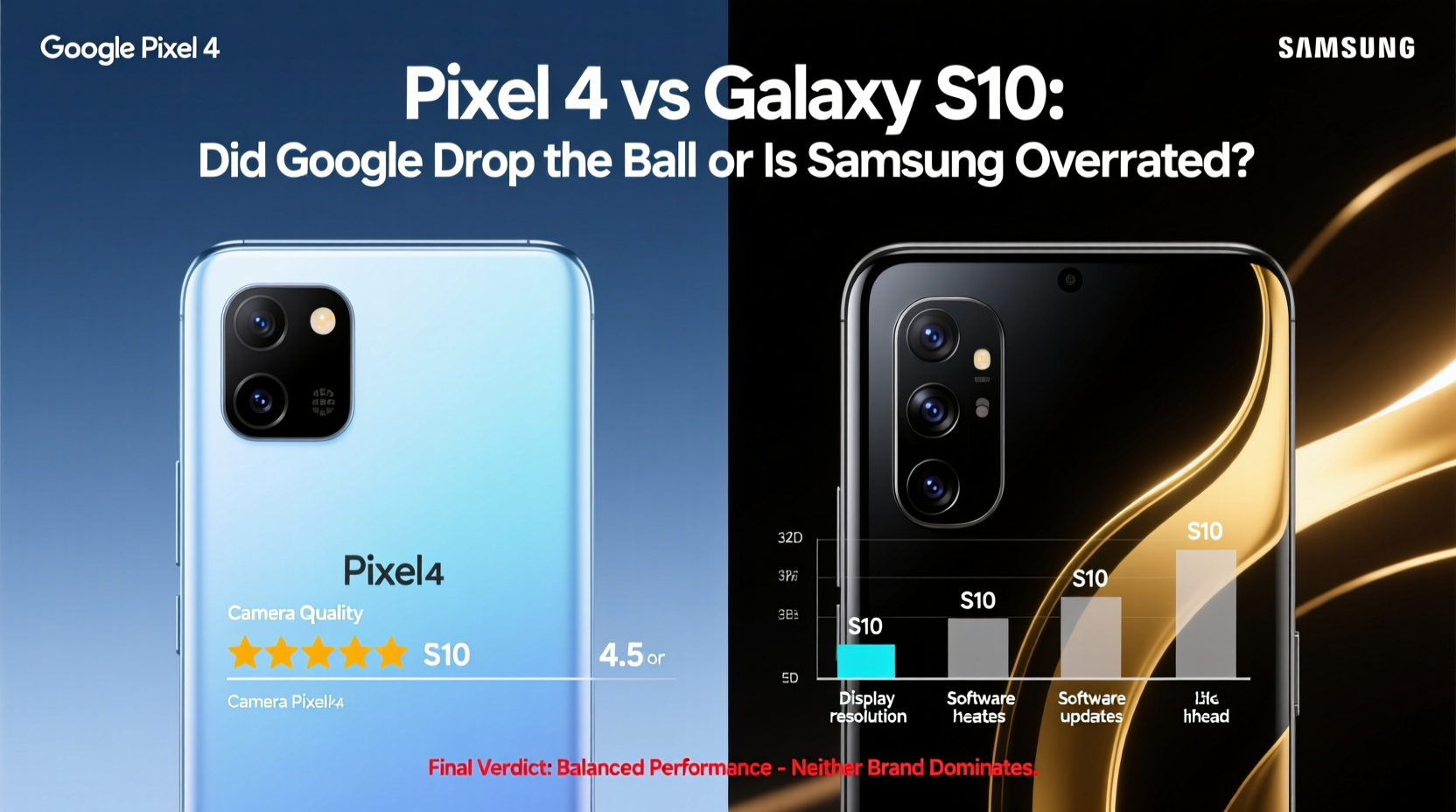
The Pixel 4 embraces Google’s design ethos: clean lines, matte finishes, and restrained branding. Available in Just Black, Clearly White, and Oh So Orange, it features a compact 5.7-inch OLED display with slim bezels and a noticeable top bezel housing the Soli radar and face unlock sensors. The squared-off aluminum frame gives it a distinctive feel, though some users found it less ergonomic than curved rivals.
In contrast, the Galaxy S10 dazzles with its sleek, symmetrical design. Its 6.1-inch Dynamic AMOLED display curves at the edges and features a small hole-punch front camera—a significant upgrade from older notch designs. Crafted with Gorilla Glass 6 on both front and back and an aluminum frame, the S10 feels luxurious. It’s also IP68-rated for water resistance, while the Pixel 4 lacks official certification despite anecdotal durability.
Tip: If you prioritize pocketability and one-handed use, the smaller Pixel 4 may suit you better. For immersive media consumption, the S10’s larger, edge-to-edge screen wins.Performance and Hardware: Raw Power vs. Optimization
Under the hood, both phones used the Qualcomm Snapdragon 855—the top-tier chipset of 2019. On paper, they’re evenly matched. However, real-world performance diverges due to software optimization and thermal management.
The Pixel 4 ships with stock Android, meaning faster updates, cleaner UI, and smoother multitasking. But its 6GB of RAM was modest compared to the S10’s 8GB. In sustained workloads—like gaming or heavy app switching—the S10 holds an edge thanks to better heat dissipation and more memory headroom.
Still, Google’s tight integration between hardware and software often makes the Pixel feel snappier in day-to-day tasks. Features like Now Playing (which automatically identifies background music) and Call Screen (AI-powered spam call handling) showcase what pure Android can achieve when hardware and services work in tandem.
“Google doesn’t win on specs. They win on context-aware intelligence. The Pixel 4 proves that sometimes, less hardware with smarter software beats raw power.” — Linus Lee, Mobile Analyst at TechPulse Weekly
Camera Comparison: Computational Photography vs. Versatility
This is where the debate gets heated. The Pixel 4 carries a single 12.2MP rear sensor—no ultra-wide, no telephoto. Instead, Google relies on advanced HDR+, Night Sight, and Super Res Zoom to deliver exceptional photos. The result? Stunning dynamic range, natural colors, and class-leading low-light performance. Even today, many photographers prefer Pixel shots for their realism.
Samsung, meanwhile, equipped the S10 with a triple-lens system: 12MP main, 12MP telephoto, and 16MP ultra-wide. This gives users flexibility—zooming without quality loss, capturing sweeping landscapes, or shooting portraits with depth control. Samsung’s processing leans toward vibrant, saturated images, which appeal to social media users but can appear less authentic.
| Feature | Pixel 4 | Galaxy S10 |
|---|---|---|
| Rear Cameras | Single 12.2MP | Triple: 12MP + 12MP + 16MP |
| Ultra-Wide Lens | No | Yes |
| Night Mode Quality | Excellent (industry-leading) | Very Good |
| Zoom Performance | Digital (Super Res Zoom up to 8x) | Optical 2x, Digital up to 10x |
| Front Camera | 8MP (standard) | 10MP + Depth Sensor |
If you value photographic accuracy and low-light prowess, the Pixel 4 remains compelling. But if you want creative options—like fisheye perspectives or optical zoom—the S10 offers more tools out of the box.
Battery Life and Software Updates: Longevity Matters
The Pixel 4 disappointed many with its 2800mAh battery. Even with aggressive Doze modes and adaptive brightness, most users struggled to get through a full day of moderate use. Fast charging helps, but there’s no wireless reverse charging or expandable storage.
The Galaxy S10, with its 3400mAh battery, delivers noticeably better endurance. Combined with adaptive power-saving modes and efficient hardware, it reliably lasts a full day and then some. Samsung also supports major Android updates for two years, plus four years of security patches—on par with Google’s policy at the time.
However, Google still leads in update speed. Pixel devices receive monthly security patches and immediate access to new Android versions. The S10, despite Samsung’s improved track record, faced delays in rolling out updates across carrier networks.
Tip: Enable Dark Mode and reduce screen timeout to extend battery life on either device—especially critical on the Pixel 4.User Experience: Gestures, Face Unlock, and Ecosystem Fit
The Pixel 4 introduced Motion Sense, powered by Soli radar, enabling gesture controls like skipping songs with a wave. While innovative, the feature saw limited adoption due to narrow use cases and inconsistent responsiveness. Face unlock is fast and secure but lacks a fallback PIN/pattern option after boot—requiring fingerprint entry initially, which confused users.
The S10 uses an ultrasonic in-display fingerprint scanner, which works well in varied lighting and wet conditions. Its face recognition is less secure (2D-based), serving more as a convenience than protection. However, the overall UX benefits from Samsung’s rich ecosystem—DeX desktop mode, Samsung Pay, Secure Folder, and seamless integration with Windows PCs via Link to Windows.
For those embedded in Google’s ecosystem—using Gmail, Google Photos, Assistant, and YouTube—the Pixel delivers unmatched synergy. Samsung integrates well with Microsoft and third-party services, appealing to productivity-focused users.
Mini Case Study: Travel Photographer’s Dilemma
Alex, a freelance travel photographer, used the Pixel 3 before upgrading to the Galaxy S10. Initially skeptical of Samsung’s “overprocessed” look, he grew to appreciate the ultra-wide lens for capturing mountain vistas and cityscapes. But during a night shoot in Marrakech, he borrowed a friend’s Pixel 4 and was stunned by how much clearer the night sky and market lights appeared—without any manual adjustments. He now keeps a used Pixel 4 as his backup night camera, proving that purpose shapes preference.
FAQ
Is the Pixel 4 still worth buying in 2024?
No, not for primary use. While its camera remains impressive, it no longer receives software updates (security support ended January 2023), and battery degradation affects most units. It’s best suited for collectors or secondary roles.
Did Samsung overrate the Galaxy S10?
Not overrated, but perhaps overhyped. It was a complete package in 2019, but its strengths lie in breadth rather than depth. Some features, like the ultrasonic fingerprint sensor, were prone to false rejections early on. Still, as a well-rounded flagship, it justified its price for most users.
Why did Google fail to gain market share despite superior software?
Brand perception, distribution, and ecosystem lock-in play big roles. Samsung dominates retail presence and offers tiered product lines. Google lacks carrier partnerships and physical service centers, making post-purchase support harder. Great software alone isn’t enough without infrastructure.
Checklist: Choosing Between Pixel 4 and Galaxy S10 (At Launch)
- ✅ Prioritize camera quality and clean Android? → Pixel 4
- ✅ Need all-day battery and rugged reliability? → Galaxy S10
- ✅ Want multiple lenses and flexible shooting? → Galaxy S10
- ✅ Value instant updates and Google AI features? → Pixel 4
- ✅ Use Samsung DeX or Windows integration? → Galaxy S10
- ✅ Prefer compact size and one-handed operation? → Pixel 4
Conclusion
The Pixel 4 wasn’t a failure—it was a statement. Google chose focus over fragmentation, betting that intelligent software could outweigh hardware limitations. For enthusiasts and developers, it was a triumph. But for mainstream consumers, its shortcomings in battery, storage, and missing features made it hard to recommend over the more balanced Galaxy S10.
Samsung didn’t do anything revolutionary with the S10—it refined what already worked. That polish, versatility, and ecosystem strength justify its acclaim, even if individual components don’t always lead the pack.
So, did Google drop the ball? Not entirely. They played a different game. And is Samsung overrated? Only if you measure excellence solely by innovation, not execution. In the end, both phones reflect their makers’ priorities—one rooted in vision, the other in volume.
🚀 What’s your take? Was the Pixel 4 ahead of its time, or should Google have played it safer? Share your thoughts in the comments below.








