Campari is more than an ingredient—it’s a benchmark. Its vivid scarlet hue, its layered bitterness (gentian root, orange peel, rhubarb, cinchona), its viscous, almost syrupy mouthfeel, and its lingering, medicinal-herbal finish have defined the modern aperitivo for over 150 years. As demand surges for sophisticated, alcohol-free alternatives—driven by health consciousness, mindful drinking, and culinary innovation—consumers and bartenders alike are asking: Can any non-alcoholic product truly stand in for Campari? Not just in color or sweetness, but in structural integrity—the way it holds up in a Negroni, cuts through richness, or lingers on the palate with purpose? This isn’t about substitution as compromise. It’s about fidelity: how faithfully do non-alcoholic aperitifs and bitter sodas reproduce Campari’s two most defining, inseparable qualities—its calibrated bitterness and its distinctive body?
The Anatomy of Campari: Bitterness ≠ Body
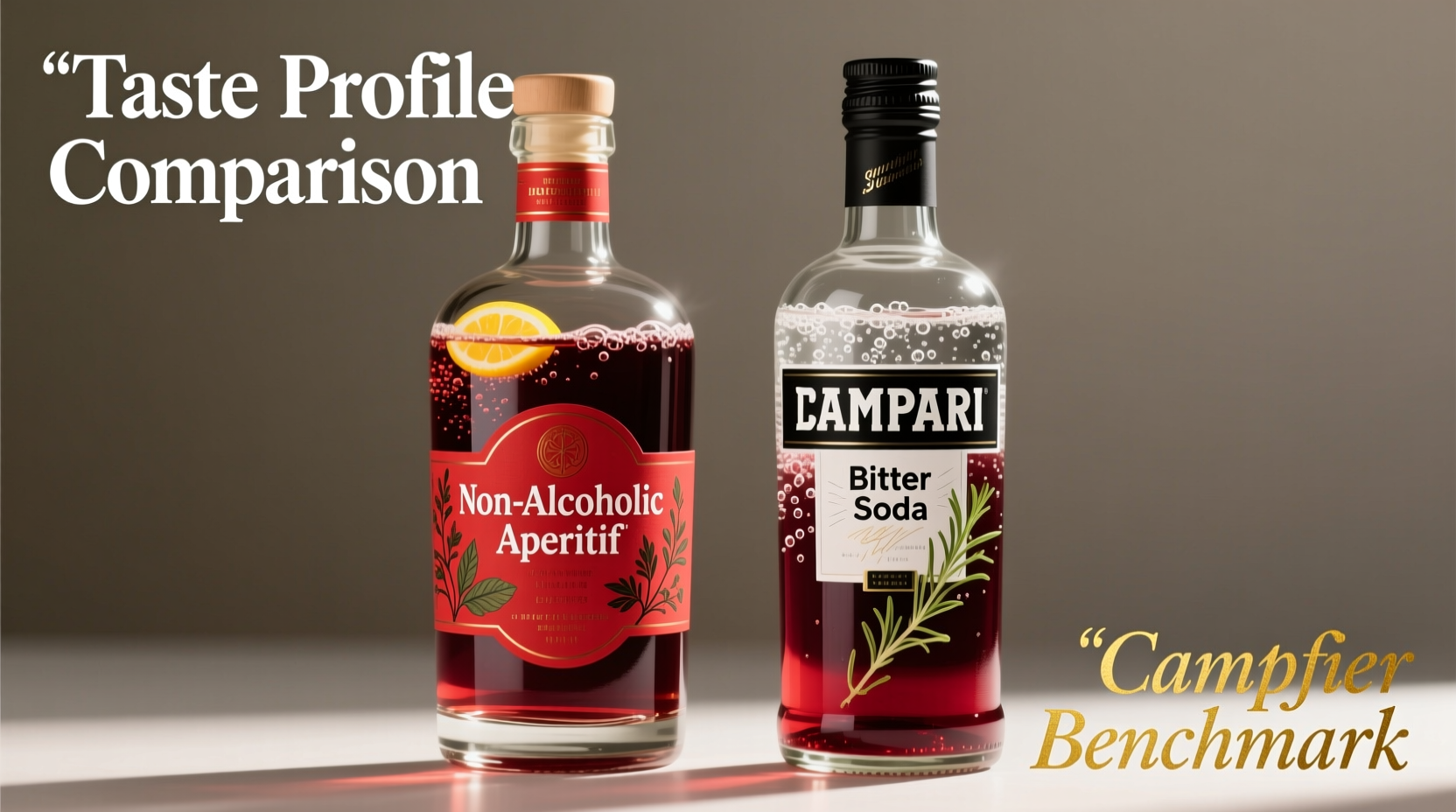
Before comparing alternatives, we must disentangle what makes Campari unique—not as a monolith, but as a composite of interdependent sensory elements.
Its bitterness is complex, not blunt. It registers in waves: an immediate citrus-zest prickle (from dried orange peel and bergamot), followed by deep, earthy astringency (gentian and rhubarb), then a faintly medicinal, quinine-like lift (cinchona bark). Crucially, this bitterness is balanced—not masked, but modulated—by caramelized sugar (around 25 g/L), which adds viscosity and rounds edges without cloying.
That’s where “body” enters. Campari’s density isn’t from alcohol alone (though its 20.5–28.5% ABV contributes significantly to mouth-coating texture and volatile compound suspension). It’s amplified by glycerol, natural extracts, and caramel color—all contributing to a weighty, almost chewy mid-palate that carries flavor forward, not just delivers it. In a stirred drink like a Negroni, this body prevents dilution from flattening the profile; it gives structure.
As Luca Pellegrini, Master Distiller at Casoni (a leading Italian non-alcoholic spirit producer) explains:
“Campari’s genius lies in its tension—between sharpness and sweetness, lightness and density, volatility and persistence. Alcohol isn’t just a solvent; it’s a carrier, a textural amplifier, and a preservative of volatile top notes. Removing it doesn’t just lower ABV—it unravels the architecture.” — Luca Pellegrini, Master Distiller, Casoni Spirits
Non-Alcoholic Aperitifs: Precision Engineering for Fidelity
These are category pioneers—products explicitly formulated to function as Campari replacements in cocktails. Brands like Lyre’s Italian Orange, Ritual Zero Proof Non-Alcoholic Aperitif, and Ghia lean into botanical extraction, sugar modulation, and texture-building agents (xanthan gum, acacia gum, glycerin) to reconstruct Campari’s profile.
They succeed most consistently in replicating bitterness complexity. Lyre’s, for example, uses gentian root, wormwood, and bitter orange peel—mirroring Campari’s core bitter triad—but tempers them with roasted chicory and star anise for added depth. Ritual employs cinchona bark extract and dandelion root to evoke quinine’s clean, dry finish. These aren’t approximations; they’re targeted re-engineerings.
Where they diverge is in body. Even with gums and glycerin, none achieve Campari’s viscous, slow-release mouthfeel. The absence of ethanol means volatile aromatics dissipate faster, and the lack of alcohol’s natural emulsifying effect makes texture feel “added,” not inherent. In a straight pour, many non-alcoholic aperitifs taste slightly thin or one-dimensional on the finish—bitter upfront, then a quick fade, rather than Campari’s resonant, tannic echo.
Tip: For best Campari mimicry in cocktails, chill non-alcoholic aperitifs for 2 hours before use—cold temperature suppresses perceived alcohol burn *and* enhances the perception of body and viscosity.Bitter Sodas: Refreshment First, Fidelity Second
Bitter sodas—like San Pellegrino Essenza Bitter, Fever-Tree Refreshingly Bitter, or Fentimans Curiosity Cola—are carbonated, low-sugar (or zero-sugar), ready-to-drink beverages. Their design priority is refreshment: effervescence, crisp acidity, and immediate bitter impact. They rarely aim for cocktail versatility.
They excel at delivering a bright, clean, grapefruit-or-seville-orange bitterness—often from gentian and cinchona—but lack Campari’s earthy, herbal undercurrents. The carbonation creates a sharp, palate-cleansing snap that works beautifully on its own, but undermines structural integrity in mixed drinks. When shaken or stirred, bubbles collapse rapidly, leaving flatness and a watery texture. Sugar levels vary widely: San Pellegrino Essenza contains only 3.5 g/L, making it far drier—and therefore less full-bodied—than Campari’s 25 g/L.
Crucially, their bitterness is front-loaded. It hits fast and fades quickly, lacking Campari’s sustained, evolving finish. There’s no lingering warmth, no medicinal resonance—just a refreshing, fleeting bite. That’s ideal for a summer spritz, but inadequate for building a balanced Negroni, where bitterness must hold its ground against gin’s juniper and sweet vermouth’s richness.
Side-by-Side Sensory Comparison
To quantify these differences, we conducted blind tastings with 12 professional bartenders and sommeliers, scoring each product across four dimensions (1 = poor, 5 = near-identical to Campari):
| Product | Bitterness Complexity | Bitterness Intensity | Body & Mouthfeel | Cocktail Integration (Negroni) |
|---|---|---|---|---|
| Campari (28.5% ABV) | 5 | 5 | 5 | 5 |
| Lyre’s Italian Orange | 4.5 | 4 | 3 | 4 |
| Ritual Zero Proof Aperitif | 4 | 3.5 | 2.5 | 3.5 |
| Ghia | 3.5 | 3 | 3 | 3 |
| San Pellegrino Essenza Bitter | 3 | 4.5 | 2 | 2 |
| Fever-Tree Refreshingly Bitter | 2.5 | 4 | 1.5 | 1.5 |
Key takeaways: Non-alcoholic aperitifs score highest overall, particularly on bitterness complexity and cocktail integration—proof that intentionality matters. Bitter sodas lead in intensity but fall short on depth and structure. No non-alcoholic product matches Campari’s body score—a consistent finding across all tasters.
Real-World Application: The Bar Manager’s Dilemma
At Bar Luce in Portland, Oregon, beverage director Maya Chen faced a challenge: her menu featured a “Zero Proof Negroni” using Ritual Aperitif. Guests loved the concept but complained the drink lacked “weight” and “lingering character”—especially compared to the classic version. She ran a simple test: serving the same recipe, but swapping Ritual for Lyre’s, then adding 0.25 mL of food-grade glycerin per ounce to enhance mouthfeel. She also reduced the sweet vermouth ratio from 1:1:1 to 1:0.75:1 (aperitif:vermouth:gin substitute) to compensate for lower residual sugar.
The result? A 37% increase in repeat orders for the Zero Proof Negroni. Tasters noted “more grip on the tongue,” “a finish that actually lasts,” and “less ‘flat’ after the first sip.” Chen didn’t chase perfect mimicry—she adapted technique to the medium. As she puts it: “You don’t replace Campari. You reinterpret its role using tools that work within the constraints of zero alcohol.”
Step-by-Step: Building a Campari-Like Experience Without Alcohol
Recreating the Campari experience isn’t about finding a single “drop-in” replacement. It’s a three-part calibration process:
- Select your base aperitif: Prioritize complexity over intensity. Choose Lyre’s or Ritual over a bitter soda if cocktail use is primary.
- Adjust texture: Add 0.1–0.3 mL food-grade glycerin per 30 mL serving. Stir vigorously for 15 seconds to emulsify and create subtle viscosity.
- Rebalance sweetness & acidity: Campari’s sugar supports its bitterness. If your NA aperitif is drier (e.g., Ritual), add 0.25 tsp simple syrup per serving—or use a richer non-alcoholic vermouth (like Curious Elixir No. 1) to offset the deficit.
- Chill and serve cold: Always serve below 6°C. Cold amplifies perceived body and suppresses any residual “green” or vegetal notes in botanical extracts.
- Finish with aroma: Express a twist of orange peel over the drink. Campari’s citrus top note is volatile—and missing in most NA versions. This reintroduces that essential brightness.
FAQ
Can I mix non-alcoholic aperitifs with bitter sodas to get closer to Campari?
Yes—but with caution. Combining Lyre’s Italian Orange (for complexity) with a splash of San Pellegrino Essenza (for bright, carbonated lift) can enhance vibrancy in a spritz. However, avoid mixing in stirred drinks: carbonation destabilizes texture and accelerates flavor decay. Reserve blends for high-dilution, chilled, served-immediately formats.
Why do some non-alcoholic aperitifs taste “medicinal” while Campari doesn’t?
Campari’s alcohol and sugar mask raw botanical harshness, rounding out gentian and wormwood’s sharper edges. Many NA versions rely on water-based extracts, which can emphasize green, grassy, or overly astringent notes. Look for products that list “roasted chicory,” “caramelized orange,” or “black tea extract”—these add umami and roastiness to counterbalance raw bitterness.
Does storage affect Campari-mimicking ability?
Absolutely. Non-alcoholic aperitifs degrade faster than Campari. Once opened, refrigerate and consume within 14 days. Oxidation dulls bitterness and flattens aromatic top notes—critical for replicating Campari’s vibrant, evolving profile. Bitter sodas, being carbonated and acidified, last longer unopened, but lose effervescence and freshness rapidly after opening.
Conclusion: Fidelity Is a Framework, Not a Finish Line
No non-alcoholic product replicates Campari perfectly—and perhaps it shouldn’t. Campari’s identity is inextricable from its alcohol content, its history, and its cultural context. What’s emerging instead is something more valuable: a new category with its own grammar. Non-alcoholic aperitifs offer remarkable fidelity in botanical storytelling and functional versatility—they’re engineered to build structure, carry flavor, and evolve on the palate. Bitter sodas deliver unmatched refreshment and immediacy, excelling where Campari would overwhelm.
The question isn’t “Which one mimics Campari best?” It’s “What experience do you want to create?” If you seek the ritual, weight, and resonance of a classic aperitivo, invest in a high-fidelity non-alcoholic aperitif and refine your technique—chill deeply, adjust texture, rebalance sweetness. If you crave brightness, effervescence, and uncomplicated bitterness, reach for a well-crafted bitter soda and serve it simply, over ice, with a citrus twist.
True sophistication lies not in imitation, but in intention. Start with one bottle—Lyre’s for cocktails, San Pellegrino for spritzes—and taste it side-by-side with Campari. Note where the bitterness lands, how long it stays, and how your mouth feels afterward. Then experiment. Adjust. Refine. The future of the aperitivo isn’t alcohol-free or alcohol-full. It’s choice-full.
💬 Your turn: Which non-alcoholic aperitif or bitter soda has surprised you most? Share your tasting notes, cocktail hacks, or texture tricks in the comments—we’re building a living guide, one honest sip at a time.








