In 2017, when HMD Global launched the Nokia 8, it wasn’t just another Android phone—it was a statement. The Finnish brand, once synonymous with mobile phones, returned with a premium device aiming to challenge established players. Meanwhile, Apple’s iPhone 6s, released in 2015, had become a benchmark for iOS reliability and longevity. Comparing these two devices across time reveals more than specs—it reflects shifting philosophies in smartphone design, user expectations, and corporate strategy.
The question isn't simply about which phone performs better. It's whether Apple lost momentum with incremental updates, or if Nokia’s resurgence was merely capitalizing on nostalgia and solid engineering. Let’s dissect both devices across key dimensions to understand where each stood—and where they still stand today.
Design and Build Quality: Metal, Glass, and Longevity
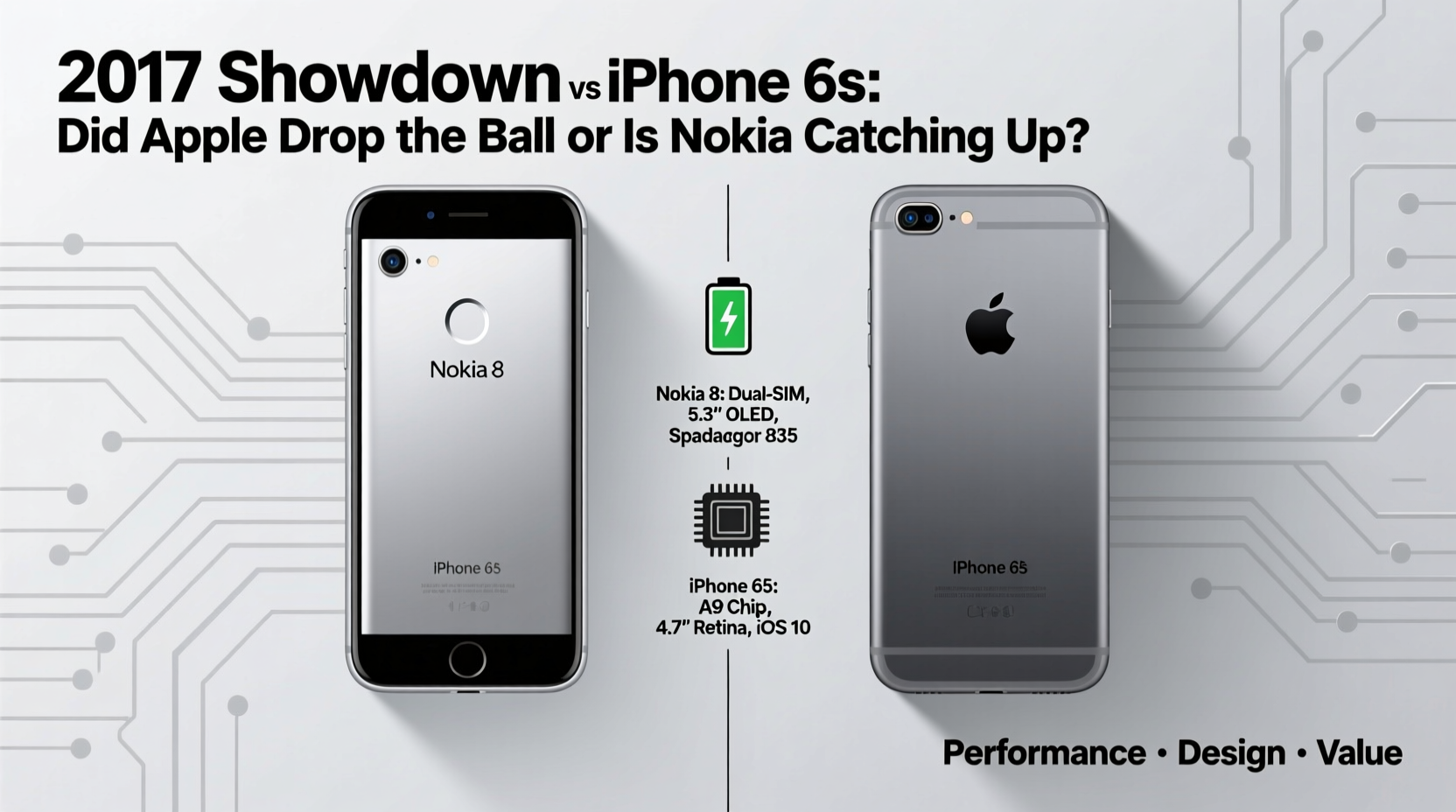
The Nokia 8 featured an all-metal unibody with chamfered edges and a symmetrical dual-camera setup. Its build quality echoed the durability Nokia was known for, but now wrapped in a modern, minimalist aesthetic. At 160 grams and 7.9mm thickness, it felt substantial without being unwieldy.
In contrast, the iPhone 6s used aerospace-grade aluminum and introduced 3D Touch. It was slightly heavier at 143 grams but thinner at 7.1mm. The real innovation was its use of 7000-series aluminum—though early batches faced “bendgate” issues, later models corrected this flaw.
Both phones emphasized durability, but differently. The Nokia 8 leaned into clean lines and symmetry; the iPhone 6s prioritized seamless integration of hardware and software. Over time, the 6s proved remarkably resilient, thanks in part to Apple’s strict control over materials and manufacturing.
Tip: When evaluating older phones, check for structural integrity—especially around buttons and ports—as signs of long-term reliability.Performance and Hardware Comparison
The Nokia 8 ran on Qualcomm’s Snapdragon 835—a flagship chip in 2017—paired with 4GB or 6GB of RAM. This gave it strong multitasking capabilities and smooth performance even under heavy loads. The 5.3-inch QHD display offered vibrant colors and excellent outdoor visibility.
The iPhone 6s used Apple’s A9 chip with 2GB of RAM. While technically outgunned on paper, iOS optimization allowed it to deliver snappy performance and efficient power management. Apps launched quickly, animations remained fluid, and background processes were tightly controlled.
Real-world usage tells a nuanced story. In raw benchmarks, the Nokia 8 wins decisively. But in daily tasks like messaging, browsing, and media playback, the difference was barely noticeable. The iPhone 6s maintained responsiveness years after release due to aggressive memory management and consistent software updates.
“Hardware specs matter, but user experience is defined by how well the system manages those resources.” — David Liu, Mobile Systems Analyst
Software Experience: Stock Android vs iOS Ecosystem
One of the Nokia 8’s standout features was its near-stock Android experience. Running Android Nougat (upgradable to Pie), it offered fast updates, minimal bloatware, and a clean interface. HMD Global committed to two years of OS upgrades and three years of security patches—an impressive promise at the time.
The iPhone 6s shipped with iOS 9 and received updates all the way to iOS 15, spanning six major versions over six years. This level of support far exceeded most Android competitors and ensured continued compatibility with modern apps and services.
While stock Android appealed to purists and developers, iOS provided consistency and ecosystem integration. Features like iMessage, FaceTime, iCloud sync, and AirDrop created a sticky environment that made switching costly for users.
| Feature | Nokia 8 | iPhone 6s |
|---|---|---|
| Operating System | Android 7.1.1 (Nougat) | iOS 9.0 |
| Final Update | Android 9 (Pie) | iOS 15.7 |
| Ram | 4GB / 6GB | 2GB |
| Processor | Snapdragon 835 | Apple A9 |
| Storage Options | 64GB (non-expandable) | 16/32/64/128GB |
| Battery | 3090 mAh | 1715 mAh |
| Charging | Quick Charge 3.0 | Standard USB Power |
Camera Capabilities: Dual Sensors vs Computational Photography
The Nokia 8 introduced a dual-lens rear camera setup—13MP monochrome + 13MP color—marketed as “Bothie,” allowing front and rear cameras to record simultaneously. Image quality was solid in daylight but struggled in low light compared to top-tier contemporaries.
The iPhone 6s featured a single 12MP rear sensor but leveraged advanced image signal processing and True Tone flash. Its video stabilization and dynamic range were class-leading at launch. More importantly, Apple’s computational photography techniques improved significantly over time via software updates—even enhancing older hardware.
In head-to-head photo tests, the 6s often produced more balanced exposures and natural skin tones. The Nokia 8 captured sharper details in ideal conditions but lacked the post-processing polish of iOS. Neither phone matched modern standards, but the 6s held up better over time due to app optimization and editing tool availability.
User Longevity and Real-World Relevance
A mini case study illustrates their staying power: Sarah, a freelance photographer, used her iPhone 6s from 2015 to 2021 for client communication, scheduling, and basic photo editing. Despite aging hardware, she extended its life through iCloud backups, battery replacements, and selective app use. She only upgraded when newer apps began dropping support.
Meanwhile, James, a tech enthusiast, bought a Nokia 8 in 2017 expecting flagship longevity. By 2020, he noticed slower app launches and declining update frequency. Though rooted and running custom ROMs helped, mainstream app compatibility waned faster than expected.
This highlights a crucial divergence: Apple’s closed ecosystem enables longer functional life, while Android’s fragmentation limits even well-built devices. Nokia delivered excellent hardware, but couldn’t match Apple’s software lifecycle.
Checklist: Evaluating Smartphone Longevity
- ✅ Check official software update policy (years of OS & security updates)
- ✅ Assess app compatibility trends for your core tools
- ✅ Consider repairability (battery replacement, screen fixes)
- ✅ Evaluate cloud integration and cross-device syncing
- ✅ Review community support (custom ROMs, forums) for older models
Did Apple Drop the Ball—or Is Nokia Catching Up?
The iPhone 6s wasn’t a revolutionary device at launch—it refined rather than redefined. But its enduring relevance came from strategic decisions: robust hardware, consistent software updates, and tight ecosystem control. Apple didn’t need to innovate wildly every year because it optimized what worked.
Nokia’s return with the 8 showed ambition. It packed high-end specs, clean software, and a compelling design. But launching in 2017 meant competing against Samsung’s Galaxy S8 and Google’s Pixel line—both pushing boundaries in displays and AI photography. The Nokia 8 was competent, not transformative.
So, did Apple drop the ball? No. The 6s aged gracefully because Apple designed it to last. Was Nokia catching up? Yes—but not to the present, rather to the recent past. The Nokia 8 matched flagships from 2016, not 2017. That gap mattered in perception and market impact.
Frequently Asked Questions
Can the iPhone 6s still be used in 2024?
Limitedly. It can handle calls, texts, emails, and light browsing, but many modern apps no longer support iOS versions compatible with the 6s. Safari lacks current web standards support, and security risks increase without updates.
Why did Nokia fail to gain market share despite good phones?
Brand recognition wasn’t enough. Without a unique software differentiator, app ecosystem, or aggressive marketing, Nokia competed solely on hardware—where others innovated faster. Additionally, carrier partnerships and retail presence lagged behind rivals.
Which phone offers better value today?
Neither should be purchased new, but secondhand, the iPhone 6s has higher utility due to potential battery swaps and familiarity. However, for collectors or retro enthusiasts, the Nokia 8 offers a rare blend of stock Android purity and solid build.
Conclusion: Legacy, Not Leadership
The Nokia 8 was a commendable effort—a sign that classic engineering values could return to smartphones. But it arrived late to a race already accelerated by software intelligence and ecosystem depth. Apple didn’t stumble with the iPhone 6s; instead, it demonstrated that thoughtful execution beats flashy specs over time.
Nokia wasn’t catching up to Apple’s future—it was reconnecting with a legacy of reliability in a world that had moved beyond hardware alone. The true lesson? Longevity isn’t just about build quality or processor speed. It’s about sustained support, adaptive software, and creating an experience people don’t want to leave.
🚀 What do you think shaped smartphone loyalty more: hardware excellence or software continuity? Share your perspective and join the conversation below.








