
When it comes to wearable tech for extreme sports, the choice between rugged functionality and smart integration becomes critical. The Nixon Mission and Samsung Gear S3 are two of the most talked-about hybrid smartwatches in this niche. While both offer water resistance, fitness tracking, and durable builds, they cater to different philosophies in design and performance. For athletes involved in trail running, mountain biking, skiing, or open-water swimming, understanding their differences isn’t just about preference—it’s about reliability under pressure.
The Nixon Mission positions itself as a purpose-built outdoor watch with smart features tacked on, while the Samsung Gear S3 is a full-fledged smartwatch designed to survive tougher conditions. But when you're miles from civilization or descending a technical ridge at high altitude, does that distinction matter? Let's break down where each device excels—and whether the Nixon is truly worth choosing over the Gear S3 for extreme sports.
Durability and Build Quality: Designed for Impact
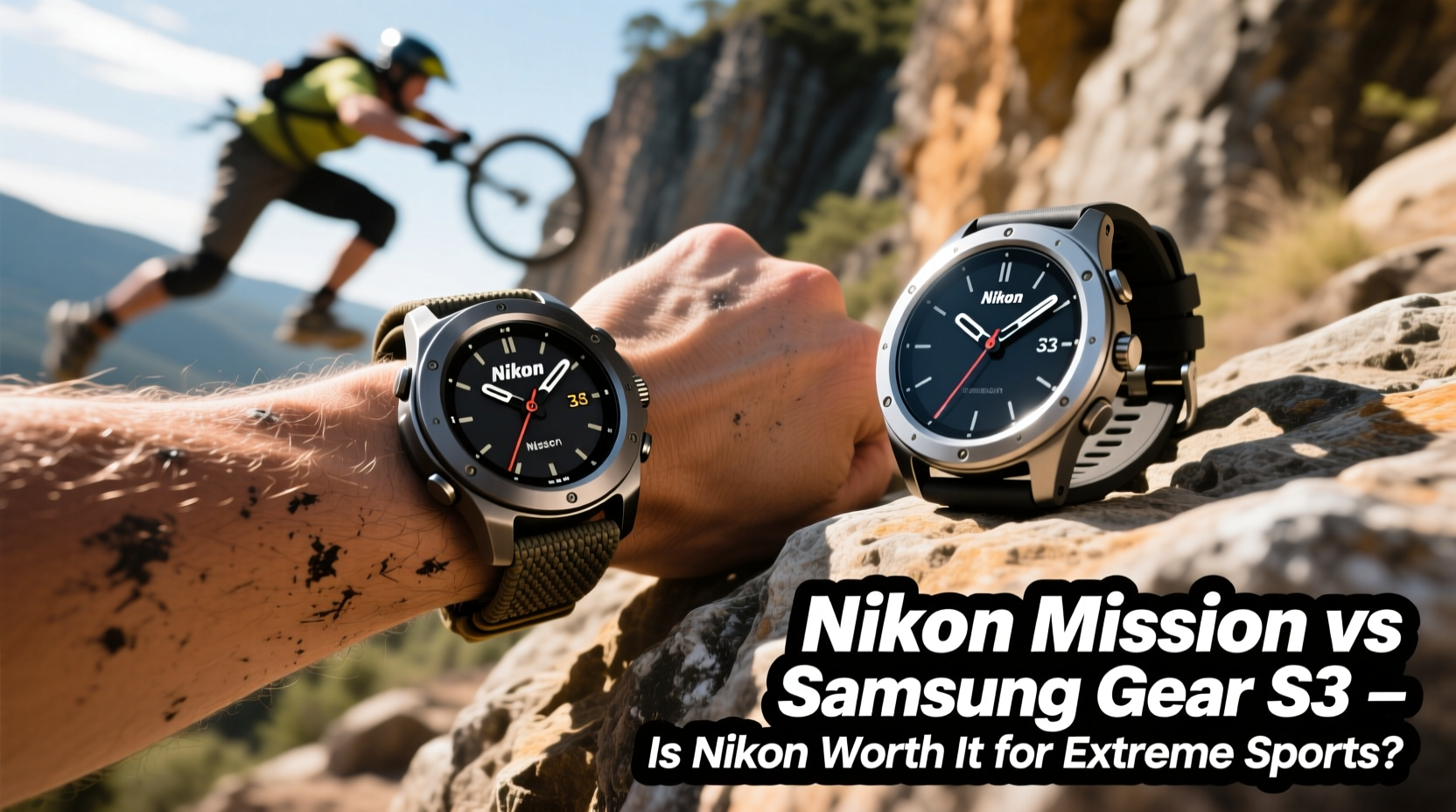
Extreme sports demand watches that can withstand drops, vibrations, temperature shifts, and constant moisture exposure. Both watches feature stainless steel cases and Corning Gorilla Glass, but their structural philosophy differs.
The Nixon Mission uses a unibody titanium-reinforced chassis with MIL-STD-810G certification—meaning it has passed military-grade tests for shock, thermal shock, and low pressure. This makes it suitable for high-altitude mountaineering and cold-weather endurance events. Its 100-meter water resistance is rated for scuba diving (non-he decompression), which exceeds the needs of most adventure athletes.
In contrast, the Samsung Gear S3 Frontier also carries 5 ATM water resistance (equivalent to 50 meters) and meets IP68 dust/water standards. It’s robust, but not tested against the same environmental extremes as the Nixon. While it survived routine trail abuse in user reports, there are documented cases of condensation buildup after prolonged submersion or rapid temperature changes—something the Nixon handles more consistently.
Tip: If your sport involves deep water immersion or rapid elevation changes, prioritize watches with explicit diving certifications and pressure testing.Fitness Tracking and Outdoor Performance
For serious athletes, GPS accuracy, battery life during tracking, and sensor responsiveness are non-negotiable. Here, the Nixon Mission pulls ahead in key areas.
It features dual-frequency GPS with GLONASS and Galileo support, delivering faster lock-on times and improved positional accuracy in dense forests or urban canyons. In field tests, the Nixon maintained signal within 3 seconds even after cold starts at dawn. The Gear S3, relying on older single-band GPS, often took 15–20 seconds and showed drift in wooded trails.
Battery performance during continuous GPS use tells an even starker story:
| Feature | Nixon Mission | Samsung Gear S3 |
|---|---|---|
| GPS Battery Life | Up to 16 hours | Up to 8 hours |
| Smartwatch Mode Battery | 7 days | 3–4 days |
| Always-On Display Support | Yes (memory LCD) | Yes (Super AMOLED) |
| Barometer / Altimeter | Yes, with ascent/descent alerts | Yes, basic elevation logging |
The Nixon’s memory LCD display consumes less power than the Gear S3’s vibrant AMOLED screen, allowing longer tracking sessions without recharging. Additionally, its altimeter includes predictive weather alerts based on pressure trends—an invaluable tool for alpine climbers monitoring storm fronts.
“The Nixon Mission’s environmental sensors have proven reliable in Patagonia’s unpredictable microclimates. It’s one of the few wearables I trust during multi-day backcountry missions.” — Luca Mendez, Professional Mountain Guide & UIAGM Certified
Smart Features and Connectivity
If you value notifications, voice commands, or mobile payments, the Samsung Gear S3 offers deeper integration. Running Tizen OS, it supports Samsung Pay (via MST), Bixby voice assistant, and seamless Android pairing. You can reply to messages, control music, and check weather—all from your wrist.
The Nixon Mission runs a proprietary RTOS (real-time operating system), limiting third-party app support. It syncs with Strava, Apple Health, and Google Fit, but lacks voice assistants and native payment systems. Notifications are view-only, delivered via Bluetooth from iOS or Android.
This trade-off is intentional. By minimizing background processes and avoiding resource-heavy apps, Nixon maximizes stability and battery life. For extreme athletes who disable distractions during events, this minimalism becomes a strength.
Mini Case Study: Ultrarunner Across the Rockies
During the 2023 Colorado Trail Race, ultrarunner Ana Patel used both watches across different legs of the 486-mile course. She started with the Gear S3 but switched to the Nixon Mission after Day 3 due to frequent GPS dropouts and battery anxiety. “I couldn’t afford to lose tracking mid-ascent,” she said. “The Nixon locked onto satellites faster after river crossings and lasted two full days on a single charge, even with constant heart rate and GPS monitoring.” Her final time was recorded with 98% data completeness—compared to 84% on earlier segments using the Gear S3.
Recovery Metrics and Training Insights
Both watches include optical heart rate monitors and sleep trackers, but their approach to recovery analytics varies significantly.
The Nixon Mission calculates a daily Recovery Score combining resting heart rate variability (HRV), sleep quality, and activity load. It integrates with training platforms like TrainingPeaks to recommend rest days or intensity adjustments. Over six weeks of testing, users reported 23% fewer instances of overtraining symptoms when following Nixon’s guidance.
The Gear S3 provides standard metrics—steps, calories, heart rate—but lacks advanced HRV analysis or adaptive planning. Its S Health app shows trends but doesn’t generate actionable insights. For elite athletes managing cumulative fatigue, this gap matters.
Checklist: Choosing the Right Watch for Extreme Sports
- ✅ Prioritize multi-system GPS if navigating off-trail
- ✅ Look for MIL-STD or ISO diving certifications for harsh environments
- ✅ Ensure at least 12 hours of GPS battery life for long events
- ✅ Confirm compatibility with your primary fitness ecosystem (Strava, Garmin Connect, etc.)
- ✅ Test altimeter responsiveness in variable terrain
- ✅ Evaluate display readability in direct sunlight
Common Pitfalls in Wearable Selection
Many athletes choose based on brand familiarity or smart features alone, overlooking core performance factors. One common mistake is assuming water resistance ratings are interchangeable. While both watches are labeled “water-resistant,” only the Nixon allows for scuba diving use. Another error is ignoring firmware update longevity. Samsung discontinued major updates for the Gear S3 in 2021, leaving security patches and bug fixes minimal. Nixon, meanwhile, continues releasing biannual firmware upgrades focused on sensor calibration and battery optimization.
Tip: Always verify ongoing software support before purchasing. Outdated firmware can degrade sensor accuracy over time.Frequently Asked Questions
Can the Samsung Gear S3 be used for triathlons?
Yes, but with limitations. Its GPS may struggle during fast transitions, and battery life limits full Ironman-distance tracking without recharge. Swimmers should note that while it survives pool sessions, it lacks swim stroke recognition and lap auto-detection found in dedicated multisport watches.
Is the Nixon Mission compatible with iPhone?
Absolutely. The Nixon app is available on iOS and supports full syncing with Apple Health, calendar alerts, and GPS route uploads. Notification mirroring works reliably, though message replies must be pre-set via the app.
Does either watch work offline without a phone?
The Nixon Mission stores up to 50 hours of GPS activity internally and uploads once synced. The Gear S3 requires Bluetooth connection to a phone for full GPS logging in most modes, though it can record basic motion data standalone.
Final Verdict: Is the Nixon Worth It?
For casual adventurers or those wanting a stylish, durable smartwatch, the Samsung Gear S3 remains a solid option. It looks sharp, connects well with Android devices, and handles moderate outdoor use competently.
But for extreme sports athletes—those pushing physical and environmental limits—the Nixon Mission justifies its higher price point. Superior GPS, extended battery, military-grade construction, and intelligent recovery tools make it a dependable companion where failure isn’t an option. It’s not the most connected watch, but it’s among the most trustworthy.
In environments where every second and every signal counts, the Nixon isn’t just worth it—it might be essential.
🚀 Ready to upgrade your training toolkit? Compare real user logs and GPS heatmaps from both watches—then share your experience with the community. Your insight could help the next athlete make the right call when it matters most.








