When shopping for a dazzling tennis chain, two popular gemstone options consistently rise to the top: moissanite and cubic zirconia. Both offer brilliant sparkle at a fraction of the cost of diamonds, making them appealing choices for fashion-forward jewelry lovers. But when it comes to long-term wear, visual impact, and overall value, how do they truly compare? The answer lies in understanding their physical properties, aesthetic performance, and real-world durability—especially on a piece as prominent as a tennis chain.
A tennis chain, with its continuous line of stones set closely together, demands consistent brilliance and resilience. Every stone must catch the light evenly, and the setting must withstand daily movement and friction. This makes material choice critical. While both moissanite and cubic zirconia shine brightly in store lighting, their behavior over time—and under scrutiny—can differ significantly.
Understanding the Basics: What Are Moissanite and Cubic Zirconia?
Before comparing these stones side by side, it's essential to understand what they are and how they're made.
Moissanite is a naturally occurring mineral—silicon carbide—first discovered in meteorite fragments by French scientist Henri Moissan in 1893. Today’s moissanite is lab-created, offering near-identical properties to the rare natural form. It ranks 9.25 on the Mohs scale of hardness, second only to diamond, which makes it highly resistant to scratches and abrasions.
Cubic zirconia (CZ), on the other hand, is a synthetic crystalline form of zirconium dioxide. First developed in the 1970s, CZ was designed to mimic the look of diamonds at a much lower cost. It scores between 8 and 8.5 on the Mohs scale, making it softer than moissanite and more prone to surface wear over time.
While both are man-made and visually similar to diamonds, their chemical composition and optical properties lead to different levels of fire, brilliance, and longevity—factors that become especially noticeable on a full-length tennis chain.
Sparkle Showdown: Brilliance, Fire, and Refractive Index
The “sparkle” of a gemstone is determined by two main factors: brilliance (the amount of white light reflected back to the eye) and fire (the dispersion of light into spectral colors). These are measured by the refractive index (RI) and dispersion value.
| Gemstone | Refractive Index (RI) | Dispersion (Fire) | Visual Effect |
|---|---|---|---|
| Diamond | 2.42 | 0.044 | Balanced brilliance and subtle fire |
| Moissanite | 2.65–2.69 | 0.104 | Intense fire and higher brilliance |
| Cubic Zirconia | 2.15–2.18 | 0.058–0.066 | Good sparkle, but less brilliance than moissanite |
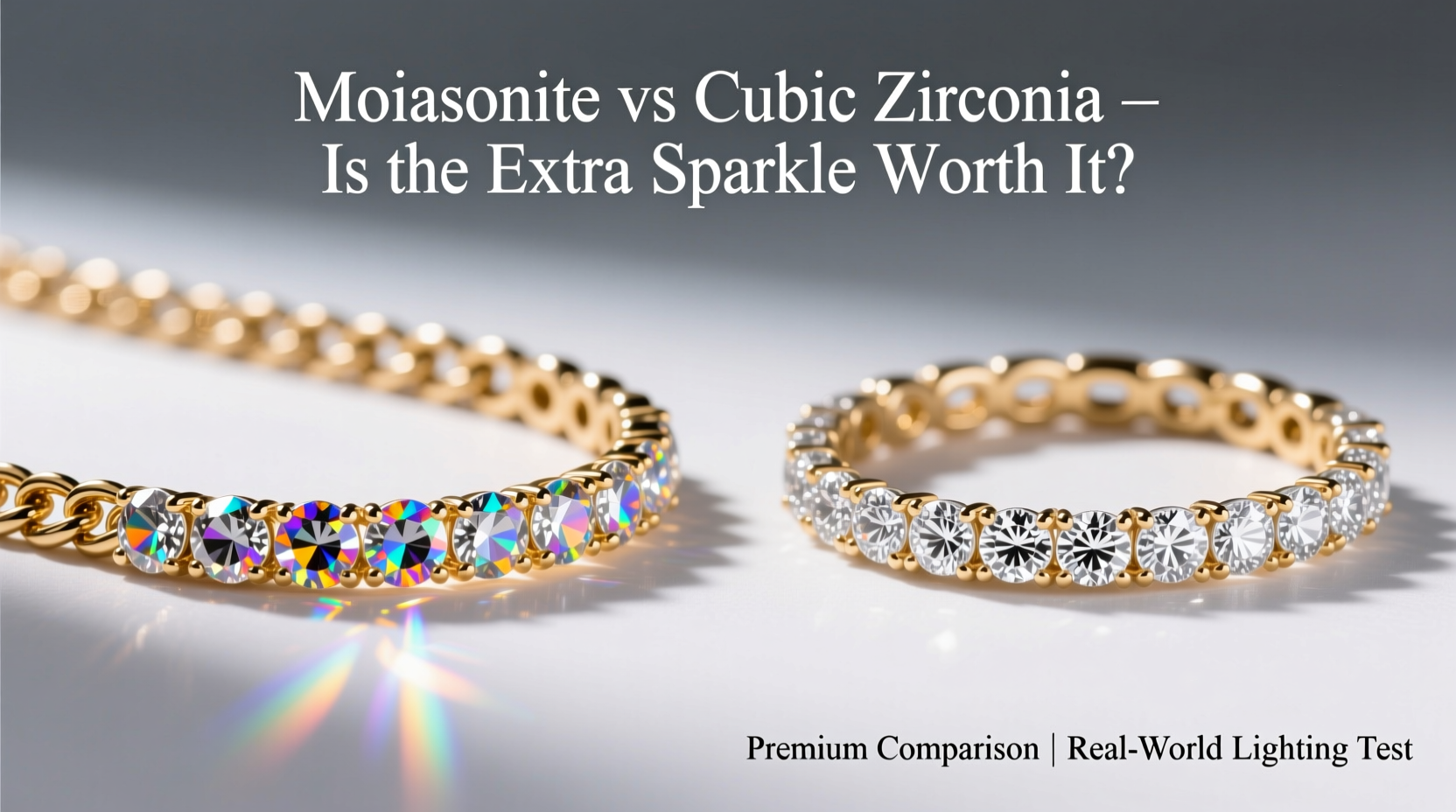
Moissanite’s higher refractive index means it reflects more light than CZ, giving it a livelier appearance in bright environments. Its exceptional dispersion results in rainbow-colored flashes that some describe as “disco ball” effects—especially under sunlight or artificial lighting. For a tennis chain, this can mean unmatched radiance from across a room.
Cubic zirconia, while still sparkly, tends to appear slightly glassy or static in comparison. It lacks the depth of light return seen in moissanite, and over time, surface scratches can dull its luster further.
Tip: If you love dramatic sparkle and don’t mind attention-grabbing flashes of color, moissanite will outperform CZ every time.Durability and Longevity: How Do They Hold Up Over Time?
A tennis chain isn’t just worn occasionally—it’s often a signature accessory, exposed to skin oils, lotions, friction, and occasional knocks. Durability matters.
Moissanite’s hardness (9.25) means it resists scratching from everyday contact. Even after years of wear, each stone in a moissanite tennis chain will maintain its polish and clarity. Because it’s chemically stable, it won’t cloud or discolor due to environmental exposure.
Cubic zirconia, while durable enough for short-term use, begins to show signs of wear within months. Micro-scratches accumulate on the surface, scattering light and reducing shine. Many CZ pieces develop a hazy film over time, especially when exposed to soap, perfume, or chlorine. Polishing can help temporarily, but repeated cleaning may alter the facet structure and symmetry.
“Moissanite offers a level of resilience that makes it ideal for high-wear jewelry like tennis chains. Unlike CZ, it doesn’t degrade visibly with regular use.” — Dr. Lena Peterson, Gemologist & Materials Scientist
In practical terms, a moissanite tennis chain can last decades with minimal care, while a CZ version may need replacement every 2–3 years if worn frequently.
Cost Comparison and Value Over Time
At first glance, cubic zirconia wins on upfront cost. A high-quality CZ tennis chain might retail for $100–$250, depending on length and metal type. In contrast, a comparable moissanite chain typically ranges from $600 to $1,500.
But evaluating value requires looking beyond the initial price tag. Consider this scenario:
Mini Case Study: Two Chains, Three Years Later
James bought a 20-inch CZ tennis chain in sterling silver for $180. He wore it weekly. By year two, the stones had dulled, and one fell out during routine wear. He replaced it once, spending another $160. After three years, he considered upgrading to something more permanent.
Sophia purchased a similar-length moissanite chain in 14K gold-plated brass for $950. She wore it just as often. After three years, the chain looked nearly new—no scratches, no cloudiness, all stones intact. She hadn’t spent a penny on maintenance.
Over time, Sophia saved money and enjoyed superior aesthetics. James spent $340 and ended up with inferior performance.
This illustrates a key point: moissanite may have a higher entry cost, but its longevity and sustained beauty offer better long-term value.
How to Choose the Right Option for You: A Practical Checklist
Selecting between moissanite and cubic zirconia depends on your lifestyle, budget, and expectations. Use this checklist to guide your decision:
- Do you wear jewelry daily? → Choose moissanite for lasting durability.
- Is budget a primary concern? → CZ is acceptable for occasional wear.
- Do you prioritize maximum sparkle? → Moissanite offers superior fire and brilliance.
- Will the chain be exposed to water or chemicals? → Avoid CZ; opt for moissanite.
- Are you investing in a statement piece? → Moissanite enhances perceived quality and craftsmanship.
- Do you plan to pass it down or resell? → Moissanite holds value better than CZ.
Frequently Asked Questions
Can you tell the difference between moissanite and cubic zirconia?
Yes, especially in larger settings like a tennis chain. Moissanite has sharper sparkle and stronger rainbow flashes. Under magnification, CZ shows more rounded facet edges and lower clarity consistency.
Does moissanite test as a diamond?
Most handheld diamond testers will identify moissanite as a diamond due to its thermal conductivity. However, advanced testers can distinguish between the two. Jewelers familiar with lab-grown stones can spot the difference through cut precision and dispersion patterns.
Will people know my chain isn’t made with diamonds?
Unless inspected closely with professional tools, most people cannot tell the difference between diamond, moissanite, and high-end CZ. Moissanite’s brilliance often exceeds that of diamonds, leading many to assume it’s premium quality rather than non-diamond.
Final Verdict: Is the Extra Sparkle Worth the Price?
The answer depends on what you value most. If you want a temporary accessory for photoshoots or special events, cubic zirconia offers affordability and decent sparkle. But if you’re investing in a piece meant to be worn regularly, admired up close, and kept for years, moissanite is unquestionably worth the premium.
The extra sparkle isn't just cosmetic—it reflects superior material science, durability, and long-term satisfaction. On a tennis chain, where every stone contributes to the overall effect, consistency and resilience matter. Moissanite delivers both.
Ultimately, jewelry should inspire confidence and joy. Paying more upfront for a moissanite tennis chain isn’t about status—it’s about choosing a piece that performs as brilliantly tomorrow as it does today.
🚀 Ready to upgrade your jewelry game? Invest in a moissanite tennis chain today and experience the perfect blend of luxury, brilliance, and lasting value. Share your thoughts or styling tips in the comments below!








