
For runners with flat feet—also known as overpronators—the choice of running shoe can make a critical difference in performance, comfort, and long-term joint health. While many focus on cushioning or weight, the materials used in the upper (like mesh) and midsole (typically foam) play distinct roles in how well a shoe supports a low or collapsed arch. Understanding the functional differences between mesh and foam is essential, but more importantly, it’s how these components work together that determines real-world support.
Flat feet tend to roll inward excessively during gait, increasing stress on the ankles, knees, and lower back. The ideal running shoe must counteract this motion through structure, not just softness. So when comparing “mesh vs foam,” the question isn’t about material superiority in isolation—it’s about how each contributes to stability, breathability, durability, and motion control in shoes designed for flat-footed runners.
The Role of Mesh in Running Shoes for Flat Feet
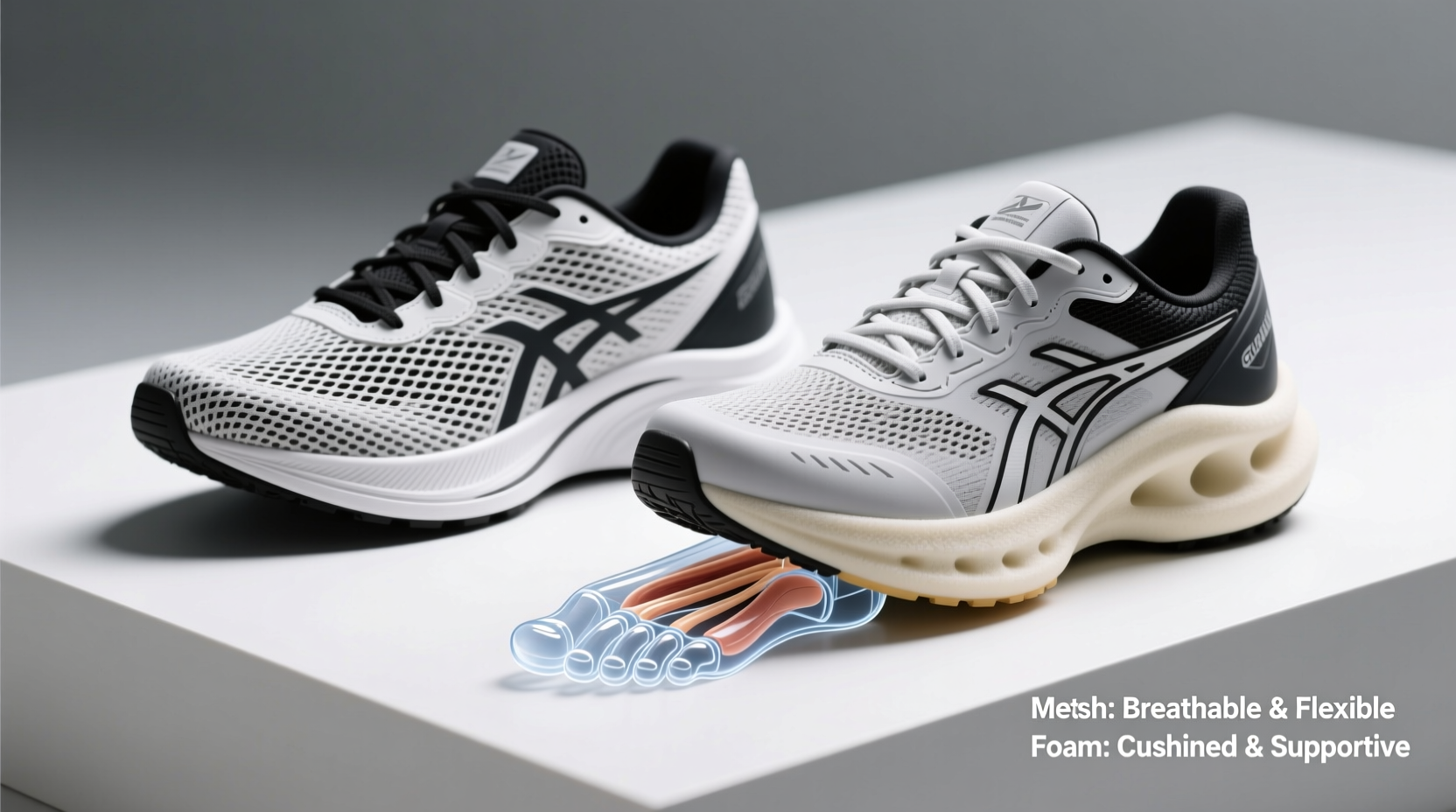
Mechanically, mesh refers to the fabric-like upper material that wraps around the foot. It's lightweight, breathable, and flexible—qualities that enhance comfort during long runs. However, breathability should not be mistaken for structural support. Mesh alone does not stabilize a flat foot. In fact, overly stretchy or thin mesh can compromise containment, allowing the foot to shift inside the shoe during heel strike and toe-off.
That said, high-quality engineered mesh—found in premium stability and motion-control shoes—can offer strategic reinforcement. These uppers are often layered with fused overlays, internal booties, or 3D-printed zones that lock the midfoot in place without sacrificing ventilation. For flat-footed runners, this kind of structured mesh helps maintain alignment by reducing lateral movement.
Tip: Look for \"engineered mesh\" or \"adaptive fit\" uppers with reinforced medial (inner) panels—they provide breathability while enhancing midfoot security for overpronators.In contrast, budget models may use single-layer mesh that stretches over time, leading to a loose fit and diminished support. Since flat feet already struggle with instability, a poorly constructed upper can worsen biomechanical inefficiencies, increasing the risk of plantar fasciitis or shin splints.
How Foam Midsoles Influence Support and Stability
If mesh handles fit and airflow, foam governs cushioning, energy return, and—critically—motion control. The midsole foam is where most support technology lives. For flat-footed runners, density, placement, and dual-density formulations matter far more than softness.
Traditional EVA (ethylene vinyl acetate) foam is lightweight and cost-effective but tends to compress quickly under repetitive load, especially for heavier runners. This breakdown reduces arch support over time, making the shoe less effective at controlling overpronation. Higher-end foams like PU (polyurethane), Pebax, or proprietary blends (e.g., Adidas’ Boost, Brooks’ DNA Loft, ASICS’ FlyteFoam) offer better durability and resilience.
More importantly, many stability shoes use **dual-density foam**—a firmer wedge of dense foam embedded along the medial (inside) side of the midsole. This feature, often called a \"medial post,\" actively resists inward collapse. When combined with a firm heel counter and a wide base, dual-density foam becomes a cornerstone of overpronation management.
“Foam composition and geometry are more important than material labels. A well-designed stability shoe uses foam strategically—not just generously—to guide the foot into neutral alignment.” — Dr. Lena Torres, Podiatrist and Sports Medicine Specialist
Recent innovations have introduced \"guidance rails\" and \"dynamic support systems\" that replace traditional medial posts with external TPU frames or zonal compression zones. These rely on precise foam shaping rather than added stiffness, offering smoother transitions while still limiting excessive roll.
Comparative Analysis: Mesh vs Foam – What Matters Most for Flat Feet?
To clarify the roles each material plays, here’s a direct comparison of how mesh and foam contribute to key performance factors for flat-footed runners:
| Feature | Mechanical Role of Mesh | Mechanical Role of Foam |
|---|---|---|
| Arch Support | Indirect—depends on upper structure and tongue attachment; minimal direct contribution | Direct—via midsole geometry, shank integration, and dual-density design |
| Overpronation Control | Limited—only if reinforced with overlays or internal strapping | Primary—through medial posts, guidance systems, or dual-density foam |
| Breathability | High—especially with open-knit or perforated mesh | Low—foam is non-porous and traps heat |
| Durability | Moderate—engineered mesh lasts longer than basic mesh | Varies—PU > EVA; high-resilience foams resist compression set |
| Weight | Light—mesh reduces overall shoe mass | Heavier when using dense stability foams |
| Foot Containment | High—if structured with heel counters and adaptive fit systems | Indirect—depends on midsole shape and heel cup integration |
This table underscores a key insight: foam is the primary determinant of functional support for flat feet, while mesh mainly affects comfort, fit, and climate management. A shoe with plush foam but flimsy mesh may lack lockdown, whereas one with rigid foam and poor breathability might cause overheating and blistering. The best options balance both.
Real-World Example: Choosing the Right Shoe After Injury
Consider Mark, a 38-year-old recreational runner with moderate flat feet who began experiencing sharp arch pain after switching to a popular minimalist shoe with ultra-breathable mesh and soft, single-density foam. Initially drawn to the shoe’s sleek design and lightweight feel, he logged 15 miles weekly without issues. But within six weeks, he developed plantar fasciitis.
Upon visiting a sports podiatrist, Mark learned that the shoe lacked medial support and used compressible foam that failed to correct his overpronation. His arch was collapsing with every step, straining the plantar fascia. He was advised to switch to a stability shoe with a structured upper and dual-density midsole.
He transitioned to the **Brooks Adrenaline GTS 23**, which features GuideRails support (a blend of foam zoning and upper reinforcement) and a precision-engineered mesh upper with 3D Fit Print overlays. Within three weeks of cross-training in the new shoe, his pain subsided. He now rotates between two supportive models and performs foot-strengthening exercises twice weekly.
Mark’s case illustrates that even experienced runners can misjudge support needs when swayed by marketing claims about \"cloud-like comfort\" or \"maximum breathability.\" For flat feet, biomechanics must trump aesthetics.
Step-by-Step Guide to Choosing the Best Running Shoe for Flat Feet
Selecting the right shoe involves more than comparing mesh and foam—it requires a systematic approach. Follow this timeline to make an informed decision:
- Assess Your Gait (Week 1): Visit a specialty running store for a gait analysis. Alternatively, record a slow-motion video of yourself running from behind on a treadmill. Look for excessive inward rolling of the ankles.
- Identify Your Needs (Week 1): Determine whether you need mild stability, maximum support, or motion control based on arch height and past injuries.
- Research Models (Week 2): Focus on shoes labeled \"stability\" or \"motion control.\" Top picks include Brooks Beast (motion control), ASICS GT-2000 (moderate stability), and Saucony Guide (balanced support).
- Check Upper Construction: Prioritize shoes with structured mesh, internal heel counters, and midfoot holsters. Avoid overly stretchy or minimal uppers.
- Evaluate Midsole Technology: Look for dual-density foam, medial posts, or guidance systems. Avoid all-soft foam unless specifically designed for dynamic stability.
- Test Fit (Week 3): Try shoes in the afternoon when feet are slightly swollen. Wear running socks and walk or jog in-store. Ensure no heel slip and that the arch feels supported.
- Break-In and Monitor (Weeks 4–6): Start with short runs. Note any discomfort in the arch, ankle, or knee. Replace orthotics if needed.
Checklist: What to Look for in a Running Shoe for Flat Feet
- ✅ Firm heel counter for rearfoot stability
- ✅ Dual-density or zoned midsole foam for overpronation control
- ✅ Structured, non-stretch mesh with medial overlays
- ✅ Wide base or \"platform\" design for improved balance
- ✅ Roomy toe box to prevent crowding during long runs
- ✅ Removable insole to accommodate custom orthotics if needed
- ✅ Durable outsole rubber in high-wear areas (especially medial forefoot)
Frequently Asked Questions
Can I use neutral shoes with orthotics if I have flat feet?
Yes, some flat-footed runners successfully pair neutral shoes with high-quality custom orthotics. However, this requires precise matching. A neutral shoe with a soft midsole may compress unevenly under orthotic pressure, reducing effectiveness. It’s generally safer to use a stability shoe with a built-in support system and add a minimalist insert only if necessary.
Do carbon-plated racing shoes work for flat feet?
Rarely. Most carbon-plated shoes are designed for efficiency, not stability. They often feature soft, compliant foams and minimal uppers that don’t control overpronation. Some newer models (like the Nike ZoomX Invincible Run) offer more inherent stability due to ultra-thick, resilient foam, but they’re exceptions. Flat-footed runners should stick to dedicated stability trainers for daily use and consult a specialist before using race-day plates.
How often should I replace my running shoes if I have flat feet?
Every 300–500 miles, or sooner if you notice increased fatigue, joint pain, or visible midsole compression. Flat-footed runners often break down foam faster due to concentrated pressure on the medial side. Inspect the outsole for uneven wear and press the heel area with your thumb—if it feels mushy or permanently indented, it’s time to replace.
Final Recommendations and Action Steps
When it comes to supporting flat feet, foam plays a far more critical role than mesh. While breathable mesh enhances comfort, it cannot compensate for inadequate midsole structure. The foundation of support lies in the foam’s density, geometry, and integration with the shoe’s chassis. That said, a high-performance upper made of engineered mesh ensures the foot stays securely aligned over that supportive base.
The best shoes for flat feet combine both: a resilient, dual-density foam system to manage overpronation and a structured, semi-rigid upper to maintain fit and reduce slippage. Brands like Brooks, ASICS, Saucony, and New Balance consistently deliver in this category, with models specifically tuned for overpronators.
Don’t let marketing terms like “plush” or “airy” distract from functional needs. Support isn’t always soft, and breathability shouldn’t come at the cost of stability. Invest time in proper fitting, prioritize evidence-based design, and listen to your body’s feedback after each run.
🚀 Ready to find your perfect fit? Visit a specialty running store this week, get a gait analysis, and test at least two stability-focused models. Your feet—and future runs—will thank you.








