When selecting running shoes, the upper material—whether mesh or knit—plays a pivotal role in comfort, breathability, and crucially, foot support. As athletic footwear technology evolves, manufacturers are increasingly using engineered knits and advanced mesh weaves to improve fit and performance. But for runners concerned about stability and long-term foot health, the question remains: which material truly delivers superior support?
This article breaks down the structural and functional differences between mesh and knit uppers, evaluates how each contributes to foot support, and provides actionable guidance for choosing the right shoe based on your biomechanics, activity level, and personal needs.
Understanding Upper Materials: Mesh vs Knit
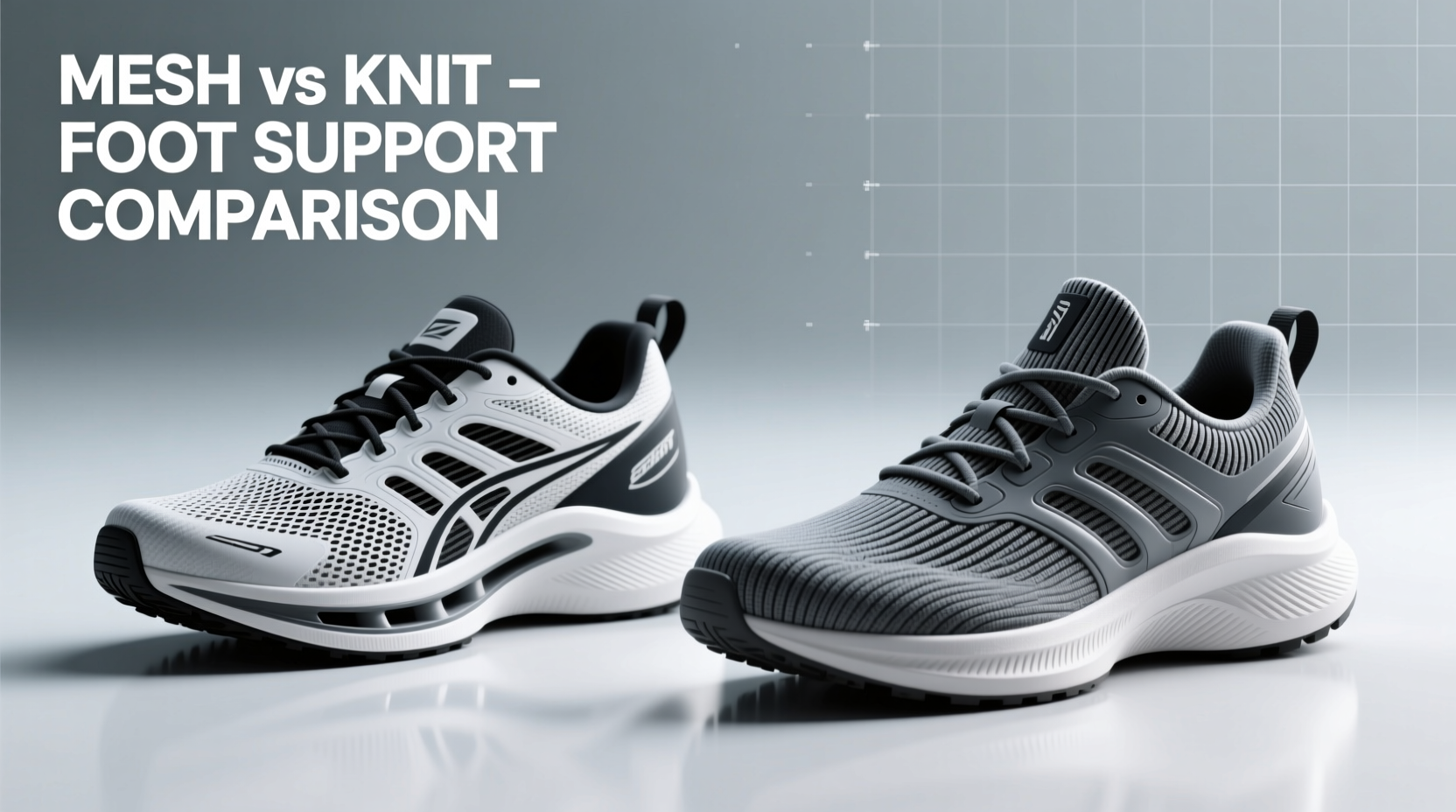
The upper is the part of the shoe that covers the top and sides of the foot. It’s responsible for securing the foot within the shoe, managing airflow, and contributing to overall weight and flexibility. Traditionally, running shoes used synthetic leather or nylon, but today’s performance models rely heavily on lightweight textiles like mesh and knit.
Mesh is typically a woven fabric with open spaces designed to promote ventilation. It can be made from polyester, nylon, or blends, and often features layered constructions for added durability. Mesh is known for its breathability and is commonly found in both entry-level and high-performance running shoes.
Knit uppers, by contrast, are created through precision knitting techniques similar to those used in apparel. Brands like Nike (Flyknit), Adidas (Primeknit), and New Balance (FuelCell) have popularized this technology. Knit fabrics are often seamless, form-fitting, and engineered with zones of varying elasticity and density to mimic the function of traditional overlays and support structures.
While both materials aim to reduce weight and enhance comfort, their inherent properties lead to different support characteristics.
How Support Is Delivered in Running Shoes
Foot support isn’t just about cushioning—it encompasses containment, midfoot lockdown, heel stability, and resistance to lateral movement. True support prevents excessive motion that could lead to strain, blisters, or overuse injuries.
Support comes from three main components:
- Upper Structure: How well the shoe hugs and stabilizes the foot during movement.
- Midsole Integration: The way the upper connects to the midsole and heel counter to prevent slippage.
- Zonal Reinforcement: Targeted areas of stiffness or tension that control stretch in key regions like the medial arch or heel collar.
In traditional designs, support was achieved with plastic overlays, TPU films, and rigid heel counters. Modern minimalist trends have shifted focus toward adaptive uppers that provide dynamic support without adding bulk.
Mechanical Differences: Stretch, Fit, and Stability
Mechanically, mesh and knit behave differently under stress:
- Mesh tends to be more dimensionally stable. While breathable, it resists stretching over time, especially when reinforced with fused layers or synthetic backing. This makes it less likely to sag or deform after repeated use.
- Knit has inherent elasticity. High-quality knits are engineered with variable stitch patterns to create zones of compression and give. However, some knits may stretch slightly with prolonged wear, potentially reducing lockdown if not paired with internal support frames.
A 2021 biomechanical study published in the *Journal of Sports Engineering and Technology* found that while knit uppers offered superior initial fit conformity, they exhibited up to 12% more elongation after 50km of simulated running compared to dual-layer mesh. This suggests that mesh may maintain structural integrity longer, contributing to consistent support over time.
“Engineered knit can offer excellent support when integrated with internal heel cups and midfoot bands, but standalone knit lacks the rigidity needed for runners with overpronation.” — Dr. Lena Torres, Biomechanics Researcher at Portland State University
Comparative Analysis: Support Features by Material Type
| Feature | Mes | Knit |
|---|---|---|
| Breathability | Excellent – large open weave allows airflow | Good – depends on yarn density; tighter weaves reduce ventilation |
| Stretch & Flexibility | Low to moderate – minimal give once broken in | High – conforms closely to foot shape |
| Midfoot Lockdown | Relies on lacing and external overlays | Superior due to sock-like fit and zonal tensioning |
| Durability Over Time | High – resists deformation and abrasion | Moderate – may loosen slightly with extended use |
| Heel Stability | Depends on padding and counter integration | Generally strong due to seamless heel cup construction |
| Suitability for Wide Feet | Often better – less constrictive | Can feel too tight unless specifically designed for width |
| Support for Overpronators | Better when combined with medial posts and stiff overlays | Limited unless supported by internal stability chassis |
Real-World Performance: A Runner’s Perspective
Consider the case of Marcus R., a recreational marathoner training for his third race. He previously wore a pair of knit-based racing flats but began experiencing Achilles irritation and a sensation of foot “wandering” during long runs. After switching to a dual-density mesh shoe with a reinforced midfoot band, he noticed immediate improvements in heel hold and lateral stability.
“The knit shoes felt great the first few miles,” Marcus explained, “but by mile 10, I could feel the upper stretching slightly. My foot wasn’t as secure, especially on uneven pavement. The mesh ones stayed consistent throughout.”
This scenario reflects a common trade-off: knit excels in initial comfort and lightweight performance, while mesh often wins in long-term structural consistency. For runners logging high mileage or those with mechanical inefficiencies, that consistency translates directly into better support.
When Knit Excels: Precision Engineering Matters
It would be inaccurate to dismiss knit entirely. When properly engineered, knit uppers can deliver exceptional support. For example, the Adidas Adizero Boston 12 uses Primeknit+ with a supportive midfoot web that integrates with the lacing system to create a locked-down feel. Similarly, Nike’s ZoomX Invincible Run Flyknit combines a full-length carbon fiber plate with a dynamic flywire-supported knit upper to guide the foot through gait.
The key is integration. Knit alone is rarely sufficient for robust support. It must be combined with internal frameworks, heel counters, and midsole geometry to be effective for runners needing stability.
Actionable Guidance: Choosing Based on Your Needs
Selecting between mesh and knit shouldn’t be arbitrary. It should align with your foot type, running style, and goals. Use the following checklist to make an informed decision:
✅ Foot Support Decision Checklist
- Do you overpronate or have flat arches? → Prioritize mesh or knit with internal support systems.
- Are you a neutral runner seeking lightweight speed? → Knit may offer better energy return and fit.
- Do you run long distances (10+ miles regularly)? → Choose materials proven for durability and consistent fit.
- Have you had issues with blisters or heel slip? → Look for seamless knit heels or mesh with padded collars.
- Do you run in hot climates? → Mesh generally offers superior breathability.
- Do you prefer a snug, sock-like fit? → Knit will likely feel more natural.
Step-by-Step: Evaluating Support in Store or Online
- Inspect the upper: Press your finger into the side of the shoe near the arch. Does it resist compression, or does it give easily?
- Check for reinforcements: Look for fused panels, TPU overlays, or internal cages—even on knit shoes.
- Test heel security: Slide your hand inside the heel; there should be minimal stretch and a firm counter.
- Simulate movement: Mimic a running motion by flexing the shoe. Observe if the upper twists excessively.
- Read expert reviews: Focus on feedback about mid-run fit changes, not just initial comfort.
Frequently Asked Questions
Can knit shoes provide enough support for heavy runners?
Yes, but only if they include additional structural elements like molded heel counters, dual-density midsoles, and supportive shanks. Heavy runners (over 200 lbs) should avoid minimalist knit designs and opt for models explicitly labeled as “max cushion” or “stability.”
Do mesh shoes last longer than knit?
Generally, yes. Mesh is less prone to fiber fatigue and stretching over time. Knit uppers, especially those made with fine gauge yarns, may show signs of loosening after 200–300 miles, particularly around high-stress zones like the toe box and lacing area.
Is one material better for wide feet?
Mesh typically accommodates wider feet more comfortably because it doesn’t cling as tightly. Many knit shoes are designed for medium-width feet and may feel constrictive without specific wide-width options. Always check availability in EE or 2E widths if needed.
Final Verdict: Which Offers Better Foot Support?
When evaluated purely on structural support, **mesh running shoes generally outperform knit** in consistency, durability, and resistance to deformation. They maintain their shape and containment over hundreds of miles, making them ideal for runners who need reliable midfoot and heel stability.
However, modern knit technology has closed the gap significantly. High-end knit shoes with integrated support systems—such as internal exoskeletons, adaptive lacing zones, and thermoplastic heel cups—can rival or even exceed the support of basic mesh models. The difference lies not in the material itself, but in how it’s engineered.
For runners with neutral mechanics and no history of injury, knit offers a compelling blend of comfort and performance. But for those requiring medical-grade support, dealing with overpronation, or logging high weekly mileage, a well-constructed mesh upper—especially one combined with stability features—is often the safer, more dependable choice.
“The best shoe isn’t defined by its upper material, but by how that material works with the rest of the shoe to support your unique stride.” — Dr. Arjun Patel, Podiatrist and Sports Medicine Consultant
Take Action Today for Healthier Runs
Your running shoes are more than just gear—they’re foundational to your performance and long-term joint health. Don’t settle for style over substance. Whether you choose mesh or knit, prioritize engineering over aesthetics. Test shoes over distance, not just in the store. And remember: support isn’t something you feel only at mile one. It’s what you experience at mile ten, when fatigue sets in and your feet need the most protection.
💬 What’s your experience with mesh vs knit running shoes? Share your thoughts, recommendations, or questions below—your insights could help fellow runners make smarter choices.








