
Ten-ball is often regarded as the most technically demanding of all pocket billiards games. Played with ten numbered object balls and a cue ball, it combines precision, strategy, and consistency in a way that challenges even seasoned players. Unlike nine-ball, where players can rely on run-outs and aggressive shots, ten-ball requires tighter control, better pattern play, and superior position management. Whether you're new to the game or looking to refine your skills, mastering ten-ball means embracing discipline, planning, and execution under pressure.
Understanding the Rules and Structure of Ten-Ball
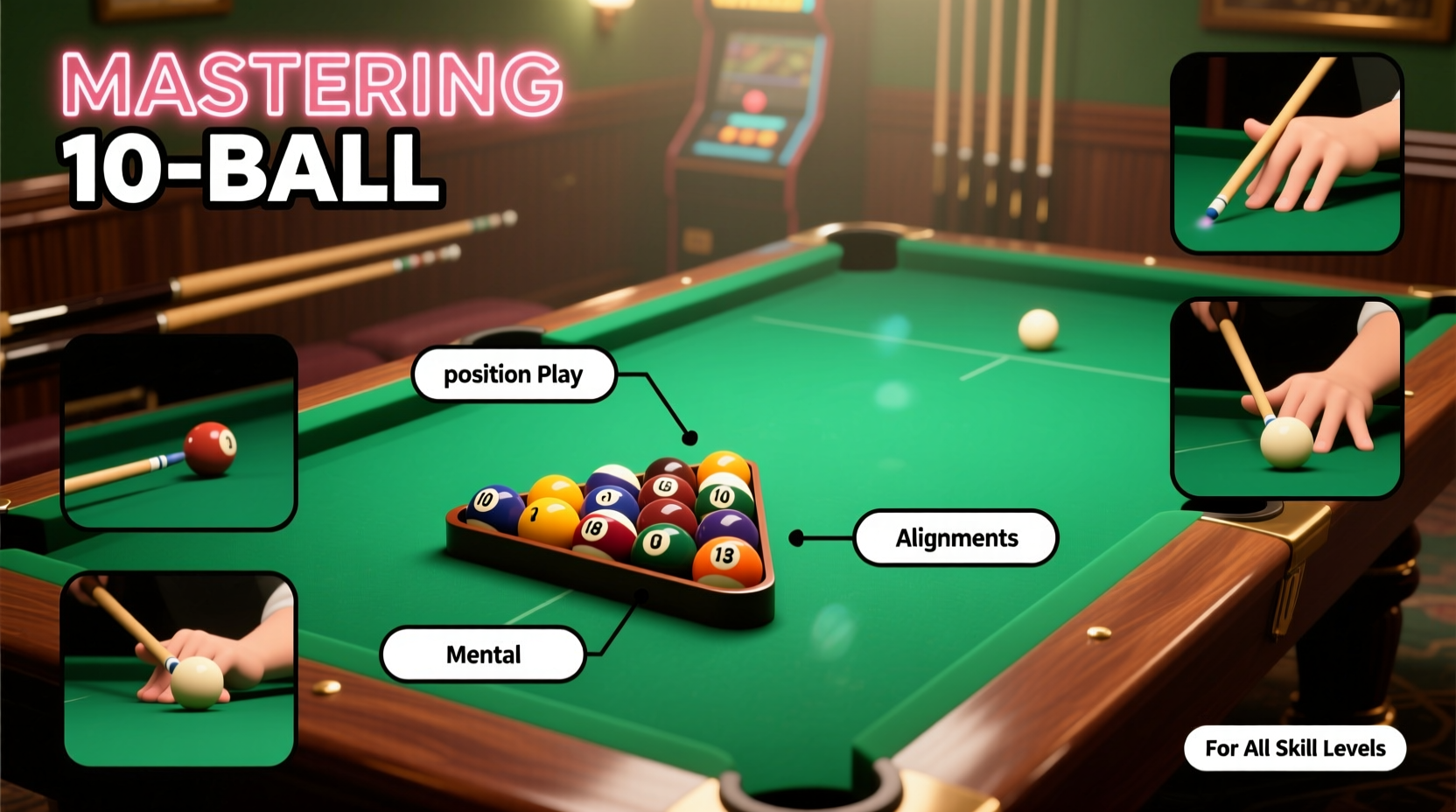
Ten-ball follows a straightforward set of rules but demands strict adherence to shot legality. The game begins with a rack of ten balls in a triangle formation, with the 1-ball at the front and the 10-ball in the center. The break must be executed legally: the cue ball must strike the 1-ball first, and either an object ball must be pocketed or at least four object balls must hit cushions after contact. Failure results in a foul, giving the opponent ball-in-hand.
After the break, players must call their shots—meaning they must declare which ball will go into which pocket. However, if house rules allow, some variations permit \"call-everything\" or \"call-pocket\" formats. The objective is to legally pocket the 10-ball, but only after all lower-numbered balls have been cleared—or when the 10-ball is the lowest remaining ball on the table.
Tip: Always aim to break with controlled power. A clean break increases your chances of running out, while over-powering can scatter balls unpredictably.Core Strategies for Every Skill Level
Success in ten-ball isn’t just about sinking balls—it’s about controlling the table. Players must think several shots ahead, managing both ball position and cue ball trajectory. Here are key strategic principles across three skill tiers:
Beginner: Focus on Fundamentals
- Develop consistent stroke mechanics and stance.
- Practice calling shots accurately—even obvious ones.
- Avoid risky bank or kick shots until cue ball control improves.
- Learn basic patterns: always plan the next two shots during setup.
Intermediate: Build Shot Sequences
- Map out entire racks before shooting.
- Use soft draw and follow shots to fine-tune cue ball positioning.
- Study common cluster breakouts (e.g., separating two close balls).
- Incorporate safety play when runs aren’t possible.
Advanced: Master Table Control
- Anticipate opponent patterns and leave minimal openings.
- Use spin strategically—not excessively—to navigate tight spaces.
- Execute break-and-run attempts with precision, not force.
- Adapt dynamically when the rack doesn't unfold as planned.
“Ten-ball separates good players from great ones because it removes luck from the equation. You earn every point.” — Efren Reyes, Professional Pool Champion
Essential Techniques for Position Play and Pattern Running
One of the defining features of ten-ball is its emphasis on pattern play—the ability to sequence shots efficiently without leaving yourself stuck. Because the 10-ball cannot be pocketed early (unless it’s legal), players must clear a path through the rack methodically.
To build effective patterns:
- Identify natural progressions: look for groups of balls near pockets that can be cleared in order.
- Plan escape routes: if a cluster blocks access, determine how to open it safely.
- Control cue ball speed: too much force leads to loss of control; too little risks leaving easy safeties for opponents.
- Use rails wisely: banks and kicks should only be attempted when necessary and calculated.
Positional finesse comes down to understanding angles, spin transfer, and rebound behavior. Practicing stop shots, stun draws, and half-tip follow allows players to place the cue ball within inches of desired targets.
| Skill Focus | Drill Exercise | Purpose |
|---|---|---|
| Cue Ball Control | Stop Shot Drill (straight-in shots with middle CB) | Minimize post-contact movement |
| Draw Control | Draw Shot Ladder (progressive distance pulls) | Improve backspin accuracy |
| Pattern Recognition | Rack Repetition (same layout daily) | Build muscle memory for common sequences |
| Safety Play | Three-Ball Hide Game (hide CB behind obstacle) | Develop tactical awareness |
Step-by-Step Guide to Executing a Successful Break
The break sets the tone for the entire game. A poor break gives your opponent an immediate advantage, while a strong one can lead to a run-out. Follow this step-by-step process:
- Position the cue ball: Place it slightly off-center along the head string, typically favoring the side opposite your dominant hand for better angle coverage.
- Align your tip: Aim to strike the 1-ball full or slightly angled, targeting the second or third ball in the rack to create symmetrical dispersion.
- Adjust cue elevation: Slightly raise the butt of the cue to reduce deflection and ensure clean contact.
- Apply moderate speed: Use firm but not maximum power. Overpowering causes excessive spread and loss of control.
- Follow through smoothly: Maintain balance and let the cue extend naturally forward after impact.
- Evaluate outcome: If no ball is pocketed, check whether four balls hit cushions. If yes, continue. If not, expect ball-in-hand for your opponent.
Common Mistakes and How to Avoid Them
Even experienced players fall into traps that cost them games. Recognizing these pitfalls is half the battle:
- Over-aggression: Trying to pocket difficult shots instead of playing safe. This often leads to unforced errors.
- Neglecting the 10-ball: Forgetting its position until late in the rack. Always know where it is and how to legally access it.
- Poor pre-shot routine: Rushing into shots without visualizing the path or planning position. Slow down and breathe.
- Misjudging clusters: Attempting to plow through packed balls instead of using finesse shots to separate them.
- Ignoring safety options: Failing to consider defensive plays when a run isn’t viable, giving opponents free tables.
Frequently Asked Questions
Can I pocket the 10-ball early and win?
No. The 10-ball can only be legally pocketed when it is the lowest-numbered ball remaining on the table. Pocketing it earlier—intentionally or accidentally—results in a loss of turn or a foul, depending on the rule set.
Is calling shots mandatory in ten-ball?
In official APA and WPA rules, yes. You must call the ball and the pocket. Some recreational leagues may relax this rule, but competitive play enforces it strictly.
What happens after a foul?
The incoming player receives “ball-in-hand,” meaning they can place the cue ball anywhere on the table before taking their shot. This is a significant advantage and underscores the importance of avoiding fouls.
Putting It All Together: A Real-Game Scenario
Consider this scenario: Alex, an intermediate player, breaks cleanly but fails to pocket a ball. His opponent, Jamie, runs seven balls before missing on the 8-ball. Alex steps up with the 9 and 10 still on the table.
Instead of going for a risky 9-ball combo, Alex assesses the layout. The 9-ball is near the corner, blocked slightly by the cue ball’s position. He opts for a soft draw shot, gently pocketing the 9 and drawing the cue ball back toward the center. Now, with a clear path to the 10-ball, he calls his shot precisely and sinks it to win the game.
This example illustrates patience, positional control, and smart decision-making—hallmarks of strong ten-ball play. Alex didn’t try to force anything; he waited for the right opportunity and capitalized.
Final Tips for Long-Term Improvement
Becoming proficient at ten-ball is a journey grounded in repetition, reflection, and resilience. To keep progressing:
- Play against stronger opponents regularly—they expose weaknesses faster than practice alone.
- Record and analyze your matches to identify recurring mistakes.
- Set specific weekly goals (e.g., improve break consistency, master one new safety technique).
- Join a league or find a training partner to maintain accountability.
- Stay mentally composed—even missed shots offer learning value.









