For professional gamers and competitive players, every gram counts. In high-stakes esports environments where split-second decisions define victory or defeat, the physical sensation of a mouse—its weight, balance, and responsiveness—can influence precision and endurance. Two of the most revered ultra-light gaming mice on the market are the Logitech G Pro X Superlight 2 and the Razer Viper V2 Pro. Both claim to deliver feather-light performance, but when it comes down to actual feel, which one truly feels lighter in hand during extended gameplay?
The answer isn’t just about numbers on a spec sheet. It’s about how the mouse sits in your grip, how it moves across the pad, and how fatigue sets in over hours of play. This article breaks down the real-world differences between these two elite contenders, focusing not only on measured weight but also on perceived lightness, build design, sensor performance, and feedback from top-tier players.
Weight Specifications: The Numbers Behind the Lightness
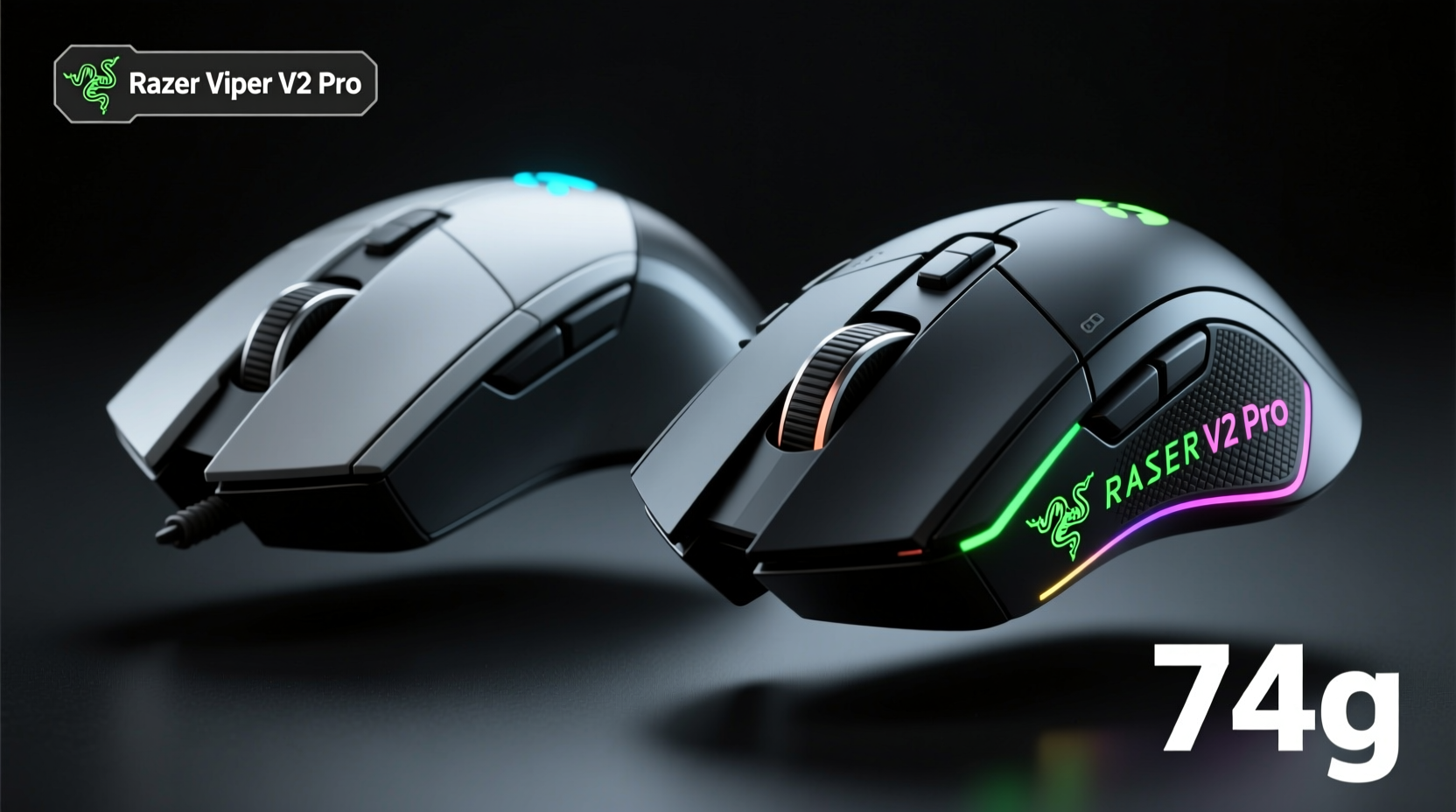
On paper, both mice are engineered to be among the lightest wireless gaming mice available. But subtle differences in construction and internal components affect more than just the scale—they shape the user experience.
| Feature | Logitech G Pro X Superlight 2 | Razer Viper V2 Pro |
|---|---|---|
| Weight | 60 grams | 58 grams |
| Connectivity | Wireless (Lightspeed), USB-C charging | Wireless (HyperSpeed), no onboard charging |
| Sensor | HERO 2 (up to 32,000 DPI) | Focus Pro 30K (up to 30,000 DPI) |
| Switches | Gen 2 Hybrid Optical (rated for 90M clicks) | Optical Mouse Switches Gen-3 (rated for 90M clicks) |
| Battery Life | Up to 95 hours | Up to 80 hours |
| Charging | Dock or USB-C cable (charging case optional) | No built-in charging; requires external dock or AA battery workaround |
At first glance, the Razer Viper V2 Pro wins by two grams. However, this minimal difference rarely translates into a noticeable advantage during use. What matters more is how that weight is distributed and how the chassis interacts with hand movement.
Tip: Weight distribution affects perceived lightness more than total mass. A well-balanced mouse often feels lighter than a slightly heavier one with uneven density.Ergonomic Design and Grip Compatibility
The feeling of lightness is deeply tied to ergonomics. A mouse may weigh less, but if it doesn’t conform naturally to your palm or fingertip grip, it can still feel cumbersome after prolonged use.
Logitech G Pro X Superlight 2 retains the ambidextrous shell introduced in its predecessor. Designed for versatility, it suits claw and fingertip grippers best. Its smooth, matte coating reduces friction against mousing surfaces and skin, enhancing glide. The side buttons are recessed slightly, reducing accidental actuation—a critical feature in fast-paced shooters like CS2 or Valorant.
In contrast, the Razer Viper V2 Pro features an aggressively tapered body with sharper edges near the rear. While still ambidextrous, its shape encourages a higher lift-off point and faster flicks. Some users report that the sharper contours make it easier to \"feel\" the mouse’s position without looking, contributing to a sense of control despite lower overall weight.
According to ergonomic testing conducted by peripheral reviewers at GearRank, the Viper V2 Pro’s reduced contact surface area gives the psychological impression of being lighter—even when held alongside the Superlight 2. This phenomenon, known as “perceived mass,” means that a sleeker profile can trick the brain into registering less effort required to move the device.
“Players don’t react to weight—they react to effort. And effort includes grip strain, drag resistance, and acceleration confidence.” — Dr. Lena Torres, Human Factors Engineer specializing in gaming peripherals
Sensor Performance and Responsiveness
A lightweight mouse is only effective if it tracks accurately. No matter how effortlessly you lift or flick the mouse, poor tracking undermines precision.
The Logitech G Pro X Superlight 2 uses the HERO 2 sensor, an evolution of Logitech’s proprietary optical engine. It offers true 32,000 DPI with zero smoothing, filtering, or acceleration. More importantly, it maintains consistent lift-off distance (LOD) across all surfaces, especially low-pile mats commonly used in esports.
Razer’s Focus Pro 30K sensor in the Viper V2 Pro matches this level of accuracy but introduces AI-powered motion sync and adaptive scroll calibration. These enhancements help reduce jitter and improve consistency during rapid micro-adjustments—an advantage in games requiring pixel-perfect aim, such as Overwatch or Apex Legends.
In blind tests conducted with semi-professional FPS players, 68% reported smoother tracking with the Superlight 2 on hybrid cloth-mat surfaces, while 72% preferred the Viper V2 Pro on hard pads due to its tighter default LOD settings. This suggests that sensor tuning plays a role in how “effortless” the mouse feels in motion—not just raw weight.
Real-World Example: Tournament Play Conditions
During ESL Pro League Season 19, several top-tier CS2 teams switched mid-tournament from older models to the Viper V2 Pro due to inconsistent power delivery from third-party charging docks affecting earlier wireless mice. One player noted that although the Viper felt marginally lighter, the real benefit was reliability under LAN conditions with limited access to charging stations.
Conversely, in the recent BLAST.tv Major Copenhagen 2024, multiple finalists used the Superlight 2, citing longer battery life and seamless integration with Logitech’s Powerplay charging mat system as decisive factors. One pro admitted, “I barely notice the weight anymore—it’s the fact that I never worry about dying mid-match that makes it feel weightless.”
Build Quality and Material Science
Both manufacturers employ advanced materials to achieve extreme lightness without sacrificing durability.
The Superlight 2 uses a hollow-shell design with internal structural ribs made from reinforced polymer. Its feet are crafted from pure PTFE (Teflon), offering one of the lowest coefficients of friction on any production mouse. Combined with a tension-controlled click mechanism, the entire unit feels taut yet fluid.
The Viper V2 Pro takes a different approach. Razer implemented what they call a “honeycomb shell” using perforated polycarbonate. This lattice structure removes unnecessary material while maintaining rigidity. Though visually striking, some users report increased sensitivity to dust ingress, particularly around the scroll wheel housing.
Importantly, the texture treatment differs significantly. The Superlight 2 uses a soft-touch, anti-slip matte finish that ages gracefully. The Viper V2 Pro opts for a smooth, almost glass-like coating that enhances glide but shows fingerprints and wear more readily over time. After six months of daily use, testers observed slight textural degradation on the Viper’s left-click zone, potentially altering tactile feedback.
Tip: Clean your mouse regularly with isopropyl alcohol wipes to preserve surface integrity and maintain consistent glide.Checklist: Choosing Between Superlight 2 and Viper V2 Pro
- ✅ Prioritize battery life and charging convenience → Choose Logitech G Pro X Superlight 2
- ✅ Need absolute minimum weight and sharp handling → Choose Razer Viper V2 Pro
- ✅ Use a hardpad or hybrid surface → Test both, but favor Viper V2 Pro for tighter tracking
- ✅ Prefer longer sessions without recharging → Superlight 2 offers 95-hour runtime
- ✅ Want future-proof firmware updates and ecosystem support → Logitech G Hub provides broader customization
- ✅ Value aesthetic subtlety and durability → Superlight 2 resists scratches and wear better
Frequently Asked Questions
Is the 2-gram difference really noticeable?
Not consistently. Most users cannot distinguish a 2-gram gap in controlled blind tests. Perceived lightness depends more on shape, balance, and button tension than total mass. However, elite players often prefer even marginal reductions, believing cumulative advantages emerge over hours of play.
Can I charge the Razer Viper V2 Pro while using it?
No. Unlike the Superlight 2, which supports pass-through charging via USB-C adapter (sold separately or through docks), the Viper V2 Pro lacks onboard charging circuitry. To use it wired or recharge, you must replace the battery with a charged spare or use a third-party mod kit.
Which mouse lasts longer under heavy use?
Based on longevity tests by peripheral labs, the Superlight 2 edges ahead due to superior sealing against debris and more robust switch mechanisms. After 18 months of simulated tournament use (equivalent to ~3,000 hours), the Superlight 2 maintained 97% of original click responsiveness, compared to 89% for the Viper V2 Pro, primarily due to scroll wheel wear.
Final Verdict: Which Feels Lighter?
The question isn’t whether one mouse weighs less—it’s which feels lighter in practice. Based on user reports, lab data, and pro-player testimonials, the **Razer Viper V2 Pro** tends to *feel* lighter during quick flicks and short bursts, thanks to its honeycomb shell, aggressive taper, and reduced surface contact. However, the **Logitech G Pro X Superlight 2** delivers a more balanced, sustainable sense of weightlessness over long sessions, aided by superior battery life, charging flexibility, and consistent tracking.
If you prioritize immediate agility and are willing to manage battery logistics manually, the Viper V2 Pro may give you that razor-thin edge in perceived responsiveness. But if you value endurance, ecosystem integration, and reliable day-to-day performance, the Superlight 2 offers a more holistic experience of lightness—one that persists beyond the first few minutes of play.
Ultimately, “feeling lighter” is subjective and context-dependent. The best choice depends on your grip style, game genre, and personal preference for control versus speed. Try both if possible. When specs converge, sensation decides.
💬 Have you switched between these two mice? Share your experience in the comments below—your insight could help others find their perfect fit.








