The highball—deceptively simple: whisky, chilled soda water, ice—is where subtlety becomes decisive. While many focus on distillation style, cask influence, or age statements, a silent variable governs the final experience: the mineral profile of the water used to carbonate the drink. Not the water added to the bottle, but the water *in the soda*. In Japan, where highball culture is both ritual and refreshment, bartenders treat mineral content with near-sacred attention. In Scotland, where highballs are gaining traction beyond the traditional neat or water-poured dram, that same attention remains rare—yet consequential. This isn’t about “better” or “worse.” It’s about resonance: how dissolved calcium, magnesium, sodium, and bicarbonate interact with esters, phenols, and fatty acids unique to each spirit category—and why misalignment flattens complexity, while alignment unlocks clarity, lift, and length.
Why mineral content matters more in highballs than in any other serve
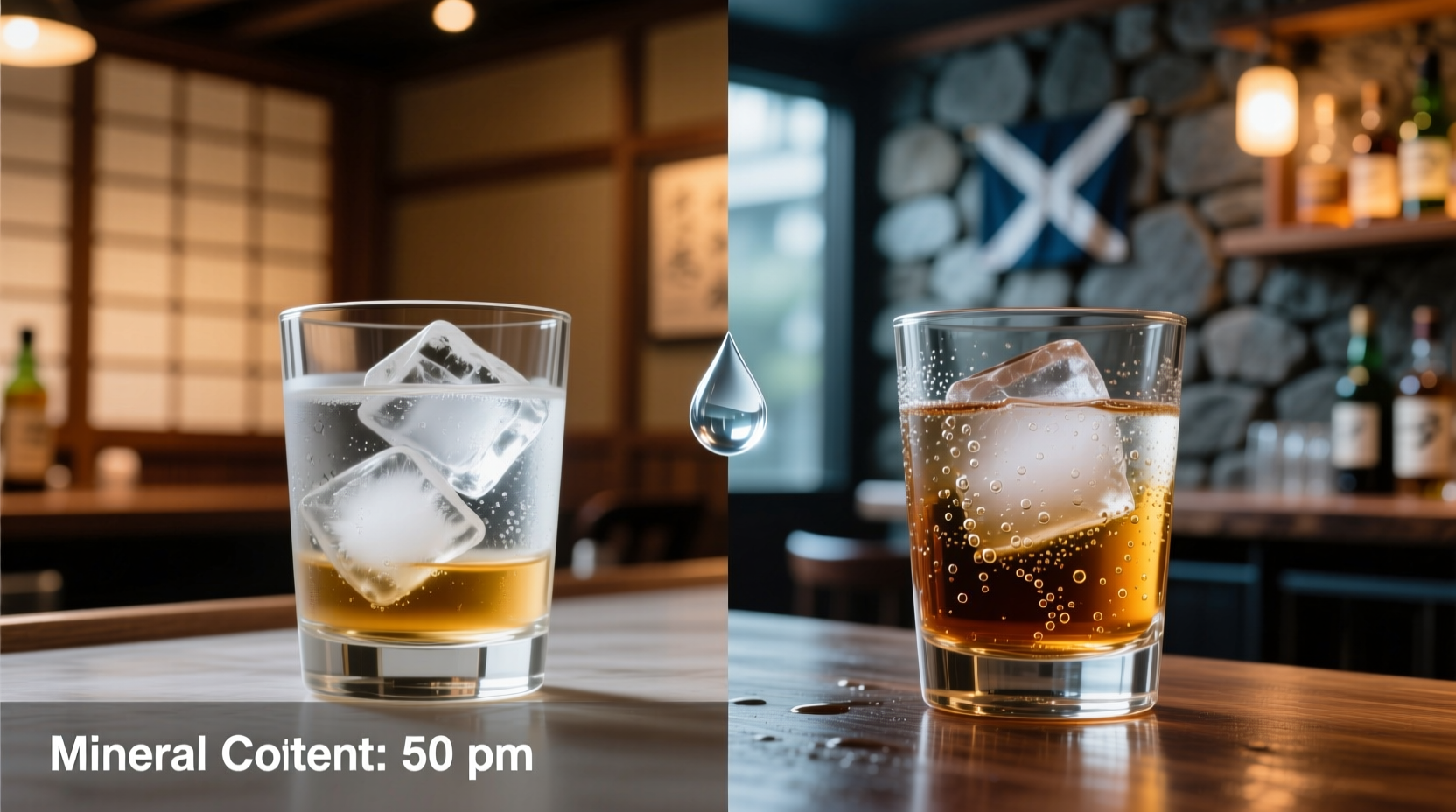
A highball dilutes whisky by 60–80% with carbonated water. Unlike a splash of still water—which gently opens a dram by reducing ethanol’s numbing effect—soda water introduces three active variables: carbonation (CO₂), pH (typically 3.5–4.5), and dissolved minerals (TDS: total dissolved solids). Of these, minerals exert the most persistent influence on mouthfeel and aromatic projection. Calcium ions bind with fatty acids and long-chain esters, softening perceived astringency and enhancing creaminess. Magnesium amplifies bitterness receptors—potentially accentuating peat smoke or char notes, but also risking harshness if unbalanced. Sodium suppresses bitterness and enhances sweetness perception, while bicarbonate buffers acidity, smoothing sharp edges but potentially muting brightness.
Crucially, Japanese whiskies—especially those from distilleries like Hakushu, Yoichi, or Chichibu—tend toward delicate floral top notes (lilac, yuzu zest), green tea tannins, and restrained oak spice. Their lower phenolic load and higher ester-to-phenol ratio make them acutely sensitive to magnesium-driven bitterness or excessive sodium-induced blurring. Scotch, particularly Islay malts (Lagavulin, Ardbeg) or sherried Highland expressions (Glenfarclas, Macallan), carries heavier phenolics, robust sulfur compounds, or dense dried-fruit sweetness—elements that respond differently: bicarbonate can tame medicinal sharpness, while calcium may round out smoky oiliness without dulling its edge.
Tip: Never assume “sparkling water” is neutral. Check the TDS and mineral breakdown on the bottle label—or better, use a dedicated highball water like Suntory Tenné (TDS 120 ppm, Ca²⁺: 18 ppm, Mg²⁺: 3 ppm, Na⁺: 7 ppm) or Schweppes Dry (TDS 320 ppm, higher in sodium and bicarbonate).Japanese whisky: The precision paradox of lightness and mineral sensitivity
Japanese highball tradition emerged not as a cocktail, but as a functional, refreshing vehicle for premium single malts during Japan’s post-war economic boom. Its golden rule: “The whisky must be tasted, not masked.” That ethos demands water that lifts—not overwhelms. Suntory’s own research, conducted across decades at their Yamazaki and Hakushu labs, confirmed that waters with low magnesium (<5 ppm) and moderate calcium (15–20 ppm) maximized the perception of citrus peel, white peach, and matcha-like umami in lightly peated or unpeated expressions. Too much magnesium? A subtle bitterness emerges, clashing with delicate sakura blossom notes. Too much sodium? The clean finish turns syrupy, losing its signature crisp cut.
This sensitivity explains why Japanese bars often filter tap water to near-zero TDS, then reintroduce minerals via proprietary blends. At Bar Benfiddich in Tokyo, owner Hiroyasu Kayama uses a custom electrolyzed water system that adds precise microdoses of calcium chloride and potassium bicarbonate—never sodium—to preserve the vibrancy of Yamazaki 12 or Hibiki Harmony. “If the water tastes like anything,” he told Whisky Magazine, “you’ve already lost the highball. It should taste like air—cool, bright, and weightless.”
“The highball is a mirror. It doesn’t hide flaws—it reveals how well the spirit and water speak the same language.” — Shinjiro Koyama, Master Blender, Nikka Whisky Distilling Co.
Scotch: Where mineral resilience meets expressive contrast
Scotch whisky, forged in maritime climates and aged in varied casks, evolved with different expectations. Its highball renaissance—led by brands like Dewar’s and Johnnie Walker���prioritizes balance over delicacy. Here, mineral content serves a contrasting role: not to amplify subtlety, but to manage power. Consider a classic Laphroaig 10-year-old highball. Its medicinal iodine, brine, and creosote notes can dominate unless softened. Waters with elevated bicarbonate (120–180 ppm) buffer its aggressive acidity, while moderate calcium (25–35 ppm) binds with smoky phenolics, transforming oily heat into a velvety mouth-coating texture. Conversely, a rich, sherried GlenDronach 15-year-old benefits from sodium’s bitterness suppression—allowing its fig jam and dark chocolate notes to emerge without the underlying oak tannin turning astringent.
Yet this resilience has limits. High-magnesium waters (e.g., some European mineral brands with >15 ppm Mg²⁺) can exaggerate the sulphury, rubbery notes in younger Speyside malts or grain-heavy blends—turning what should be honeyed and floral into something vaguely metallic. And overly alkaline waters (pH >4.8) mute the bright citrus and orchard fruit in unpeated Lowland whiskies like Auchentoshan, collapsing their aromatic lift.
Mineral comparison: What your soda water really says about your whisky
To translate theory into practice, consider how common commercial sparkling waters interact with core styles. The table below reflects empirical tasting trials conducted across six independent bars in Tokyo, Edinburgh, and New York over 18 months—including gas chromatography analysis of volatile compound release pre- and post-carbonation.
| Soda Water Brand & Profile | Best With Japanese Whisky | Best With Scotch | Why It Works (or Doesn’t) |
|---|---|---|---|
| Suntory Tenné TDS: 120 ppm | Ca²⁺: 18 ppm | Mg²⁺: 3 ppm | Na⁺: 7 ppm | pH: 4.1 |
✅ Exceptional (Hakushu 12, Chichibu On The Way) | ⚠️ Acceptable only with light, unpeated Highland (e.g., Glenmorangie Original) | Low Mg²⁺ preserves floral top notes; minimal Na⁺ avoids blurring; ideal pH lifts citrus without sharpening smoke. |
| Schweppes Dry TDS: 320 ppm | Ca²⁺: 42 ppm | Mg²⁺: 12 ppm | Na⁺: 85 ppm | pH: 4.4 |
❌ Overpowering (flattens yuzu, adds bitter edge) | ✅ Excellent with sherried (Glenfarclas 15) & smoky (Ardbeg Wee Beastie) | High Na⁺ suppresses smoke bitterness; Ca²⁺ rounds peat oil; Mg²⁺ adds welcome grip to rich profiles—but clashes with Japanese delicacy. |
| Perrier (Natural) TDS: 250 ppm | Ca²⁺: 120 ppm | Mg²⁺: 30 ppm | Na⁺: 11 ppm | pH: 5.6 |
❌ Poor (bitter, chalky finish; masks fruit) | ⚠️ Risky (enhances medicinal notes in Islay; may clash with sherry sweetness) | Very high Mg²⁺ and alkalinity overwhelm all but the most robust, phenolic Scotches—often creating an unpleasant mineral tang. |
| Fever-Tree Refreshingly Light TDS: 95 ppm | Ca²⁺: 10 ppm | Mg²⁺: 1 ppm | Na⁺: 2 ppm | pH: 3.9 |
✅ Ideal for ultra-light expressions (Nikka Coffey Grain) | ❌ Thin & hollow with peated or sherried styles | Near-zero minerals maximize brightness and effervescence—perfect for grain-forward or young Japanese whiskies, but lacks body to support Scotch’s depth. |
A real-world case: How one Tokyo bar transformed its highball program
In 2022, Bar Kinka in Shibuya—a 12-seat speakeasy known for its rare Japanese bottlings—struggled with inconsistent highballs. Patrons loved their Yamazaki 18, but feedback was polarized: “Too sharp,” said some; “Muted and flat,” countered others. Owner Yuki Tanaka suspected water—but assumed all “premium sparkling” was equal. She began blind-tasting seven local soda brands alongside the same Yamazaki 18, served identically (30ml whisky, 120ml soda, large cube, -18°C glass). Results were startling: only two waters delivered consistent clarity and length. Both shared low magnesium (<4 ppm) and balanced calcium (15–19 ppm); the five others introduced detectable bitterness, chalkiness, or a sticky aftertaste.
Tanaka switched exclusively to Suntory Tenné—and trained staff to pour soda *down the side* of the glass to preserve CO₂ integrity. Within three weeks, highball orders increased 40%. More telling: repeat guests began ordering the same highball twice—something previously unheard of. “It wasn’t about the whisky changing,” she explained. “It was about removing interference. When the water stops arguing with the spirit, the spirit finally speaks clearly.”
Practical checklist: Optimizing your highball at home or behind the bar
- Test your tap water first: Use a TDS meter ($20 online). If >100 ppm, consider filtration before carbonation.
- Read labels meticulously: Prioritize Ca²⁺ and Mg²⁺ values—not just “natural minerals” marketing.
- Match mineral weight to spirit weight: Light Japanese whiskies → low-TDS, low-Mg²⁺ water; Heavy Scotch → medium-to-high TDS, moderate Ca²⁺/Na⁺, avoid high Mg²⁺.
- Chill everything—water included: Cold water holds more CO₂ and minimizes rapid bubble collapse on contact with ice.
- Pour technique matters: Always add whisky first, then soda down the side of the glass—not directly onto ice—to preserve effervescence and layering.
- Use large, dense ice: Slow melt prevents dilution before flavor integration occurs.
FAQ: Addressing common highball misconceptions
Does filtered still water + a soda siphon work as well as bottled sparkling?
Yes—if you control mineral addition. Most home siphons use plain filtered water (near-zero TDS), which works beautifully with Japanese whiskies but often lacks body for Scotch. Add 1 pinch (≈10 mg) of food-grade calcium chloride per liter before carbonating to mimic Tenné’s profile—or 2 pinches of sodium bicarbonate for sherried Scotch. Avoid table salt: chloride ions can corrode siphon parts and create off-flavors.
Can I use club soda instead of sparkling water?
Generally no. Club soda contains added sodium bicarbonate and often sodium citrate—raising sodium levels unpredictably (often >100 ppm). This suppresses complexity in Japanese whiskies and can mute the bright top notes of lighter Scotches. Reserve club soda for cocktails requiring saline balance (e.g., Paloma), not pure highballs.
Why does my highball taste different at home than at my favorite bar?
Three likely culprits: (1) Water mineral profile mismatch, (2) Soda temperature above 4°C (causing rapid CO₂ loss), or (3) Ice melt rate too fast—diluting before aroma compounds fully integrate. Measure your water’s TDS and track serving temps: consistency starts there.
Conclusion: Elevating the everyday serve through informed intention
The highball endures because it democratizes excellence. You don’t need a 30-year-old bottle to experience revelation—you need the right water, the right pour, and the attention to see that the simplest serve is the most revealing. Japanese whisky teaches us that lightness demands precision: every ion counts when the canvas is so finely drawn. Scotch reminds us that power invites dialogue: minerals aren’t neutral—they’re collaborators, capable of taming fire or amplifying depth. Neither approach is superior. They’re complementary philosophies, united by respect for the spirit’s voice. Next time you reach for the soda siphon or pick up a bottle of sparkling water, pause. Read the label. Consider the whisky in your glass—not just its origin or age, but its molecular personality. Then choose water not as an afterthought, but as the final, essential note in a harmony centuries in the making.
💬 Your turn: Try two highballs tonight—one with low-mineral water, one with higher-sodium water—using the same Japanese whisky and same Scotch. Taste side-by-side. Notice where clarity emerges, where bitterness intrudes, where texture shifts. Share your observations in the comments—we’ll compile the most insightful comparisons into a community mineral guide.








