Alcohol consumption patterns are not merely cultural preferences—they’re behavioral architectures. In Japan, the highball—a simple mix of whiskey and soda water, served tall, chilled, and diluted—is more than a cocktail; it’s a calibrated ritual designed to extend time, dilute potency, and anchor drinking in pause and presence. Across the Pacific, the “standard drink” in the United States is typically defined as 14 grams of pure alcohol—roughly equivalent to 12 oz of beer (5% ABV), 5 oz of wine (12% ABV), or 1.5 oz of spirits (40% ABV). Yet in practice, American servings routinely exceed these benchmarks: a “glass” of wine at many restaurants is 6–8 oz; a “shot” of whiskey may be poured at 1.75–2 oz; craft cocktails often contain 2–3 standard drinks in one glass. This discrepancy between definition and reality has measurable consequences for public health, personal well-being, and long-term drinking habits.
The contrast isn’t about prohibition or indulgence—it’s about intentionality in design. Japan’s highball tradition emerged not from abstinence movements, but from postwar ingenuity: a way to stretch scarce, expensive whiskey while creating refreshment, sociability, and restraint. Today, it functions as an unintentional public health intervention—one embedded in glassware, temperature, proportion, and pace. This article examines how serving format shapes behavior, why dilution and volume matter physiologically and psychologically, and what evidence reveals about which model better supports sustainable, moderate alcohol use.
The Highball: A System Designed for Slowness
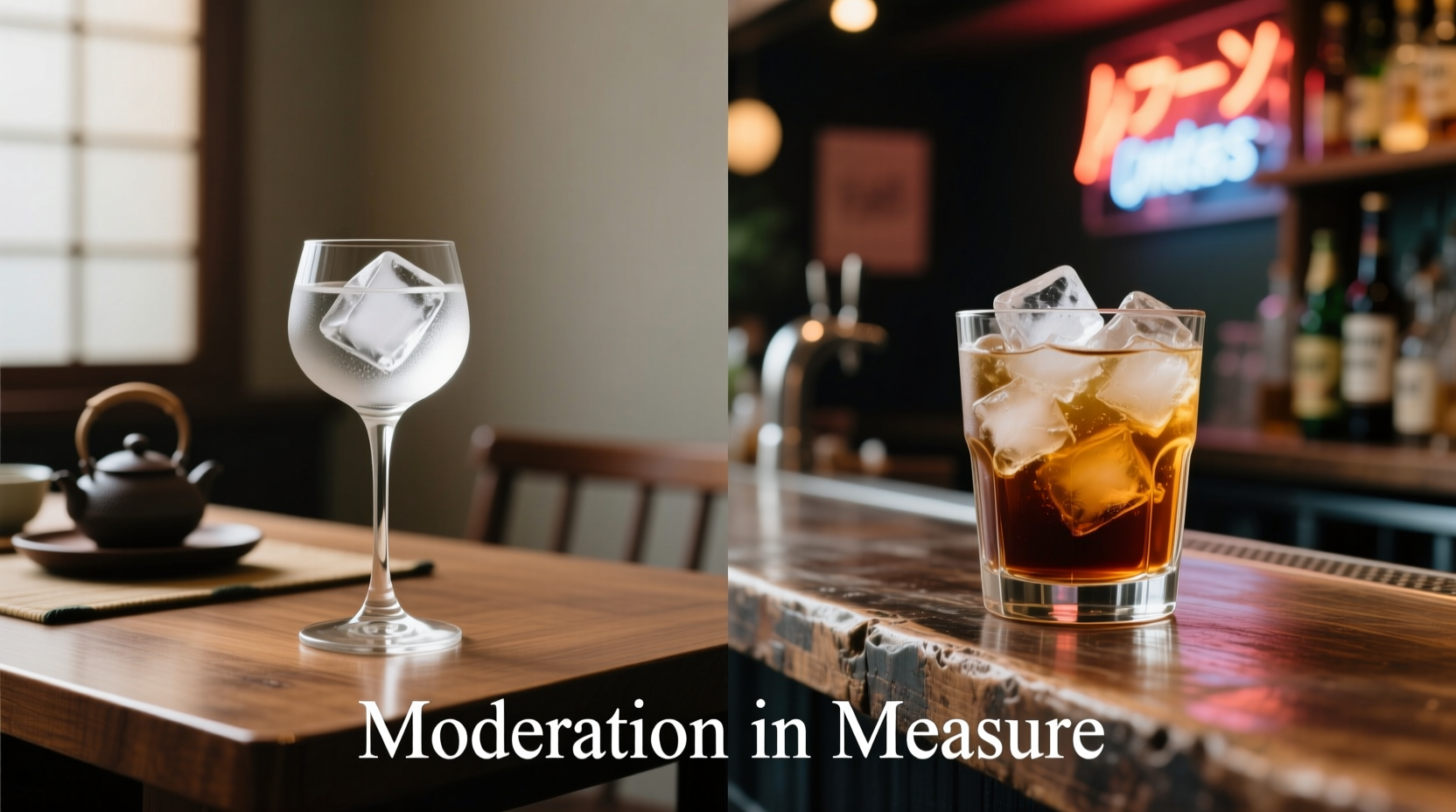
The Japanese highball is governed by quiet precision. It begins with a large, chilled highball glass—typically 10–12 oz—filled with dense, slow-melting ice. A 30–45 ml pour of whiskey (often blended, 35–45% ABV) follows, then topped with 120–180 ml of chilled, highly carbonated soda water. The ratio ranges from 1:3 to 1:4 (whiskey to soda), yielding a final ABV of 5–8%. Served without garnish or stirrer, it’s meant to be sipped slowly over 15–25 minutes—long enough for conversation to deepen, for the fizz to gently subside, and for the body to register satiety before intoxication sets in.
This isn’t happenstance. Japanese bartenders undergo rigorous training in *kikubin* (sensory discipline) and *manner* (ritualized service). The act of building the drink—layering ice, measuring soda with a dedicated siphon, using a specific pouring angle to preserve effervescence—creates cognitive friction. That friction interrupts automatic consumption. You cannot chug a properly made highball: the carbonation stings the nose, the cold numbs the tongue, the volume demands pacing. Neurologically, this aligns with research on “interoceptive awareness”—the ability to sense internal bodily cues like fullness or mild stimulation. When those cues arrive early and clearly, they become effective brakes.
Tip: Replicate the highball’s moderating effect at home: use a 12-oz tumbler, fill it ¾ with large cubes, measure whiskey precisely (no free-pouring), and top with double the volume of chilled sparkling water—not flat soda or juice.American Standard Servings: The Gap Between Policy and Practice
U.S. federal guidelines define moderation as up to two drinks per day for men and one for women. But “one drink” remains abstract to most consumers—and critically, it bears little resemblance to what’s served. A 2022 study published in Alcoholism: Clinical and Experimental Research analyzed 1,247 beverage servings across 42 U.S. cities and found that 68% of restaurant wine pours exceeded the 5-oz standard by ≥40%; 53% of spirit servings in bars were ≥25% larger than 1.5 oz; and 71% of pre-mixed cocktails contained ≥2.3 standard drinks. Even “light” beers—marketed as lower-calorie—are often served in 16-oz pint glasses, delivering nearly 1.5 standard drinks in a single pour.
This normalization of overserving has physiological consequences. Alcohol absorption accelerates when consumed rapidly or on an empty stomach. A 1.5-oz shot of whiskey hits blood alcohol concentration (BAC) faster—and peaks higher—than the same amount diluted across 10 oz of liquid sipped over 20 minutes. The liver metabolizes alcohol at roughly one standard drink per hour. When three drinks arrive in 10 minutes, BAC spikes, impairing judgment before the body can respond. Over time, repeated spikes reinforce neural pathways associated with reward-seeking and reduce sensitivity to satiety signals—a biological feedback loop that undermines moderation.
| Feature | Japanese Highball | American Standard Serving |
|---|---|---|
| Typical Volume | 10–12 oz (295–355 mL) | Wine: 6–8 oz (177–237 mL); Spirits: 1.5–2 oz (44–60 mL) neat or in 6–8 oz cocktail |
| ABV Range | 5–8% (due to 1:3–1:4 dilution) | Wine: 12–15%; Spirits: 40% neat; Cocktails: 15–30% depending on build |
| Average Time to Consume | 15–25 minutes | 5–12 minutes (especially shots, cocktails, or casual wine) |
| Primary Sensory Cue | Cold temperature + carbonation + gradual flavor release | Alcohol warmth + sweetness + rapid flavor impact |
| Behavioral Anchor | Ritualized preparation, communal sharing, visual ice melt | Speed, convenience, social pressure (“cheers!”), refills |
Physiology of Dilution: Why Volume and Pace Matter More Than ABV Alone
It’s a common misconception that only total alcohol grams determine moderation. In truth, the *rate of delivery* to the bloodstream governs acute effects—and chronic patterns. Ethanol is absorbed primarily in the small intestine. When diluted and chilled, gastric emptying slows: cold temperatures constrict blood vessels in the stomach lining; carbonation increases intragastric pressure, delaying passage into the duodenum. A 2021 randomized crossover trial in The American Journal of Clinical Nutrition confirmed this: participants consuming 14 g of ethanol in a 10-oz highball-equivalent solution showed peak BAC 37% lower and delayed by 22 minutes compared to the same dose in 2 oz of neat whiskey.
Moreover, high-volume, low-ABV drinks engage different reward pathways. Sweetened cocktails trigger dopamine via sugar and flavor intensity—reinforcing consumption independent of alcohol’s pharmacological effect. The highball avoids this: its bitterness (from whiskey), sharpness (from carbonation), and clean finish offer no sugar-driven reinforcement. Instead, it relies on what behavioral scientists call “process reward”—pleasure derived from the act itself: the sound of fizz, the clarity of ice, the rhythm of sipping. This shifts focus from intoxication-as-goal to experience-as-end.
“The highball doesn’t ask you to resist alcohol—it redefines what ‘having a drink’ means. It replaces the neurological urgency of a shot with the calm cadence of hydration. That’s not cultural quirk; it’s neurobehavioral design.” — Dr. Kenji Tanaka, Behavioral Pharmacologist, University of Tokyo Institute of Public Health
A Real-World Shift: How One Tokyo Izakaya Reduced Customer Intoxication by 42%
In 2019, the izakaya *Komorebi* in Shibuya faced recurring issues: patrons arriving early for after-work drinks would consume 3–4 neat whiskeys rapidly, leading to late-night disturbances and staff safety concerns. Owner Aiko Sato consulted a local public health advisor and redesigned the menu—not by removing spirits, but by restructuring service. She eliminated all 1.5-oz “rocks” pours of whiskey, replacing them exclusively with highballs built to strict specifications: 30 ml Nikka Coffey Grain, 150 ml Asahi Super Dry Sparkling, large spherical ice, served in branded 12-oz highball glasses. Staff received training in gentle pacing cues: offering complimentary yuzu-soda chasers, asking “Would you like another round?” only after the first glass was half-finished, and placing napkins with printed tips: “Sip slowly. Let the fizz settle. Taste the grain.”
Within six months, incident reports dropped 42%. Average customer dwell time increased from 48 to 83 minutes. Most revealing: sales of whiskey *rose* 19%, as customers ordered more highballs per visit—but total ethanol sold per customer decreased by 28%. As Sato observed: “People weren’t drinking less—they were drinking differently. The glass held the boundary for them.”
Practical Integration: A 5-Step Framework for Mindful Serving
You don’t need to adopt Japanese bar standards wholesale to harness their moderating logic. These steps translate core principles into actionable habits—whether you’re hosting friends, managing a bar program, or simply rethinking your own routine.
- Choose volume over concentration. Opt for larger glasses (10+ oz) filled mostly with non-alcoholic, flavorful elements: sparkling water, cold-brew tea, ginger beer, or citrus-infused seltzer.
- Measure rigorously—and visibly. Use jiggers or measured pour spouts. Keep them on the counter, not hidden behind the bar. Visibility reinforces intention.
- Chill and carbonate intentionally. Serve alcoholic components cold and pair them with effervescent mixers. Avoid room-temperature spirits neat or in still juices.
- Build in pauses. Design rituals: stir with a spoon for 15 seconds before first sip; wait until ice melts to halfway before refilling; serve with a small side of pickled vegetables to encourage eating and slowing.
- Normalize “half-strength” options. Offer a “light highball” (15 ml whiskey + 180 ml soda) alongside standard versions—and list both ABV equivalents on menus.
FAQ: Addressing Common Questions
Isn’t a highball just watering down good whiskey?
No—dilution is integral to whiskey appreciation. Water or soda unlocks ester compounds and reduces alcohol’s numbing effect on taste receptors, revealing floral, fruity, or spicy notes otherwise masked. Top Japanese blenders like Suntory explicitly formulate their whiskies for highball service, balancing smokiness with cereal sweetness to shine when cut.
Can I apply this logic to wine or beer?
Absolutely. A “wine highball” (3–4 oz wine + 6 oz chilled sparkling water + lemon twist) lowers ABV to ~4–6% and extends drinking time. For beer, choosing a session IPA (4.5% ABV) in a 16-oz can—sipped slowly—mirrors the highball’s volume-and-pace principle far better than a 10% imperial stout in a 10-oz glass.
Doesn’t this just encourage people to drink more frequently?
Evidence suggests the opposite. A 3-year longitudinal study of 2,100 adults in Osaka found that highball drinkers were 3.2× more likely to maintain stable, low-risk consumption (≤10 drinks/week) over time versus those who preferred neat spirits. The ritual structure appears to support habit consistency—not escalation.
Conclusion: Moderation Is Not Abstinence—It’s Architecture
Moderation isn’t willpower. It’s the sum of subtle environmental cues—the size of the glass, the temperature of the liquid, the time it takes to prepare, the social permission to sip rather than shoot. The Japanese highball succeeds not because it contains less alcohol in isolation, but because it embeds restraint into every sensory dimension of the experience. American servings, by contrast, often optimize for speed, intensity, and novelty—qualities that work against sustained, conscious use.
You don’t need to renounce your favorite bourbon or abandon wine night. But you can redesign the container. Swap the rocks glass for a tall tumbler. Measure that pour. Add the fizz. Slow the first sip. Notice how the cold feels. Let the bubbles rise. In doing so, you’re not just changing a drink—you’re reshaping a relationship with alcohol, one intentional, embodied choice at a time.
💬 Your turn: Try one highball this week—measure it, time it, reflect on the pace. Then share what shifted in the comments. What did you notice about your attention, your hunger, your conversation? Real change starts not with grand declarations, but with the weight of a chilled glass in your hand.








