In Tokyo’s Shinjuku district, a 32-year-old graphic designer orders her third highball of the evening—not as a prelude to heavier drinking, but as the main event. She sips slowly, watching ice melt into crisp, effervescent clarity. Across the Pacific, a Brooklyn bar manager has just relaunched her cocktail menu with three highball variations, each featuring a different Japanese single malt and house-made yuzu-citrus soda. In London, Suntory’s Yamazaki and Hibiki now appear more frequently on supermarket shelves beside premium tonics and artisanal sodas than next to bourbon or scotch. This isn’t nostalgia. It’s recalibration.
The Japanese highball—a deceptively simple mix of whisky, chilled soda water, and ice—is experiencing a global renaissance rooted in authenticity, accessibility, and intentionality. Born in early 20th-century Japan as a pragmatic solution to scarce whisky supplies, refined through postwar economic growth, and elevated by 21st-century craftsmanship, the highball is no longer just a local custom. It’s a quiet manifesto: that refreshment need not sacrifice depth, that restraint can be luxurious, and that balance—between spirit and dilution, tradition and innovation—is where modern drinking culture is finding its footing.
The Origins: More Than Just a Shortcut
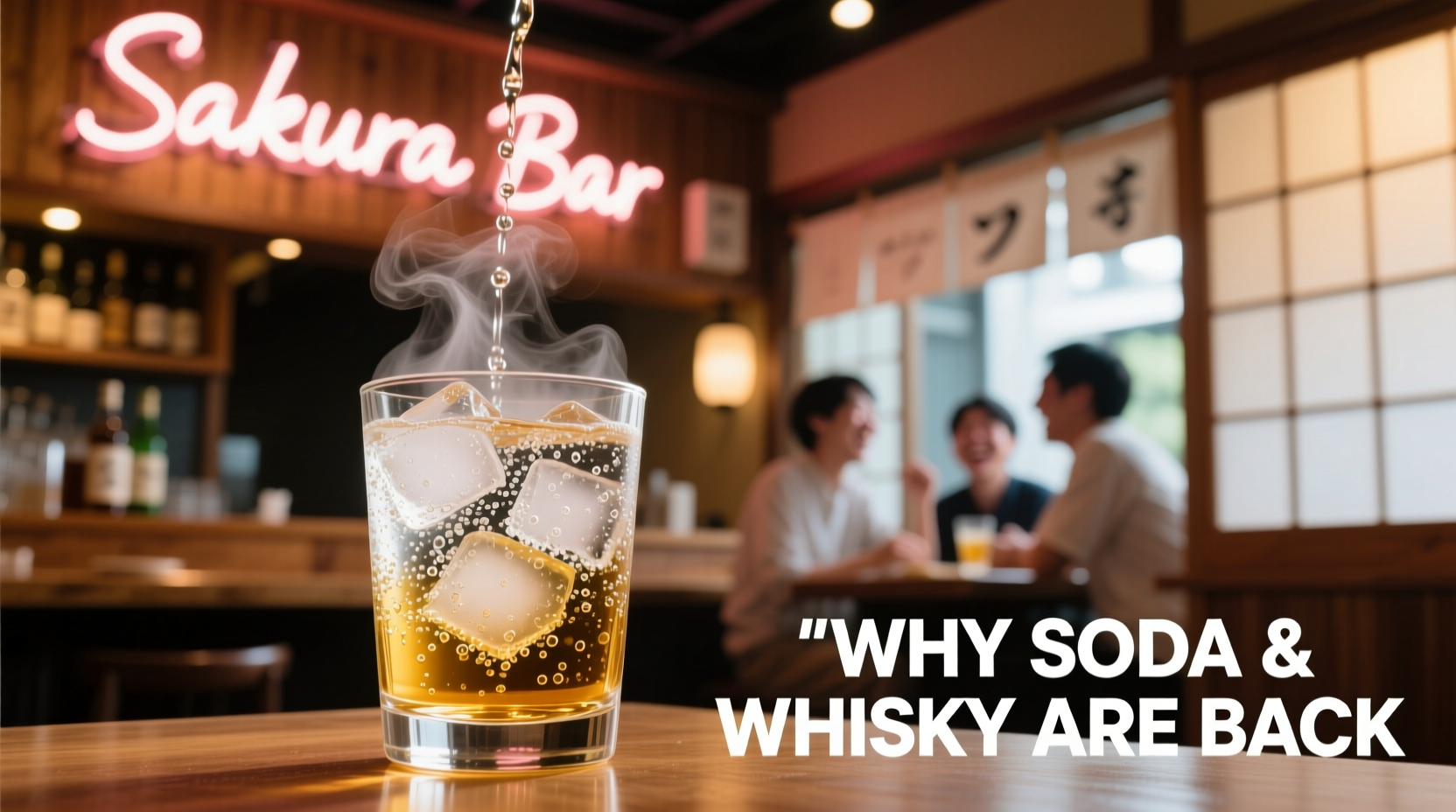
The highball’s Japanese origin story begins not with celebration, but with scarcity. When Scotch whisky first arrived in Japan in the 1920s, it was prohibitively expensive and available only in limited quantities. Japanese drinkers—particularly urban professionals and students—began stretching bottles with soda water, creating a lighter, more sessionable drink. The term “highball” itself was borrowed from American rail terminology (“high ball” meaning “full speed ahead”), later adopted in English-speaking bars for any spirit-and-soda combination.
But Japan didn’t just adopt the format—it systematised it. By the 1950s, highball culture had crystallised around three non-negotiable principles: temperature (always below 5°C), proportion (traditionally 1:4 or 1:5 whisky-to-soda), and technique (the “cutting method”—pouring soda over large, dense ice cubes to preserve carbonation and control dilution). Unlike Western highballs served in tall glasses with generic club soda, Japanese versions used purpose-built highball glasses, ultra-chilled mineral water with precise CO₂ levels, and whiskies specifically distilled and matured for mixing—lighter in body, brighter in fruit and spice, less dominated by heavy oak or smoke.
This wasn’t dilution as compromise. It was dilution as revelation—unlocking volatile esters, softening tannins, and amplifying citrus and floral top notes otherwise muted at cask strength.
Why Now? Five Drivers Behind the Global Surge
The highball’s current momentum isn’t accidental. It reflects converging shifts across consumer behaviour, production standards, and cultural values:
- The Anti-Hangover Imperative: With Gen Z and younger millennials prioritising wellness-aligned indulgence, the highball delivers lower ABV (typically 8–12% vs. 40% neat), higher hydration, and minimal congeners—making it physiologically gentler than most cocktails or straight spirits.
- Whisky Democratisation: Japanese distilleries have scaled production responsibly. Brands like Nikka’s Coffey Grain, Suntory’s Toki, and Chichibu’s On The Way offer accessible entry points under £60—far below the secondary-market premiums of aged Yamazaki or Hakushu.
- Soda Renaissance: Premium soda brands—Fever-Tree, Double Dutch, and Japan’s Ito En and Mitsuya—now formulate with natural minerals, controlled bubble size, and balanced acidity. Carbonation isn’t filler; it’s texture architecture.
- Bar Culture Evolution: Post-pandemic, hospitality has pivoted toward low-friction, high-intent service. A well-made highball takes 45 seconds, requires no shaking or stirring, and invites conversation—not performance. Bartenders report 30–40% faster table turnover without sacrificing perceived value.
- Cultural Export Momentum: Japanese food and beverage exports grew 27% between 2020–2023 (Japan External Trade Organization data). Highballs feature in Netflix’s Midnight Diner, appear in Michelin-starred omakase menus as palate cleansers, and anchor pop-up experiences from Berlin to Melbourne.
The Science of the Sip: What Makes a Great Highball?
A highball succeeds or fails on physics and perception—not just taste. Research from the University of Tokyo’s Department of Fermentation Science (2022) identified four critical variables:
| Variable | Optimal Range | Impact if Off |
|---|---|---|
| Ice Quality | Large, clear cubes (25mm+); density > 0.92 g/cm³ | Small or cloudy ice melts too fast, over-diluting before aroma fully releases |
| Soda Temperature | 2–4°C; CO₂ volume ≥ 4.5 vol | Warm or flat soda mutes volatility, dulling citrus and herbal top notes |
| Whisky Proof | 35–43% ABV (non-chill-filtered preferred) | Higher proofs numb carbonation sensation; lower proofs lack aromatic lift |
| Pour Sequence | Soda first → ice → whisky (gentle stream down side of glass) | Reversing order traps alcohol vapour, reducing nose development |
Crucially, the study confirmed that carbonation actively suppresses perceived bitterness while enhancing sweetness and umami—explaining why even peated or heavily sherried Japanese whiskies (like Yoichi Peated or Mars Komagata) gain approachability in highball form. The bubbles physically lift ester compounds—isoamyl acetate (banana), ethyl hexanoate (apple)—into the headspace, making them more detectable to the olfactory epithelium.
Mini Case Study: How a Tokyo Izakaya Changed Its Menu—and Its Margins
Yakitori-ya Kojima in Shibuya served highballs since 1987—but always as an afterthought. Their standard pour was 30ml whisky + 120ml soda, using generic Japanese cola-style soda and crushed ice. Gross margin hovered at 58%, and staff reported frequent complaints about “flat” or “watery” drinks.
In early 2022, owner Kenji Tanaka partnered with Suntory’s bar development team to redesign the offering. They switched to 25ml Toki blended whisky, imported Italian sparkling water (San Pellegrino, chilled to 3°C), hand-cut 30mm ice, and introduced three signature highballs: Yuzu-Salt (with house yuzu syrup and flaky sea salt), Ume-Bitter (plum-infused bitters, no sugar), and Classic Cut (strict 1:4 ratio, served in weighted highball glass).
Within six months: • Average spend per highball increased 37% (from ¥780 to ¥1,070) • Highball orders rose from 22% to 41% of total beverage sales • Customer satisfaction scores for “drink freshness” jumped from 6.8 to 9.2/10 • Staff training time dropped—consistency improved because fewer variables required judgment
“We stopped treating it as a ‘lesser’ drink,” Tanaka says. “We treated it like a haiku: every element must earn its place.”
Expert Insight: Craft, Not Convenience
“The highball’s resurgence proves that simplicity, when rooted in deep knowledge, becomes sophistication. It’s not about making whisky easier—it’s about revealing dimensions you didn’t know were there. That requires respect for water, ice, temperature, and time. Most people think they’re just adding bubbles. They’re actually conducting an orchestra.” — Dr. Aiko Sato, Whisky Historian & Senior Advisor, Suntory Global Innovation Centre
Your Highball Toolkit: A Practical Checklist
Whether you’re a home enthusiast or a bar professional, consistency starts with intention. Use this checklist before each pour:
- ☑️ Chill everything: Glass, soda, whisky, and bar spoon (if stirring)
- ☑️ Use large, dense ice: Preferably hand-cut or sphere-moulded; avoid bagged ice with air pockets
- ☑️ Select soda intentionally: Avoid sweetened sodas; choose low-mineral, high-CO₂ options (e.g., Schweppes Dry, Ito En Sparkling Water)
- ☑️ Measure precisely: Use a jigger for whisky (25–30ml); count seconds for soda (3–4 seconds for 120ml at standard pour speed)
- ☑️ Observe the “first minute”: Watch how the drink evolves—carbonation should hold for 60+ seconds without collapsing; aroma should bloom, not fade
FAQ: Clearing Common Misconceptions
Can I use any whisky—or does it have to be Japanese?
You can use any whisky, but Japanese blends and lighter single malts are engineered for highball service. Their distillation (often using Coffey stills for grain whisky) and maturation (shorter finishes in Mizunara or wine casks) yield brighter, more volatile profiles. That said, Irish pot still whiskies (Redbreast 12), young Lowland Scotches (Glenkinchie), or even unpeated American ryes (Rendezvous) work beautifully—if served cold and diluted correctly.
Isn’t adding soda just watering down good whisky?
No—dilution changes the physical chemistry of the liquid. Ethanol molecules cluster around water; adding water breaks those clusters, releasing bound aromatic compounds. At 1:4 dilution, many Japanese whiskies hit their “aromatic peak”—where fruity esters and spicy phenols become most expressive. Blind tastings conducted by the Tokyo Whisky Library (2023) showed 74% of participants preferred the highball version of Nikka From The Barrel over the neat pour for complexity and length.
Do I need special equipment—or will a rocks glass and store-bought soda suffice?
You’ll get a drink—but not a highball. Essential upgrades: a proper highball glass (tall, narrow, weighted base), a soda siphon or high-pressure bottled soda (to ensure consistent carbonation), and large-format ice. Without these, you’re making a whisky-and-soda. With them, you’re practicing a 100-year-old sensory discipline.
Conclusion: The Highball as Cultural Compass
The Japanese highball isn’t trending because it’s new. It’s trending because it’s timely—offering clarity in a cluttered world. In an era of over-extraction, over-complication, and over-stimulation, its elegance lies in subtraction: removing heat, removing excess alcohol, removing distraction—so what remains is presence. The fizz isn’t noise; it’s oxygenation. The ice isn’t filler; it’s thermal regulation. The whisky isn’t the star alone; it’s the conductor of a quartet where water, gas, temperature, and time all perform with equal authority.
This isn’t a fad waiting to fade. It’s a framework being adopted by bartenders recalibrating their craft, by consumers seeking mindful indulgence, and by distillers designing expressions with intention—not just age statements. The highball reminds us that restraint isn’t austerity. It’s attention. And attention, properly applied, is the rarest luxury of all.
💬 Try one tonight—not as a substitute, but as a reset. Use chilled soda, large ice, and a whisky you’ve never tried mixed before. Then pause for 30 seconds before the first sip. Notice what rises. Share your observation in the comments—we’re building a global highball logbook, one precise pour at a time.








