For centuries, the printed book has been the cornerstone of learning, storytelling, and knowledge preservation. Today, with e-readers, tablets, and smartphones offering instant access to millions of titles, digital reading has become commonplace. Yet many readers still reach for a physical book when they want to truly absorb what they’re reading. Is this preference rooted in superior cognitive performance—or simply nostalgia for a bygone era?
The debate over whether physical books enhance retention more than e-books isn’t just sentimental. It’s backed by neuroscience, psychology, and education research. While digital reading offers convenience and accessibility, studies consistently suggest that print may have distinct advantages when it comes to comprehension, memory, and deep engagement.
The Cognitive Science Behind Reading Formats
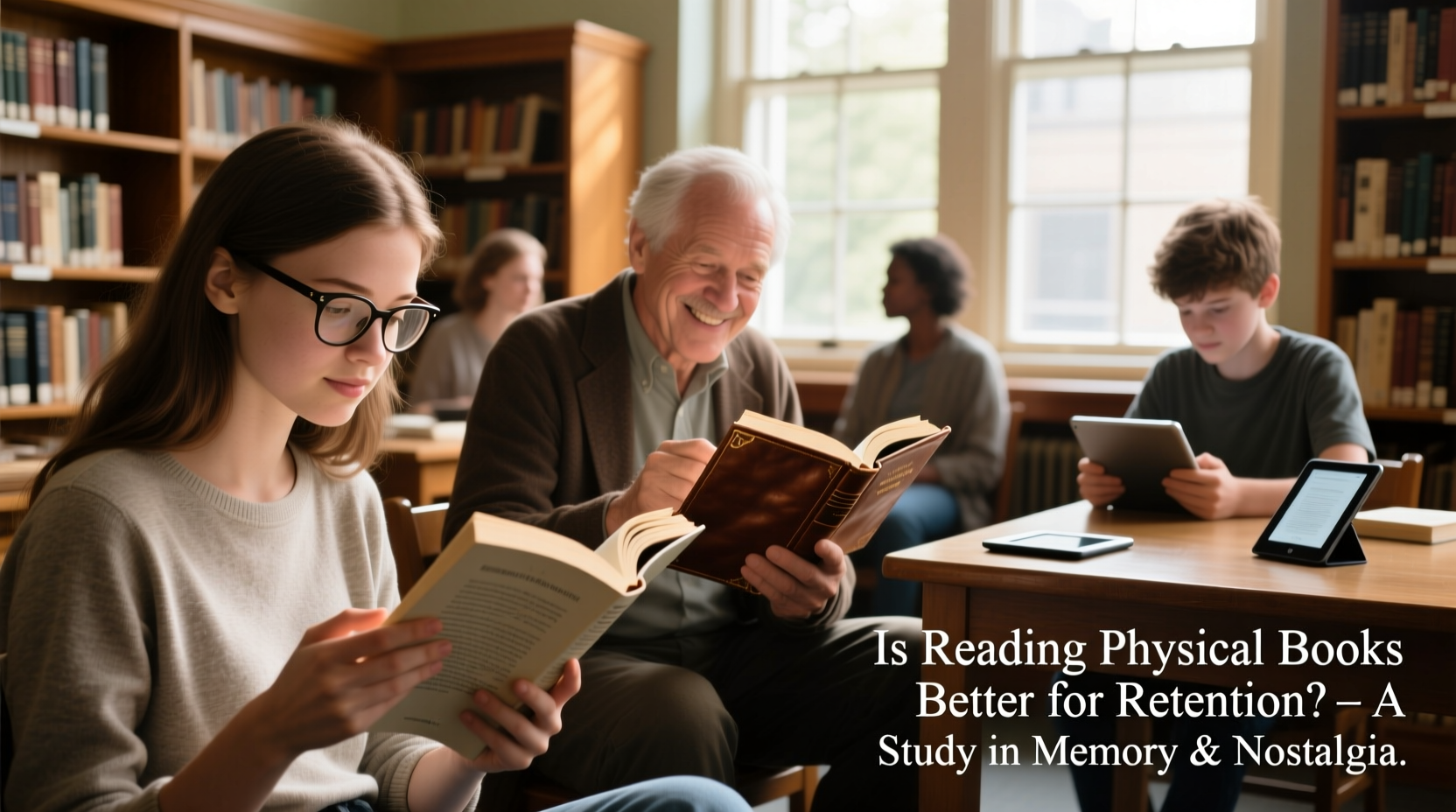
Reading is not a passive activity; it’s a complex cognitive process involving attention, working memory, spatial navigation, and mental imagery. How we interact with text—physically flipping pages, feeling paper texture, seeing a book’s thickness—can subtly shape how our brains process information.
Neuroscientists refer to “embodied cognition,” the idea that our physical interactions with objects influence thought. When reading a physical book, sensory feedback—the weight in your hands, the rustle of turning pages, even the smell of paper—creates a richer mental map of the material. This spatial context helps anchor memories. Readers often recall where on a page certain ideas appeared, aiding retrieval later.
In contrast, e-books present a uniform, scrollable interface. Without tactile or visual landmarks, the brain struggles to create a strong spatial framework. A 2014 study published in *PLOS ONE* found that participants who read a mystery story on paper performed significantly better on plot sequence recall than those who read the same story on a Kindle. The researchers concluded that physical format influences narrative comprehension and temporal understanding.
“Physical books provide spatial and tactile cues that help the brain construct a mental scaffold for the text. Digital reading often lacks these grounding features.” — Dr. Anne Mangen, Reading Researcher, University of Stavanger
Retention: What the Research Says
Multiple studies across age groups and reading types point toward an advantage for print in long-term retention. A meta-analysis conducted by the University of Maryland reviewed 33 studies comparing print and screen reading outcomes. The findings showed a consistent pattern: readers of printed text demonstrated better comprehension, especially for longer or more complex materials.
This effect is particularly pronounced in educational settings. Students reading textbooks on screens tend to skim more, report higher levels of fatigue, and perform worse on delayed recall tests. One reason may be the phenomenon known as “screen inferiority,” where digital formats lead to shallower processing due to distractions, backlight glare, and the temptation to multitask.
A 2020 study from the University of California, San Diego, tracked college students reading academic articles. Those using print versions scored 20% higher on retention tests after one week compared to their peers who read digitally. The researchers attributed this gap to reduced cognitive load and fewer interruptions during print reading.
Tip: For complex or important material—textbooks, research papers, legal documents—opt for print whenever possible to improve focus and memory encoding.Print vs. E-Books: A Comparative Breakdown
| Factor | Physical Books | E-Books |
|---|---|---|
| Retention & Comprehension | Higher, especially for long-form or complex texts | Moderate; lower for dense material |
| Distractibility | Low (no notifications or hyperlinks) | High (notifications, apps, web access) |
| Portability | Limited (one book at a time) | High (thousands of books on one device) |
| Eye Strain | Minimal (reflective light, no blue light) | Potentially high (backlit screens, prolonged use) |
| Navigation | Spatial memory aids recall (e.g., “it was near the bottom of the left page”) | Search functions help, but lack spatial cues |
| Environmental Impact | Higher per-unit footprint (paper, shipping) | Lower per-use impact, but devices require rare minerals and energy |
When E-Books Shine: Context Matters
While print holds an edge in retention, dismissing e-books would overlook their strengths. Digital formats excel in accessibility, searchability, and adaptability. For casual reading, quick reference, or travel, e-books are unmatched in convenience.
People with visual impairments benefit greatly from adjustable font sizes, text-to-speech, and screen reader compatibility. Students conducting research can instantly search keywords across multiple e-books, saving hours compared to flipping through print volumes. Language learners appreciate built-in dictionaries and translation tools.
Moreover, environmental concerns about paper production make digital reading appealing. However, the full lifecycle of e-readers—including manufacturing, energy use, and disposal—must also be considered. A single e-reader takes years of use to offset its carbon footprint compared to buying physical books.
“Digital reading isn’t inherently worse—it’s just different. The key is matching the format to the purpose.” — Naomi Baron, Professor of Linguistics, American University
A Real-World Example: Medical Students’ Study Habits
At Johns Hopkins School of Medicine, a cohort of first-year students were surveyed about their textbook preferences. Over 70% reported using e-books for quick lookup and portability during clinical rotations. However, when preparing for board exams—a task requiring deep understanding and long-term retention—nearly all switched to print or printed PDFs.
One student noted, “I could highlight and bookmark everything on my tablet, but I remembered almost nothing. Once I started printing out chapters and annotating them by hand, my recall improved dramatically.”
This shift reflects a broader trend: professionals and students often default to digital for efficiency but return to print when mastery is required.
Practical Tips for Maximizing Retention Across Formats
Whether you prefer print or digital, you can optimize your reading for better retention. The medium matters, but so do your habits. Here’s how to get the most out of both:
Tip: Use active reading strategies like marginalia, summarization, and self-quizzing regardless of format to boost memory.Checklist: Improve Retention in Any Format
- Read in distraction-free environments (e.g., library, quiet room)
- Take handwritten notes instead of digital highlights
- Summarize each chapter in your own words
- Use the SQ3R method: Survey, Question, Read, Recite, Review
- Avoid multitasking—close unrelated tabs and silence notifications
- Revisit material after 24 hours to reinforce memory
- Discuss what you’ve read with others to deepen understanding
Step-by-Step: Transitioning from Passive to Active Reading
- Preview the material: Skim headings, subheadings, and summaries to build a mental framework.
- Generate questions: Turn section titles into questions (e.g., “How does sleep affect memory?”).
- Read with intent: Focus on answering your questions as you go.
- Pause and reflect: After each section, close the book or minimize the screen and recall key points.
- Write a summary: Use pen and paper to jot down main ideas in your own words.
- Review within 24 hours: Revisit your notes and test yourself.
Beyond Nostalgia: Why Print Endures
It’s easy to dismiss the preference for physical books as sentimentalism—especially among older generations. But the evidence suggests something deeper: print supports the kind of slow, focused reading that builds lasting knowledge.
In an age of constant digital stimulation, physical books offer a sanctuary. They demand presence. You can’t easily swipe away from a difficult paragraph or jump to another app mid-sentence. This friction, often seen as a drawback, is actually a feature. It forces deeper engagement.
Nostalgia may play a role—many associate print books with childhood, education, and intellectual growth—but the benefits are measurable. Libraries, universities, and publishers continue to invest in print because it works. Bestsellers still launch in hardcover. Academic journals remain more prestigious in print form. These aren’t relics of tradition; they’re acknowledgments of efficacy.
Frequently Asked Questions
Do e-books cause more eye strain than physical books?
Yes, especially backlit screens. Prolonged exposure to blue light can lead to digital eye strain, dry eyes, and disrupted sleep. E-ink devices like Kindle Paperwhite reduce this risk by mimicking paper and minimizing glare, but they still lack the complete comfort of print under natural light.
Are audiobooks as effective for retention as reading?
It depends on the listener and context. Audiobooks engage auditory processing and can be great for narrative content or multitasking. However, studies show lower retention for complex or technical material compared to reading—especially when listeners don’t take notes or pause to reflect.
Can I improve e-book retention with better habits?
Absolutely. Using annotation tools, taking handwritten notes, reading in focused sessions, and revisiting material can narrow the gap. Pairing digital reading with offline summarization techniques helps transfer information to long-term memory.
Conclusion: Choose Wisely, Read Deeply
The question isn’t whether physical books are better due to nostalgia—but whether their structural and sensory qualities support deeper cognitive processing. The answer, supported by research, is yes—particularly for learning, comprehension, and retention.
That doesn’t mean abandoning e-books. Digital reading has transformed access to knowledge and serves vital roles in modern life. The goal isn’t to pick sides, but to make intentional choices. Use e-books for convenience, exploration, and accessibility. Reach for print when you want to understand, remember, and internalize.
Ultimately, how we read shapes what we remember. In a world overflowing with information, the ability to retain and apply knowledge is more valuable than ever. Whether your shelf is filled with paperbacks or your device loaded with PDFs, the most important thing is to read with purpose, attention, and care.
💬 What’s your experience? Do you retain more from print or digital? Share your thoughts and reading strategies in the comments below.








