Natural wine occupies a curious space in today’s beverage culture: revered by sommeliers at Michelin-starred restaurants, championed by Instagram influencers with minimalist aesthetics, and yet routinely dismissed by traditional winemakers as ���unstable,” “unserious,” or “a marketing mirage.” At its core, natural wine promises transparency—grapes grown organically or biodynamically, fermented with native yeasts, zero or near-zero added sulfites, and no fining or filtration. But behind the bucolic labels and earthy descriptions lies a persistent tension: Is this movement delivering something genuinely profound—or simply trading consistency for mystique?
The answer isn’t binary. It’s layered—shaped by philosophy, microbiology, climate volatility, and human intention. To assess whether natural wine is “worth the hype,” we must move beyond romanticism and examine what happens when you remove industrial safeguards from fermentation, aging, and bottling. This isn’t about choosing sides—it’s about understanding trade-offs so consumers can drink with clarity, not confusion.
What “Natural Wine” Actually Means (and Why Definitions Vary)
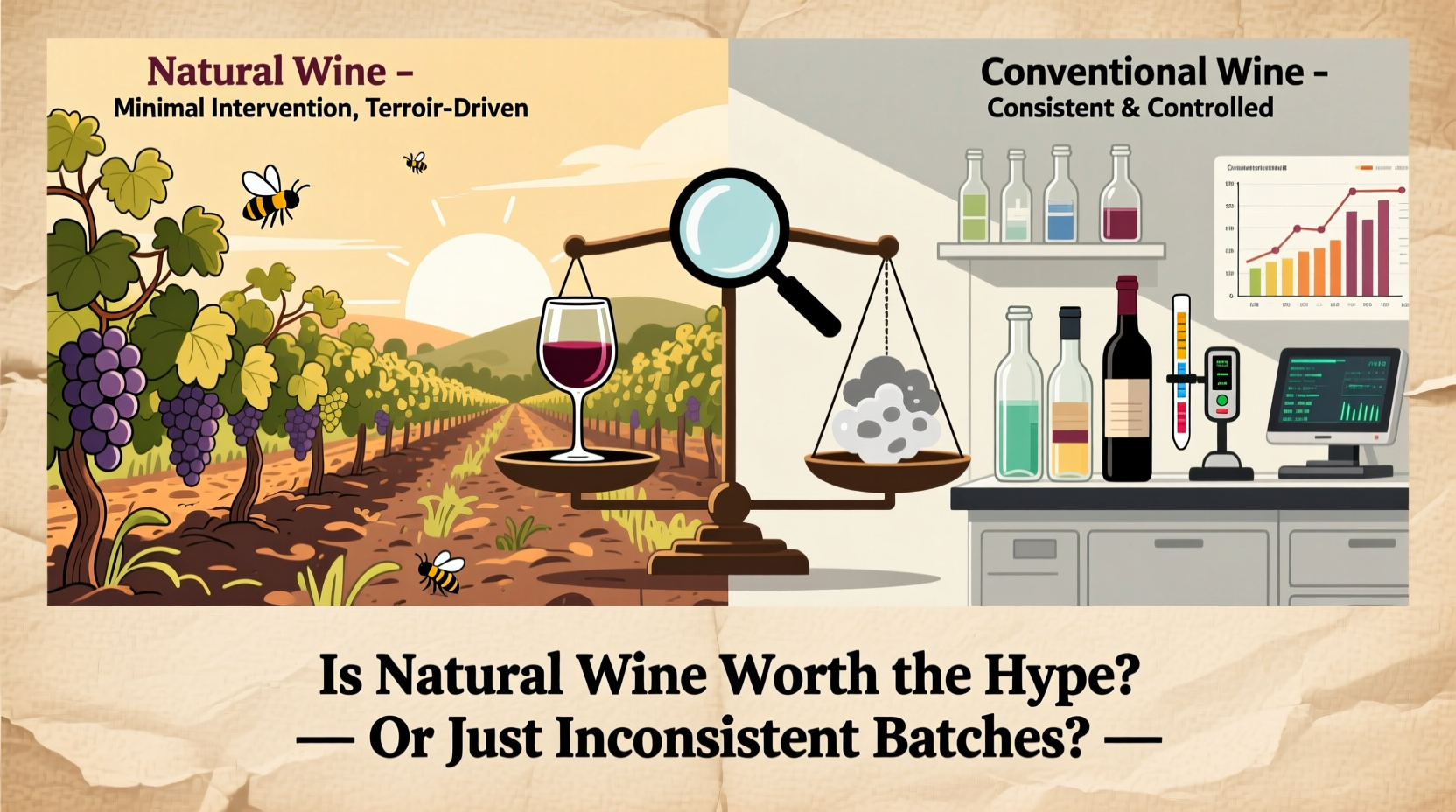
There is no legal definition of “natural wine” in the U.S., EU, or most major wine-producing countries. Unlike “organic” (certified under USDA or EU standards) or “biodynamic” (regulated by Demeter), “natural” remains an unregulated descriptor—a self-applied label rooted in practice rather than paperwork. That ambiguity fuels both its appeal and its credibility gap.
The widely accepted baseline comes from the French-led La Renaissance des Appellations manifesto: wines made from organically grown grapes; fermented spontaneously with indigenous yeasts; no chaptalization, acidification, or de-alcoholization; no additions except minimal sulfur dioxide (<50 mg/L total, often far less); and no fining or filtration. In practice, however, adherence varies—from rigorously hands-off producers like Marcel Lapierre in Beaujolais to urban natural winemakers who source fruit from uncertified growers but prioritize low-intervention cellar work.
This definitional flexibility means that two bottles labeled “natural” may differ dramatically in stability, shelf life, and even microbial safety—not because one is “better,” but because intent, skill, and context diverge.
The Consistency Problem: Microbiology Without a Safety Net
Conventional winemaking relies on predictable tools: cultured yeast strains selected for reliable fermentation kinetics and flavor profiles; precise temperature control; measured doses of sulfur dioxide to suppress spoilage microbes; and sterile filtration to remove residual yeast and bacteria before bottling. Natural wine intentionally sets many of these aside—creating conditions where microbial outcomes are inherently probabilistic.
Consider this reality: A single barrel of Gamay harvested in a cool, dry vintage may ferment cleanly over 12 days, yielding bright, crunchy reds with subtle barnyard nuance. The same vineyard, in a warm, humid year, may host higher populations of Brettanomyces or Lactobacillus—microbes that, while harmless, produce volatile phenols (band-aid, horse blanket) or lactic sourness that some perceive as “funky” and others as flawed.
That variability isn’t random—it’s responsive. It reflects soil health, canopy management, harvest timing, ambient cellar temperature, and the winemaker’s tolerance for microbial expression. As Master of Wine Isabelle Legeron explains:
“Natural wine doesn’t eliminate inconsistency—it foregrounds it. What you taste is less a ‘product’ and more a document of a specific place, season, and decision point. That honesty has value—but it demands a different kind of literacy from the drinker.” — Isabelle Legeron, MW, founder of RAW Wine Fair
In other words: inconsistency isn’t always a flaw. It’s a feature—when intentional, informed, and communicated. The problem arises when inconsistency masks negligence: poor sanitation, inadequate temperature monitoring, or bottling before malolactic fermentation completes.
When “Inconsistent” Crosses Into Unreliable: Red Flags to Watch For
Not all variation is equal. Some expressions—like gentle oxidative notes in Jura whites or soft mousiness in Loire reds—are stylistic signatures embraced by connoisseurs. Others signal technical shortcomings. Here’s how to distinguish between thoughtful variation and avoidable instability:
| Sensory Cue | Typical Cause | Is It Intentional? |
|---|---|---|
| Pronounced vinegar sharpness (high volatile acidity) | Acetobacter growth due to oxygen exposure or warm storage | Rarely—most natural producers keep VA under 0.6 g/L; above 0.9 g/L usually indicates fault |
| Flat, stewed fruit with muted aromas | Excessive SO₂ use *or* premature oxidation pre-bottling | No—indicates either contradiction (claiming “zero added sulfite” while using high doses) or poor handling |
| Cloudiness + visible sediment + fizzy prickle | Unfiltered wine with residual sugar and active yeast | Often yes—especially in pet-nats or glou-glou styles; check label for “unfiltered” or “petillant naturel” |
| Wet cardboard or moldy basement aroma | 2,4,6-Trichloroanisole (TCA) contamination—same compound causing cork taint | No—taint is never intentional and reflects compromised closures or cellar hygiene |
| Sharp, nail-polish-like acetone note | High levels of ethyl acetate from stressed yeast or bacterial activity | Usually no—above threshold (>150 mg/L), it reads as fault, not funk |
A Real-World Case Study: The 2021 Chinon Experiment
In spring 2021, Loire vigneron Clément Pabiot released three cuvées from identical Cabernet Franc parcels in Cravant-les-Côteaux—all farmed organically, all fermented with native yeasts, all aged in neutral foudres. But each followed a distinct path:
- Cuverie A: Bottled unfined, unfiltered, with 20 mg/L total SO₂ after full malolactic fermentation.
- Cuverie B: Bottled early (3 months post-ferment), with no SO₂, before malolactic completion.
- Cuverie C: Lightly fined with bentonite, filtered, and dosed with 35 mg/L SO₂—still considered “low-intervention” by most natural wine circles.
By autumn 2022, retail partners reported stark differences. Cuverie A showed vibrant red currant, chalky tannins, and quiet earth—consistent across 120 bottles tasted. Cuverie B developed pronounced spritz and tart raspberry sherbet notes in 60% of bottles, while 25% displayed slight mousiness (a metallic, mouse-cage aroma). Cuverie C was reliably clean and structured—but lacked the textural immediacy of A.
Pabiot didn’t hide the variance. He included a QR code on each back label linking to a vintage diary: pH logs, brix readings at harvest, fermentation temperature graphs, and tasting notes from weekly barrel checks. He also noted that Cuverie B’s batch variation correlated directly with cellar humidity spikes during bottling week—a detail most conventional producers would mitigate with climate control.
This case illustrates a crucial truth: inconsistency in natural wine isn’t inherently chaotic. It’s traceable. When producers document process and communicate openly, variation becomes legible—not arbitrary.
How to Navigate Natural Wine With Confidence: A Practical Checklist
You don’t need a wine degree to enjoy natural wine responsibly. You do need a few grounded habits. Use this checklist before buying, storing, or opening:
- Read the back label closely: Look for harvest year, grape variety, region, producer name, and—critically—SO₂ level (e.g., “total SO₂: 28 mg/L”) and terms like “unfiltered,” “pet-nat,” or “fermented in amphora.” Avoid vague phrasing like “made with love” without technical detail.
- Check provenance and storage history: Buy from retailers known for climate-controlled storage (ideally under 15°C / 59°F). Avoid natural wines shipped in summer heat or displayed in sunlit shop windows.
- Start with lower-risk styles: Petillant naturels (pet-nats) and skin-contact whites (orange wines) tend to be more forgiving of minor flaws than delicate, low-SO₂ reds.
- Open and assess within 30 minutes: Natural wines often evolve rapidly in glass. If it smells aggressively volatile or tastes flat and hollow after 15 minutes, it’s likely past its prime—not “just funky.”
- Taste blind with a friend: Compare side-by-side with a conventionally made wine from the same region and grape. Note differences in texture, acidity, aromatic precision, and finish length—not just whether it’s “weird.”
FAQ: Addressing Common Concerns Head-On
Does “natural” mean healthier or lower in sulfites?
Not necessarily. While many natural wines contain significantly less total sulfur dioxide than conventional counterparts (often 20–40 mg/L vs. 80–150+ mg/L), sulfite sensitivity is rare—and most reactions attributed to sulfites are actually caused by histamines or tyramines, which occur naturally in all fermented foods. No credible evidence shows natural wine is objectively “healthier.” Its primary distinction is reduced technological intervention—not nutritional superiority.
Why do some natural wines cost more than conventional ones?
Three key drivers: lower yields (organic/biodynamic farming often produces 15–30% less fruit per hectare), labor-intensive practices (hand-harvesting, manual sorting, gravity-fed transfers), and higher risk of loss (spoilage, stuck fermentations, bottle variation). A $32 natural Pinot Noir may reflect $18 in production cost—not markup. That said, pricing inflation exists in the category, especially among trendy urban labels with limited track records.
Can I age natural wine?
Most cannot—and aren’t meant to. Without stabilizing additives or sterile filtration, natural wines rely on balance (acid, tannin, alcohol) and intrinsic freshness. Only a small subset—typically high-acid, low-pH whites like Savagnin or robust, tannic reds from granite soils—develop gracefully over 3–5 years. Assume most natural wines are best consumed within 12–24 months of release unless the producer explicitly states otherwise.
Conclusion: Worth the Hype—If You Know What You’re Signing Up For
Natural wine is not “better” than conventional wine. Nor is it “worse.” It is a different paradigm—one that privileges ecological integrity and sensory honesty over reproducibility. Its inconsistency is neither a bug nor a virtue in isolation; it’s a consequence of relinquishing control in favor of responsiveness. When executed with deep knowledge, humility, and transparency, that inconsistency reveals terroir with startling fidelity—like hearing a voice without autotune.
But hype obscures nuance. It encourages us to valorize every cloudy bottle as “authentic” while ignoring the craft required to guide fermentation without guardrails. It lets poorly stored, prematurely oxidized, or microbiologically unsound bottles slide under the banner of “funk.” True value emerges only when drinkers meet the category with curiosity—not credulity—and when producers meet it with rigor—not rhetoric.
So is natural wine worth it? Yes—if you seek wines that taste alive, change in the glass, and connect you viscerally to a specific time, place, and person’s choices. No—if you expect every bottle to mirror the last, or believe “natural” guarantees quality, safety, or longevity. The movement’s greatest contribution may not be the wines themselves—but the conversation it forces us to have about what we truly want from what we drink.
💬 Have you had a revelatory—or disappointing—natural wine experience? Share your honest tasting note, producer, and vintage in the comments. Let’s build collective literacy, one bottle at a time.








