
Jumping rope has long been a staple in fitness routines, from boxing gyms to high-intensity interval training (HIIT) sessions. It's efficient, portable, and burns calories fast. But as fitness technology evolves, so do the tools—enter the weighted jump rope. Marketed as a more intense alternative to the traditional plastic or beaded rope, the weighted version promises greater strength, endurance, and cardiovascular payoff. But does it actually deliver superior cardio benefits? Or is the standard jump rope still the better choice for heart health and calorie burn?
The answer isn’t binary. The effectiveness of a weighted versus standard jump rope for cardio depends on your fitness level, goals, technique, and how you structure your workouts. To understand the real differences, we need to break down biomechanics, energy expenditure, muscle engagement, and sustainability over time.
How Cardiovascular Exercise Is Measured
Cardio, short for cardiovascular exercise, refers to any activity that elevates your heart rate and improves the efficiency of your heart and lungs. The primary metrics used to assess cardio effectiveness include:
- VO2 max – the maximum amount of oxygen your body can utilize during intense exercise.
- Caloric expenditure – total calories burned per minute or session.
- Heart rate zones – time spent in moderate (60–70% max HR) or vigorous (70–90% max HR) intensity.
- Exercise adherence – how consistently someone can perform the activity long-term.
While all forms of jumping rope elevate heart rate, the method and equipment influence these variables differently. A heavier rope changes movement dynamics, which affects both effort and outcome.
Weighted vs. Standard Jump Ropes: Key Differences
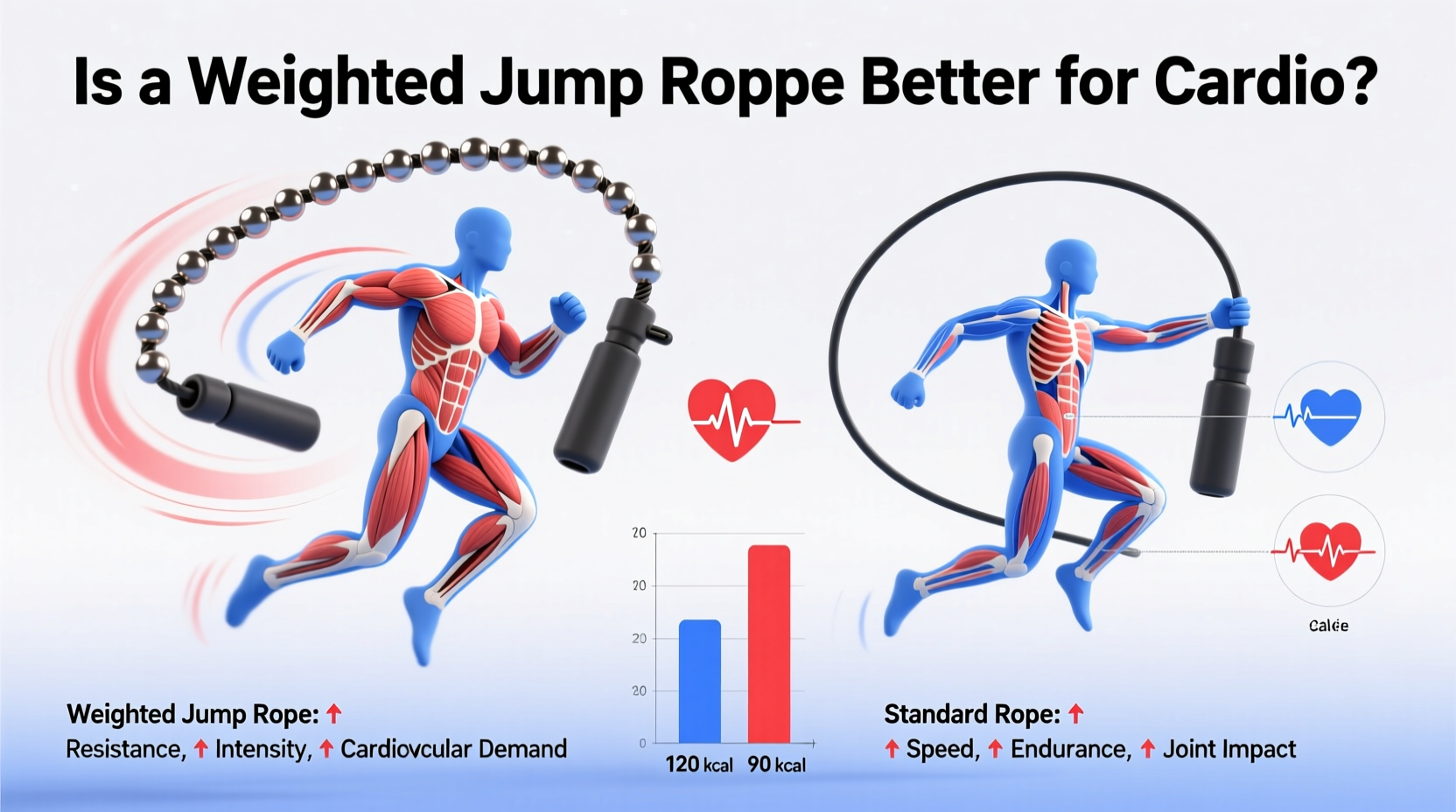
The main distinction lies in resistance and swing mechanics. A standard jump rope typically weighs between 0.25 to 0.5 pounds and is made of lightweight materials like PVC or nylon. These are ideal for speed and agility, allowing rapid rotations—up to 180+ jumps per minute. In contrast, a weighted jump rope usually ranges from 0.5 to 3 pounds, with thicker cables or segmented weights near the handles.
This added mass increases rotational inertia, requiring more force to turn the rope. As a result, muscles in the shoulders, arms, back, and core engage more actively. However, this also slows down rotation speed, making double-unders or fast single jumps more challenging.
| Feature | Standard Jump Rope | Weighted Jump Rope |
|---|---|---|
| Weight | 0.25–0.5 lbs | 0.5–3 lbs |
| Rotation Speed | Fast (ideal for speed drills) | Slower (controlled motion) |
| Muscle Engagement | Moderate (arms, wrists) | High (shoulders, arms, core, back) |
| Calories Burned (approx./min) | 10–14 | 12–16+ |
| Best For | Endurance, footwork, HIIT | Strength-endurance, power training |
| Beginner-Friendly? | Yes | With caution |
The increased resistance of a weighted rope demands more energy per jump, potentially increasing caloric burn. But this doesn’t automatically mean it’s “better” for cardio across the board.
When Weighted Ropes Enhance Cardio Performance
For intermediate to advanced exercisers, a weighted jump rope can amplify cardiovascular demand through greater total-body exertion. Because more muscle groups are recruited to swing the rope, your heart must pump harder to supply oxygen-rich blood. This leads to higher heart rates at lower jump counts compared to a light rope.
A 2021 study published in the Journal of Strength and Conditioning Research found that participants using a 1-pound rope reached 80% of their maximum heart rate within 3 minutes, whereas those using a standard rope took closer to 5 minutes. Additionally, post-exercise oxygen consumption (EPOC)—a marker of afterburn effect—was 18% higher in the weighted group.
“Adding external load to aerobic movements increases metabolic cost without extending workout duration. That makes weighted ropes a smart tool for time-efficient conditioning.” — Dr. Lena Patel, Exercise Physiologist
Moreover, the rhythmic, full-body nature of swinging a heavy rope engages the posterior chain and scapular stabilizers, turning a simple cardio drill into a hybrid strength-and-conditioning move. This is particularly beneficial for athletes or individuals looking to build work capacity—the ability to sustain high-effort output over time.
Tip: Start with a 0.5–1 lb weighted rope if you're new to them. Focus on form before increasing weight or duration.Limitations of Weighted Ropes for Pure Cardio
Despite their advantages, weighted ropes come with trade-offs that may reduce their effectiveness for sustained cardiovascular training. The most significant issue is fatigue. Due to increased muscular demand, most people cannot maintain continuous jumping for extended periods—often limiting sessions to 1–3 minutes before needing rest.
In contrast, a skilled jumper can sustain a standard rope workout for 10–20 minutes nonstop, accumulating significantly more total cardio volume. Since total calorie burn and aerobic adaptation depend heavily on duration and consistency, the lighter rope often wins in pure endurance development.
Additionally, improper use of a weighted rope increases injury risk. The heavier cable moves with more momentum, raising the chance of tripping or hitting limbs. Overuse can also strain rotator cuffs or elbows, especially if shoulder stability is weak. Beginners or those with joint concerns should proceed cautiously.
Another factor is accessibility. Many people skip rope not just for fitness but because it’s low-cost and easy to learn. Weighted ropes have a steeper learning curve and require more coordination, which may discourage consistent use—undermining long-term cardio progress.
Real-World Example: Two Approaches to Fat Loss
Consider two individuals aiming to lose fat and improve cardiovascular fitness:
Jamal, an experienced gym-goer, incorporates a 1.5-pound weighted rope into his HIIT routine. He performs 30 seconds of jumps followed by 30 seconds of rest, repeating for five rounds. His heart rate spikes quickly, and he feels engaged in his upper body throughout. He burns approximately 120 calories in 10 minutes, including recovery.
Sophia, newer to fitness, uses a standard speed rope. She starts with 1-minute intervals at a moderate pace, resting 1 minute between sets. Over 20 minutes, she completes eight cycles. Though her peak heart rate is slightly lower, she accumulates more total workout time and burns around 140 calories. She also reports feeling more confident and less fatigued afterward.
Both see improvements in stamina and body composition over six weeks. Jamal gains noticeable upper-body tone; Sophia builds endurance and consistency. Neither approach is objectively “better”—they align with different goals and starting points.
Optimal Use: Combining Both for Maximum Cardio Benefit
The most effective strategy may not be choosing one over the other, but integrating both types strategically. Think of the standard rope as your endurance engine and the weighted rope as your power amplifier.
Here’s a sample weekly plan that leverages both:
- Monday – Speed & Footwork (Standard Rope): 5 rounds of 1 min jump, 1 min rest. Focus on quick turnover and light landings.
- Wednesday – Power Intervals (Weighted Rope): 6 rounds of 30 sec jump (1 lb rope), 30 sec rest. Emphasize controlled swings and core bracing.
- Friday – Endurance Circuit (Standard Rope): 3 rounds: 2 min jump, 1 min squats, 1 min push-ups. Builds stamina and work capacity.
- Sunday – Mixed Modality (Both Ropes): Alternate 1 min light rope, 1 min weighted rope for 10 minutes total. Challenges adaptation and prevents plateau.
This hybrid model maximizes cardiovascular stimulus while minimizing overuse risk. It also keeps workouts engaging—a critical factor in long-term adherence.
Expert Checklist: Choosing the Right Rope for Your Goals
✅ Weighted Rope If You:
- Want to build upper-body strength alongside cardio
- Are training for sports requiring explosive power
- Have mastered basic jump rope technique
- Prefer shorter, high-intensity workouts
- Can dedicate time to proper warm-up and recovery
✅ Standard Rope If You:
- Are a beginner or returning to fitness
- Prioritize endurance and stamina
- Need a low-impact, joint-friendly option (with soft landing)
- Want to maximize calorie burn over longer durations
- Value simplicity and portability
Frequently Asked Questions
Does a weighted jump rope burn more calories than a standard one?
Per minute, yes—typically 10–20% more due to increased muscle activation and effort. However, most people can jump longer with a standard rope, so total session burn may be higher with the lighter version.
Can beginners use a weighted jump rope?
With caution. Start with a lighter model (0.5–1 lb) and limit usage to short intervals. Master form with a standard rope first to build coordination and joint resilience.
Is jumping rope safe for knees with a weighted rope?
When done correctly—soft landings, bent knees, flat surfaces—it’s generally safe. But the increased impact and momentum require better control. Those with knee issues should consult a physical therapist before use.
Final Verdict: Better Cardio Depends on Context
So, is a weighted jump rope better for cardio than a standard one? Not universally. It excels in boosting intensity, muscle engagement, and metabolic demand in short bursts. But for building aerobic base, endurance, and sustainable fitness habits, the standard jump rope remains unmatched in versatility and accessibility.
The best approach is personalized. Listen to your body, assess your goals, and consider blending both tools. Whether you're training for performance, fat loss, or general health, jumping rope—weighted or not—is a potent cardiovascular tool when used wisely.
💬 Ready to upgrade your cardio game? Try alternating between weighted and standard ropes this week and track how your energy, endurance, and enjoyment shift. Share your experience in the comments!








